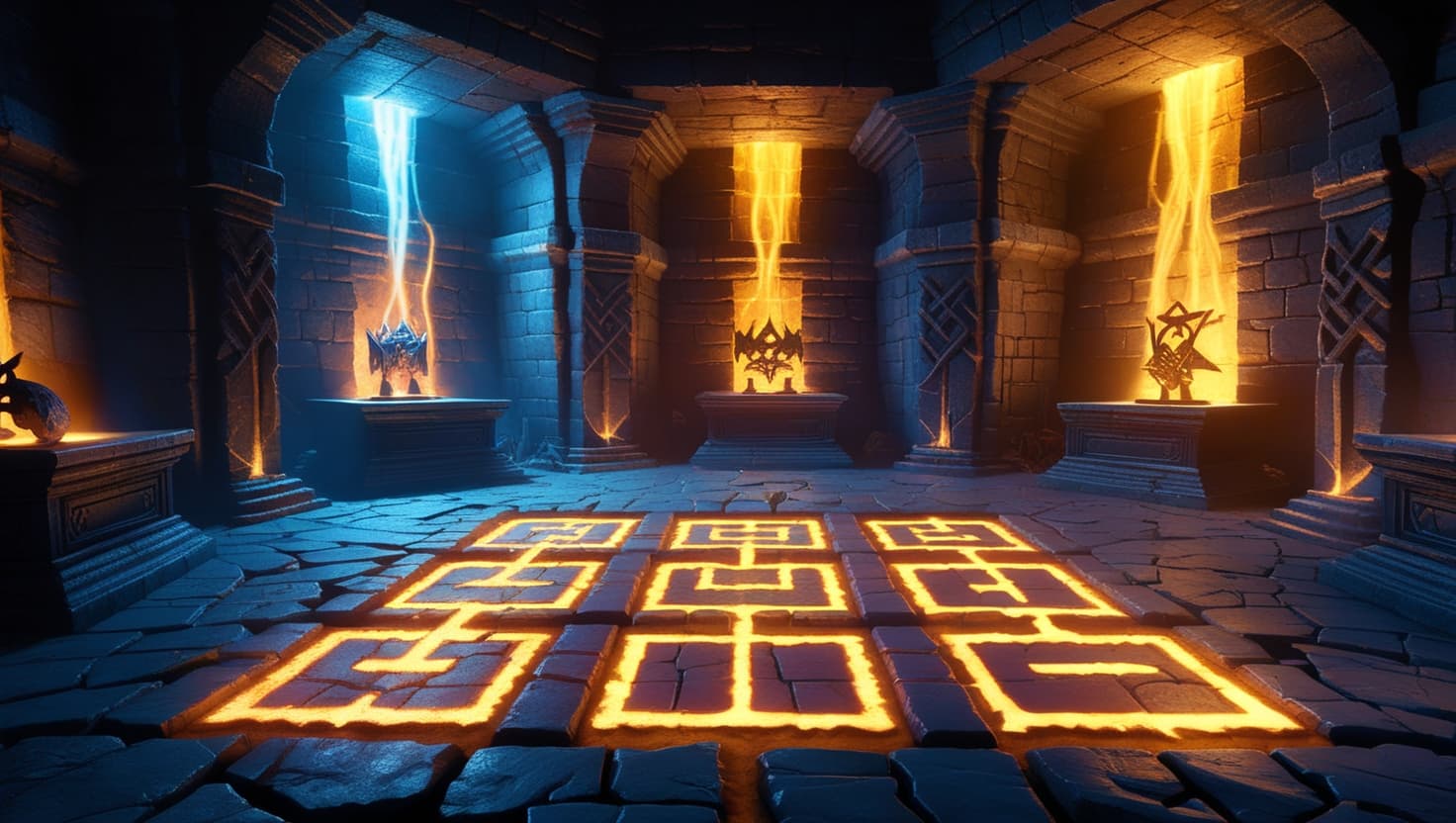
Why Most D&D Puzzles Fail (And 5 Designs That Actually Work)
You spent 45 minutes designing a sliding tile puzzle for your dungeon. You drew diagrams. You tested it yourself twice. Your players stared at it for 12 minutes, tried one thing, failed, and the Barbarian asked if he could just break the wall down.
Sound familiar? r/DMAcademy has a new post about failed puzzles roughly every week. The pattern is always the same: DM builds something clever, players bounce off it, session momentum dies. The puzzle "worked" in the DM's head because the DM already knew the answer.
D&D puzzles fail for predictable, fixable reasons. And once you understand those reasons, designing puzzles that players actually enjoy becomes way less mysterious.
The Core Problem with D&D Puzzles
Most D&D puzzles commit the same fundamental error: they challenge the player sitting at the table instead of the character on the sheet.
Your Wizard has 20 Intelligence. The person playing that Wizard might be a graphic designer who hasn't thought about logic puzzles since high school. When you put a cipher on the table and expect the player to crack it, you're testing the wrong person.
This is the opposite of how every other D&D challenge works. Combat tests character stats. Social encounters use Charisma modifiers. Exploration relies on Perception and Survival. But puzzles? Puzzles suddenly demand that the human brain do all the work while the character sheet sits there being useless.
The best D&D puzzles sit in the overlap between player thinking and character abilities. Players make the strategic decisions. Characters provide the tools and information to execute them.
Matt Colville's take on this is blunt: puzzles in D&D are "bad design" when they create a binary pass/fail gate with no character interaction. He's not entirely wrong. But the fix isn't removing puzzles. It's building them differently.
Why Your Puzzle Stalled the Session
Before the fixes, here are the four failure modes that kill D&D puzzles. If your last puzzle bombed, it probably hit at least two of these.
Single-solution lock-in. You designed one correct answer. Players tried something creative that should have worked but didn't because it wasn't your answer. Now they're frustrated and you're improvising a way to unstick the game. A trapped chest that only opens when you press the ruby, the emerald, then the sapphire in that exact order is fragile design. One wrong assumption and everything stops.
Zero feedback loops. Players try something. Nothing happens. They try something else. Nothing happens. They have no idea if they're getting warmer or colder. In video game design this is called "guess the verb" and it's been considered a design sin since the 1990s. Your dungeon puzzle shouldn't repeat Zork's worst habits.
No character hooks. The Rogue is sitting there with Thieves' Tools, Expertise in Investigation, and nothing to do because the puzzle is a pure logic exercise. The Cleric's Religion proficiency could be relevant to the temple puzzle but you never built that connection. When half the party has nothing to contribute, they check their phones.
Pacing black holes. The puzzle takes 30+ minutes. The energy in the room dies. Players who solved it five minutes ago are waiting for the rest of the table to catch up. By the time the door opens, nobody cares what's behind it anymore.
D&D Puzzle Design That Actually Works: 5 Frameworks
These aren't specific puzzles to copy-paste. They're structural frameworks that fix the failure modes above. Adapt them to your dungeon, your party, your story.
1. The Multi-Station Puzzle (Fixes: No Character Hooks, Single Solution)
Place four interactable elements in the room that require different skills to engage. A set of Draconic runes on the north wall (Arcana check to read). A pressure plate mechanism under the floor tiles (Investigation to find, Thieves' Tools to disable or redirect). A mural depicting a historical event (History or Religion to interpret). A pool of enchanted water that reacts to certain spell schools.
Each station reveals one piece of the solution. The Wizard reads the runes, the Rogue maps the pressure plates, the Cleric interprets the mural, the Druid tests the water. Nobody sits idle. And because each piece is a clue rather than a gate, players who miss one station can still solve the puzzle with the information from the other three.
I ran a version of this in StoryRoll where the AI generated a four-element puzzle in a yuan-ti temple - each station tied to a different ability score. The Barbarian's Strength check on the stone lever was just as critical as the Wizard's Arcana check on the glyph sequence. Party solve time: 8 minutes. Zero phone-checking.
Why it works: Multiple entry points mean multiple valid approaches. Even if players skip a station entirely, they have enough information from the others. And every character class has something to interact with.
2. The Escalating Threat Puzzle (Fixes: Pacing Black Holes, Zero Feedback)
The room is flooding. Or filling with poisonous gas (Constitution saves every 2 rounds, DC increasing by 2 each time). Or the ceiling is descending - 10 feet per round. The puzzle itself can be simple: arrange the four elemental crystals on the correct pedestals. What creates tension isn't the intellectual difficulty. It's the ticking clock.
This framework fixes pacing problems by definition - the puzzle can't take 30 minutes because the room kills you in 5. And the escalating threat provides constant, unmistakable feedback. Wrong crystal placement? The gas gets thicker. Right placement? One vent seals shut.
The published adventure Tomb of Annihilation uses this approach in several rooms, and Dungeon of the Mad Mage layers combat encounters on top of environmental puzzles. The design principle is identical: never let the puzzle exist in a vacuum.
Set a real upper limit. If nobody solves it, the party takes damage or loses resources - but they still get through. A puzzle that creates a dead end violates the first rule of D&D encounter design: the game must continue.
3. The Information Asymmetry Puzzle (Fixes: Single Solution, No Character Hooks)
Split the party. Not the whole dungeon - just this room. Two characters can see the mechanism but can't reach it. Two characters can reach the controls but can't see the result. They have to communicate through a wall, a mirror, a familiar, or a Message cantrip.
This forces real-time collaboration where each player holds information nobody else has. There's no single "aha moment" for one smart player to carry the group. The Paladin describes what she sees ("the left dial shows a crescent moon, the right one shows a sun") while the Ranger on the other side turns dials based on those descriptions.
You've seen this structure in video games - Portal 2 co-op, Keep Talking and Nobody Explodes, We Were Here. It works because the challenge is communication, not raw intellect. And communication is something every player can participate in regardless of their character's Intelligence score.
When I tested information asymmetry puzzles in StoryRoll's solo mode, the AI handled the split perspective by giving different clue sets through environmental descriptions versus Investigation checks - essentially playing both sides of the communication wall. Solve rate across 30+ test sessions: about 85%, compared to roughly 50% for traditional single-room logic puzzles.
4. The "Puzzle as Negotiation" Framework (Fixes: Everything)
The puzzle isn't a mechanism. It's a creature. A sphinx, a bound elemental, a cursed portrait, a sentient door. The "puzzle" is figuring out what it wants and convincing it to cooperate.
This reframes puzzle-solving as a social encounter, which means it uses the existing D&D skill framework. Persuasion, Insight, Intimidation, Deception, History, Arcana - all suddenly relevant. The Bard who was useless during the sliding tile puzzle is now the star.
A sphinx that asks riddles is the classic version, but it's been done to death. Try a sentient lock that's been sealed for 300 years and is lonely. A guardian construct that follows ancient orders but can be convinced the party qualifies as "authorized personnel" with the right History checks and some forged documentation (Forgery Kit, anyone?). A ghost who won't open the door until you help resolve her unfinished business - a mini side-quest as a puzzle.
This framework almost can't fail because DMs already know how to run social encounters. You're just applying those same improvisational muscles to what would normally be a rigid logic gate.
- Multi-Station - 4+ elements, different skills each, partial info still solvable
- Escalating Threat - Timer or damage, simple puzzle, clear feedback per action
- Info Asymmetry - Split perspective, communication is the challenge
- Negotiation - Social encounter disguised as a puzzle, uses existing skills
- Layered Reveal - Progressive clues, each check deepens understanding
5. The Layered Reveal Puzzle (Fixes: Zero Feedback, Pacing Black Holes)
Start with an obvious surface-level interaction. The door has five symbols. Pressing them does something visible - lights up, makes a sound, shifts a tile. That's layer one. Any player can experiment and observe results.
Layer two comes from skill checks. An Arcana check reveals the symbols correspond to the schools of magic. An Investigation check notices wear patterns suggesting three symbols get pressed more than others. A Perception check catches a faint melody playing when symbols are pressed in a certain direction.
Layer three is the environmental context. A journal on a nearby skeleton mentions "the old dean's favorite subjects." A mosaic on the floor depicts a wizard casting three specific spells. The answer has been in the room the whole time - players just needed to look.
Each layer gives more information. Players who only get layer one can still brute-force it with experimentation (5 symbols, finite combinations). Players who get layer two narrow the options. Players who get layer three know the exact answer. The puzzle scales to the party's engagement and skill checks without ever hitting a dead end.
I've watched StoryRoll's AI DM deploy this pattern naturally - starting with broad environmental descriptions, then offering deeper detail when players make Investigation or Perception checks. The AI doesn't gate the solution behind a single roll. It layers information so every check makes the puzzle easier without making it trivial.
Common D&D Puzzle Mistakes (Quick Checklist)
Before you put a puzzle in your next dungeon, run it against these questions:
- Can a player with zero outside knowledge solve this using only in-game information? If no, redesign it.
- Does at least one character ability (skill, spell, tool proficiency) interact with this puzzle? If no, add a hook.
- What happens if nobody solves it? If the answer is "the game stops," add a bypass or timer.
- Can one player solve this alone while everyone else watches? If yes, add multi-person elements.
- Does the puzzle provide feedback when players try something? If no, add visible/audible reactions.
That third question is the non-negotiable one. A puzzle that creates a dead end is worse than no puzzle at all. Your players showed up to play D&D, not to stare at a locked door for 40 minutes.
D&D Puzzles Work Better When the DM Doesn't Know the Answer Either
Hot take: the best D&D puzzles are ones where the DM decides the solution after the players try something reasonable.
Present the puzzle elements. Let players interact. When someone proposes a solution that's clever and makes sense within the fiction, that's the answer. You're not writing an exam. You're creating a moment where players feel smart. The specific sequence of rune activations matters way less than whether the table had fun figuring it out.
This is improvisation, not cheating. Published adventure designers like Chris Perkins have talked about this approach - the puzzle exists to create a moment, not to test whether players can reverse-engineer your thought process.
AI dungeon masters are actually built for this model. StoryRoll evaluates player approaches against the established fiction rather than checking against a predetermined answer key. When a player says "I pour holy water on the altar to purify it," the AI weighs whether that makes narrative sense given the dungeon's context - not whether it matches a specific solution the system had pre-loaded. That flexibility is something human DMs should steal for their own games.
D&D puzzles fail when they're designed as logic tests dropped into a roleplaying game. They succeed when they're designed as encounters - with multiple interaction points, character skill hooks, clear feedback, and escape valves for when things stall. Use the five frameworks above as starting structures, not rigid templates. And remember: the point of a puzzle isn't to stump your players. It's to give them a moment where creative thinking pays off. If you want to test puzzle designs without committing a whole session to the experiment, StoryRoll's solo mode lets you run a puzzle room in 10 minutes and see how it plays before you bring it to the table.
Frequently Asked Questions
Why do D&D puzzles frustrate players?
D&D puzzles frustrate players when they have only one solution, provide no feedback on progress, or challenge the player's knowledge instead of the character's abilities. The fix is designing puzzles with multiple valid solutions, clear feedback for each action, and hooks for character skills like Investigation, Arcana, and Thieves' Tools.
How long should a D&D puzzle take to solve?
Aim for 5 to 20 minutes of real table time. Anything longer risks killing session momentum. Build in escalation mechanics (timers, increasing environmental danger) or allow skill checks to provide hints that narrow the solution space. Never design a puzzle without an upper time limit in mind.
What's the biggest mistake DMs make with puzzles?
Designing a single correct solution and then being unwilling to accept creative alternatives. The best approach: present puzzle elements, let players interact, and accept any solution that's clever and makes sense within the fiction. You're creating a moment, not administering a test.
How do I make D&D puzzles that involve the whole party?
Use the Multi-Station framework: place 4+ interactable elements in the room, each requiring different skills. Runes for the Wizard (Arcana), mechanisms for the Rogue (Thieves' Tools), murals for the Cleric (Religion), and physical elements for the Fighter (Athletics). Each station reveals one piece of the solution.
Can I use puzzles in solo D&D?
Solo D&D puzzles work best with the Layered Reveal framework, where progressive skill checks reveal more information. AI dungeon masters like StoryRoll handle this by providing deeper environmental detail based on the character's checks, making puzzles solvable without needing another human to set them up.
Written by StoryRoll Team
Founder of StoryRoll. Building AI-powered tabletop RPGs.