How to Run Combat in D&D 5e: The Complete Guide for Game Masters
You read the encounter. You set the scene. A player says, "I attack the goblin." And then everything stalls while you flip through the Player's Handbook trying to remember how grappling works.
Running combat in D&D 5e is the part of being a Game Master that either makes your table lean forward or reach for their phones. The rules aren't complicated once you've internalized them, but there are enough moving pieces - initiative, action economy, movement, conditions, reactions - that it's easy to lose the rhythm if you're not prepared.
This guide covers every piece of the combat system you need to know, from the first initiative roll to the final death save. Whether you're a first-time GM or someone who's been running games for years but wants tighter encounters, this is the reference you'll keep coming back to.
Step 1: Setting the Scene and Determining Surprise
Before anyone rolls initiative, you need to establish what's happening. Where are the enemies? What does the environment look like? Are either side aware of the other?
Surprise happens when one side is caught completely unaware. If the party's rogue sneaks ahead and spots a group of bandits around a campfire, the party might get a surprise round. If a gelatinous cube drops from the ceiling onto an unsuspecting party, the players are the ones surprised.
Here's how surprise works mechanically:
- Compare the Dexterity (Stealth) checks of the hiding side against the passive Perception of the other side
- Any creature that fails to notice the threat is surprised
- Surprised creatures can't move or take actions on their first turn of combat
- Surprise ends at the end of that creature's first turn - meaning they can use reactions after their turn passes
A common mistake is treating surprise as a full extra round for the ambushers. It's not. Everyone rolls initiative normally. The surprised creatures just skip their first turn.
Write the passive Perception of every party member on an index card or sticky note behind your GM screen. You'll reference it constantly - for surprise, traps, hidden enemies, and stealth encounters. Don't slow the game by asking players to calculate it on the spot.
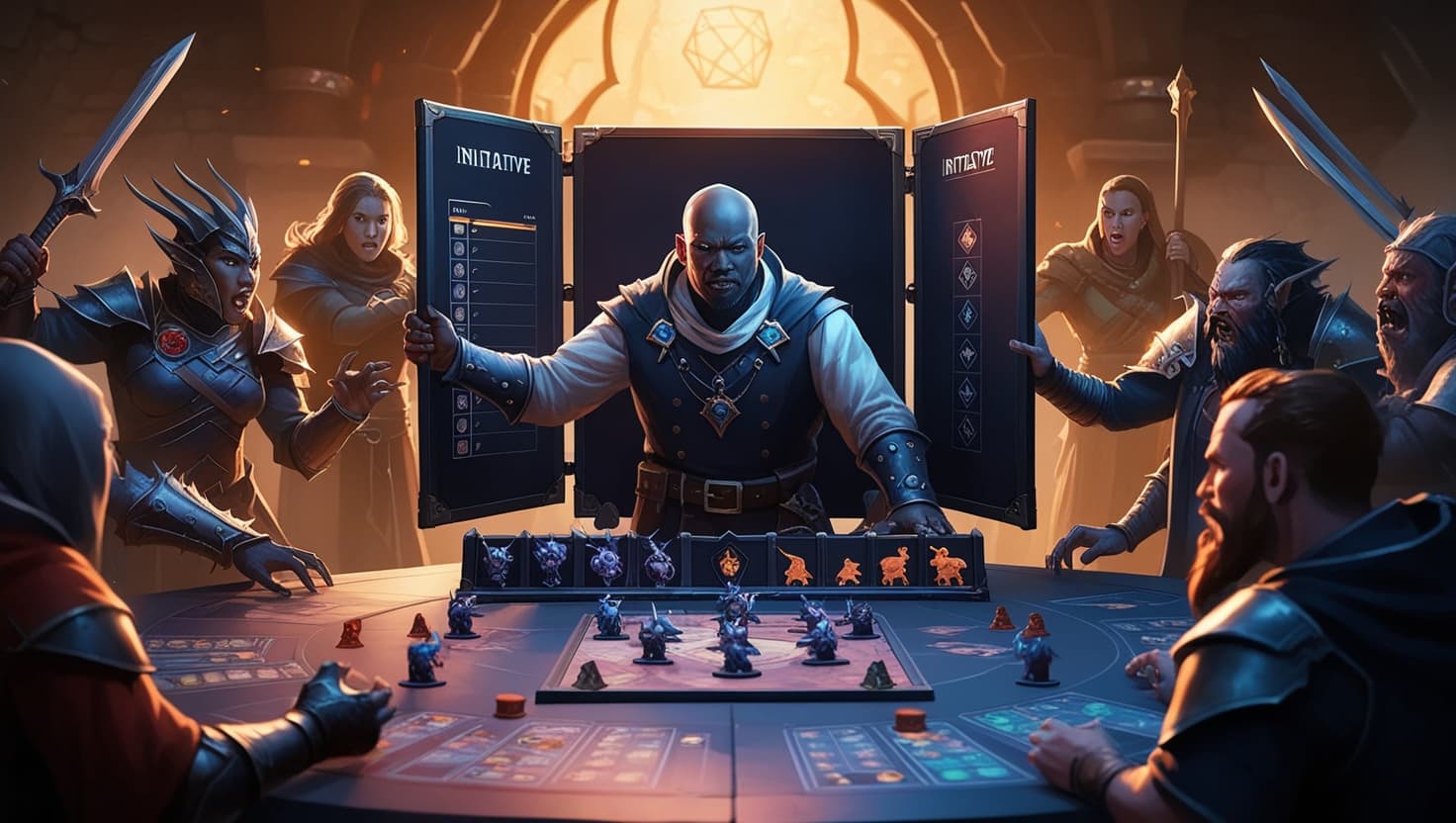
Step 2: Rolling Initiative
Initiative determines turn order for the entire combat. Every creature involved rolls a d20 and adds their Dexterity modifier. Higher results go first.
How to handle ties: The Player's Handbook says the DM decides. Most tables use one of these approaches:
- Players win ties against monsters (simplest)
- Higher Dexterity modifier goes first
- Roll off with another d20
Tracking initiative: You need a system. The classic approaches work:
- A written list on scratch paper, crossed off and rewritten each round
- Index cards sorted along the top of your GM screen
- A digital initiative tracker that handles sorting and HP automatically
The key is speed. Initiative should take under 30 seconds at your table. Call for rolls, write them down in order, and start the first turn.
Group initiative for monsters: When you're running six identical goblins, roll once for the group. They all act on the same turn. This cuts your tracking in half and speeds the game up noticeably. For boss fights with a main villain and unique lieutenants, roll individually.
Step 3: Understanding Action Economy
Action economy is the most important concept in D&D 5e combat. It determines what each creature can do on their turn, and understanding it is the difference between combat that flows and combat that stalls.
On each turn, a creature gets:
- Movement — Move up to your speed (typically 30 feet). You can split movement before and after your action
- Action — The main thing you do: Attack, Cast a Spell, Dash, Disengage, Dodge, Help, Hide, Ready, Search, or Use an Object
- Bonus Action — Only if you have a feature or spell that specifically grants one (like offhand attacks with two-weapon fighting, or the rogue's Cunning Action)
- Reaction — One per round, triggered by a specific event. Opportunity attacks and the Shield spell are the most common examples
- Free Interaction — One small object interaction per turn: drawing a sword, opening a door, picking up a dropped item
The Common Actions
Attack: Make one melee or ranged attack (or more, if you have Extra Attack). Roll a d20, add your attack modifier. Meet or beat the target's AC, and you hit.
Cast a Spell: Follow the spell's casting time, range, and components. Remember: if a spell requires concentration, you lose any other concentration spell you're maintaining.
Dash: Double your movement for the turn. Useful for closing gaps or fleeing.
Disengage: Your movement doesn't provoke opportunity attacks for the rest of the turn. Critical for squishy characters surrounded by enemies.
Dodge: Attacks against you have disadvantage, and you have advantage on Dexterity saving throws. Lasts until your next turn. Underused and powerful.
Help: Give an ally advantage on their next ability check or attack roll against a target within 5 feet of you. Familiars love this action.
Ready: Prepare an action with a specific trigger. "When the orc opens the door, I fire my crossbow." Uses your reaction when triggered.
Print or display a quick-reference card listing all available actions. New players often think their only option is "I attack" because they don't know Dodge, Help, and Ready exist. Giving them the full menu dramatically improves engagement.
Step 4: Movement and Positioning
Movement in 5e is straightforward but has tactical depth that many tables skip.
Basic movement: On your turn, you can move up to your speed. You can break this up - move 15 feet, attack, then move 15 more feet.
Difficult terrain: Costs double movement. Rubble, thick undergrowth, shallow water, ice, and stairs all qualify. If a 5-foot square is difficult terrain, it costs 10 feet of movement to enter.
Opportunity attacks: When a creature leaves your melee reach without taking the Disengage action, you can use your reaction to make one melee attack against it. This is the fundamental rule that controls positioning in 5e combat. Frontline characters pin enemies down. Enemies that want to reach your backline have to eat an opportunity attack or spend their action disengaging.
Vertical movement: Climbing costs double movement (unless you have a climb speed). Flying creatures can move in three dimensions but fall if knocked prone or their speed drops to 0.
Squeezing: A creature can move through a space one size smaller than itself, but that space counts as difficult terrain, and the creature has disadvantage on attack rolls and Dexterity saving throws while squeezing.
Positioning Matters More Than You Think
A common trap for new GMs is running combat in a featureless void. "You're in a room. There are orcs." This eliminates all the interesting decisions that movement creates.
Instead, think about:
- Chokepoints where the fighter can hold a line
- Cover that gives +2 AC (half cover) or +5 AC (three-quarters cover)
- Height that gives ranged attackers an advantage (literally - many tables grant advantage for high ground)
- Hazards that both sides have to navigate around
You don't need a detailed battle map for every fight. Even theater-of-the-mind combat benefits from the GM saying "there's a stone pillar to your left and a 10-foot drop behind the enemies."
Step 5: Conditions and Status Effects
Conditions are how 5e models everything from being scared to being turned to stone. They have precise mechanical effects, and knowing them prevents the most common rule disputes at the table. Our conditions reference covers all thirteen conditions in detail with examples of when each one matters most.
The conditions you'll use most often:
| Condition | Key Effect | Common Source |
|---|---|---|
| Prone | Disadvantage on attacks; melee attacks against have advantage; ranged attacks against have disadvantage | Shove, tripping attacks, falling |
| Grappled | Speed becomes 0 | Grapple action, tentacles, vines |
| Restrained | Speed 0, disadvantage on attacks and Dex saves, attacks against have advantage | Entangle, Web, nets |
| Frightened | Disadvantage on ability checks and attacks while source is visible; can't willingly move closer | Fear spell, dragon Frightful Presence |
| Stunned | Incapacitated, can't move, auto-fail Str and Dex saves, attacks against have advantage | Stunning Strike, Power Word Stun |
| Poisoned | Disadvantage on attacks and ability checks | Poison, venomous creatures |
| Blinded | Can't see, auto-fail checks requiring sight, attacks have disadvantage, attacks against have advantage | Blindness/Deafness, darkness effects |
| Concentrating | Not a condition per se, but critical: taking damage forces a Constitution save (DC 10 or half damage, whichever is higher) to maintain | Any concentration spell |
Concentration is the most frequently forgotten rule in 5e combat. Every time a spellcaster maintaining a spell takes damage, they must make a concentration check. Track who's concentrating on what - it changes the tactical picture completely.
Step 6: Running Monsters Effectively
The Monster Manual gives you stat blocks. What it doesn't give you is how to run those creatures in a way that creates interesting fights.
Give Every Monster a Goal
A wolf doesn't want to defeat a party of adventurers. It wants to eat and not die. A bandit wants gold, not a fight to the death. A necromancer wants to complete a ritual and will retreat if interrupted.
When monsters have goals, combat has more outcomes than "everyone on one side dies." Morale breaks. Enemies retreat. Hostages get taken. The narrative continues beyond the initiative tracker.
Use Monster Abilities
Read the full stat block before the fight, not during. If the ogre has a Javelin attack, it should throw javelins while closing distance, not just stand there waiting for the fighter to walk up. If the mage has Misty Step, it should teleport away from the barbarian, not accept its fate in melee.
Vary Your Tactics
- Pack creatures (wolves, kobolds) flank and use Help actions
- Brutes (ogres, trolls) charge the most threatening target
- Spellcasters stay at range and use control spells before damage
- Leaders (hobgoblin captains, bandit lords) direct allies and use tactical abilities
- Hit-and-run enemies (shadow demons, will-o'-wisps) dart in, strike, and vanish
This doesn't mean you need to play monsters optimally. A group of drunken bandits won't execute a perfect flanking maneuver. But they should feel like creatures with survival instincts, not video game NPCs standing in place.
Step 7: Encounter Balance and Pacing
Not every fight needs to be deadly, and not every session needs five combats. The pacing of combat encounters throughout a session matters more than any individual fight's difficulty.
Using Challenge Rating
CR gives you a rough baseline. A CR 5 monster is a medium challenge for a party of four level-5 characters. But CR breaks down in practice because:
- Action economy dominates. Four CR 1/4 creatures can be harder than one CR 1 creature because they get four times the actions
- Party composition matters. A party with a paladin and cleric will crush undead encounters that would devastate a party without radiant damage
- Magic items, class features, and player skill create massive variance
Use an encounter calculator to get the XP thresholds right, then adjust based on what you know about your party. If you're unsure what DCs to set for ability checks and saving throws during combat, start with 10 for easy, 15 for medium, and 20 for hard.
The Adventuring Day
The 5e system assumes 6-8 medium encounters per long rest, with short rests in between. Most tables run 2-3 encounters per session. This means short-rest classes (fighters, warlocks, monks) are relatively weaker than long-rest classes (wizards, clerics) at most tables.
You don't have to fix this, but be aware of it. If your warlock player seems underpowered, it might be because they're only getting one short rest per day instead of two or three.
Encounter Variety
Mix your encounter types across a session:
- A quick skirmish (3-4 rounds) to burn some resources and build tension
- An exploration encounter where combat might be avoidable
- A set-piece battle (the big one) with environmental hazards, multiple enemy types, and real stakes
The set-piece feels dramatic because the skirmishes softened the party first. If every fight is the climax, nothing feels climactic.
Tips for Running Faster Combat
Slow combat is the number one complaint at D&D tables. Here's how to fix it.
Before the Session
- Read every stat block you'll use. Know the monster's AC, HP, attacks, and special abilities before initiative is rolled
- Pre-roll initiative for monsters. Write their initiative results on the stat block. One less thing to do at the table
- Prepare the environment. Know what's in the room, what can be interacted with, what the lighting is like
- Have hit points pre-tracked. Use a simple list: Goblin 1: 7hp, Goblin 2: 7hp, Goblin 3: 7hp
During Combat
- Announce who's next. "Fighter, you're up. Wizard, you're on deck." This gives the next player time to plan
- Enforce a soft turn timer. Not a hard rule, but if a player takes more than 30 seconds to decide, prompt them: "What does your character do in the heat of the moment?"
- Roll attack and damage together. "That's a 17 to hit for 8 slashing damage" is one statement instead of two exchanges
- Describe in shorthand during chaotic fights. Save the poetic narration for killing blows and critical moments. "The goblin misses you. Next" keeps things moving
- Batch monster turns. All the goblins act together. Roll their attacks quickly. Report results as a group
For Players
Encourage your players to:
- Know their abilities before their turn
- Have their spell descriptions pulled up
- Declare their action, bonus action, and movement together
- Roll all their dice at once (attack + damage, multiple attacks simultaneously)
The single biggest speed improvement: tell players to plan their turn while other players are going, not when their turn starts. The phrase "you're on deck" works wonders.
Death Saves, Dropping to Zero, and Healing in Combat
When a character drops to 0 hit points, they fall unconscious and start making death saving throws. This is the tensest mechanic in the game when run well.
Death saves: At the start of each turn, the dying character rolls a d20. 10 or higher is a success, 9 or lower is a failure. Three successes: stabilized. Three failures: dead. A natural 20 brings you back with 1 hit point. A natural 1 counts as two failures.
Healing at zero: Any healing brings a character back to consciousness. This is why Healing Word is one of the best spells in the game - it's a bonus action that picks someone up from across the room.
Attacks on unconscious characters: Melee attacks against an unconscious creature are automatic critical hits, which means two death save failures. Intelligent enemies targeting downed characters is realistic but controversial. Use it sparingly - against a villain who has a reason to finish someone off, not as standard goblin behavior.
Instant death: If damage reduces a character to negative hit points equal to their maximum, they die outright. A wizard with 30 max HP who takes 60+ damage from a single hit at 0 HP is dead. No saves.
Putting It All Together: Running Your First Fight
Here's the complete flow for a combat encounter:
- Set the scene. Describe the environment, the enemies, and the tension
- Check for surprise. Compare Stealth vs. passive Perception if either side was hidden
- Roll initiative. Everyone rolls, you sort the order
- Run rounds. Each creature takes their turn in initiative order: movement, action, bonus action
- Track conditions. Note who's concentrating, grappled, prone, etc.
- Track HP. Mark damage on monsters, remind players of their HP when they take hits
- Narrate results. Don't just announce numbers - describe what the hit looks like, what the spell does, how the environment reacts
- End the encounter. When enemies are dead, fled, or surrendered, drop out of initiative
The difference between a forgettable fight and a memorable one isn't the stat blocks. It's the GM narrating the orc's sword sparking off the paladin's shield instead of saying "he missed." It's the environment crumbling around the players. It's monsters that fight smart and flee when outmatched.
Combat in D&D 5e gives you all the tools. The guide above is how you use them.
Run Combat Without the Prep Work
Setting up balanced encounters, tracking initiative, managing conditions, and keeping combat moving is a lot of work. That's why so many Game Masters burn out or dread the combat portions of their sessions.
StoryRoll handles all of it. Our AI Game Master tracks initiative automatically, runs monsters with intelligent tactics, balances encounters to your party's level, and narrates every hit, miss, and critical with cinematic detail. You focus on playing. The system handles the bookkeeping.
No prep. No page-flipping. Just the fight.
Join the waitlist and be the first to run combat the way it should feel.
Written by Anthony Goodman
Founder of StoryRoll. Building AI-powered tabletop RPGs.
Related Posts
D&D Encounter Balancing Guide for New Game Masters
CR math alone won't save your encounters. This guide covers everything new GMs need to know about balancing D&D 5e encounters - from XP budgets and action economy to reading your table and adjusting mid-fight.
D&D 5e Conditions Explained: A Complete Guide
Every D&D 5e condition explained in plain language - what they do mechanically, how they interact, and practical tips for Game Masters who want to use them well.
D&D Encounter Building Tips for New GMs: From Boring Fights to Memorable Moments
A practical guide to building D&D encounters that actually challenge and excite your players. Covers action economy, terrain, pacing, enemy variety, and using encounter calculators - written for GMs who are tired of one-sided stomps and lifeless combats.