Passive Perception 5e: Most Tables Use It Wrong
If you've ever heard "everybody roll Perception" three times in one dungeon room, your table probably has a passive perception 5e problem.
Passive perception 5e exists so the game doesn't turn into a motion sensor powered by d20s. It is the rule that lets a DM decide whether the ranger notices the tripwire, whether the rogue clocks the goblin ambush, or whether the cleric hears someone breathing behind the false wall before anyone says they are "searching the area for the twentieth time." When tables ignore it, play gets slower, sneakier characters get weirdly worse at their job, and discovery starts feeling random instead of earned.
The mistake is not using rolls. Rolls still matter. The mistake is using rolls for everything and treating passive perception like some dusty side rule for rules lawyers and people who own three DM screens.
Passive Perception 5e Is Not a Backup Button
A lot of DMs run passive perception 5e like this: call for a Perception roll, then if nobody rolls well enough, secretly check passive scores and hand out the clue anyway.
That feels harmless. It is not harmless.
It turns one rule into two overlapping systems that do the same job badly. First you ask for randomness. Then you quietly replace the randomness with a static score because missing the clue would stall the game or make the room feel empty. The players learn that Perception checks are mandatory ritual behavior, and the characters who invested in Wisdom, proficiency, expertise, or the Observant feat stop feeling special because everyone gets the same lottery ticket.
Passive perception 5e works better when you use it first. Compare the hidden thing to the characters' passive scores. If someone notices it, tell that player what stands out. If nobody notices it, the thing stays hidden until the fiction changes.
That change matters. Walking through a hallway and actively pulling up rug corners are different actions. A Gloom Stalker with a 19 passive Perception should feel like a person who notices too much. That is the point.
In StoryRoll sessions, this is one of the cleanest places where AI adjudication helps. The system can track each character's passive perception 5e score in the background and surface the clue to the right player without stopping the scene to ask for a group roll.
When to Use Passive Perception 5e Instead of Rolling
Use passive perception 5e when the character could notice something without declaring a special action.
That covers more situations than most tables think:
- Hidden enemies - compare Stealth to passive perception before combat starts
- Obvious-but-missable clues - blood under a door, ash in a cold fireplace, sulfur smell in a wizard's lab
- Traps with visible tells - disturbed dust, hair-thin wire, fresh scrape marks on stone
- Ambient danger - footsteps upstairs, muffled chanting, something moving in the brush
- Social reads at a glance - a noble's fake smile, a guard reaching for the alarm, the innkeeper watching one table too closely
- Secret doors with real visual hints - uneven mortar, airflow, worn floorstone, fingerprint oil near a latch
The common thread is simple: the character is present, alert enough, and has a reasonable chance to notice something without stopping the game to conduct a forensic sweep.
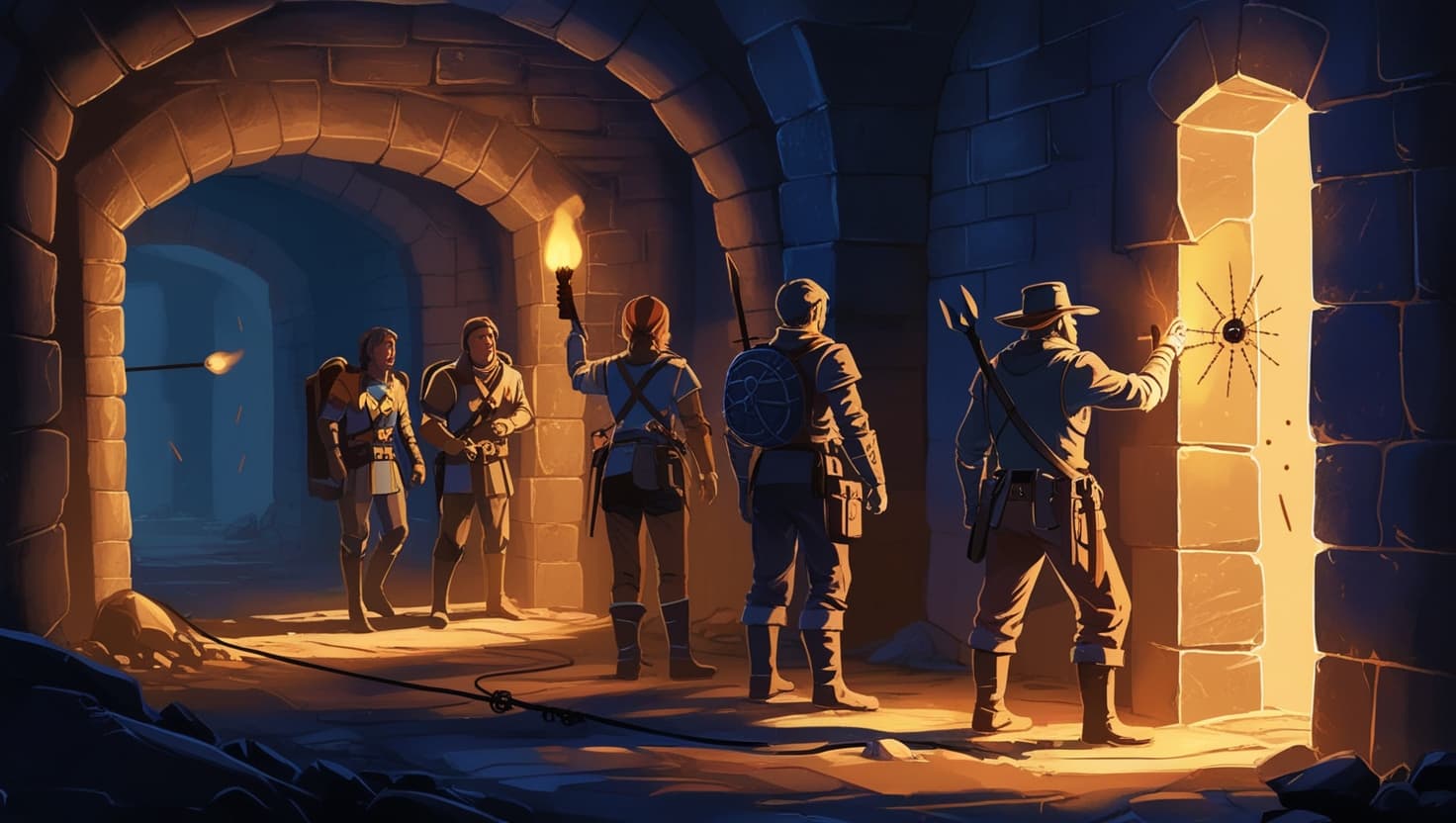
Take a classic dungeon example. The party enters a corridor with a pressure plate tied to dart launchers. The trap DC is 15 to notice. Your cleric has a passive Perception of 11. Your ranger has 16. You do not need a roll to determine whether someone spots the slightly sunken stone. The ranger notices it. Done.
Now the scene becomes interesting. Do they warn the group in time? Do they try to jam the mechanism? Does the barbarian step on it anyway because subtlety is not on the character sheet?
Passive perception 5e also matters a lot for ambushes. If six goblins hide in a ravine, you should not open with "everyone roll Perception." You compare the goblins' Stealth rolls to each character's passive score. Maybe the druid catches movement in the brush. Maybe the paladin does not.
When Passive Perception 5e Should NOT Be Doing the Work
Passive perception 5e is not telepathy. It is not X-ray vision. It is not a free room clear.
You still call for a roll when a player deliberately does something active, costly, or unusually focused.
Examples:
- "I press my ear to the door and listen for voices"
- "I search the bookshelf for a hidden switch"
- "I scan the ceiling for murder holes"
- "I watch the duke's face when we mention the Black Spider"
- "I kneel by the chest and inspect the lock for poison needles"
That is an active Perception or Investigation check depending on what they are doing. They are not passively absorbing the world. They are choosing a target and spending attention.
This distinction matters because passive perception 5e only answers "do you notice that something is off?" It does not always answer "what exactly is happening here?"
A character might notice the floorstone is scratched. That does not mean they understand the trap mechanism. They might hear whispering behind the wall. That does not mean they catch every word.
One of the cleaner rulings I use is this:
- Passive Perception notices the signal
- Active Perception sharpens the signal
- Investigation explains the system
That stops Perception from eating the whole skill list.
If a player says "I search the room," ask what they are actually doing. You will get better rulings and better scenes than you get from generic roll spam.
Passive Perception 5e and Traps Work Better Than Most Tables Let Them
Trap play gets much better once you trust passive perception 5e.
Too many trap scenes follow the same annoying loop: DM knows there is a trap, players know there is probably a trap because the DM's voice got weird, everybody rolls Perception, someone rolls a 19, trap spotted, everybody congratulates themselves for participating in the ritual.
That loop is not tension. It is paperwork.
Passive perception 5e creates better tension because it lets you reveal the clue before the catastrophe, but only to the characters who would actually catch it. The dwarf with stonecunning-adjacent vibes and a huge passive score gets the hairline crack. The rogue sees the tiny holes in the wall. The wizard with 8 Wisdom does not. That split knowledge is fun.
And it produces better downstream play. Once the clue exists in the fiction, the players have to decide what to do.
Do they disarm it? Do they trigger it from a distance with Mage Hand? Do they send the Unseen Servant forward? Do they mark the tile with chalk and hope the barbarian can read?
This is also where passive perception 5e keeps the Observant feat from feeling like a joke. In 2014 rules, Observant gives +5 to passive Perception and passive Investigation. That is massive. It should create real table moments.
StoryRoll handles this kind of trap pacing well because the AI does not need to stop and ask for a roll every time hidden information exists. In one set of dungeon tests, the system flagged trap tells to the high-Perception monk before the rest of the party understood why she suddenly stopped moving.
Passive Perception 5e in Social Scenes Is Underrated
Most people think of passive perception 5e as a dungeon rule. It is also a social rule.
If the party meets a merchant who keeps glancing at the back door every few seconds, somebody might notice. If the captain of the guard subtly signals an archer on the roof, somebody might notice. If a cultist's smile cracks for half a second when the group mentions a missing child, somebody might notice.
That does not require an active check every time. People pick up on vibes constantly. Some people are just better at it.
Now, passive Insight exists too, and some DMs prefer using that in social scenes. Fair. But passive perception 5e still has a lane here when the cue is physical or sensory rather than psychological.
- Perception notices the noble's hand shake
- Insight interprets what the shake means
- Investigation later connects it to the poison vial in his sleeve
Specific examples help:
- A Rakshasa disguised as a courtier never blinks at the right times
- A spy keeps touching the same ring when certain names come up
- A barmaid has ash on her cuffs after denying she went near the fireplace
- A veteran guard checks the murder hole above the party before saying the hall is secure
Those are passive-perception moments. They make scenes feel watched instead of gamified.
How to Calculate Passive Perception 5e Without Making It Weird
The base formula for passive perception 5e is easy:
10 + Wisdom (Perception) modifier
If the character has advantage on Perception checks, add 5. If they have disadvantage, subtract 5. The 2014 Player's Handbook calls this out in the rules for passive checks, and it matters more than people remember.
A few quick examples:
- Cleric with +3 Wisdom and Perception proficiency for +5 total = 15 passive perception
- Rogue with Expertise in Perception for +7 total = 17 passive perception
- Observant druid with a normal passive 15 = 20 passive perception
- Exhausted ranger with disadvantage on Perception relying on sight in a sandstorm = passive score drops by 5
That last part is useful because it keeps passive perception 5e grounded in the actual scene. Darkness, distance, roaring waterfalls, packed taverns, magical silence, or plain old exhaustion should affect what people notice.
The best practical DM move here is boring and effective: write every character's passive score where you can see it. DM screen. encounter sheet. VTT note. Whatever. If you have to stop and ask "what's your passive again?" every five minutes, you lose half the benefit of using the rule.
In StoryRoll, this kind of hidden rules bookkeeping is where the product has real teeth. The AI can reference passive values constantly without turning the session into admin work.
Why Passive Perception 5e Fixes Bad Group-Roll Habits
The worst perception habit in 5e is the reflexive group roll.
One player says "I look around," and suddenly six d20s hit the table like the room owes everybody a chance. Then the highest number wins, which means the party's actual build choices matter less than how many bodies they brought. A wizard with +0 Perception becomes weirdly competent because the ranger, druid, and rogue are all donating extra lottery tickets.
Passive perception 5e is the antidote.
It lets the character who is actually best at noticing things notice things first.
It also preserves surprise better. If you ask for a roll, players know there is something to find even when they fail. If you use passive scores behind the screen, the world just behaves like a world. Sometimes they spot the hidden ghoul in the crypt. Sometimes they do not and the ghoul gets the drop.
This is one reason I like passive perception 5e so much in no-DM and AI-assisted formats. A good rules engine can simply compare the DC, decide who notices, and move on.
Spicy take number two: if your table uses group Perception checks for every hidden thing, your table is flattening class identity for the sake of fake fairness.
A Better Table Rule for Passive Perception 5e
If you want one clean rule that fixes most of this, use this:
Default to passive perception 5e for noticing hidden information. Roll only when a player takes a distinct active search action or when time pressure makes uncertainty interesting.
That one sentence does a lot of work.
It means ambushes start cleaner. It means traps feel less canned. It means secret doors stop depending on whether somebody remembered to say the magic phrase. It means your observant characters feel observant.
And when you do call for a roll, the roll matters more.
A player kneeling to inspect the altar while skeletons rattle closer in the next room? Great roll. A rogue hanging upside down over a trapped chest trying to find the poison needle while the torch burns low? Great roll. A fighter scanning the treeline after hearing one snapped branch at dusk? Great roll.
Those are moments with intention. Passive perception 5e handles the background awareness so the active checks can actually feel dramatic.
Frequently Asked Questions
Is passive perception always on in 5e?
Yes, passive perception is generally always on in 5e unless the circumstances justify a penalty, such as distraction, darkness, deafening noise, exhaustion, or another source of disadvantage.
Can passive perception find secret doors in 5e?
Yes, if the secret door has a noticeable clue and the character's passive perception meets the DC. Passive perception might reveal a draft, scrape marks, or odd stonework, but an active check may still be needed to figure out how to open it.
Do you use passive perception or Investigation for traps?
Usually passive perception notices that something is wrong, while Investigation helps determine how the trap works. A visible tripwire is Perception. Understanding which tile triggers the dart launcher can be Investigation.
Does passive perception beat Stealth in 5e?
Yes. A hidden creature's Stealth check is commonly compared against each observer's passive perception to determine who notices the creature before it acts.
Is the Observant feat worth it for passive perception 5e?
If your campaign has hidden clues, traps, social tells, or ambushes, yes. A +5 boost to passive perception 5e is enormous and can change who gets information first throughout an entire campaign.
Passive perception 5e is one of the best pacing rules in the game, and most tables quietly sabotage it by asking for too many rolls. Use passive scores first for ambient awareness, hidden threats, and visible clues. Save active checks for focused searching, pressure, and moments where uncertainty deserves screen time. Your dungeons move faster, your ambushes land cleaner, and your high-Wisdom characters finally feel like they notice things before the rest of the party walks into the obvious death hallway. StoryRoll benefits from this rule especially well because AI can track passive awareness in the background without turning it into bookkeeping. That makes the game feel less like a dice ritual and more like an actual world.
Written by StoryRoll
Founder of StoryRoll. Building AI-powered tabletop RPGs.
Related Posts
Does a Natural 20 Always Succeed on a Skill Check in D&D 5e?
A natural 20 is an automatic hit on an attack roll. On a skill check, it is just a 20. Here is why that distinction keeps tripping up tables, and what to do about it.
D&D 5e Concentration Checks: You're Failing Them Before You Even Roll
D&D 5e concentration checks are less about dice luck and more about positioning, spell choice, and damage timing. Here's how to stop dropping your best spells.
Best D&D Classes for Small Parties: Stop Building Like You Have Five Players
Best D&D classes for small parties need to cover multiple jobs at once. Here’s which 5e classes actually hold up in 1, 2, and 3 player groups.