Skill Challenges in D&D 5e: The Best Mechanic WotC Never Published
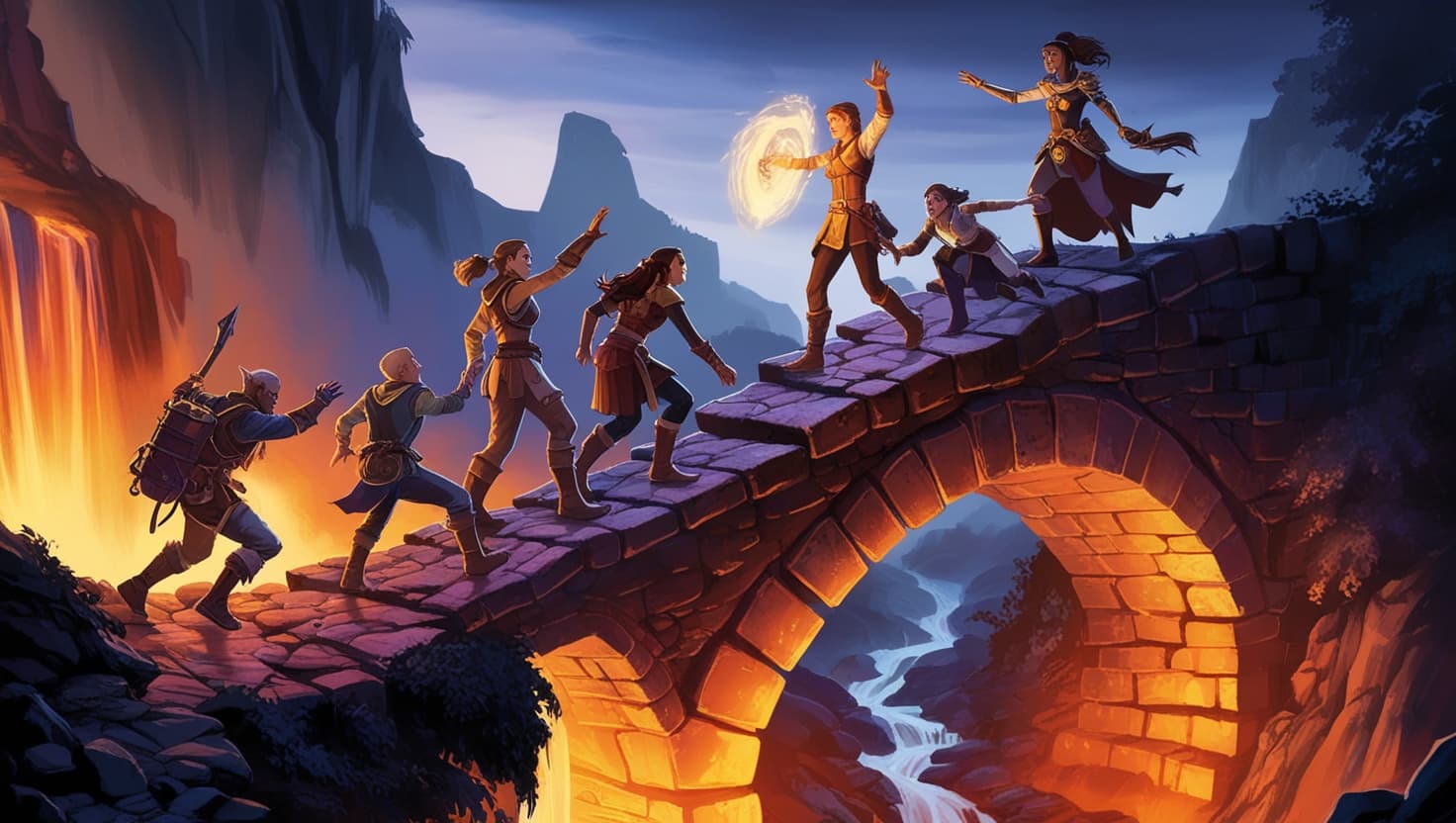
A 4th-level party needs to cross a canyon. The bridge is gone. The ranger spots a narrow ledge 60 feet down. The wizard remembers a Feather Fall scroll. The barbarian just wants to jump.
You could handle this with a single Athletics check and move on. Most DMs do. But single-check resolution flattens what could be a 15-minute sequence of creative problem-solving into one die roll and a sentence of narration.
Skill challenges in D&D 5e fix that problem. They give structure to non-combat encounters that matter - chases, heists, negotiations, escapes, rituals - without requiring you to improvise everything from scratch or railroad players through a scripted cutscene.
The weird part: this mechanic already existed. D&D 4th edition had skill challenges baked into the core rules. When 5e launched, Wizards of the Coast dropped them entirely. No replacement. No alternative framework. Just... nothing.
DMs noticed. And they've been homebrew-rebuilding skill challenges ever since.
Why D&D 5e Skill Challenges Keep Getting Reinvented
The 5e Dungeon Master's Guide offers exactly one tool for non-combat encounters: "call for an ability check." That's it. No structure for multi-step challenges. No guidance on how many checks should matter. No framework for partial success.
Compare that to combat, which gets initiative, action economy, hit points, conditions, legendary actions, lair actions, and 200+ pages of monster stat blocks.
The gap is obvious once you see it. Combat has a system. Everything else has "the DM figures it out."
Skill challenges fill that gap. They turn "make a Persuasion check to convince the duke" into a scene where the rogue gathers blackmail material, the bard performs for the court to create a distraction, the wizard identifies the duke's magical defenses, and the fighter stands guard at the door - all building toward a collective outcome.
I've run about 40 skill challenges across StoryRoll sessions and in-person games over the past year. The framework below is what survived contact with actual players.
The Core Skill Challenge Framework for 5e
- Set the stakes - what happens on success AND failure (both must advance the story)
- Pick your numbers - successes needed (4-6) and failure limit (usually 3)
- Set a base DC - typically 13-15 for Tier 1 play
- Go around the table - each player describes an action and picks a skill
- No repeats - a player can't use the same skill they used last round
- Narrate every result - successes AND failures change the scene
That's the skeleton. Here's where the detail matters.
Successes and Failures: Finding the Right Numbers
4e used a flat "X successes before 3 failures" structure, and the math was... fine. But 5e characters have higher average modifiers thanks to bounded accuracy, so the old 4e numbers need adjustment.
After testing different ratios, here's what I landed on:
Quick scene (collapsing tunnel, short chase): 4 successes before 3 failures. Takes 10-15 minutes. Every roll matters because you're always one failure from the edge.
Standard scene (heist, negotiation, wilderness trek): 6 successes before 3 failures. Takes 15-25 minutes. Enough room for creative approaches without dragging.
Epic set piece (siege defense, planar ritual, political trial): 8 successes before 3 failures. Reserve this for sessions where the skill challenge IS the encounter. I've only used 8-success challenges twice - both times the players said it was their favorite session moment. But it needs strong narration to sustain.
Resist the urge to go above 8 successes. I tried a 10-success challenge once during a heist sequence in StoryRoll. By success 7, the players were running out of skill justifications and the tension had plateaued. Cut to 8 max.
Setting DCs That Actually Create Tension
A flat DC across all checks is boring. A DC 15 Persuasion check feels the same as a DC 15 Athletics check, and players quickly realize they're just rolling against a number.
Better approach: variable DCs based on how well the player justifies the skill.
- Perfect fit (the skill obviously applies): DC 12-13
- Good fit (reasonable application with some creativity): DC 15
- Stretch (unusual skill, but the player sells it): DC 17
- Reach (barely connected, but you want to reward the attempt): DC 19
This creates a natural risk-reward dynamic. The rogue can use Stealth (DC 12) to sneak past the guards, or attempt Intimidation (DC 17) to bluff through - harder, but it counts the same if it works.
At higher tiers, bump everything up by 2. A 12th-level party with +8 to +11 in their best skills needs DCs of 14-21 to feel pressure.
Skill Challenge Examples That Actually Work at the Table
Theory is nice. Playable examples are better.
The Collapsing Mine (4 successes / 3 failures)
Setup: The party triggered a trap. The mine is caving in. They have roughly 2 minutes to reach the exit 300 feet away.
Round 1 possibilities:
- Athletics (DC 13) - sprint through falling debris
- Perception (DC 15) - spot the safest path through the collapse
- Arcana (DC 17) - recognize the magical runes destabilizing the stone and counter them
What failure looks like: Each failure doesn't mean "you don't move." It means complications. First failure: a beam falls, separating the party. Second failure: someone takes 2d6 bludgeoning damage from falling rock. Third failure: the exit collapses - the party survives but is trapped, and now they need to find another way out (which becomes the next encounter).
What success looks like: The party escapes with enough time to grab one valuable item from the mine on the way out.
Never make failure mean "nothing happens." A failed Athletics check to sprint through debris should trigger something - falling rocks force the group to detour, or a PC takes damage, or the ceiling drops lower and now everyone is crawling. Each failure should visibly change the scene.
The Noble's Gala (6 successes / 3 failures)
Setup: The party needs to get close enough to the Marchioness to deliver a warning about the assassination plot. She's surrounded by guards, sycophants, and a court wizard running Detect Thoughts.
Key mechanic twist: In social skill challenges, let failures create suspicion rather than immediate consequences. Track suspicion separately. Three failures means the guards escort the party out before they reach the Marchioness. Partial success (4-5 successes before 3 failures) means they deliver the warning but the court wizard flags them as persons of interest.
Skill applications I've seen players use:
- Performance to entertain the crowd and draw attention away from the rogue
- Insight to read the Marchioness's body language and find the right moment to approach
- Sleight of Hand to slip a written note past the guards
- History to reference an obscure noble house lineage, impressing a key courtier
- Animal Handling to calm the Marchioness's nervous hunting hound (DC 17, but the player argued the hound's reaction would make the Marchioness curious about them - I allowed it)
That last one is the magic of skill challenges. A player found a way to use Animal Handling at a gala. No pre-scripted encounter would have included that option.
The Arcane Ritual (6 successes / 3 failures)
Setup: The party found an ancient teleportation circle, but the runes are damaged. They need to repair and activate it before the pursuing army catches up.
What makes this different: I ran this one in StoryRoll and tracked each player's contribution as a step in the ritual sequence. The AI narrated how each success layered magical energy into the circle - the wizard's Arcana check stabilized the base runes, the cleric's Religion check invoked a divine anchor, the ranger's Survival check (justified as reading the ley lines like animal trails) oriented the destination. When they hit their 6th success, the AI described the portal flaring to life with all those individual contributions woven into the visual. Way more satisfying than "you fixed the circle."
Failure consequence: Each failure corrupts the destination slightly. 0 failures: arrive exactly where intended. 1 failure: arrive 1d6 miles off target. 2 failures: arrive in the right location but 1d4 days in the past or future. 3 failures: the circle explodes for 4d6 force damage and the army catches up.
Common Skill Challenge Problems (and How to Fix Them)
Problem: "I Roll Persuasion" Every Round
One player has a +9 to Persuasion. They want to use it for everything. The no-repeat rule helps, but some players will just rotate between their two best skills.
Fix: After a skill has been used by anyone in the challenge, increase its DC by 2 for subsequent uses by different characters. The guards have already been charmed once - doing it again is harder. The physical obstacles have already been partially cleared - further Athletics checks yield diminishing returns.
This naturally pushes players toward creative solutions instead of optimization.
Problem: The Ranger Has Nothing to Contribute at the Gala
Not every character build maps well to every skill challenge scenario. The fighter with -1 Charisma is dead weight in a social encounter if you don't build entry points for them.
Fix: Design at least one "physical" or "observational" entry point into every social challenge, and at least one "social" or "knowledge" entry point into every physical challenge. The fighter at the gala can use Perception to spot the assassin's accomplice in the crowd. The wizard in the collapsing mine can use Arcana to identify weak points in the stone.
When I build skill challenges for StoryRoll campaigns, I aim for at least 8 different skills to be viable. If I can only think of 4, the challenge is too narrow.
Problem: It Feels Like Rolling Dice in a Vacuum
The most common failure mode. Players roll, DM says "success" or "failure," repeat. No narrative momentum.
Fix: Narrate the consequence of every single roll before moving to the next player. Not "you succeed on Athletics." Instead: "You vault over the fallen beam, and the impact sends a shockwave through the floor - the halfling behind you watches the ground crack under their feet. They're next. What do they do?"
Each narration should set up the next player's turn. Failures should physically change the environment or situation. If narration feels like work, write 3-4 complication prompts before the session. "A new obstacle appears." "An NPC reacts badly." "The environment shifts." "A timer accelerates."
Problem: Players Don't Know What They Can Do
In combat, options are clear: Attack, Cast a Spell, Dash, Dodge, Help. Skill challenges have no such menu, and some players freeze.
Fix: Describe the environment in enough detail that skills suggest themselves. Don't say "you're in a collapsing mine." Say "Dust is falling from the ceiling. You can see three tunnel branches ahead - one has fresh air flowing from it, one has intact support beams, and one is shortest but the floor is cracked. Behind you, the rumbling is getting louder." Now Survival, Perception, Athletics, and Investigation all have obvious hooks.
Skill Challenges and Spells: The Ruling That Prevents Arguments
Spells break skill challenges if you're not careful. A wizard casts Fly during a "cross the chasm" challenge and the whole thing evaporates.
My ruling, tested across 40+ challenges: Spells that directly solve the obstacle count as an automatic success but cost the spell slot. No roll needed.
Pass Without Trace during a stealth challenge? Automatic success, burns a 2nd-level slot. Fly during a traversal challenge? Automatic success, but only for the caster - each party member still needs their own success. Suggestion on the guard captain? Automatic success, but the captain will remember being magically influenced after the spell ends (potential future consequence).
This rewards players for preparing the right spells without trivializing the encounter. And it costs resources, which matters in a day with more encounters ahead.
Class features work the same way. A Rogue's Reliable Talent means they can't roll below 10 - treat this as a significant advantage but don't give automatic successes. A Bard's Cutting Words can be used to reduce an NPC's contested check. Channel Divinity, Rage, Wild Shape - if it logically applies, let it contribute.
When NOT to Use Skill Challenges in 5e
Not every non-combat encounter deserves this treatment. Skill challenges work best when:
- Multiple characters can contribute different approaches
- Both success and failure lead to interesting outcomes
- The scene would otherwise collapse into a single ability check
- There's time pressure or escalating stakes
Skip them when the outcome only depends on one character's action (the rogue picking a lock), when failure would halt the story entirely (the party MUST cross this bridge to continue), or when the scene is better served by pure roleplay without mechanical structure.
I've also learned to avoid skill challenges for pure information-gathering. "Research the villain's weakness" sounds like a skill challenge, but it devolves into "I roll Investigation, I roll Arcana, I roll History" with no tactical decisions. Just give them the information and move on.
Running Skill Challenges with AI
One underrated advantage of running skill challenges in an AI-assisted game: the AI can track every success and failure and weave them into the narrative automatically. When I run skill challenges in StoryRoll, the AI remembers that the bard's Performance distracted the guards in round 1, so when the rogue attempts Stealth in round 2, the narration references the still-lingering musical distraction. Human DMs can do this too, obviously, but it's easy to lose track when you're also adjudicating DCs and managing the failure count.
The AI also excels at generating complications on failures. Instead of me reaching for the same "rocks fall" consequence, StoryRoll generates contextual consequences based on what the character attempted and how the scene has evolved. A failed Persuasion check at the gala doesn't just mean "they're suspicious" - the AI narrates which specific NPC overheard, what they think they heard, and how the social dynamics shift.
Skill challenges are the best mechanic 5e never included. They give non-combat encounters the same structural backbone that combat gets from initiative and action economy, without overcomplicating things. Start with a 4-success challenge next session. Pick a scene that would normally be one ability check - a chase, an escape, a negotiation - and expand it. Your players will spend 15 minutes being creative instead of 15 seconds rolling a die. The no-repeat rule does most of the heavy lifting; variable DCs and strong narration do the rest. You don't need to houserule much. You just need to give your non-combat encounters the same respect you give your boss fights.
Frequently Asked Questions
Can I use skill challenges in published D&D 5e adventures?
Absolutely. Published modules are full of scenes that beg for skill challenge treatment. The chase through Waterdeep in Dragon Heist, the survival trek in Tomb of Annihilation, the social encounters in Curse of Strahd - all of these can be restructured as skill challenges without changing the adventure's plot. Replace any scene where the book says "have the party make a group check" with a proper skill challenge and the scene will play better.
How long should a skill challenge take at the table?
A 4-success challenge runs 10-15 minutes. A 6-success challenge takes 15-25 minutes. If it's going longer, your narration between rolls is either too detailed or players are deliberating too long on skill choices. Set a soft 60-second timer per player turn to keep momentum.
Should I tell players it's a skill challenge?
Yes. Transparency works better than mystery here. Say "this is a skill challenge - you need X successes before 3 failures" so players understand the stakes and can strategize. Hiding the mechanic leads to confusion and players who don't realize their choices matter.
Do natural 1s and natural 20s matter in skill challenges?
RAW, nat 1s and nat 20s don't apply to ability checks. But most tables houserule them, and skill challenges are a great place to make them matter. A nat 20 could count as 2 successes. A nat 1 could count as 2 failures or trigger an immediate complication. This adds variance and memorable moments. Just make sure players know the house rule before the challenge starts.
Written by Anthony Goodman
Founder of StoryRoll. Building AI-powered tabletop RPGs.
Related Posts
How to Set DCs in D&D 5e: A Complete Game Master Guide
The official DC chart only gets you so far. Here's how experienced GMs actually set Difficulty Classes — with examples for every skill, homebrew situations, and the mistakes that trip up new Game Masters.
D&D 5e Conditions Explained: A Complete Guide
Every D&D 5e condition explained in plain language - what they do mechanically, how they interact, and practical tips for Game Masters who want to use them well.
Theater of the Mind D&D: How to Run Combat Without Battle Maps
Battle maps are great until they aren't. Here's how to run vivid, fast-paced D&D combat using nothing but words - and why some of the best sessions happen without a single grid square.