Theater of the Mind D&D: How to Run Combat Without Battle Maps
Four goblins burst from the treeline. The cleric is standing in the river. The rogue is... somewhere? And the fighter wants to know exactly how many feet away the nearest goblin is because they have 30 feet of movement and need to close the gap.
This is where theater of the mind either sings or collapses.
If you've ever abandoned a battle map mid-session because setting it up killed the momentum, or run an entire campaign online without ever touching a VTT grid, you already know the appeal. Theater of the mind combat is faster, more cinematic, and strips the game down to what actually matters: decisions, consequences, and shared imagination.
But it also terrifies DMs. Without a grid, how do you track positioning? What happens when someone casts Fireball and wants to know exactly who's in the radius? How do you keep combat fair when "close enough" is doing all the heavy lifting?
After running hundreds of sessions - grid-based, theater of the mind, and everything in between - here's what actually works.
What Theater of the Mind Actually Means
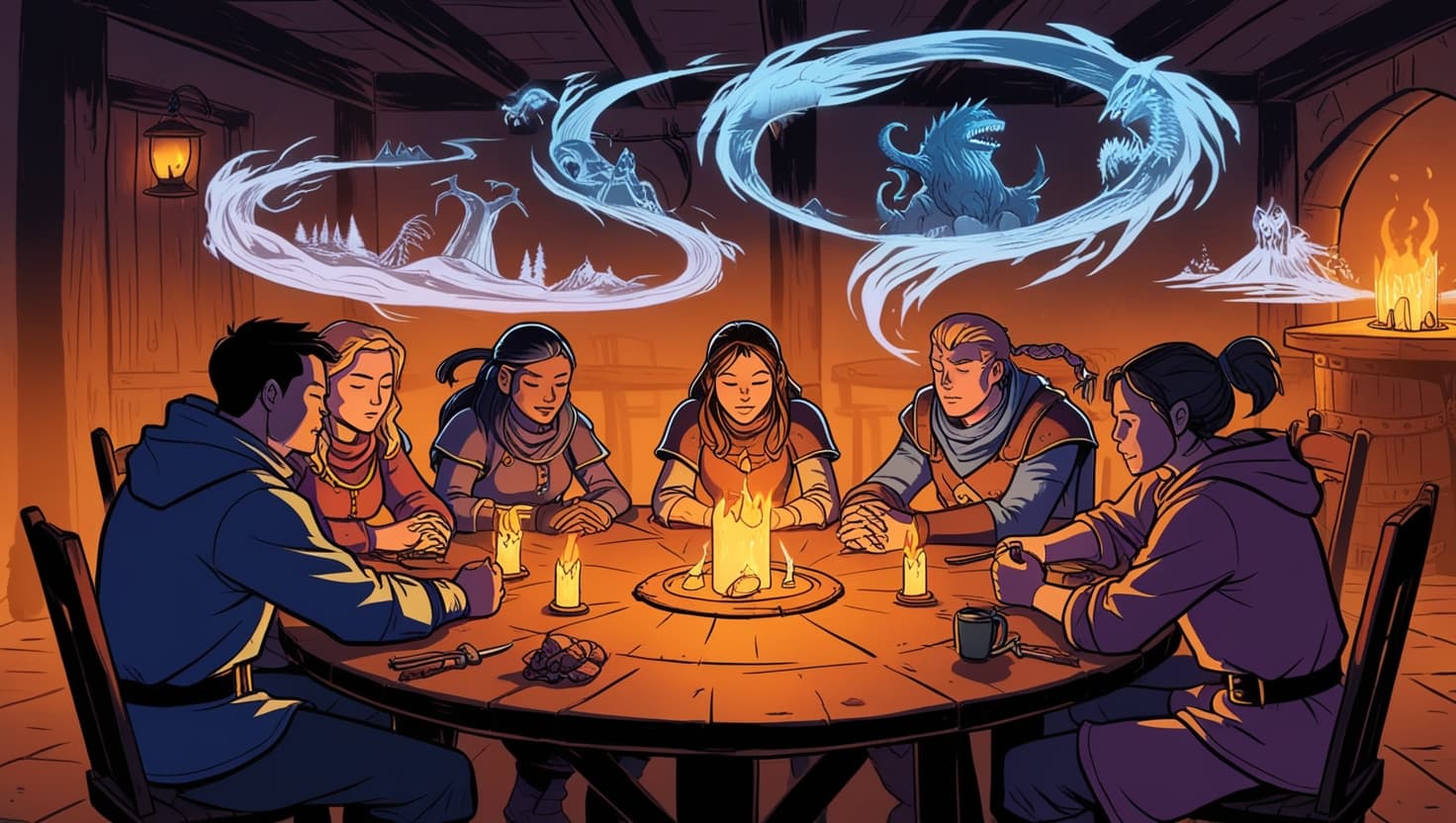
Theater of the mind - sometimes abbreviated TotM - is a style of D&D where the game space exists entirely in spoken description. No map. No miniatures. No tokens on a grid. The DM describes the scene verbally, players declare actions based on that description, and the group collectively imagines the shared space.
This was how D&D was played for most of its history. Battle maps and miniatures existed early on (wargaming roots and all), but the idea that every combat needs a gridded map is relatively modern. The 2014 Dungeon Master's Guide includes an entire section on running combat without a grid. It's not a house rule. It's a first-class play style.
The core trade-off is simple: you lose spatial precision, you gain narrative speed. A combat encounter that takes 90 minutes on a grid can wrap in 30 minutes in theater of the mind. Not because you're skipping things, but because you're not spending half the time counting squares.
Theater of the mind doesn't mean "no visuals." Many DMs still sketch quick relationship diagrams on paper - who's near whom, what's between the party and the enemy. The point is that these sketches serve the narrative, not the other way around.
Why DMs Avoid It (And Why They Shouldn't)
The number one objection: "My players will argue about positioning."
Fair. This does happen. But it happens on battle maps too - players squinting at grid squares, debating whether a diagonal counts as 5 or 10 feet, lawyering about whether their miniature was technically behind half-cover. The arguments just feel more legitimate because there's a visual reference.
The real fear is losing control. When you have a map, you feel like you have the authority of the grid behind you. Everything is measurable. Without it, you're making judgment calls every round, and some DMs worry that players will challenge those calls.
Here's the fix: say yes more than you say no.
When a player asks "Am I close enough to reach the goblin?" the answer should almost always be yes, unless there's a dramatic reason for it to be no. Theater of the mind works best when the DM treats positioning as a narrative tool rather than a physics simulation. The question isn't "is the rogue exactly 25 feet away?" It's "would it be interesting if the rogue could get there this turn?"
That last sentence will make some tactical players break out in hives. Good. We'll handle them in a minute.
The Only Three Rules You Need
You can read a dozen guides on theater of the mind techniques. Most of them overcomplicate it. Here's the entire framework:
Rule 1: Establish zones, not distances.
At the start of combat, describe the scene in zones. "The goblins are across the clearing, about 40 feet away. There's a fallen log between you. The river is to your left, the treeline is behind the goblins." Players now have a mental map with three or four zones. That's enough.
Rule 2: Restate positions every 2-3 rounds.
"Quick recap: the fighter is up in melee with two goblins near the log. The cleric is by the river, about 30 feet back. The rogue is flanking from the treeline on the right." Takes ten seconds. Prevents the "wait, where am I?" drift.
Rule 3: When in doubt, rule in the player's favor.
If a player wants to do something cool and the positioning is ambiguous, let them do it. You can always add a complication ("You can reach the goblin, but you'll provoke an opportunity attack from the one next to you") rather than flatly saying no.
That's it. Everything else is refinement.
Handling the Hard Stuff
Area of Effect Spells
This is the panic point for most DMs, and it's way simpler than people make it.
When a caster drops a Fireball, don't try to mentally calculate a 20-foot radius in imaginary space. Instead, ask two questions:
- How tightly grouped are the enemies? If they're clustered, the Fireball hits most or all of them. If they're spread across a clearing, it hits maybe two.
- Is there any risk to allies? If a party member is in melee with the targets, the caster has to make a choice.
A 20-foot radius Fireball in a typical combat hits about 3-4 tightly grouped enemies. A 15-foot cone (Burning Hands) hits 2-3 enemies in front of the caster. A 10-foot radius (Shatter) hits 2-3 if they're close together. These are approximations, and they're good enough.
- Fireball (20ft radius): 3-4 grouped enemies, 1-2 spread out
- Burning Hands (15ft cone): 2-3 enemies directly ahead
- Shatter (10ft radius): 2-3 closely grouped enemies
- Lightning Bolt (100ft line): 2-3 enemies in a rough line
- Spirit Guardians (15ft radius): Enemies who start turn near the cleric or move close
- Thunderwave (15ft cube): 2-3 enemies directly in front
Opportunity Attacks
On a grid, opportunity attacks are binary: you either leave a threatened square or you don't. In theater of the mind, use this rule: if a creature wants to move away from an enemy it's engaged with, it provokes. If it was never described as being in melee, it doesn't.
This is actually cleaner than the grid version. No arguments about diagonal movement or whether you skirted the edge of someone's reach.
Difficult Terrain
"The area near the river bank is muddy and rough. Moving through there costs extra effort." Then, when a player tries to cross it: "You can get through the mud this turn, but you won't have enough movement to reach the goblin on the other side. You'll end up in the middle of the muck."
See? No math. Just narration with mechanical consequences.
When Theater of the Mind Falls Apart
I'd be lying if I said it works for everything. It doesn't.
Complex multi-level environments with elevation, ladders, bridges, and multiple connected rooms get confusing fast when you can't see them. If your encounter involves a three-story tower with enemies on each floor and the wizard wants to position a Wall of Fire across the second-floor doorway, pull out a map. Even a quick sketch on paper.
Encounters with more than 8-10 combatants start losing coherence. When there are four different enemy types in five different positions and the party is split across three zones, the mental overhead is too much. Some players will check out.
Highly tactical players who built their character around precise positioning - the Sentinel/Polearm Master fighter, the Rogue who needs exact flanking angles - will feel robbed if you hand-wave distances. You have two options: adapt encounters so positioning matters less, or accept that some fights need a grid.
The best approach is hybrid. Run 80% of combats in theater of the mind and save the grid for set-piece encounters where tactical depth matters. That random encounter with wolves on the road? Theater of the mind, done in 15 minutes. The dragon fight in the crumbling cathedral? Break out the map.
Ask your players what they prefer. Some tables are fully theater of the mind and love it. Some need the grid for every combat. Most fall somewhere in between. There's no wrong answer, just mismatched expectations you should surface before session one.
Making It Cinematic
Here's where theater of the mind actually surpasses maps. On a grid, combat is mechanical: move token, declare attack, roll dice, next turn. In theater of the mind, every action is a description.
Instead of "I move here and attack": "You sprint across the muddy clearing, boots sliding on wet grass, and bring your sword down on the goblin before it can finish nocking an arrow."
That takes exactly the same amount of real time. But it transforms a mechanical exercise into a scene. Players start describing their own actions more vividly because you set the expectation. The rogue doesn't just "attack." She "drops from the low branch she'd been crouching on, driving her dagger into the hobgoblin's shoulder."
Three techniques for making this work:
Engage more senses. Don't just describe what players see. "The campfire's smoke stings your eyes. You can smell the goblins before you see them - wet fur and rotten meat." Suddenly this isn't an encounter on a grid. It's a place.
Describe enemy reactions. "The goblin flinches back from your swing, nearly tripping over its own feet. It's scared. The one behind it is barking orders, trying to rally them." Now the enemies feel like creatures, not stat blocks.
Let damage tell a story. "Your arrow catches the hobgoblin captain in the gap between its pauldron and breastplate. It staggers, drops to one knee, then forces itself back up. It's hurt but not done." This is way more interesting than "you deal 14 damage, it has some HP left."
Theater of the Mind for Online Play
This is where it gets interesting. Most online D&D happens on virtual tabletops - Roll20, Foundry VTT, Owlbear Rodeo - where the map is the centerpiece. The entire interface is built around token movement on a grid.
But a growing number of online D&D groups are ditching the VTT grid entirely. They hop on Discord or Zoom, talk through combat the same way they would at a physical table, and find that sessions run faster and feel more natural.
The barrier to online theater of the mind is lower than ever. You don't need to prep maps, import assets, configure lighting and fog of war, or troubleshoot why someone's token disappeared. You just... talk. And play.
This is actually the model that AI dungeon masters naturally gravitate toward. When an AI is running your game, it's describing scenes in text and responding to your actions in natural language. There's no grid because the AI's strength is narrative, not spatial simulation. Platforms like StoryRoll run entirely in theater of the mind - the AI describes environments, generates art to set the mood, and handles combat through narration rather than grid positioning.
It turns out that removing the map doesn't just save prep time. It fundamentally changes what the game feels like. Sessions feel more like collaborative storytelling and less like a turn-based strategy game. Whether that's a positive or negative depends entirely on what you want from D&D.
If you're curious about running games without a traditional VTT setup, we compared the major options in our guide to whether you even need a VTT.
A Quick Conversion Guide for Grid DMs
Already comfortable with battle maps and want to try theater of the mind? Here's how to convert your existing style without starting from scratch.
Your next session: Pick one encounter - preferably a simple one with 4-6 enemies in a single location. Don't prep a map for it. Write three bullet points: the environment (what does the space look like?), the enemies (where are they roughly?), and one interesting terrain feature (a bridge, a pit, a burning building). Run that encounter in theater of the mind. Keep the rest on the grid.
After three sessions: You'll notice which combats need maps and which don't. Random encounters, ambushes, and social-encounters-turned-violent almost never need grids. Boss fights and dungeon rooms with traps and complex terrain usually benefit from them.
The confidence milestone: When you stop worrying about whether the ranger is 28 or 35 feet from the enemy and start just saying "you're in range," you've got it. That shift from precision to narrative authority is the whole transition.
Try These Free Tools
Theater of the mind means fewer tools, but these free ones still come in handy:
- Dice Roller — Roll dice instantly without breaking the flow of narration.
- NPC Name Generator — Generate NPC names on the fly when players go somewhere unexpected.
- Encounter Calculator — Balance encounters quickly so you can focus on storytelling, not math.
Frequently Asked Questions
Does theater of the mind work for D&D 5e specifically?
Yes. The 5e Dungeon Master's Guide (Chapter 8) explicitly supports theater of the mind as a combat style. Movement speeds, ranges, and areas of effect are written in feet specifically so they can be approximated without a grid. Many groups who play without a dedicated DM or use AI tools run theater of the mind exclusively.
What about players who have features that rely on precise positioning?
Features like Sentinel, Polearm Master, and the Rogue's Sneak Attack (flanking variant) work fine with a small adaptation. Instead of exact positioning, agree on narrative conditions: "If you're in melee and an enemy tries to run, Sentinel triggers." For Sneak Attack, if an ally is fighting the same enemy, flanking applies. The mechanics stay intact; only the visualization changes.
Can new players learn D&D in theater of the mind?
Some new players actually find theater of the mind easier because there's less visual information to parse. They don't need to learn VTT controls, token movement, or grid tactics. They just describe what they want to do. That said, some visual learners struggle without a spatial reference. A quick sketch on paper or a shared whiteboard can bridge the gap. New players should try both styles and see what clicks.
How do you handle initiative tracking without a map?
Initiative order doesn't change between styles. Use any tracker you like - a written list, an app, index cards. The only difference is that when you call someone's turn, you give a brief situational update: "You're near the doorway. Two goblins are in front of you, one is trying to get around behind the cleric. What do you do?"
Theater of the mind isn't a compromise or a shortcut - it's a legitimate play style that predates battle maps by decades. It makes combat faster, more narrative, and more accessible, especially for online play. It won't replace grids for every table or every encounter. But if you've never tried running a fight purely through description, you're missing one of the best parts of this game. Start with one encounter. Keep it simple. Trust your instincts over your ruler. The grid will still be there if you want it back.
Written by Anthony Goodman
Founder of StoryRoll. Building AI-powered tabletop RPGs.
Related Posts
Skill Challenges in D&D 5e: The Best Mechanic WotC Never Published
Skill challenges didn't survive the jump from 4e to 5e, but DMs keep reinventing them anyway. Here's how to run them without the clunky parts - plus a framework that actually works at the table.
D&D 5e Conditions Explained: A Complete Guide
Every D&D 5e condition explained in plain language - what they do mechanically, how they interact, and practical tips for Game Masters who want to use them well.
D&D Encounter Building Tips for New GMs: From Boring Fights to Memorable Moments
A practical guide to building D&D encounters that actually challenge and excite your players. Covers action economy, terrain, pacing, enemy variety, and using encounter calculators - written for GMs who are tired of one-sided stomps and lifeless combats.