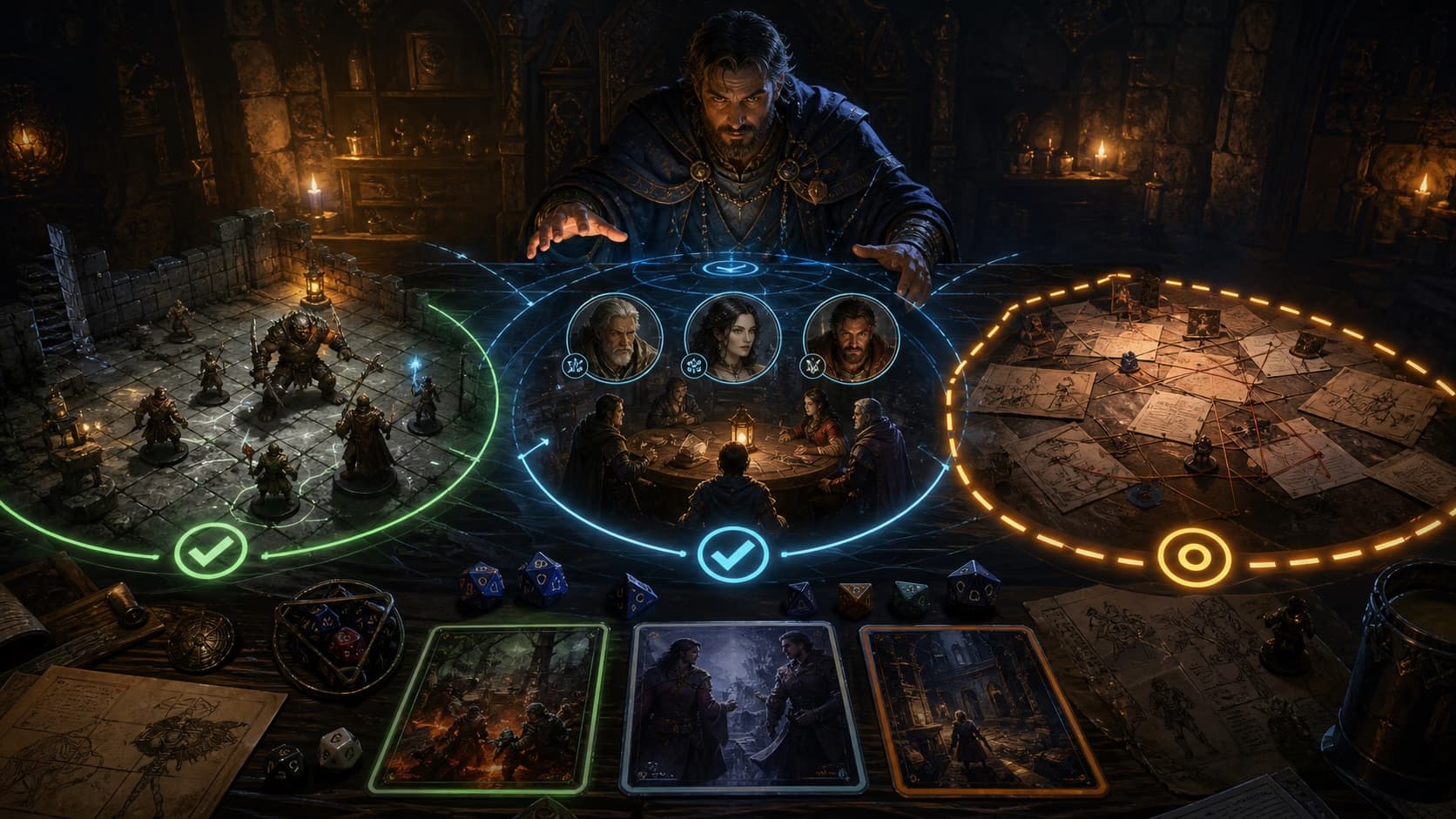
AI DM: What It Can Actually Run in D&D
An AI DM can run more D&D than skeptics think and less D&D than hype merchants want to admit.
That is the useful middle.
The bad version of this conversation turns into theater. One side says AI will replace every Game Master by next Thursday. The other side says AI could never understand the sacred emotional geometry of a goblin ambush. Neither take helps the player sitting at home with a character sheet and no table.
The better question is practical:
What parts of D&D can this kind of tool actually run well enough that the session feels worth playing?
Not someday. Not in a pitch deck. Now.
The answer depends less on how pretty the narration is and more on whether the system can handle pressure: rules, turns, memory, failure, pacing, and player choices that were absolutely not in the plan.
That pressure is where real play lives. A product can look impressive in a five-minute demo and still fall apart when the cleric is down, the rogue wants to split the party, and somebody asks whether Silvery Barbs changes the whole messy outcome.
An AI DM Can Run Exploration Pretty Well
Exploration is the easiest win.
A dungeon corridor, a locked shrine, a ruined bridge, a suspicious merchant, a strange sound behind the next door - these are all comfortable territory for current AI systems. They can describe spaces, offer sensory details, improvise clues, and respond when players poke the obvious cursed object anyway.
This works because exploration gives the AI room to breathe. The stakes are real, but the rules load is lighter than combat. A failed Investigation check can reveal partial information. A good Survival roll can point the party toward a safer path. A weird player idea can become a new branch without breaking the whole system.
In StoryRoll sessions, exploration tends to feel strongest when the AI keeps choices concrete:
- inspect the altar
- follow the wet footprints
- force the rusted gate
- talk to the wounded scout
- leave before the chanting gets louder
That is enough. D&D does not need every room to become a novel. It needs pressure, texture, and a next decision.
The best AI exploration scenes give players a situation, not a lecture. One good detail beats five paragraphs of ancient stonework.
AI DMs Can Run Basic Roleplay, But Not Every Social Scene
AI is good at NPC surface area.
Names, voices, motives, secrets, insults, tavern rumors, nervous guards, arrogant nobles, cultists with terrible excuses - all of that is well within reach. A decent AI game master can keep a shopkeeper alive for a scene, make a captured bandit bargain, or let a suspicious druid reveal information slowly.
Where it gets harder is emotional continuity.
A human DM remembers the tone at the table. They know when a player is joking, when someone is uncomfortable, when a quiet player finally wants the spotlight, and when an NPC should stop talking because the room is done with them.
AI does not naturally know that. It can approximate social pacing, but it does not know your group.
That means AI roleplay works best when the scene has a clear function:
- get information
- negotiate a price
- persuade an ally
- interrogate an enemy
- make a moral choice
- reveal a hook
It works worse when the scene depends on years of friendship, private jokes, or the exact way your table handles tension.
That is fine. Not every tool needs to do every job.
An AI DM Can Run Combat If It Has Real State
Combat is where weak AI game masters fall apart.
The first round sounds fine. The second round gets fuzzy. By round three, the goblin has attacked twice, the wizard forgot they were concentrating on Web, and the owlbear is somehow both dead and charging.
That happens when the AI is only narrating combat instead of tracking it.
To run combat, the system needs structure:
- Initiative: who acts next and who already acted.
- Resources: HP, spell slots, rage uses, ammo, and conditions.
- Rules limits: actions, bonus actions, reactions, movement, concentration.
- Consequences: failed saves, opportunity attacks, death saves, and retreat.
Without those rails, the AI will eventually choose drama over mechanics. That can be fun for a loose storytelling game. It is bad for D&D, where the difference between Healing Word and Cure Wounds matters.
StoryRoll's combat direction is built around this idea: narration is layered on top of game state, not used as a substitute for it. If the AI says the skeleton hits, the roll and damage need to exist. If the paladin drops to 0 HP, death saves need to matter. If the rogue used their reaction, they do not get another one because the sentence would sound cooler.
Rules make the story sharper.
An AI DM Can Handle Short Campaign Memory
One-shots are forgiving. Campaigns are not.
In a one-shot, the AI only needs to remember what happened tonight. In a campaign, it needs continuity: names, choices, unresolved threats, promises, enemies, allies, places, and consequences.
Current AI can handle short memory when the product gives it help. Raw chat history is not enough forever. Long transcripts get noisy. Important details sink under descriptions of doors, weather, and players asking whether they can loot the curtains.
Useful memory needs selection.
The AI should remember that:
- the party spared the hobgoblin captain
- the warlock promised a favor to their patron
- the ranger's wolf companion was injured
- the village blamed the party for the fire
- the necromancer escaped with the silver reliquary
It does not need to remember every torch sconce.
This is one of the places where purpose-built game tools have a real advantage over general chatbots. They can decide what becomes campaign memory instead of treating every line as equally important.
AI DMs Still Struggle With Deep Human Table Feel
This is the part AI boosters usually underplay.
A great human DM is not just a rules engine with a spooky voice. They know the players. They know when to bend a rule, when to enforce one, when to cut a scene, when to push a character, and when someone at the table needs a lighter night.
AI does not have that shared history.
It can generate a tragic NPC. It cannot know that this specific player has had a brutal week and probably does not need a grief-heavy scene tonight. It can create a rival. It cannot know that two players are already annoyed at each other and the rivalry will land badly.
That is not a small gap.
For long, emotionally dense campaigns, human DMs still win. Easily.
The useful claim is not "better than your best DM." It is "better than no game, and good enough for many sessions that would otherwise never happen."
That framing matters because it keeps expectations sane.
AI DMs Should Say No Sometimes
If every player idea works, nothing works.
AI systems are often trained to be agreeable. D&D needs a little resistance. Not cruelty. Not adversarial nonsense. Just enough structure that choices have edges.
No, you cannot persuade the lich to retire with one decent Charisma roll.
No, you cannot cast Misty Step through a wall you cannot see through.
No, the dragon does not forget it can fly because melee characters would prefer that.
A useful game master says no when no protects the game. It can still offer alternatives: "You cannot teleport through the wall, but you can hear water behind it and might find another entrance." That is the sweet spot. Constraint plus momentum.
StoryRoll should be judged on this as much as prose quality. The AI needs to keep the session moving without turning the game into wish fulfillment.
How to Judge an AI DM Before You Trust It
Do not judge the tool by the first tavern scene.
Judge it under stress.
Try these tests:
- Can it run three rounds of combat without losing initiative?
- Does a failed roll change the situation?
- Does a spell's limitation matter?
- Does an NPC remember a promise from earlier?
- Does the AI ask for a meaningful choice instead of monologuing?
- Can it recover when the player does something weird?
- Does it know when to end a scene?
If a tool passes those, it is worth taking seriously.
If it only writes pretty descriptions, it may still be fun. Just do not confuse it for a Game Master.
The Honest Place for AI at the Table
AI is not here to replace the best version of D&D.
It is here to rescue the sessions that never start.
The solo player who wants to try a character tonight. The forever DM who wants to play for once. The friend group with no volunteer behind the screen. The beginner who wants to learn before joining a real table. The campaign that would otherwise go cold because two people cancelled.
That is the job.
It does not need to be better than Matt Mercer, Brennan Lee Mulligan, or your friend who makes every goblin sound like a tax attorney.
It needs to be good enough to make playing possible.
This kind of tool can run exploration, basic roleplay, structured combat, short campaign memory, and backup sessions when the product gives it real game state. It still struggles with deep table feel and human social nuance. Use it for the empty chair problem, not as a replacement for a great human DM.
Frequently Asked Questions
What can an AI DM run in D&D?
It can handle narration, exploration, simple roleplay, dice checks, basic combat, NPC reactions, and short campaign continuity when the tool has enough structure. It works best when the session has clear choices and tracked game state.
What is an AI DM bad at?
These tools struggle most with deep table feel, long-term emotional callbacks, complex homebrew, ambiguous rulings, and social nuance that depends on knowing the players personally.
Can an AI DM run combat?
Yes, but only if it tracks initiative, hit points, actions, conditions, and rules constraints. A chatbot without game state will usually drift during combat because it is narrating the fight instead of running it.
Is an AI DM better than a human Dungeon Master?
No. A great human DM is still better for personal, long-running campaigns. The software is strongest when the alternative is no session at all.
Who should try an AI DM?
They are best for solo players, groups without a DM, forever DMs who want to play, beginners, and tables that need backup sessions when the normal campaign cannot happen.
Written by StoryRoll
Founder of StoryRoll. Building AI-powered tabletop RPGs.
Related Posts
One Hour D&D Session: Stop Shrinking the Wrong Parts
A one hour D&D session can work, but not if you run a four-hour game faster. Cut setup, cap scenes, and keep the first choice close.
Play D&D Online With AI: The Missing-DM Problem VTTs Can't Fix
Play D&D online with AI when the real blocker is not maps, dice, or voice chat. It is the missing Dungeon Master.
D&D Campaign Notes: Stop Writing Recaps Nobody Uses
D&D campaign notes should help the next session start faster. Track decisions, debts, threats, and next moves instead of writing a novel.