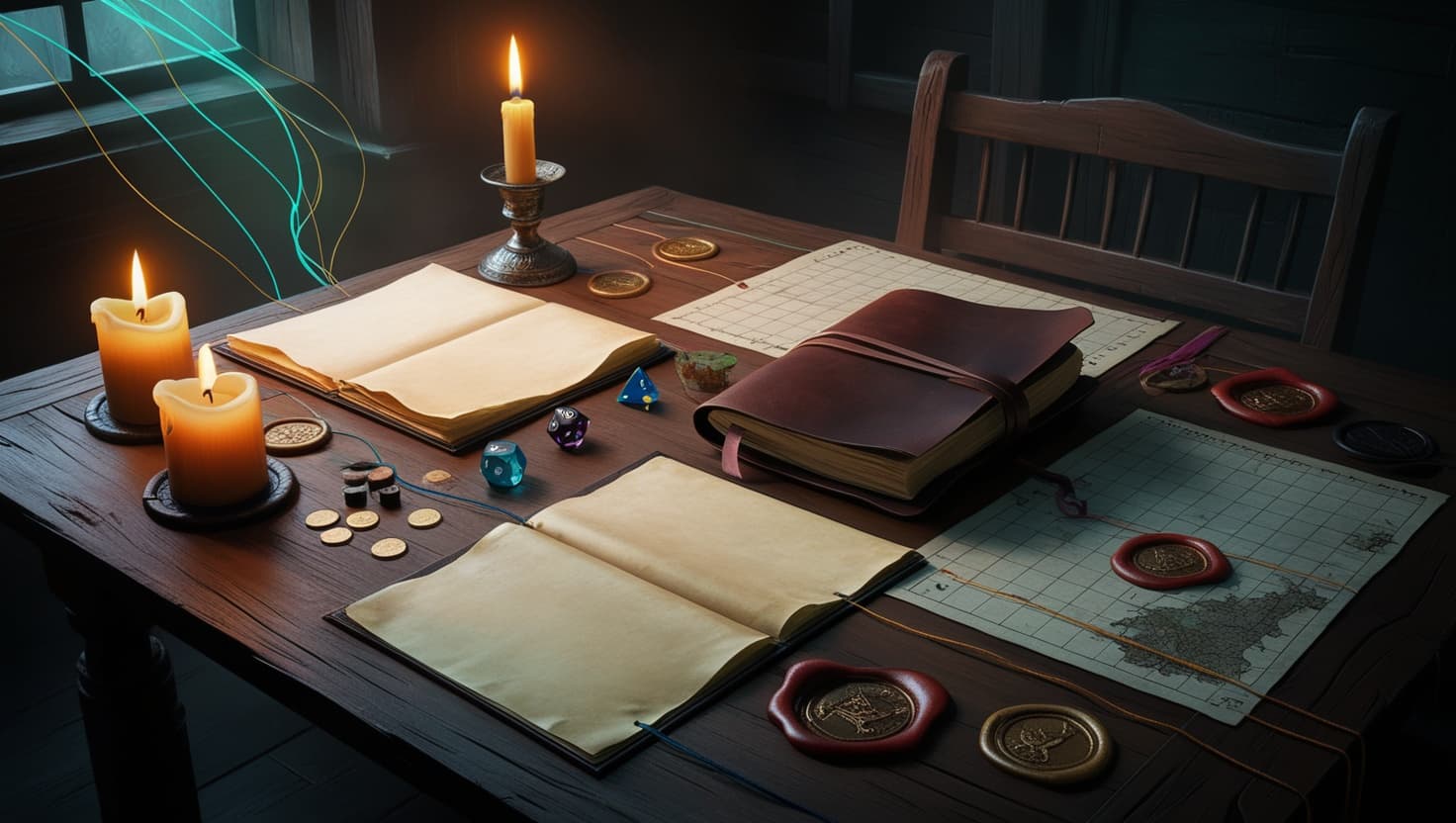
D&D Campaign Notes: Stop Writing Recaps Nobody Uses
D&D campaign notes are not supposed to prove you were paying attention.
They are supposed to make the next session easier to start.
That sounds obvious until you look at how most campaign notes are written: three pages of recap, six NPC names with no reason attached, a paragraph about the tavern, two unresolved prophecies, one joke about the bard, and no clue what the party was about to do when everyone logged off.
I love a good notes doc. I also think many DMs are maintaining a fantasy scrapbook when what they actually need is a restart button.
The test is simple. If your D&D campaign notes cannot answer "what do we do first next time?" in under thirty seconds, they are not doing their job.
D&D Campaign Notes Should Track Change, Not Everything
The best D&D campaign notes are selective.
They do not record every line of dialogue. They record what changed because the players showed up and made decisions.
That means this is useful:
- The party spared the goblin scout from Klarg's cave.
- Sister Garaele now thinks the rogue is lying about the stolen letter.
- The fighter used the last healing potion before entering the Redbrand hideout.
- The necromancer escaped with the silver reliquary.
- The cleric promised to return the bones before sunset.
This is less useful:
- The tavern had oak tables.
- The guard's name was Bren.
- Everyone debated the left hallway for twelve minutes.
- The wizard made a joke about soup.
Maybe Bren matters later. Fine. Promote Bren when Bren changes something. Until then, let the man guard his gate in peace.
Good notes are not complete notes. Good notes are playable notes.
After every session, write down the five things that would be annoying to reconstruct next time. That list is usually better than a full recap.
StoryRoll has to make this distinction constantly because AI-run sessions generate a lot of text. Raw chat history is a terrible memory system. It treats a failed Perception check, a scene-setting paragraph, a goblin surrender, and a death save as equally important. They are not equal. The death save matters. The surrender probably matters. The paragraph about dripping stone only matters if the dripping stone is hiding a black pudding.
D&D Campaign Notes Need a Next Move
Campaigns stall when nobody knows where the story was pointed.
Not the plot. The next move.
Players can remember the broad story. They beat the cultists. They found the map. They annoyed the mayor. What they forget is the immediate playable question:
- Are we chasing the cultist tonight or resting first?
- Did we promise the druid we would return before dawn?
- Which NPC actually knows where the shrine is?
- Are we still poisoned?
- Did we leave the horses outside the haunted mill?
That is the material that gets a session moving.
Use a notes format that ends with a launch point:
- Last choice: what the party decided before stopping.
- Open pressure: what gets worse if they delay.
- Known options: two or three reasonable actions.
- Loose thread: one thing that might come back later.
- First prompt: the sentence that starts next session.
That last line is underrated. Write the first prompt while the session is still warm.
"The shrine bell is still ringing when you wake, and the acolyte is gone."
"The goblin scout waits outside camp with Klarg's map and a knife in his boot."
"The vampire spawn in the cellar starts laughing exactly ten minutes before sunset."
Now the next session has a grip.
This is why one hour D&D sessions live or die by notes. A short session cannot spend twenty minutes rebuilding context from memory. It needs the first choice close enough to touch.
D&D Campaign Notes Should Separate Facts From Suspicions
Player theories are precious and dangerous.
They are precious because they tell you what the table cares about. They are dangerous because if you write them next to confirmed facts, everyone starts treating guesses like canon.
Keep them separate.
Facts:
- Baron Vallakovich invited the party to dinner.
- Ireena refused to enter the church basement.
- The silver raven watched the road from the pines.
Suspicions:
- The raven might be connected to the Martikov family.
- Ireena may know more about the basement than she admitted.
- The Baron is probably setting a trap because, well, look at him.
That split matters in a human-run game, and it matters even more with AI. If an AI Dungeon Master reads "the Baron is setting a trap" as fact, it may lock the story into a twist the players only imagined. If it reads the same line as suspicion, it can decide later whether the theory was right, wrong, or partly right in the most irritating possible way.
That is good D&D.
StoryRoll's campaign memory works best when it preserves both sides: what happened, and what the players currently believe. The first protects continuity. The second protects dramatic opportunity.
D&D Campaign Notes Should Remember Debts
The most useful campaign notes are usually about debts.
Not money, though your rogue may disagree.
I mean unfinished obligations:
- favors owed
- threats made
- bargains accepted
- lies told
- resources spent
- items promised
- enemies humiliated
- NPCs saved and then ignored
These are the things that make a campaign feel alive. A world does not need 400 years of royal lineage to feel responsive. It needs the hobgoblin captain to remember that the party spared him. It needs the hag to collect on the favor. It needs the innkeeper to stop extending credit after the barbarian broke the second stair rail.
The rules support this more than people think. Geas is a spell about obligation. A Warlock's pact is obligation with better branding. Paladin oaths, cleric domains, faction ranks in published adventures, and even the Dragon of Icespire Peak job board all create promises the game can cash in later.
If your notes only track plot, you miss the best fuel.
Try a debt list:
| Debt | Who cares | When it returns |
|---|---|---|
| Party owes the apothecary 50 gp | Mira Vale | When they need antitoxin |
| Goblin scout was spared | Rikkit | When Klarg hunts deserters |
| Cleric lied about the relic | Sister Garaele | When the shrine is attacked |
| Warlock promised a name | Patron | During the next long rest |
That table is more useful than two pages of recap because it gives the DM handles.
In StoryRoll sessions, these handles are where AI memory earns its keep. A saved goblin can return with a warning. A patron can interrupt a rest. A neglected NPC can become a problem without the player needing to remind the system every time.
D&D Campaign Notes Need Less Lore Than You Think
Lore is not bad. Lore bloat is bad.
There is a difference between "the ruined keep belonged to the Order of the Dawn, whose old oath still binds the ghost knights below" and "the Order of the Dawn was founded in 842 by High Marshal Edran after a taxation dispute involving three duchies and a horse plague."
One is playable. One is a hostage situation with parchment.
Write lore when it changes action.
Useful lore does one of these jobs:
- explains a danger
- creates a choice
- reveals a motive
- unlocks a route
- reframes an NPC
- makes a reward matter
The rest can stay in your private worldbuilding folder where it can be happy and weird.
Players do not need the whole history of a haunted mine. They need to know the miners sealed the lower lift because something below learned their names. That is enough to make opening the lift feel like a decision instead of a hallway.
This is also where AI tools can get sloppy. They love generating lore. So much lore. Buckets of ancient kingdoms. Everyone had a vanished order. Every sword has a lineage. Every cave was once a temple because apparently normal caves unionized and left fantasy.
The fix is constraint. Ask for lore that changes the next scene. If it does not change a choice, cut it from the campaign notes.
If a lore entry has no verb attached to it, it probably is not ready for the table. "The queen betrayed the order" is playable. "The order was ancient" is wallpaper.
D&D Campaign Notes Should Be Written for Future You
Future You is tired.
Future You has ten minutes before the session. Future You cannot remember whether the ranger's wolf companion was injured, whether the party already searched the chapel, or whether the bard's fake name was Vellum or Velren or something equally bard-coded.
Write for that person.
Use blunt headings:
- Start here
- Current danger
- NPCs in motion
- Party resources
- Promises and lies
- Places changed
- Rewards pending
No elegance required.
The goal is not to impress anyone. The goal is to keep play from drowning in "wait, what happened last time?"
For player-facing notes, keep a different version. Players do not need every secret clock and hidden faction plan. They need enough to make informed choices. Give them a clean recap, known leads, NPC names they have met, and unresolved decisions.
DM notes and player notes should overlap, not match.
That is especially true for playing D&D online with AI. The system can remember hidden state, but players still need a readable version of what their characters know. Memory that only the machine can use is operationally useful. Memory the table can act on is what makes the session better.
D&D Campaign Notes Are a Play Tool, Not Homework
If your notes system makes you avoid prepping, it has failed.
Obsidian, Notion, Google Docs, paper notebooks, index cards, Discord threads, and purpose-built campaign managers can all work. The tool matters less than the discipline: short, selective, decision-focused notes that point toward play.
My preferred minimum viable note after a session is this:
- What changed?
- Who now wants something?
- What did the party spend or gain?
- What are the next two playable choices?
- What sentence starts next session?
That is it.
You can add maps, timelines, NPC portraits, and lore pages later if they help. Just do not let the system become a second campaign you have to maintain.
StoryRoll is biased here because we are building for people who want the game to start, not people who want another admin dashboard. The notes need to disappear back into play. If the AI remembers that the rogue owes a favor, great. If it makes the player manage a twelve-field memory form after every scene, we have recreated homework with better lighting.
The best campaign notes make the table feel like the world remembered.
Not like the DM kept minutes.
Frequently Asked Questions
What should I write in D&D campaign notes?
Write player decisions, unresolved threats, NPC relationships, spent resources, changed locations, promised rewards, and the next obvious choice. Skip full transcripts and decorative lore unless they affect play.
How long should D&D campaign notes be?
Most useful D&D campaign notes fit on one page. If the recap is too long to read before the next session, it will not help the table restart.
Who should take D&D campaign notes?
The DM can own the official notes, but players should add short character-facing reminders. For online or AI-run games, the system should capture key state automatically.
Can AI help with D&D campaign notes?
Yes. AI can summarize sessions, extract unresolved threads, remember NPCs, and turn messy play into next-session prompts, but it needs structured game state instead of raw chat history alone.
What is the biggest mistake with D&D campaign notes?
The biggest mistake is recording everything equally. Campaign notes work when they preserve what changes the next session, not every sentence spoken at the table.
D&D campaign notes are useful when they get the table back into motion: last choice, open pressure, debts, changed relationships, and the first prompt for next session. Write less recap. Keep more consequence. The campaign does not need a stenographer. It needs a memory that knows what matters.
Written by StoryRoll
Founder of StoryRoll. Building AI-powered tabletop RPGs.
Related Posts
One Hour D&D Session: Stop Shrinking the Wrong Parts
A one hour D&D session can work, but not if you run a four-hour game faster. Cut setup, cap scenes, and keep the first choice close.
AI DM: What It Can Actually Run in D&D
An AI DM can run more than tavern banter, but not every part of D&D is equally ready. Here's what works, what breaks, and how to judge it.
AI Tabletop RPGs Need More Than a Chatbot in a Cloak
An AI tabletop RPG needs rules, memory, dice, characters, and consequences. A fantasy chatbot can fake the vibe, but not the game.