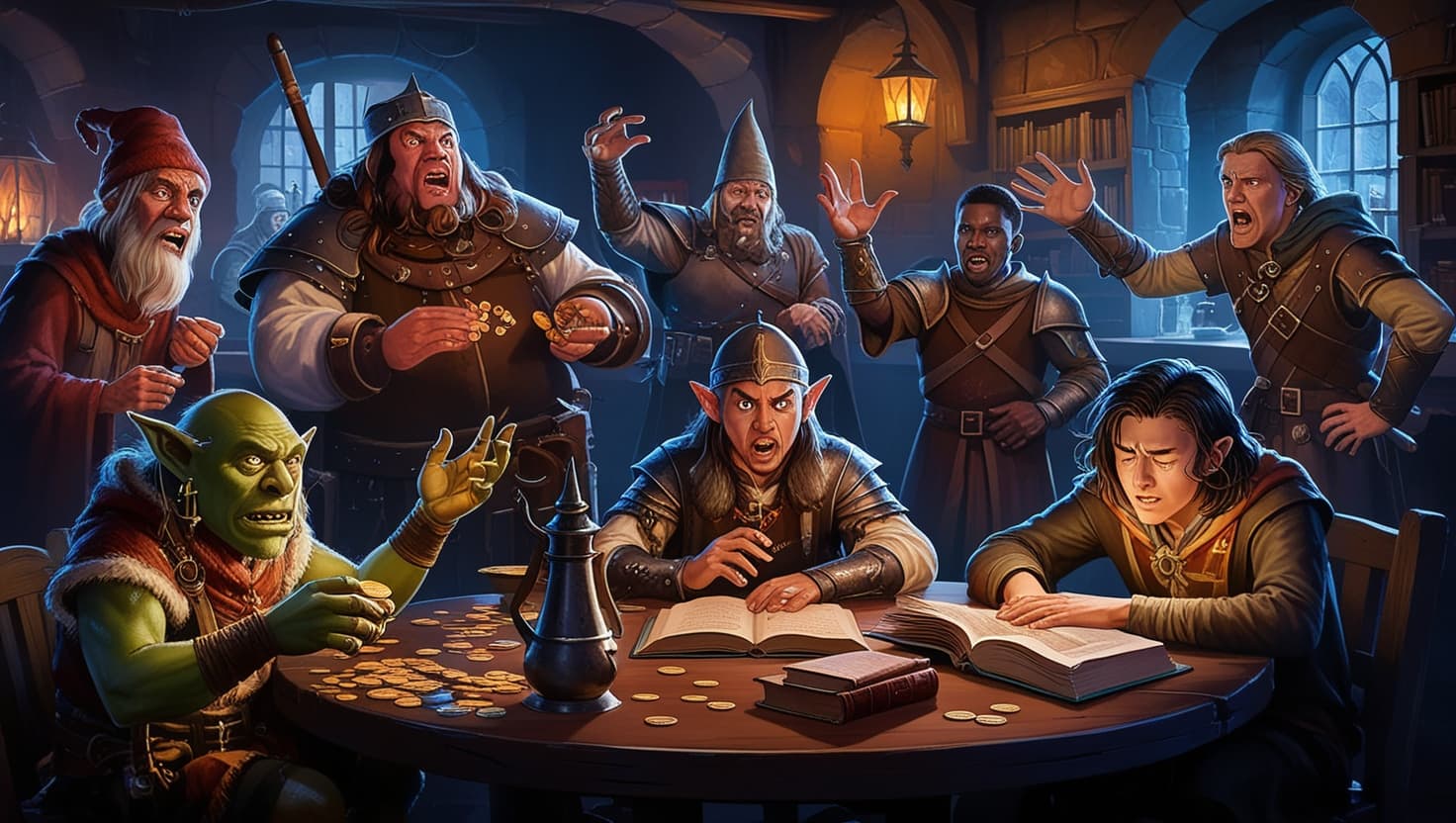
How to Create Memorable NPCs in D&D (Without Overthinking It)
Your players will remember the nervous goblin merchant who accidentally sold them a cursed amulet. They won't remember the stoic guard captain who gave them directions to the temple.
The difference? One had personality. The other was a function.
Most DMs overthink NPC creation - building elaborate backstories, complex motivations, and detailed stat blocks for characters players will interact with for 90 seconds. Or they underthink it, creating cardboard cutouts who exist only to deliver plot hooks.
Neither approach works.
Here's how to create NPCs that actually stick in your players' minds without wasting hours of prep time on characters who might never show up again.
Why Most NPCs Are Instantly Forgettable
Every NPC in your campaign competes for mental real estate with every other character your players have met. If you've been running a campaign for six months, that's 50+ named NPCs.
Most of them blur together.
The guard captain, the tavern owner, the quest-giver merchant, the wise old wizard - these archetypes don't stick because they're expected. Players have met them before. They'll meet them again in the next campaign.
What makes an NPC memorable is contrast. Something that differentiates them from the pattern.
This doesn't mean every NPC needs to be a quirky, over-the-top caricature. It means they need at least one element that breaks the mold.
The 3-Layer NPC Framework
Skip the 10-page backstory document. You need three layers:
1. Personality (The Surface)
This is what players notice immediately - the first impression. A visual detail, a speaking pattern, a mannerism.
Good personality hooks:
- A blacksmith who's terrified of fire
- A noble who constantly interrupts themselves mid-sentence
- A bartender who only speaks in questions
- A street urchin who uses absurdly formal language
Bad personality hooks:
- "Friendly"
- "Mysterious"
- "Wise"
- Any single adjective that doesn't create contrast
The test: Can a player describe this NPC to another player without using their name or job title?
2. Purpose (The Function)
What role does this NPC serve in the story right now?
Not "what's their life goal?" or "what's their tragic backstory?" - what do they want from the players in this specific scene?
- Information broker who wants payment
- Guard who wants to avoid paperwork
- Merchant who wants to offload cursed inventory
- Cultist who wants to recruit the party
Purpose creates interaction. It gives the NPC something to push for, which creates friction, which creates memorable moments.
The best NPC purposes create a decision point for players. An NPC who offers free help is functional. An NPC who offers help if the party does something questionable first is memorable.
3. Presentation (The Hook)
This is the detail that makes them stick. The thing players reference weeks later.
It can be:
- Visual: Missing fingers, ornate tattoos, always covered in flour
- Verbal: Catchphrase, unusual accent, speaks only in riddles
- Behavioral: Counts coins obsessively, refuses to make eye contact, laughs at inappropriate times
You only need one. Maybe two if they're a recurring character.
More than that and you're overdesigning.
Quick NPC Generation for Improvisation
Your players will always find the one NPC you didn't prepare for and want to have an extended conversation with them.
Have a generation system ready.
- Pick a contrast - Choose one trait that breaks expectations for their role
- Pick a want - What do they want from this interaction right now?
- Pick a hook - One memorable detail (visual, verbal, or behavioral)
- Play it forward - Commit to the bit and see where it goes
Example:
- Role: Random city guard the party is asking for directions
- Contrast: Extremely chatty (most guards are terse)
- Want: Wants to complain about his shift schedule
- Hook: Keeps referring to himself in third person ("Marcus thinks you should take the east gate")
- Result: Players remember Marcus. Probably better than they remember the quest NPC.
This takes 15 seconds. You can do it while a player is mid-sentence.
Common NPC Creation Mistakes
Mistake 1: Backstory Before Presence
You don't need to know an NPC's childhood trauma before you know what they sound like.
Start with what players will experience - appearance, voice, behavior. Build backstory only if the NPC becomes recurring and players show interest.
Your players don't care that the innkeeper is secretly a retired adventurer unless that fact surfaces during gameplay. If it doesn't, you wasted prep time.
Mistake 2: Every NPC Is Helpful
Helpful NPCs are boring.
NPCs who have their own goals - even small ones - create tension. The merchant who won't budge on price. The guard who insists on following protocol. The quest-giver who's lying about part of the job.
Friction creates memorable interactions.
Mistake 3: Quirk Without Function
A nervous tic or funny accent isn't enough if the NPC doesn't do anything interesting.
"The shopkeeper stutters" isn't memorable if the scene is just "you buy rope and leave."
"The shopkeeper stutters, avoids eye contact, and is clearly trying to sell you stolen goods" creates a decision point.
Mistake 4: Same Energy for Every NPC
If every NPC you play has the same energy level, pacing, and tone, they blend together even if they have different quirks.
Vary your delivery. Some NPCs should be loud. Some should be quiet. Some should talk fast. Some should leave long pauses.
Using AI to Generate NPCs on the Fly
Here's a take that'll annoy some people: spending 2 hours crafting the perfect NPC backstory for a character who might get 5 minutes of screen time is a waste of your prep time.
AI is good at generating NPC frameworks instantly - personality, motivation, appearance, even dialogue suggestions. You can spin up a shopkeeper or quest-giver in 30 seconds and adjust on the fly based on how players react.
Tools like StoryRoll generate NPCs dynamically during gameplay - complete with art and voices - so you're not burning prep time on characters who might never matter. The AI handles the generic "you need directions" NPC while you focus energy on the villain, the ally, the betrayer.
This doesn't mean AI replaces your creativity. It means AI handles the baseline so your creativity goes toward the NPCs who actually matter to your campaign.
Save the 2-hour character development session for the recurring antagonist, not the random guard.
When to Build Deep NPCs
Not every NPC deserves deep development. Most don't.
Build depth for:
- Recurring allies or enemies - They'll appear in multiple sessions, so investment pays off
- Plot-critical characters - The betrayer, the mentor, the BBEG
- Player-chosen favorites - If your players latch onto an NPC, reward that by developing them further
Everyone else? Surface-level is fine.
Your players won't remember the 10 NPCs who gave them quest hooks. They'll remember the one NPC they decided to adopt as a party mascot.
Follow their interest. Build what they care about.
Real Examples from Actual Play
Forgettable NPC: "The captain of the guard. He's gruff and professional. He asks you to investigate the missing shipments."
Memorable NPC: "The captain of the guard. He's missing his left eye and keeps scratching at the empty socket while he talks. He asks you to investigate the missing shipments, but he's clearly lying about something - keeps changing the story about when they went missing."
Same function. One is a cutout. The other is a character.
Another example:
Forgettable NPC: "The wise old wizard. He knows about the artifact you're looking for."
Memorable NPC: "The wizard is in his twenties, looks exhausted, and is furious that you woke him up. He knows about the artifact, yes, but he's going to make you work for the information because you interrupted his research."
Age, energy, attitude - all reversed from expectations. Instantly more interesting.
Links and Further Reading
If you're building a campaign from scratch and need NPCs to populate your world, check out our D&D worldbuilding guide for frameworks that help NPCs feel integrated into the setting.
For DMs struggling with prep time in general, our post on how to be a better DM includes time-management strategies that apply to NPC creation.
And if you're running solo games where you're creating NPCs and playing them yourself, the solo TTRPG guide covers oracle systems and NPC randomization tools.
Most NPCs need three things: a personality hook, a purpose in the scene, and one memorable detail. That's it. Full backstories are for recurring characters and major plot figures - everyone else can be generated in 30 seconds using a simple framework. The goal isn't to create 50 deep, complex NPCs. It's to create 5 NPCs players will actually remember and 45 NPCs who serve their function without wasting your prep time. Use AI for the baseline, save your creativity for the characters who matter, and follow your players' interest when they latch onto an unexpected favorite. Your time is finite. Spend it on what hits the table, not what lives in your notes.
Frequently Asked Questions
How many NPCs should I prepare for a D&D session?
Prepare 3-5 named NPCs per session - the ones who'll drive the plot or provide key information. Have a quick-generation method ready for the shopkeeper your players randomly decide to interrogate for 20 minutes.
Do I need a full backstory for every NPC?
No. Most NPCs need three things: a distinct trait, a clear motivation, and something players can remember them by. Full backstories are only worth the time for recurring characters or major plot figures.
What makes an NPC memorable vs forgettable?
Memorable NPCs have contrast - something that makes them different from the last five NPCs players met. A quirk, a speaking pattern, a visual detail, or a motivation that creates friction. Generic helpful shopkeepers blur together.
Can AI help create NPCs for D&D?
Yes. AI tools can generate NPC personalities, backstories, and even dialogue on the fly. Some platforms like StoryRoll create NPCs dynamically during gameplay with art and voices, so you're not spending prep time on characters who might never appear again.
How do I voice different NPCs without doing accents?
Change your pacing, pitch, or speaking pattern instead of attempting accents. A slow, deliberate speaker feels different from someone who talks in rapid bursts. Use repeated phrases, verbal tics, or distinctive word choices to differentiate characters.
Free tools: NPC Name Generator · Character Backstory Generator
Related guides: Character Backstory Guide · How to Be a Better GM · Worldbuilding Guide
Written by Anthony Goodman
Founder of StoryRoll. Building AI-powered tabletop RPGs.
Related Posts
How to DM for the First Time: A No-Stress Guide
Your first session behind the screen doesn't need to be perfect. It needs to happen. Here's everything you need to run your first game without spiraling.
D&D Encounter Balancing Guide for New Game Masters
CR math alone won't save your encounters. This guide covers everything new GMs need to know about balancing D&D 5e encounters - from XP budgets and action economy to reading your table and adjusting mid-fight.
D&D 5e Conditions Explained: A Complete Guide
Every D&D 5e condition explained in plain language - what they do mechanically, how they interact, and practical tips for Game Masters who want to use them well.