How to DM for the First Time: A No-Stress Guide
You've been thinking about it for weeks. Maybe months. Your group needs a GM, nobody's volunteering, and you keep almost saying "I'll do it" before your brain catches up with "but I don't know what I'm doing."
So you don't say it. And another week goes by without playing.
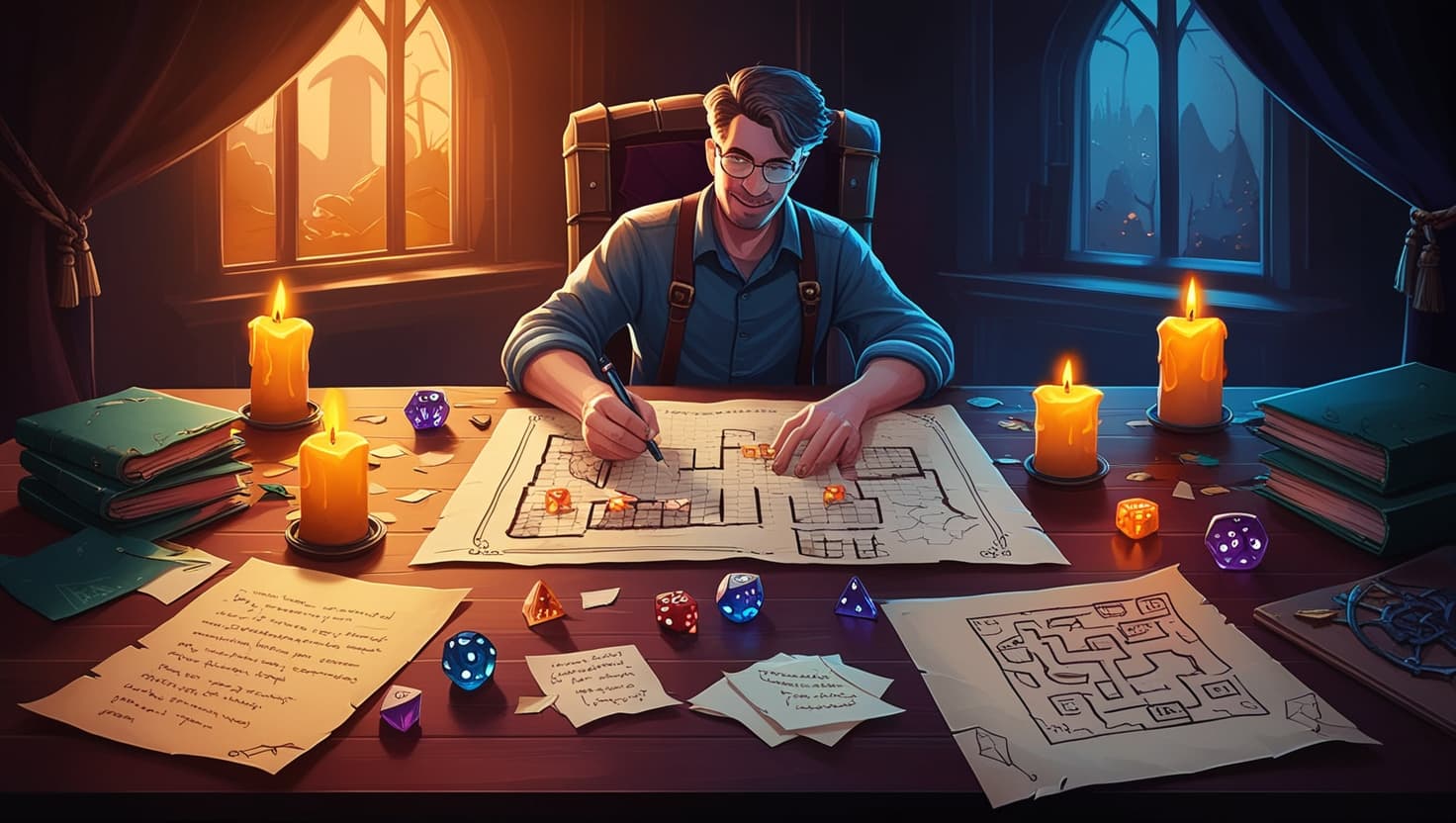
I ran my first session in college with zero prep, a printed copy of the basic rules, and a dungeon I drew on graph paper during a boring lecture. The players fought three goblins, one of them died (the player, not the goblin - TPK at level 1), and everyone wanted to play again the next week. It was objectively bad. It was also one of the best nights of that semester.
Your first session doesn't need to be good. It needs to exist.
What a Game Master Actually Does
There's this idea floating around that GMing means having the entire Monster Manual memorized, doing professional voice acting for every NPC, and crafting a 200-page campaign setting before session one. That's absurd. Some GMs do those things after running games for fifteen years. None of them started there.
A GM does three things:
- Describes what's happening. "You walk into a tavern. It smells like wet dog and cheap ale. A dwarf at the bar is arguing with the bartender about his tab."
- Asks what you do. Then shuts up and listens.
- Decides what happens next. Based on what the players said, the dice results, and whatever feels right.
That's the whole job. Everything else - voices, music, elaborate maps, 40-page backstories for the innkeeper - is decoration. Nice decoration, but optional.
The rules exist to help arbitrate edge cases. "Can I jump across the chasm?" Well, how wide is it? How strong are you? Roll an Athletics check, DC 15. If the number's high enough, you make it. If not, you're hanging off the edge by your fingernails. You don't need to know every rule. You need to know how to say "roll a d20 and add your modifier" and look up the rest when it comes up.
Keep the Player's Handbook or a free rules reference open on your phone. When you don't know a rule, check it quickly or make a ruling on the spot and look it up after the session. Both are valid approaches.
How to DM for the First Time: Prep Your First Session
The number one killer of first-time GMs isn't bad improv or forgotten rules. It's over-preparation. You spend three weeks building a world, writing NPC dialogue trees, mapping every room in a dungeon, and burn out before you ever sit down to play.
Here's what you actually need:
A starting location. A tavern, a village square, a prison cell, a merchant caravan. One place where the players begin.
One NPC with a problem. A mayor whose mines are overrun with kobolds. A merchant whose daughter went missing on the road to Neverwinter. A tavern owner who keeps hearing scratching sounds from the basement. That's your hook.
One combat encounter. Pick something from the encounter calculator for your party's level. For a level-1 group of four, something like four or five goblins or a single bugbear is plenty. You can find pre-built stat blocks in the free Basic Rules - you don't need the full Monster Manual yet.
A rough idea of where the story goes. Not a plot. Not an outline. Just a direction. "The kobolds in the mines are being controlled by a young green dragon" gives you enough to improvise for three sessions. You don't need more than that. If you plan to include loot, our magic items guide for beginners covers which items work best at low levels without breaking your game.
If you'd rather run a published adventure than build your own, our best D&D modules for beginners guide ranks the ones designed specifically for first-time GMs.
Spend 30 to 60 minutes on this. Maybe an hour if you want to draw a simple map. That's it. When I ran sessions using StoryRoll's AI Game Master, I started paying attention to how it structured openings - it drops the party into a scene with a clear problem within the first two minutes. No elaborate setup. No 20-minute lore dump. Problem, then action. Steal that approach for your own table.
Running Combat Without Panic
Combat is the part that scares most first-time GMs, because it's where the rules feel heaviest. Initiative, attack rolls, damage, saving throws, spell effects - it sounds like a lot of moving parts.
But combat in D&D 5e follows a simple loop, and once you internalize it, the rest is details.
The loop:
- Everyone rolls initiative (d20 + Dexterity modifier). Write down the order.
- On each creature's turn: move, take an action, maybe a bonus action.
- Attacking? Roll d20 + attack modifier. If it meets or beats the target's AC, roll damage.
- Repeat until one side is dead, surrendered, or running.
That's it. An initiative tracker helps keep things moving so you're not constantly asking "whose turn is it?"
For your first combat, keep it simple. No environmental hazards, no legendary actions, no spellcaster enemies. Just melee creatures with straightforward stat blocks. Goblins are perfect - they have a decent AC (15 with their shield), low HP (7), and their only trick is Nimble Escape, which lets them disengage or hide as a bonus action. That gives your players enough to deal with without overwhelming you.
When in doubt, ask for a d20. Player wants to shove an enemy off a cliff? d20. Wants to swing from a chandelier? d20. Doesn't matter if there's no official rule for it - pick a DC (10 for easy, 15 for moderate, 20 for hard) and let the dice decide. Our DC setting guide has a full breakdown of when to use each threshold. You can always look up the "correct" ruling later. For a deeper walkthrough, check our combat guide.
Three Things That Trip Up New GMs in Combat
Forgetting to track enemy HP. Write it down. On paper, on your phone, wherever. When a goblin takes 8 damage, cross out 7 and write -1 next to its name. Crude, effective.
Making combat too easy or too hard. The first time I ran a combat encounter, I threw six wolves at three level-1 characters because "it's a wolf pack, wolves travel in packs." Two characters dropped in round one. Use an encounter balancing guide, our encounter building tips, and our XP calculation guide for your first few sessions until you develop the instinct.
Letting turns drag. If a player's been thinking for 30 seconds and can't decide, say "Astrid, the goblin is lunging at you - what do you do?" A gentle time pressure keeps the energy up. But don't be a jerk about it, especially with newer players who are still learning their character sheets.
Handling NPCs and Improv
You don't need to be a voice actor. You don't even need to do accents. I know a GM who's been running games for a decade and every single NPC sounds exactly like him, just with different attitudes. His gruff dwarf blacksmith talks like him, annoyed. His elven diplomat talks like him, bored. It works fine.
What matters with NPCs is that each one wants something. The tavern keeper wants to close early and go home. The guard wants to seem important. The shopkeeper wants to upsell you on a health potion you don't need. That want drives how they respond to the players, and it's way easier to improvise when you know what a character is after.
Use an NPC name generator to have a list of 10-15 names ready. Players will talk to people you didn't plan for. When they walk up to a random market vendor and start a conversation, glance at your list, pick a name, and decide what that person wants. "Mirabel. She's trying to sell counterfeit healing potions and she's nervous about it." You just created an NPC in five seconds.
The Improv Toolkit
You don't need improv training. You need three phrases:
- "Yes, and..." - The player's idea works, and it creates a new situation. "Can I climb the chandelier?" "Yes, and as you swing from it, you can see the hidden door behind the tapestry."
- "Yes, but..." - The player's idea works, but with a cost or complication. "Can I persuade the guard to let us through?" "Roll Persuasion. You got a 14? He lets you through, but he's going to follow you."
- "No, but..." - The player's idea doesn't work, but something else happens. "Can I punch through the stone wall?" "No, but you notice the mortar is crumbling near the floor. You could dig through with a tool."
Avoid just saying "no." That kills momentum faster than anything. Even if the request is ridiculous, give the player something to work with. The guide on creating memorable NPCs goes deeper on this, but the short version is: NPCs exist to react to players, not to deliver monologues.
Common First-Time GM Mistakes (and How to Avoid Them)
I've made most of these. So has every GM you admire.
Over-prepping. Already covered this, but it's so common it's worth repeating. A first session needs a starting point, a problem, and a fight. Not a world bible.
Saying no too often. A player tries something creative and you shut it down because it's "not in the rules." The rules are a framework, not a cage. If it sounds cool and makes sense in the fiction, let them roll for it.
Railroading. You have a plan. The players go left instead of right. You panic and steer them back to your plan. Don't do this. Let them go left. Figure out what's to the left. Maybe it's something better than what you planned. And if you wrote three pages of dialogue for the NPC they were "supposed" to talk to, that NPC can show up somewhere else later. Nothing is wasted, it's just rescheduled.
Trying to be Matt Mercer. Critical Role is a produced show run by professional voice actors. Comparing your first session to Critical Role is like comparing your first painting to the Mona Lisa. Run your game. Your players are there because they want to play with you, not a YouTube celebrity.
Not asking your players what they want. Before your first session, ask: "Do you want heavy combat, exploration, or roleplay? How do you feel about character death? Any topics you'd rather avoid?" This is what a session zero is for, and it takes 20 minutes. Our session zero checklist has the full list of questions, but even asking three or four of the big ones will save you headaches.
Making it a one-person show. New GMs sometimes talk for 10 minutes straight describing a scene, then ask the players what they do. Flip that. Describe the scene in 2-3 sentences, then immediately ask a player a question. "Kael, you notice the statue's eyes are glowing. What do you do?" Pull people in. D&D is a conversation, not a lecture.
- Prep 30-60 min max - starting location, one NPC problem, one combat encounter
- DC cheat sheet - Easy: 10, Medium: 15, Hard: 20
- NPC secret - every NPC wants something, even minor ones
- Combat loop - initiative, move, action, damage, next turn. Know your conditions
- When lost - ask a player "what do you do?" and riff off their answer
- Rule disputes - make a quick ruling now, look it up after the session
Use an AI Game Master as Training Wheels
If the idea of running a full session still feels like too much, there's a middle step that didn't exist a couple years ago.
AI Game Master platforms run the game for you. You show up as a player, the AI handles narration, combat rules, NPC dialogue, dice mechanics - everything a GM normally does. It's not meant to replace human GMs (a human GM who knows your group will always have an edge). But it's a surprisingly useful way to learn the rhythm of a session before you run one yourself.
I spent about 20 sessions playing through StoryRoll campaigns before I noticed I was unconsciously absorbing GM patterns. How to pace a combat encounter so it doesn't drag. When to cut a scene and jump to the next one. How to hook players into a quest without a five-minute monologue. The AI runs through campaign setups at a pace that lets you see dozens of different openings, hooks, and encounter structures in the time it'd take to prep a single homebrew session.
It's also zero-stakes practice. You can't disappoint an AI's expectations, and if a combat goes sideways, you just start another campaign. That kind of low-pressure repetition builds confidence fast - the same way scrimmaging builds more skills than reading a coaching textbook.
And if your group can't find a GM at all? An AI Game Master lets you play tonight instead of waiting for someone to volunteer. Sometimes the best prep for your first session is just playing more D&D, however you can get it.
For a fuller comparison of AI GM tools, we covered the current options in our best AI tools for D&D roundup. And if you're curious about how AI compares to a human behind the screen, the AI vs. human GM breakdown is worth a read.
You're More Ready Than You Think
The secret that experienced GMs won't always tell you: most sessions are held together with duct tape and improvisation. That polished-looking game your friend runs? They forgot to prep the second half and made it up on the spot. The GM whose NPCs seem so alive? They recycled a character from a TV show they watched that week. Nobody has it all figured out.
Your players don't need perfection. They need someone willing to sit behind the screen and say "you walk into a tavern - what do you do?"
Be that person. The rest comes with practice.
Ready to see how a GM runs a session? Try a StoryRoll campaign and watch how the AI Game Master paces encounters, introduces NPCs, and handles player choices. Then steal everything that works for your own table.
Running your first game as a GM is simpler than the internet makes it sound. Prep a starting location, one problem, and one fight. Use "yes, and" more than "no." Keep combat simple. Ask your players what they want. And don't compare your first session to anyone else's hundredth. The better GM guide has more advanced techniques for when you're ready, but right now? You already know enough to start. Grab some dice, open a free rules PDF, and tell your friends you're running a game this weekend.
Written by Anthony Goodman
Founder of StoryRoll. Building AI-powered tabletop RPGs.
Related Posts
D&D Encounter Balancing Guide for New Game Masters
CR math alone won't save your encounters. This guide covers everything new GMs need to know about balancing D&D 5e encounters - from XP budgets and action economy to reading your table and adjusting mid-fight.
D&D 5e Conditions Explained: A Complete Guide
Every D&D 5e condition explained in plain language - what they do mechanically, how they interact, and practical tips for Game Masters who want to use them well.
D&D Campaign Ideas for New GMs: 12 Premises You Can Run Tonight
Twelve D&D campaign ideas organized by difficulty, each with a hook, setting, key NPCs, and a session 1 outline. Built for new GMs who want to stop prepping and start playing.