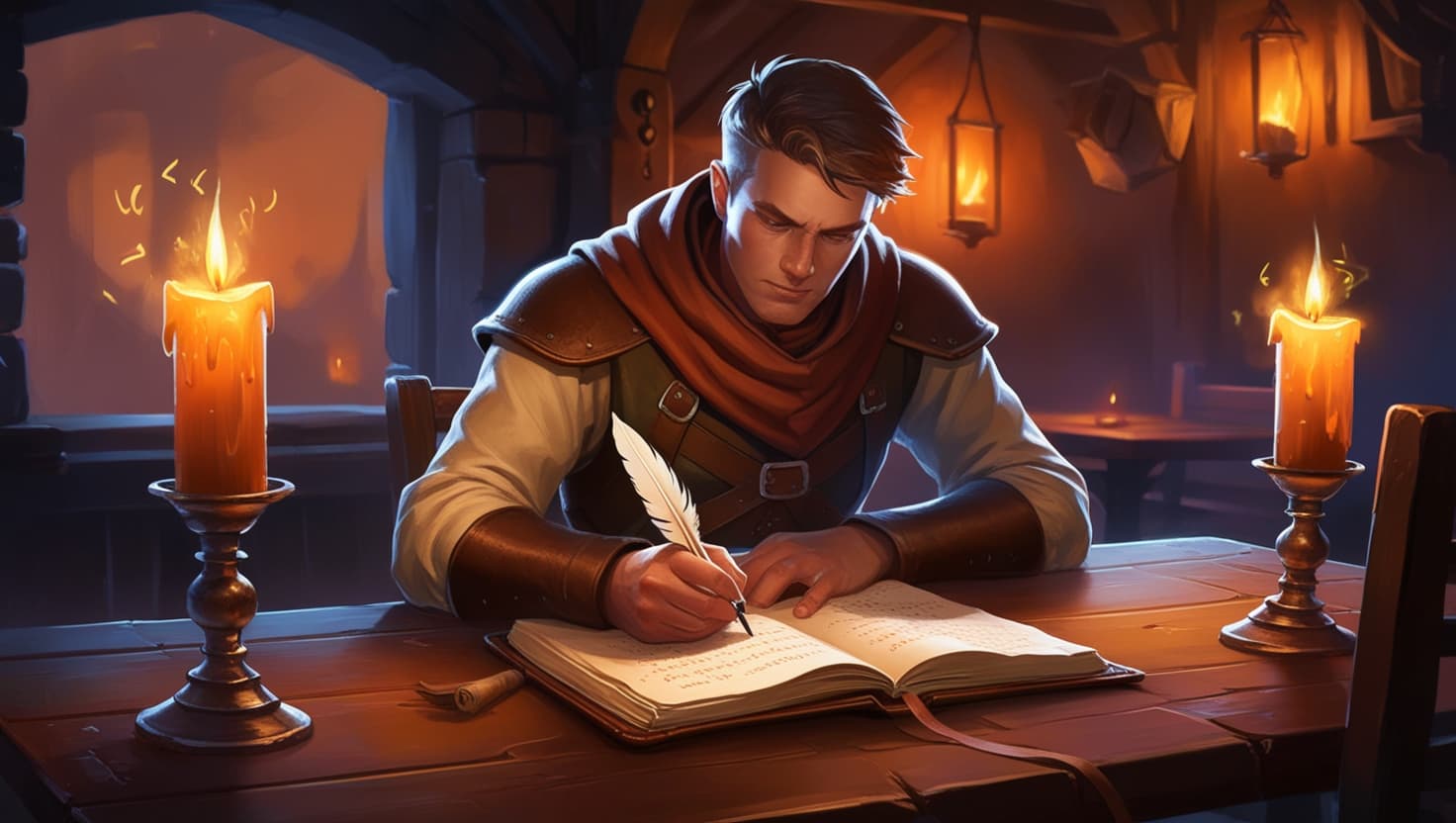
How to Write a D&D Character Backstory That Your DM Will Actually Use
I once played with a guy who handed the DM a twelve-page backstory. Single-spaced. It had a family tree. The DM read the first page, skimmed the rest, and used exactly none of it for the entire campaign. Meanwhile, the player next to him wrote "orphan rogue, hates authority" on an index card, and the DM built three sessions around it.
The length wasn't the problem. The usability was.
A D&D character backstory - the narrative history you create for your player character before a campaign begins - isn't a short story you write for yourself. It's a collaboration tool. It tells your Dungeon Master who your character is, what they care about, and where the interesting story hooks live. The best backstories aren't the longest or the most dramatic. They're the ones that give everyone at the table something to play with.
Here's how to write one that actually works.
What a D&D Character Backstory Needs to Do
Before you start writing, understand what a backstory is for. It serves three functions:
- It grounds your roleplay. When your character faces a decision, the backstory tells you how they'd react. Not because you memorized their trauma - because you understand their worldview.
- It gives the DM hooks. NPCs to bring back, locations to revisit, enemies with grudges. These are gifts to your DM.
- It connects you to the party. Even if you don't know the other PCs yet, a backstory with open threads makes it easier to weave characters together.
That's it. If your backstory accomplishes those three things in four sentences, you're ahead of the person who wrote a novella.
The One-Page Rule (And Why It Works)
Keep your backstory to one page. Maybe a page and a half if you're really cooking. This isn't arbitrary - it's practical.
DMs are juggling plots, NPCs, encounter balance, and their own notes. A concise backstory gets read, internalized, and used. A long one gets filed. Most experienced DMs on r/DMAcademy will tell you the same thing: they want backstories they can scan in two minutes and pull from all campaign.
One page forces you to prioritize. What's the core of this character? What are the two or three details that actually matter? Everything else is flavor you can reveal through play - which is more fun anyway.
Write the full backstory if it helps you understand your character. Then cut it down to one page for your DM. Keep the long version for yourself as a roleplay reference.
The Three-Hook Method
Every backstory should contain at least three hooks - loose threads the DM can pull on during the campaign. A hook is any unresolved element: a person, a place, an event, a mystery.
Good hooks:
- A mentor who disappeared under suspicious circumstances
- A debt owed to someone powerful
- A hometown the character can't go back to (and the reason why)
- A sibling who joined an opposing faction
- An item with unknown origins
Bad hooks (too closed):
- "My parents were killed by orcs" (resolved, no thread to pull)
- "I trained at a monastery for ten years" (static, nothing unresolved)
- "I want revenge on the man who wronged me" (only one direction to go)
The trick is leaving things open. Your mentor disappeared - but you don't know why. You owe a debt - but you haven't decided to whom yet (let the DM fill that in). Your hometown is off-limits - but you've heard rumors things have changed.
Open hooks are invitations. Closed hooks are demands.
- Hook 1: A Person - Someone unresolved (missing mentor, estranged family, mysterious patron)
- Hook 2: A Place - Somewhere with pull (hometown in trouble, ruins you once explored, a city you're banned from)
- Hook 3: A Secret - Something the character hides or doesn't fully understand (unknown heritage, a promise they regret, a power they can't control)
Common Backstory Mistakes (And How to Fix Them)
The Lone Wolf With No Ties
"My character trusts no one and works alone." Cool. Why are they in a party? This is D&D's most common backstory problem, and it makes the DM's job harder while making your character less interesting.
Fix: You can be guarded without being a brick wall. Maybe your character was a loner but something forced them to need help. Maybe they don't trust easily but they're loyal once that trust is earned. Give the DM (and other players) a door to knock on.
The Chosen One
Your character is the last surviving member of a royal bloodline, wielding a legendary sword, destined to defeat an ancient evil. At level 1. With 8 hit points.
The problem isn't ambition - it's that you've front-loaded all the interesting stuff. If your character already has a legendary destiny, where do they go from here? The best backstories start small. You were a farmer, a soldier, a failed merchant. The legendary part happens during the campaign.
The Trauma Dump
Backstories built entirely on suffering - dead parents, destroyed villages, betrayal after betrayal - tend to create one-note characters. Tragedy works as one ingredient. As the whole dish, it gets exhausting.
Give your character something they love, not just things they've lost. A favorite food. A hobby. A person they write letters to. These small, human details do more for roleplay than another dead family member. Some races lend themselves to richer backstories than others - a Tiefling navigating prejudice over their infernal bloodline, for instance, has built-in conflict without needing a single dead relative.
The Lore Encyclopedia
Twelve paragraphs about the geopolitical history of your character's home kingdom. That the DM didn't write. And that contradicts the actual setting.
Rule of thumb: the more specific your worldbuilding, the less useful it is. Unless your DM asked you to flesh out a region, keep setting details vague and focus on your character's experience of the world. "I grew up in a port city where smuggling was an open secret" works in any setting. "I grew up in Valdremoth, a city founded in the Third Age by the Archmage Kelestrin after the Sundering of the Pale Coast" works in exactly one.
How to Write a D&D Character Backstory: Step by Step
Step 1: Start With a Feeling
Not a plot. Not a timeline. A feeling.
What's the emotional core of this character? Guilt? Curiosity? Defiance? Loneliness? Ambition they can't admit to? Start there and build outward. Characters driven by a core emotion are easier to roleplay consistently and more interesting to watch.
Step 2: Pick One Defining Event
Something happened that sent your character on the path to adventuring. One event. Not a sequence of tragedies - a single turning point.
Maybe they witnessed something they shouldn't have. Maybe they failed someone and can't let it go. Maybe the tavern they worked at burned down and they had nothing left to lose. Whatever it is, make it specific and make it personal.
Step 3: Add Your Three Hooks
Refer back to the three-hook method. Weave them into the backstory naturally. You don't need to explain each one in detail - in fact, leaving them slightly vague is better. If you need a walkthrough of what this looks like in practice, our companion guide on how to create a D&D character backstory has worked examples for each hook type.
Step 4: Define One Relationship
At minimum, your character should have one NPC relationship the DM can use. A friend, a rival, a family member, a former employer. Give the DM a name, a brief description, and the nature of the relationship. That's enough.
Step 5: End With a Question
The backstory should end with your character at a crossroads. They don't have their life figured out - that's why they're adventuring. End with an unanswered question: Where did my mentor go? Can I ever go home? Am I the person I'm pretending to be?
This question becomes the through-line of your character's arc during the campaign.
A character backstory is an incomplete story on purpose. The campaign is where it gets finished. Leave room for your DM and fellow players to write the rest with you.
Backstory Templates That Work
Not everyone wants to write from scratch. Here are three structures that consistently produce usable backstories:
The Before-and-After: Two paragraphs. First: who your character was before the defining event. Second: who they are now and why they're adventuring. Simple, effective, DM-friendly. If you want more starting points, our backstory ideas guide has dozens of prompts organized by class and theme.
The Letter: Write your backstory as a letter your character sends to someone - a friend, a parent, a former mentor. The format naturally creates voice, reveals relationships, and implies things left unsaid.
The Three Bullets: For the minimalists. Three bullet points: (1) where you're from and what you did, (2) what happened that changed everything, (3) what you want now. Some DMs genuinely prefer this. Ask yours.
Using AI to Develop Your Character Backstory
AI tools have gotten useful for backstory development. Not as a replacement for your creativity - but as a brainstorming partner that doesn't get tired at 1 AM.
ChatGPT and similar LLMs can help you flesh out details, generate NPC names, and pressure-test your backstory for plot holes. But there's a gap between "chatbot that answers questions" and "tool that understands your character in context."
That's where purpose-built tools come in. StoryRoll, for example, functions as an AI Dungeon Master that tracks your character's backstory, motivations, and relationships across sessions. When you play through StoryRoll, your backstory isn't just flavor text you wrote once - it's active material the AI weaves into encounters, NPC reactions, and story beats.
The practical difference: if your backstory mentions a mentor who disappeared, a general-purpose AI won't remember that in session 5. A dedicated tool will, and it might introduce a letter from that mentor at exactly the right dramatic moment.
For backstory creation specifically, you can use AI to:
- Generate three backstory options based on your class and a core emotion
- Create NPC names and personalities for your hooks
- Roleplay a "session zero" conversation to discover your character's voice
- Stress-test your backstory by asking "what would this character do if..."
AI-generated backstories tend to be generic if you accept the first draft. Use AI as a starting point, then add the weird, specific details that make a character yours. The AI won't suggest that your wizard has a fear of horses or collects bad poetry - that's on you.
What DMs Actually Want From Your Backstory
I asked around. Talked to DMs on Reddit, in Discord servers, at local game stores. The consensus was remarkably consistent.
They want:
- Names they can use (NPCs, places)
- Conflicts that aren't resolved
- A reason your character would stick with the party
- Enough personality to roleplay off of
- Brevity
They don't want:
- Main character syndrome
- Contradictions with the setting they built
- Backstories that require the campaign to revolve around one PC
- Twelve pages
One DM on r/DMAcademy put it perfectly: "Give me a paragraph I can use and a question I can answer through the campaign. That's the whole job."
How to Write a D&D Character Backstory for Your First Character
If this is your first time playing D&D, keep it dead simple. You don't need hooks or narrative structure. You need three things:
- What did your character do before adventuring? (A job, a role, a situation)
- Why did they leave that life?
- What do they want?
That's a backstory. Fill those in and you're set. You'll figure out the rest through play, and honestly, the backstories that emerge from actual sessions are usually better than anything you'd pre-write.
Don't overthink it. Your first character's backstory is a rough draft. The campaign is the revision.
For more on making your backstory fit the world, see our worldbuilding guide. If you're a DM looking for ways to weave backstories into campaign arcs, or wondering how DMs can use backstories better, we've got you covered.
Frequently Asked Questions
How long should a D&D character backstory be?
One page is the sweet spot for most campaigns. DMs generally prefer concise backstories they can reference quickly. Write as much as you want for your own use, but give your DM a condensed version - one page of text, or three to five focused paragraphs. The goal is usability, not word count.
Can I change my backstory after the campaign starts?
Most DMs allow minor adjustments in the first few sessions, especially for new players still finding their character's voice. Major retcons get harder once the DM has built plot threads around your backstory. If something isn't working, talk to your DM early - they'd rather adjust than have you stuck with a character you don't enjoy playing.
Should I coordinate my backstory with other players?
If possible, yes. Shared history between PCs - even something small like "we met once at a tavern in Neverwinter" - gives the party an immediate reason to trust each other. Session zero is the ideal time for this. But it's not mandatory. Plenty of great campaigns start with strangers who become a party through play.
What if my DM doesn't use backstories?
Some DMs run published adventures or dungeon crawls where backstories take a back seat. That's fine. A backstory still helps you roleplay consistently, even if the DM doesn't weave it into the plot. And you might be surprised - most DMs will use a good hook if you hand them one, even if they didn't plan to.
A D&D character backstory doesn't need to be long, dramatic, or literary. It needs to be usable. One page, three hooks, one defining event, and a question that the campaign can answer. Write for your DM as much as you write for yourself. Leave gaps. Stay open. The best character moments aren't the ones you pre-wrote - they're the ones that happen because you gave everyone at the table something to build on. And if you want a tool that actually remembers your backstory and uses it in play, StoryRoll is built for exactly that.
Free tools: Character Backstory Generator · NPC Name Generator
Related guides: Creating Memorable NPCs · How to Be a Better GM · Best D&D Class for Beginners
Written by Anthony Goodman
Founder of StoryRoll. Building AI-powered tabletop RPGs.
Related Posts
20 D&D Character Backstory Ideas That Your GM Will Love
Staring at a blank character sheet? These 20 backstory ideas give you a jumping-off point your GM can actually use - organized by archetype, with class suggestions and built-in plot hooks.
D&D Character Sheet Guide for Beginners: Every Section Explained
The D&D 5e character sheet looks like a tax form designed by a wizard. Here's what every box actually means, which ones matter most, and the mistakes that trip up every new player.
How to Build a D&D Character in 2026: Complete Beginner's Guide
Building your first D&D character doesn't have to be intimidating. This step-by-step guide walks you through race, class, ability scores, background, equipment, and personality, everything you need to show up ready to play.