AI Tabletop RPGs Need More Than a Chatbot in a Cloak
An AI tabletop RPG is not just a chatbot that says "you enter a tavern" with more candle smoke.
That trick worked for about ten minutes in 2023. It was fun, strange, and occasionally impressive. You could ask ChatGPT to run a fantasy adventure and it would invent a barkeep, a missing heirloom, and a suspicious hooded stranger because apparently every tavern in the multiverse has one.
But D&D is not just fantasy prose. Tabletop roleplaying has rules, turns, constraints, memory, social pacing, character identity, and consequences. If the AI ignores all of that, you are prompting a fantasy story generator.
Those can be entertaining. They are not the same thing.
The difference matters now because the category is getting crowded. AI Dungeon, ChatGPT, Character.AI, Friends & Fables, AI Realm, RoleForge, DungeonsDeep, Everwhere, Macer, and StoryRoll all sit somewhere near the same search results, but they do not solve the same problem.
Some are storytelling toys. Some are DM prep assistants. Some are worldbuilding tools. Some are trying to run the actual game.
Only the last group should be judged like tabletop RPGs.
An AI Tabletop RPG Needs Rules, Not Just Vibes
The easiest way to fake D&D is to write like D&D.
Dark corridor. Ancient runes. Goblin laughter. Roll for initiative.
That gets the mood right. It does not make the game work.
D&D becomes D&D when choices interact with rules. A rogue uses Cunning Action because bonus actions matter. A wizard saves Shield because reactions matter. A fighter shoves a cultist off a ledge because positioning matters. A cleric casts Bless, then panics when concentration breaks.
If the AI treats all of those as interchangeable story flourishes, the game loses its teeth.
The game needs enough rules structure to preserve the difference between:
- a hit and a miss
- a spell slot and a free narration button
- being unconscious and being mildly inconvenienced
- a goblin with 7 HP and an ogre with 59 HP
- a clever plan and a consequence-free monologue
This does not mean every AI RPG needs to become a rules lawyer wearing a server rack. Nobody wants the AI to pause every scene so it can cite chapter and verse from the Player's Handbook.
But rules are not decoration. They are what make choices costly.
If an AI lets every cool idea work because the prose sounds good, it is not respecting player agency. It is flattening it.
An AI Tabletop RPG Needs Memory That Survives the Scene
Short-term AI memory can feel magical.
The model remembers the NPC's name for five minutes. It recalls that your bard insulted the duke. It keeps the dungeon door locked after you failed the check. Great.
Then the session gets longer.
The duke becomes a baron. The locked door quietly unlocks. The bard's insult turns into a compliment. The AI forgets that the ranger adopted the wolf, then invents a second wolf because apparently the forest is running a loyalty program.
Campaigns need continuity. Not perfect continuity, because human DMs forget things too. But enough continuity that players trust the world.
The system should remember:
- who the characters are
- what they want
- what happened last session
- which NPCs matter
- which enemies survived
- what promises were made
- what resources were spent
StoryRoll's campaign memory work matters because memory is not a nice-to-have feature. It is the difference between a campaign and a pile of disconnected fantasy scenes.
Players can forgive a weird sentence. They are less forgiving when the AI forgets the villain they have been chasing for three sessions.
An AI Tabletop RPG Needs Dice With Consequences
Dice are not there because people like plastic math rocks.
Okay, partly. D&D players do like plastic math rocks.
But dice do something important: they take control away from everyone at the table for a second. The DM does not decide whether the paladin lands the last hit on the vampire spawn. The player does not decide whether the deception works. The die decides, then the table deals with it.
That moment is central to tabletop play.
A weak AI game master will ask for rolls and then ignore them. The player rolls a 4 on Persuasion, and the guard still lets them pass because the story wanted to move forward. The rogue rolls a natural 1 on stealth, and the AI says they "barely succeed." The fighter misses three attacks, so the AI quietly gives them a cinematic hit to keep morale up.
That is not kindness. It is sandblasting the game into mush.
The dice need to matter. Failure should not always mean "nothing happens," but it should change the situation. A failed lockpick check can attract a patrol. A failed Arcana check can give incomplete information. A failed death save can make everyone sit up straighter.
In StoryRoll combat tests, the best moments usually came from constrained outcomes, not perfect success. A bad roll forced a retreat. A missed opportunity attack let the necromancer escape. A failed concentration check turned an easy fight into a problem.
The dice made the story better because they were allowed to be rude.
An AI Tabletop RPG Needs Characters, Not Just Inputs
Chatbots are good at responding to text.
Tabletop RPGs need more than response. They need character identity.
Your barbarian is not just "the user says attack." They have Strength, AC, rage uses, hit points, inventory, flaws, bonds, and maybe a cursed axe they absolutely should have thrown into a volcano three sessions ago.
The AI has to understand those things well enough to make the session feel grounded. If the paladin and wizard are functionally identical because both can type any action into a box, character choice stops mattering.
This is one reason purpose-built RPG tools have an advantage over general chatbots. They can connect the narrative layer to a character layer:
- class abilities
- spell lists
- equipment
- hit points
- conditions
- death saves
- proficiencies
- campaign notes
That does not remove creativity. It gives creativity a shape.
A Moon Druid solving a problem with Wild Shape should feel different from a Rogue using Expertise or a Warlock leaning on Eldritch Blast and a terrible patron relationship. The AI should not just say "cool, that works" to all three.
- Chatbot: responds to whatever the player types.
- Story engine: keeps narrative momentum and tone.
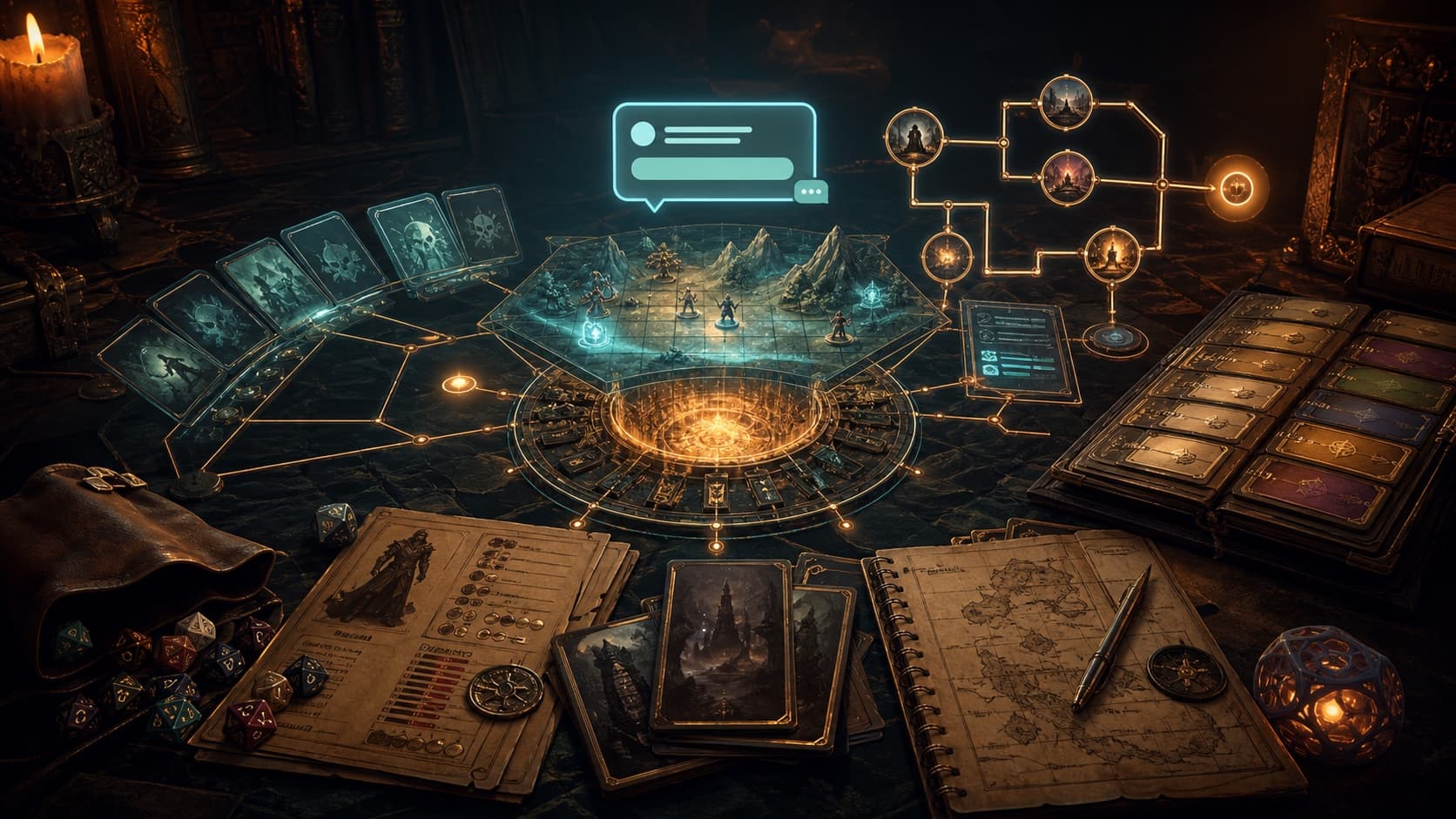
- AI tabletop RPG: connects story to characters, rules, rolls, and consequences.
An AI Tabletop RPG Needs Multiplayer Pacing
Solo AI roleplay is forgiving. If the pacing gets weird, only one person is waiting.
Multiplayer is less patient.
The AI has to manage attention. It needs to keep turns moving. It needs to give quiet players openings. It needs to avoid trapping one player in a ten-minute dialogue while everyone else watches the tavern wall. It needs to resolve combat without turning every goblin into a paragraph.
This is where "AI DM" becomes a harder problem than "AI story generator."
At a real table, the DM is constantly doing invisible pacing work:
- compressing travel
- cutting dead air
- summarizing repeated attempts
- rotating spotlight
- ending scenes before they sag
- noticing when combat is already decided
The AI has to learn those habits or the session becomes technically functional and emotionally dead.
StoryRoll's fastest sessions tend to work when the AI keeps the next meaningful choice close. Not endless lore. Not five screens of room description. A situation, a pressure point, and a decision.
That is the heartbeat of tabletop play.
The Best AI Tabletop RPGs Will Be Less Impressive Than You Think
The flashiest AI demo is usually the least important one.
Beautiful prose is nice. Voice narration is cool. AI art can make a session feel alive. All of that helps.
But the best tools in this category will win on boring reliability:
- the campaign remembers what happened
- the dice matter
- combat does not drift
- characters feel distinct
- players know what they can do next
- the AI says no when no is the right answer
That last one is underrated.
Good DMs say no all the time. Not to be controlling, but to protect the game. No, you cannot cast Fireball through three walls. No, the shopkeeper will not trade a rare magic item for vibes. No, the dead NPC cannot answer one more question unless you prepared Speak with Dead.
AI tools are often trained to be agreeable. Tabletop RPGs need friction. Not hostile friction. Useful friction. The kind that makes success feel earned.
If the AI cannot say no, it cannot make yes matter.
Where This Leaves StoryRoll
StoryRoll should not try to win by claiming AI makes everything better.
It does not.
The better promise is narrower: StoryRoll helps people play when the usual tabletop setup breaks. No Game Master. No prep time. No confidence. No stable schedule. No appetite for configuring a VTT before the first goblin appears.
That means the product has to be judged on session reality, not demo sparkle. Can players start quickly? Does the AI keep momentum? Do rules matter enough? Does multiplayer feel possible? Does the campaign remember? Do players leave with a story they want to continue?
That is the bar.
An AI tabletop RPG is not a chatbot in a cloak. It is a game system with an AI at the center. The sooner the category admits that, the better the sessions get.
An AI tabletop RPG needs more than fantasy narration. It needs rules, memory, dice, character state, multiplayer pacing, and the discipline to let consequences stand. If the AI can only describe a campaign, it is a story generator. If it can run one, then you have something closer to a table.
Frequently Asked Questions
What is an AI tabletop RPG?
An AI tabletop RPG is a roleplaying game where AI helps run or fully runs the session. The stronger versions handle narration, rules, dice, characters, combat, state tracking, and campaign continuity instead of only generating story text.
Is ChatGPT an AI tabletop RPG?
ChatGPT can imitate a game master, but it is not a complete AI tabletop RPG by itself. It lacks built-in dice, character sheets, combat state, campaign memory, and multiplayer structure unless the player manually supplies all of that.
How is an AI tabletop RPG different from AI Dungeon?
AI Dungeon is built around freeform interactive fiction. An AI tabletop RPG needs stronger game structure: rolls, character abilities, rules, consequences, persistent memory, and support for tabletop-style play.
Can an AI tabletop RPG run D&D?
Yes, if it has enough structure to handle D&D-style mechanics like ability checks, initiative, hit points, spell limits, conditions, and character progression. A general chatbot can approximate this, but a purpose-built AI DM platform is better suited to it.
Who should try an AI tabletop RPG?
AI tabletop RPGs are strongest for solo players, groups without a DM, forever DMs who want to play, beginners who need a low-pressure first session, and tables that want backup sessions when the normal campaign falls through.
Written by StoryRoll
Founder of StoryRoll. Building AI-powered tabletop RPGs.
Related Posts
One Hour D&D Session: Stop Shrinking the Wrong Parts
A one hour D&D session can work, but not if you run a four-hour game faster. Cut setup, cap scenes, and keep the first choice close.
AI DM: What It Can Actually Run in D&D
An AI DM can run more than tavern banter, but not every part of D&D is equally ready. Here's what works, what breaks, and how to judge it.
D&D Campaign Notes: Stop Writing Recaps Nobody Uses
D&D campaign notes should help the next session start faster. Track decisions, debts, threats, and next moves instead of writing a novel.