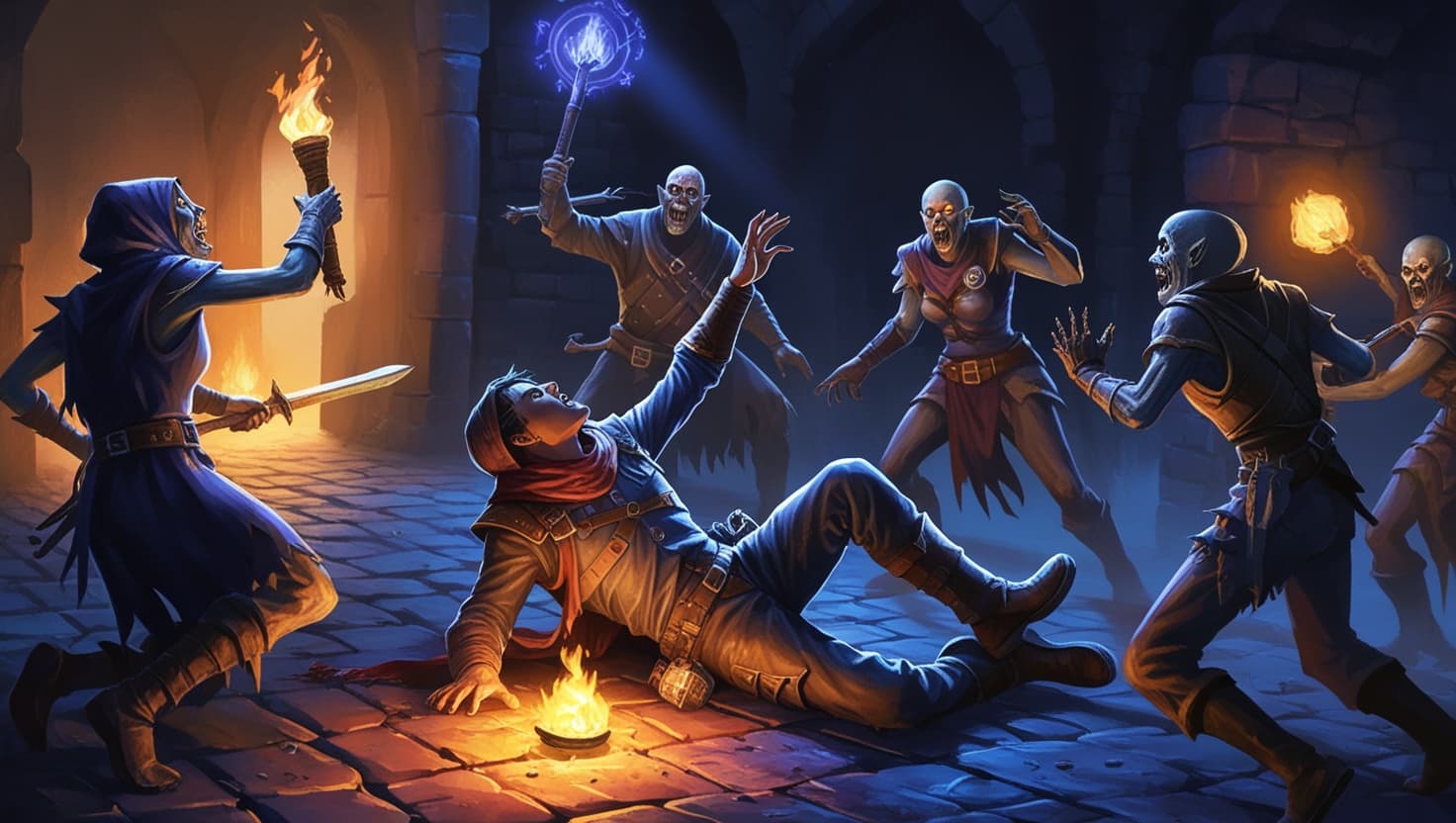
Death Saves 5e: Why Going Down Feels Too Safe
Death saves 5e are supposed to be the moment everyone at the table stops breathing for a second. The cleric glances at Healing Word. The paladin starts measuring movement. Somebody mutters, "Don't you dare roll a 1." Good rule. Good drama. Until you notice how often hitting 0 is just a brief nap with better lighting.
That is the problem with death saves 5e at a lot of tables. The tension is real the first few times. Then everybody learns the economy. A character drops. The enemies politely move on. A bonus action pops them back up. The fighter loses no action if the heal lands before their turn. The cleric spends a level 1 slot and the whole scare resets. After a while, going unconscious feels less like disaster and more like a weird crouch animation.
I do not think death saves 5e are broken. I do think most tables sand the danger off by accident. In StoryRoll combat tests, fights got much sharper the moment enemies treated downed characters as part of the battlefield instead of a protected cutscene state. A ghoul pack that kept pressing the unconscious bard forced very different choices than one that turned back to the front line out of habit. Same party. Same encounter budget. Way more panic.
Death Saves 5e Are Why Yo-Yo Healing Works So Well
This is the real engine under the rule.
Death saves 5e are generous because a creature at 0 hit points is not dead, is not out of the fight permanently, and often is not even losing its next turn. If the cleric, bard, druid, or Divine Soul Sorcerer can sneak in Healing Word before that creature's initiative comes up, the downed character stands up and keeps going.
That is why yo-yo healing dominates so many 5e tables. It is usually more efficient to let someone hit 0, then pick them up with a tiny heal, than it is to spend bigger resources trying to keep them comfortably above that threshold. A 7-point Cure Wounds before the hit and a 4-point Healing Word after the hit can function almost the same if the monster's damage was going to knock them down either way.
So the fight starts to run on a strange logic:
- damage until someone drops
- spend the cheapest possible heal
- get them standing again
- repeat until the encounter ends or someone rolls terribly
That pattern is not just common. It is rational under the rules.
And honestly, it makes some class features look sillier than they deserve. Relentless Endurance feels less special when everyone is doing a discount version of it with bonus action magic. Second Wind feels responsible and civilized, which is not a compliment in this economy.
The worst version of this shows up in parties with easy ranged rescue buttons. A Life Cleric with Healing Word, a bard with Mass Healing Word, or a druid who can spare one spell slot to keep the barbarian bouncing all turn can make death saves 5e feel like background noise instead of a crisis.
StoryRoll surfaced this fast in repeated small-party tests. When the AI played enemies as if downed PCs were off-limits, the safest frontline pattern was often "eat the hit, drop, get picked up, swing again." When the AI started checking whether a wolf, wight, or cult fanatic had a reason to finish the target or threaten the healer, those same fights stopped feeling cute.
If your table treats 0 hit points as a safe waiting room, death saves 5e will always feel softer than the designers probably intended.
Death Saves 5e Stop Feeling Scary When Enemies Never Press the Advantage
This is where table culture matters more than the text.
Death saves 5e only create real fear if failure can arrive before the rescue does. Rules-wise, that is absolutely possible. A melee hit against an unconscious creature from within 5 feet is an automatic critical hit. That means two failed death saves on one hit. If a ghoul drops the wizard, then claws them again on the next turn, that wizard is suddenly one bad roll from the grave.
But lots of DMs never do this.
Sometimes that is mercy. Sometimes it is tone. Sometimes it is the unspoken belief that attacking a downed PC is rude in the same way stealing fries off somebody else's plate is rude. Understandable. Also the reason death saves 5e can feel fake.
A monster does not need to behave like a sadist to pressure a fallen character. It just needs a reason.
A few good reasons:
- A hungry ghoul or zombie keeps mauling the body in front of it.
- A troll knows the target might stand back up unless it keeps tearing.
- A wight or vampire spawn is trying to finish prey, not politely rotate targets.
- A bandit captain sees the cleric reviving people and orders an execution.
- A mind flayer wants the stunned, helpless brain first. Fair. Horrifying, but fair.
That kind of pressure changes everything. Suddenly Spare the Dying matters. Suddenly the paladin actually uses Lay on Hands for more than post-fight cleanup. Suddenly body-blocking, dragging an ally, or burning Misty Step to reach the fallen sorcerer feels smart instead of melodramatic.
In one StoryRoll session, a troll dropped the ranger, then kept attacking because the room description had already established that it was feeding. The party had to choose between finishing the troll or forcing it off the body. They won, but the scene stuck because death saves 5e finally felt like they had teeth.
That is the key. The game gets better when downed characters still shape the board.
Death Saves 5e Make Initiative More Important Than Most Groups Realize
A lot of tables talk about death saves 5e like they are pure luck. They are not. Initiative order changes the whole risk profile.
If the cleric goes right after the fighter, a drop to 0 is often manageable. The heal comes in fast. The fighter loses almost nothing. If the fighter drops right after the cleric's turn, now the whole table has to survive a full round of danger before the rescue window comes back around.
That difference is massive.
It also changes how strong certain tools feel:
- Healing Word gets better when your healer acts before the downed ally.
- Revivify gets better in brutal, swingy combats where someone may die before the round comes back.
- A paladin with 5 points of Lay on Hands can matter more than a bigger heal if they are in the right spot at the right time.
- A familiar delivering the Help action does nothing here, which is funny until your wizard remembers that rules knowledge does not stabilize anyone.
This is also why death saves 5e punish reckless positioning harder than players think. If the rogue dashes thirty feet ahead, gets dropped by an ogre, and the healer is last in initiative behind two enemies, that is not just a hit point problem anymore. It is a sequencing problem.
Published adventures expose this pretty clearly. In Curse of Strahd, fights get ugly fast when distance, choke points, or terrain separate the rescuer from the body. In Lost Mine of Phandelver, early goblin and bugbear pressure can feel lethal less because the monsters are genius tacticians and more because low-level healing windows are thin.
Spicy take: the drama in death saves 5e comes from logistics more than dice. The dice just finish the sentence.
- Low danger: downed ally, healer acts next, enemies cannot reach the body
- Real danger: downed ally, healer already acted, melee enemy still adjacent
- High danger: two failed saves, no bonus action healing, body exposed to crits
- Best rescue tools: fast healing, forced movement, body blocking, killing the adjacent threat
- Most common mistake: assuming a fallen PC is safe because they are not dead yet
Death Saves 5e Feel Better When Going Down Still Costs the Party Something
I do not think the answer is rewriting the system every time a fighter hits the floor.
I do think tables should stop pretending death saves 5e need help from house rules before they need help from consequences. You can keep the printed rule and still make going unconscious matter.
A few ways to do that without turning the campaign into a funeral home:
First, play enemies like creatures with motives. Not every goblin should execute fallen PCs. Some absolutely should. Same with cultists, undead, beasts, or anything defending its lair.
Second, make positioning carry weight. If the sorcerer goes down in the open, rescuing them should cost movement, opportunity attacks, or an action that would have gone elsewhere.
Third, keep pressure on concentration and support. If the cleric holding Spirit Guardians is also the one responsible for emergency pickups, enemies should notice that. A lot of combat softness comes from letting the rescue caster operate without consequences.
Fourth, use the environment. Fire, collapsing bridges, rising water, webs, a room filling with necrotic fog - any of these make death saves 5e more urgent because the body itself is in danger even if the monster is busy.
StoryRoll handled this well in one cult-temple fight because the AI kept narrating the room as unstable. When the bard dropped near a spreading flame line, the party had to drag them out before even thinking about a heal. Same death save rules. Way more urgency.
And if you do want a house rule, keep it small. I would rather add one scar, one exhaustion-like penalty, or one narrative consequence after repeated knockdowns than rewrite the whole system into a spreadsheet. The goal is not to make characters die more often. The goal is to make going down stop feeling free.
You do not need to be cruel to make death saves 5e matter. You just need the world to keep moving after someone hits the floor.
Death Saves 5e Are Best When the Table Treats Them as a Turning Point
This is the version of the rule I actually like.
Death saves 5e work when they force a plan change.
The ranger drops. Now the wizard has to choose between Fireball and Dimension Door. The cleric has to decide whether the better play is Healing Word on the ranger or Hold Person on the assassin who is about to finish them. The barbarian has to choose between one more reckless swing and physically occupying the square that keeps the ghast off the body.
That is good combat. Messy, expensive, memorable combat.
What kills the drama is autopilot. If the answer is always "bonus action heal, carry on," then death saves 5e become a shallow resource tax. If the answer changes based on turn order, monster intent, distance, terrain, and what the rescue costs, now the rule is doing its job.
I think that is why the best 5e combats usually feature one downed character at the exact wrong moment. Not because failure is fun by itself. Because panic forces priorities into the open. You find out what the party actually values when somebody is bleeding out next to the objective.
That is also why StoryRoll's better combat logs feel more human. The AI is strongest when a downed PC causes the whole scene to pivot - not just when it announces, very helpfully, that someone should please roll a death save now.
Frequently Asked Questions
How do death saves 5e work?
When a creature drops to 0 hit points in 5e and is not killed outright, it makes a death saving throw at the start of each of its turns. Three successes means stable. Three failures means dead.
Do natural 20s matter on death saves 5e?
Yes. A natural 20 on death saves 5e restores 1 hit point immediately, while a natural 1 counts as two failed saves.
Can monsters attack downed characters in 5e?
Yes. Monsters can attack downed characters, and melee hits from within 5 feet against an unconscious target are automatic critical hits, which means two failed death saves per hit.
Why do death saves 5e create yo-yo healing?
Because a tiny heal after a character drops often restores them almost as effectively as a bigger preventive heal, especially if the rescue lands before that character's next turn.
How do you make death saves 5e feel dangerous without changing the rules?
Use motivated enemies, meaningful positioning, and environmental pressure so a downed character still affects the fight instead of becoming safely untouchable.
Death saves 5e are not too forgiving on paper. They feel too forgiving when tables treat unconscious characters like protected scenery and let bonus action healing erase every mistake. If you want the rule to land, keep the printed text and add real pressure - smarter enemy priorities, costlier rescues, and battlefields that do not pause for polite drama. Then hitting 0 feels like a turning point again, which is exactly what it should be.
Written by StoryRoll
Founder of StoryRoll. Building AI-powered tabletop RPGs.
Related Posts
Falling Damage 5e: The Cap Everyone Forgets
Falling damage 5e is 1d6 per 10 feet, capped at 20d6. Most tables remember the first half and forget the cap, the timing, and the prone landing.
Critical Hits in D&D 5e: The Rule Everyone Misremembers
A critical hit in D&D 5e doubles your damage dice, not your damage. Here's the rule most tables misremember, and what actually doubles on a crit.
Mounted Combat 5e: The Half-Page Rule Everyone Misplays
Mounted combat 5e fits on half a page, and most tables still get it backward: warhorses can't trample, and falling off is a real risk.