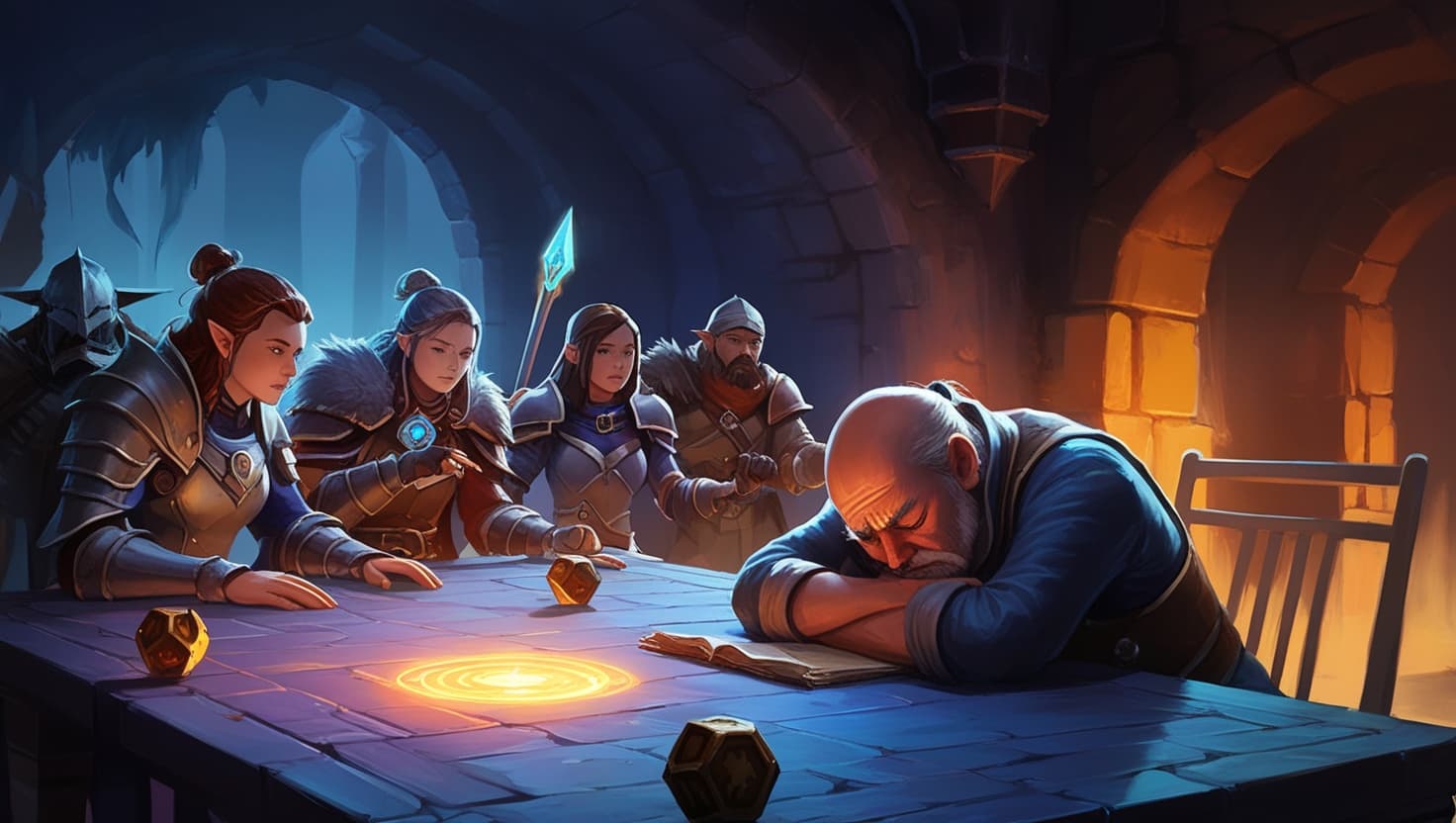
What Happens When Your DM Burns Out (And How Our Group Kept Playing)
Marcus was our DM for two years. He ran a homebrew campaign every Tuesday night without missing a week for the first eight months. Then he started cancelling. First once a month. Then every other week. Then three weeks in a row.
The last message he sent to the group chat was: "Hey guys. I love this game and I love you all but I need to step away. I'm completely fried. Sorry."
Nobody was mad. We all knew the signs. The prep was eating him alive - four to six hours a week minimum on top of a full-time job and a relationship. He'd started buying pre-made maps and encounter packs to save time, which helped for a while, but the creative energy of running a living world was the part he couldn't outsource.
Marcus didn't quit D&D because he stopped loving it. He quit because the game demanded more from him than from anyone else at the table, and nobody noticed until he was already empty.
This is the story of what our group did after Marcus left - every strategy we tried, what worked, what didn't, and the unexpected solution that saved the campaign.
The Silence
The first two weeks after Marcus quit, nobody said anything in the group chat. There's a specific kind of grief when a D&D campaign dies. You lose the story. You lose the weekly ritual. You lose the excuse to see each other.
We had four players: me, Sarah, Devon, and Kai. We'd been meeting every week for two years. Without the game, the group chat went from daily messages to nothing.
Week three, I texted: "So are we done, or what?"
That opened the floodgates.
Attempt 1: Rotating DMs
Devon suggested we take turns running one-shots. Everyone DMs one session, we rotate, nobody carries the full weight.
In theory, this distributes the workload. In practice, it exposed the exact problem that makes DM burnout so common: most people don't want to DM.
I ran the first session. I spent twelve hours prepping - partly because I'd never DMed before, partly because I wanted it to be good. It was okay. Not great. I was so focused on the mechanics that I forgot to make it fun.
Sarah ran the second session. She went full theater-kid on the roleplay, which was genuinely entertaining, but she admitted afterward that she'd had to cancel plans twice during the week to get the prep done.
Devon's session was solid. He used a pre-written one-shot and ran it efficiently. But he said he'd do it once - not regularly.
Kai never ran a session. He just didn't want to. Which is completely fair. Not everyone wants to or should DM.
The rotation died after three weeks. The prep problem wasn't solved - it was just distributed to people who hadn't signed up for it.
Attempt 2: Pre-Written Modules
I volunteered to run Curse of Strahd. It's a famous published adventure with everything written out - maps, NPCs, encounters, story beats. How hard could it be?
Hard. Very hard. Pre-written modules reduce world-building work but add a different burden: you need to read and internalize hundreds of pages of content, adapt it on the fly when players go off-script (which they will), and manage complex NPC networks that someone else designed.
I made it through six sessions. The group was having fun, but I was spending five hours a week reading ahead, re-reading encounters, cross-referencing NPC motivations, and watching YouTube guides on how to run specific chapters.
I understood Marcus now. Not because I hated it - parts of DMing are genuinely great - but because the ratio of work to play is brutal. Players show up and play for four hours. The DM works for ten.
I told the group I needed to stop. Nobody argued.
DM burnout isn't a failure. It's a structural problem. The game places dramatically unequal demands on one person. Until that asymmetry is addressed, burnout is the default outcome for most long-running campaigns.
Attempt 3: Hiring a DM
Sarah found StartPlaying.games - a marketplace for professional DMs. People who run games for a living. You pay per session, they handle everything.
We looked at the listings. The quality seemed high. Reviews were positive. Prices ranged from $15 to $25 per player per session.
For four players, that's $60 to $100 per session. At weekly cadence, $240 to $400 per month for the group.
Devon and Kai balked. Not because the service was bad - it seemed genuinely good - but because that's a significant recurring expense for a hobby. And we still had scheduling issues. Finding a time that worked for four players plus a stranger was somehow harder than when Marcus was running things.
We booked one session as a test. The DM was professional, well-prepared, and engaging. But it felt transactional in a way that our home game never had. Like eating at a restaurant versus cooking dinner with friends. The food might be better, but the experience is different.
We didn't book a second session. The group chat went quiet again.
Attempt 4: Switching Systems
Kai suggested we try a game that doesn't need a traditional DM. There are RPGs designed for this - Fiasco (collaborative storytelling), Dread (horror with a Jenga tower), and various "GM-less" or "GM-lite" systems.
We played Fiasco twice. It was fun in a chaotic, improv-comedy way. But it wasn't D&D. It didn't have the ongoing characters, the persistent world, the mechanical progression. We wanted our characters back. We wanted the story to continue.
The group chat went quiet again. This time for a month.
The Backup Plan
I don't remember who first mentioned AI Game Masters. I think Devon shared an article about AI tools for tabletop RPGs, and Sarah asked if any of them actually worked.
I was skeptical. I'd tried using ChatGPT as a makeshift DM before - in the early days when everyone was experimenting with AI for everything. It was a novelty at best. It couldn't track state, forgot the plot after a few exchanges, and had no concept of game mechanics. Using it felt like playing D&D with someone who had read the back cover of the Player's Handbook and was winging it.
But someone mentioned StoryRoll, and the description was different. Not a chatbot wearing a DM hat - an actual game platform with an AI Game Master built on real D&D 5e rules. Character creation. Inventory tracking. Combat with initiative and proper mechanics. Session continuity.
"Let's just try it," Sarah said. "What's the worst that happens?"
The First Session
We recreated our characters from Marcus's campaign. Not the same story - that belonged to Marcus - but the same characters, starting a new adventure.
The AI did something I didn't expect: it asked us about our characters' relationships with each other before the game started. Not just "what's your class and race" but "how do you know each other?" and "what's one thing your character wants that they haven't told the group?"
That immediately felt like something a real DM would do. A good DM.
The first scene was straightforward - a tavern, a quest hook, some roleplay. But the AI tracked four players simultaneously, gave each character moments in the spotlight, and maintained consistent NPC behavior across the conversation. When Devon's rogue tried to pickpocket an NPC while Sarah's paladin was talking to them, the AI handled both actions simultaneously and let the consequences unfold naturally.
We played for three hours. At the end, Kai - who hadn't said a word about D&D in a month - sent a message to the group chat: "Same time next week?"
What Changed
The obvious thing that changed is that nobody burns out. The AI is always prepared. It doesn't need a week of prep. It doesn't have a real job competing for its energy. It shows up ready to run, every single time.
But the less obvious thing is what happened to our group dynamics.
Without a human DM, the social pressure disappeared. Nobody felt guilty about cancelling because nobody had prepped for the session. If someone couldn't make it, the rest of us played anyway and the AI adapted the story. When Devon was on vacation for two weeks, his character "stayed behind in town" and rejoined seamlessly when he returned.
The game became lighter. Not lighter in tone - we still ran serious, dramatic campaigns - but lighter in obligation. Tuesday nights stopped being "I hope everyone can make it" and started being "I hope I can make it because I want to find out what happens next."
Sarah started experimenting with character concepts she'd never try with a human DM because she'd feel self-conscious. Devon leaned into his rogue's scheming in ways he wouldn't when a friend was running the game. Kai became, weirdly, the most invested player - maybe because the pressure was off and he could engage at his own comfort level.
If your group is transitioning from a human DM to an AI Game Master, start with a fresh story instead of trying to continue your old campaign. Let the old story rest with the DM who created it. New stories give the AI room to build its own world and let your group reset expectations.
What We Miss
I'd be lying if I said AI completely replaces Marcus.
Marcus knew us. He knew that Sarah's character was going through a story arc that mirrored something in Sarah's actual life, and he handled it with care. He knew Devon needed to be prodded into spotlight moments because he was happy to lurk. He knew Kai would disengage if combat went too long, so he kept fights tight.
An AI learns your playstyle over time, but it doesn't know you the way a friend does. It doesn't remember your birthday, make in-jokes about things that happened last summer, or notice when someone at the table is having a bad week and needs a lighter session.
We also miss Marcus as a player. He's still in the group chat. He shows up to non-D&D hangouts. He says he might come back to DMing someday, but he's not ready yet. We get it.
What We Don't Miss
Weekly cancellations. The guilt of asking someone to do unpaid creative work every week. The slow, visible decline of someone who loves the game being crushed by the demands of running it.
The AI doesn't burn out. The game doesn't end because one person hits their limit. The story keeps going, and so does the group.
If Your DM Just Quit
If you're reading this because your DM burned out and you're not sure what to do, here's what I learned:
Don't blame the DM. They probably pushed through exhaustion for months before saying anything. Thank them for what they gave the group.
Don't expect rotating DMs to work long-term. It redistributes the problem but doesn't solve it. Most players don't want to DM, and that's okay.
Don't let the group go silent. The longer the gap, the harder it is to restart. If nobody steps up within two weeks, try an alternative.
Try an AI Game Master as a bridge. It doesn't have to be permanent. Use it to keep the group meeting while you figure out a long-term solution. But don't be surprised if the "bridge" becomes the destination.
Invite your burned-out DM back as a player. Marcus hasn't taken us up on this yet, but the offer stands. Someday he might want to sit on the other side of the screen and just play for once. When he does, the game will be running and his seat will be ready.
DM burnout didn't kill our group. It almost did - we were one quiet month away from drifting apart entirely. But an AI Game Master gave us something we didn't know we needed: the ability to keep playing without anyone sacrificing their wellbeing for it.
Our game isn't what it was under Marcus. It's something different. In some ways less personal, in other ways more free. But the important thing is that it exists. Tuesday nights are still D&D night. The group chat is still active. The story is still going.
That's what matters.
Keep your group playing on StoryRoll. No burnout. No cancellations. Just the game.
Try These Free Tools
If your group is picking up the pieces after DM burnout, these tools can lighten the load for whoever steps up next:
- Encounter Calculator — Balance combat encounters by party size and level so nobody has to guess the math.
- NPC Name Generator — Instantly generate NPC names by race and gender when you need to populate a session fast.
- Initiative Tracker — Track turn order for the whole party so combat runs smoothly without a dedicated DM screen.
Frequently Asked Questions
Can an AI DM handle multiplayer sessions?
Yes. StoryRoll supports multiplayer sessions where each player controls their own character. The AI manages turn order, individual spotlight moments, and party dynamics. It handles split-party scenarios and simultaneous actions.
Will our group's chemistry change with an AI DM?
It'll shift, not disappear. Players tend to engage more with each other when there's no human DM to perform for. Some groups find they actually roleplay more freely with an AI running the game because the social dynamics are simpler.
Should we finish our current campaign or start fresh?
Start fresh. Your old campaign was shaped by your DM's voice, world, and vision. Trying to continue it with an AI will feel like a cover band playing originals. A new story lets the AI build something that works with its strengths.
How much does an AI DM cost compared to a paid human DM?
Significantly less. StoryRoll offers a free tier and subscription plans that cost a fraction of what professional DM services charge per session. For groups that were considering paid DMs at $15-25 per player per week, the savings are substantial.
Can our burned-out DM join as a player?
Absolutely. One of the best things about AI DMs is that the forever-DM can finally play a character. Many DMs who've burned out find that playing with an AI running the game reignites their love for tabletop RPGs - without the pressure of running everything.
Written by Anthony Goodman
Founder of StoryRoll. Building AI-powered tabletop RPGs.
Related Posts
How to Run a Space Opera Campaign (Without the Empire Turning Into Wallpaper)
A space opera campaign lives or dies on factions the crew can actually touch, not a backdrop. Here is how to keep the politics real instead of decorative.
How to Run an Isekai Campaign (Without It Turning Into Generic Fantasy by Session Five)
An isekai campaign lives or dies on the gap between two worlds, not the status screen. Here is how to keep that gap running instead of going generic.
How to Run a West Marches Campaign (Without Burning Out the DM)
West Marches solves D&D's scheduling problem by dropping the fixed party. Here's how to build the hub, the map, and the mission board, plus the one problem the format never actually fixes.