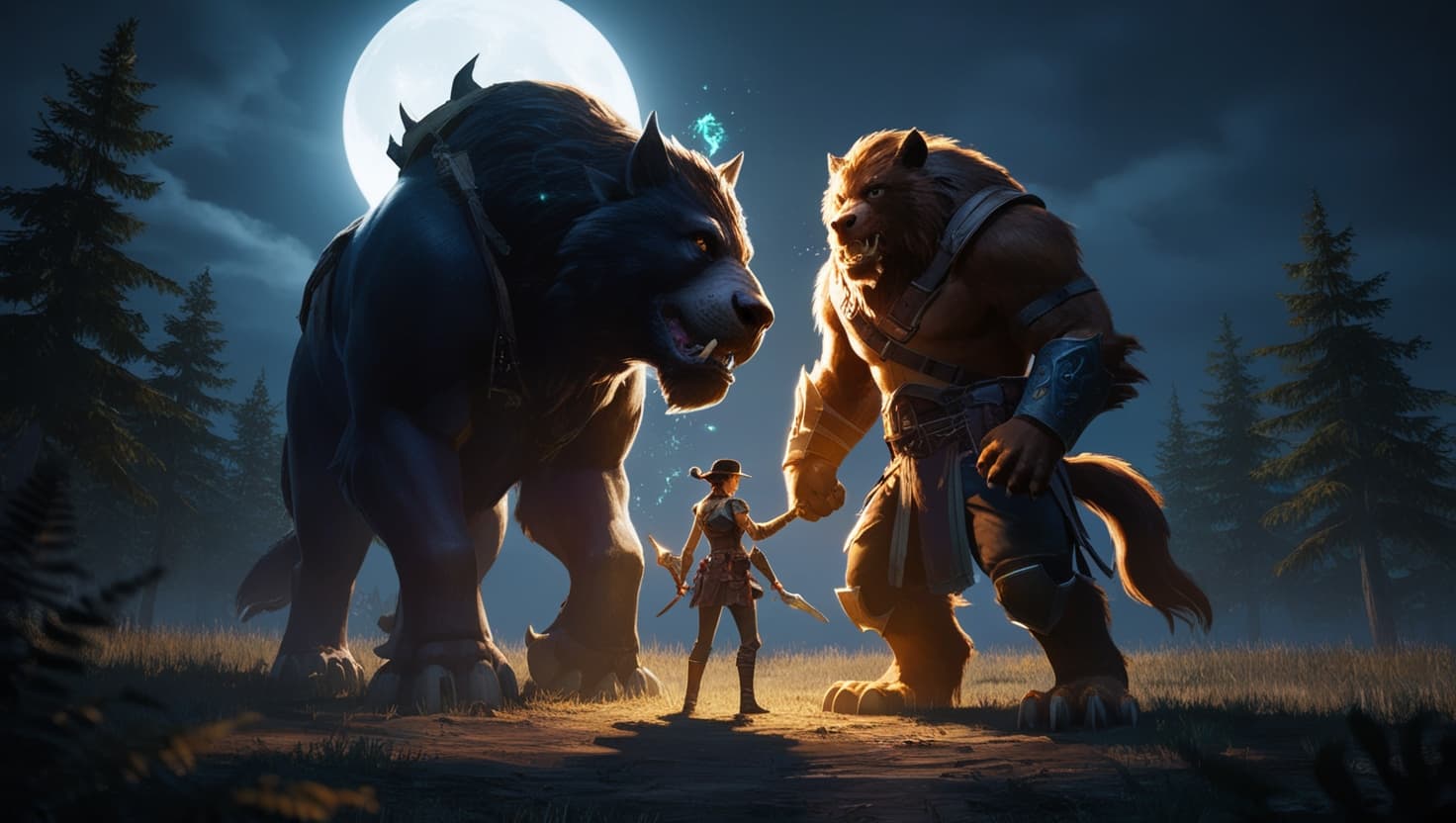
Best Beast Master Ranger Build in 5e: Your Companion Finally Works in AI D&D
Every D&D player who has ever looked at the Ranger class list has had the same thought: "I want the one with the animal."
And every D&D veteran has given the same warning: "Beast Master is a trap."
They're not wrong - in traditional games. The original Beast Master has real problems. Your companion's action costs your action until level 5. Its HP doesn't scale well. It dies to AoE spells. And most critically, keeping track of two characters' stats, positioning, and abilities is a lot of bookkeeping that bogs down already-slow combat.
AI Game Masters eliminate that last problem entirely. And with Tasha's Cauldron of Everything fixing most of the mechanical issues, Beast Master in AI D&D isn't a trap anymore. It's a genuinely compelling subclass with a fantasy no other class can deliver.
For the broad Ranger overview, read our Ranger class guide. This guide is about building the best Beast Master specifically.
Why Beast Master Works in AI Campaigns
Companion management is automated
The single biggest reason Beast Master fails at traditional tables is bookkeeping. Tracking two characters' HP, positions, attacks, and abilities slows combat to a crawl. Players forget companion actions. GMs forget companion reactions. The companion becomes a stat block that occasionally bites something.
AI GMs track everything. Your companion's HP, position, available actions, and abilities are managed independently. The AI prompts you for companion actions on your turn, applies Pack Tactics or other features correctly, and maintains the companion as a persistent entity in the narrative.
This is transformative. When the management burden disappears, you can focus on tactics - positioning your wolf for flanking, sending your hawk to scout, using your companion as a distraction while you line up a shot.
Your companion becomes a character
In traditional D&D, animal companions are often treated as equipment with feelings. Between combat, the GM might mention your wolf is "sitting nearby" and then ignore it until the next fight.
AI GMs don't do this. Your companion reacts to NPCs (growling at suspicious characters, wagging at friendly ones). It interacts with the environment (sniffing out hidden doors, alerting to danger, chasing small animals). It has personality that the AI develops over sessions.
Tell the AI your wolf is protective and it will position itself between you and perceived threats. Say your hawk is curious and it will investigate objects before you do. The companion stops being a stat block and starts being a companion.
Two bodies solve problems single characters can't
With a companion, you can be in two places at once. Send the hawk ahead to scout while you stay hidden. Have the wolf guard one corridor while you explore another. Distract a guard with your panther while you sneak past.
AI GMs handle split-party situations smoothly, describing what each character experiences. This makes Beast Master the most tactically flexible Ranger subclass in AI campaigns.
Give your companion a name and personality traits in your character description. "My wolf, Ashfall, is cautious around strangers but ferociously protective in combat" gives the AI everything it needs to play the companion as a real character throughout the campaign.
The Optimal Beast Master Build
Ability scores
Dexterity > Wisdom > Constitution > Strength > Charisma > Intelligence
Dexterity drives your ranged attacks (Beast Masters fight best at range while their companion handles melee), AC, initiative, and stealth. Wisdom powers your spells and Perception. Constitution keeps you alive. Strength is irrelevant for most Ranger builds.
Using point buy: 16 Dex, 14 Wis, 14 Con, 10 Str, 8 Cha, 8 Int before racial bonuses.
Best race picks
Wood Elf - +2 Dexterity, +1 Wisdom, 35-foot movement, Mask of the Wild for hiding in natural environments. The Ranger race. Your extra speed keeps you at range while your companion fights in melee.
Variant Human - Take Sharpshooter (-5 to hit, +10 damage on ranged attacks) to transform your longbow into a cannon. Or take Sentinel to make yourself a melee threat alongside your companion - enemies who attack your companion provoke opportunity attacks from you.
Halfling (Lightfoot) - Hide behind your companion (it's at least Medium). Lucky rerolls natural 1s. Naturally Stealthy is always relevant for a Ranger.
Shifter (Wildhunt) - Thematically perfect for Beast Master. Shifting gives you temporary HP and prevents creatures from having advantage on attacks against you. The beastial flavor matches the subclass identity.
Custom Lineage - +2 Dexterity, darkvision, and a feat. Flexible and effective.
Companion selection
Original Beast Master (PHB):
Wolf - The best all-purpose companion. Pack Tactics grants advantage on attacks when an ally (including you) is within 5 feet of the target. Its bite can knock targets prone (DC 11 Strength save), granting advantage to all melee attacks. Reliable, tactical, and the AI plays Pack Tactics consistently.
Giant Poisonous Snake - Highest damage output of any companion option. Its bite deals 1d4 + 2 plus 3d6 poison damage on a failed save. Fragile (11 HP) but devastating when it connects.
Panther - Pounce (charge 20 feet, target must save or fall prone, then bonus bite attack) creates dramatic openers. Stealth proficiency makes it an excellent scout.
Tasha's Primal Companion (recommended):
Beast of the Land - Charge attack (extra 1d6 + prone on fail), 5 + 5× your Ranger level HP. The most durable and tactically versatile option. Scales with your level.
Beast of the Sky - Flyby (no opportunity attacks), ranged-friendly. Good for archers who want a companion that harasses without getting locked down.
Beast of the Sea - Swimming speed, grapple on hit. Situational but dominant in aquatic campaigns.
Quick Build: The Wolf Commander
- Race: Wood Elf
- Ability Scores: 16 Dex (+2 racial), 14 Wis (+1 racial), 14 Con, 10 Str, 8 Cha, 8 Int
- Companion: Wolf (PHB) or Beast of the Land (Tasha's)
- Fighting Style: Archery (+2 to ranged attack rolls)
- Weapons: Longbow, two Shortswords
- Spells: Hunter's Mark, Cure Wounds, Pass Without Trace
- Level 4 ASI: +2 Dexterity (to 18)
- Playstyle: Companion engages in melee, you fire from range with Hunter's Mark, use companion for flanking and prone setup
Playstyle Tips for AI Campaigns
Your companion is your melee proxy
The ideal Beast Master combat loop: your wolf engages an enemy in melee (Pack Tactics gives it advantage), you stand 30-60 feet back firing your longbow with Hunter's Mark. If the wolf knocks the target prone, your next ranged attack gets advantage too (if within 5 feet - or you switch to melee).
Tell the AI your tactical plan: "Ashfall engages the closest enemy. I hang back and fire arrows at whatever she's fighting." The AI will play out both sides of this coordinated assault.
Scout with your companion
Before entering a room, dungeon level, or enemy camp, tell the AI: "I send Ashfall ahead to scout. She stays in the shadows and reports back." The AI describes what the companion finds - enemies, traps, treasure, exits. This is free intelligence that other classes don't have.
For flying companions (hawk, Beast of the Sky), aerial scouting is even better. "My hawk circles above the ruins and reports what it sees" gives you a bird's-eye map.
Name and develop your companion
The more personality you give your companion, the more the AI invests in it. A wolf named "Ashfall" who growls at untrustworthy NPCs and sleeps at the foot of your bedroll becomes a narrative character the AI weaves into the story.
The AI will create moments for your companion: alerting you to ambushes, reacting to story events, bonding with other party members or NPCs. These moments are unique to Beast Master and they make the subclass feel special in ways the mechanics alone don't capture.
Protect your companion
Companions can die. In AI campaigns, tell the AI when you're positioning defensively with your companion: "I move Ashfall behind cover when the dragon turns toward us." Use Cure Wounds on your companion when it's hurt. The AI respects protective behavior and narrates the bond between you.
If using Tasha's Primal Companion, you can resummon your beast with a spell slot if it falls to 0 HP. The AI handles this mechanic cleanly.
Hunter's Mark and your companion's attacks stack beautifully. Mark a target, have your companion attack it (with advantage from Pack Tactics), and fire your longbow. That's three sources of damage on one target per round - your companion's bite, your arrow, and Hunter's Mark on both hits.
Common Build Mistakes
Fighting in melee alongside your companion. You're a medium-armor, d10 hit die class. Your companion is a better melee combatant because of Pack Tactics. Stay at range with your longbow and let the wolf do the biting.
Forgetting companion actions. In traditional D&D, this is the Beast Master's biggest failure point. In AI campaigns, the AI prompts you - but you still need to tell it what your companion does each turn. Be deliberate about companion tactics.
Not giving the companion a name or personality. An unnamed wolf is a stat block. A wolf named Ashfall who was rescued from a trap as a pup is a story hook the AI builds on for entire campaigns. Invest in the fiction.
Ignoring Tasha's optional features. If your table allows Tasha's Cauldron, the Primal Companion is a strict upgrade. Scaling HP, proficiency-based attacks, and the ability to resummon fix every mechanical complaint about original Beast Master.
Dumping Wisdom. Your spells (Hunter's Mark, Cure Wounds, Pass Without Trace) use Wisdom. Your Perception uses Wisdom. As a Ranger, Wisdom is your secondary stat, not a dump stat.
Beast Master Ranger has always had the best fantasy in D&D - the lone wanderer with a loyal animal companion, fighting together against the wilderness. The subclass finally lives up to that fantasy in AI campaigns, where companion management is automated, companion personality is developed by the AI, and the tactical possibilities of controlling two characters are fully realized.
Build as a ranged archer with a wolf companion. Let the wolf handle melee while you fire from distance. Give your companion a name, a personality, and a backstory. And watch the AI turn a stat block into a character you genuinely care about.
Build your Beast Master on StoryRoll and meet the companion that fights beside you, scouts ahead of you, and growls at NPCs it doesn't trust.
Try These Free Tools
Prep your Beast Master build with these free resources:
- Ability Score Calculator — Balance Dexterity and Wisdom for the ideal ranged Ranger.
- Spell Slot Tracker — Manage Hunter's Mark, Cure Wounds, and your other half-caster slots.
- Dice Roller — Roll companion attacks, Hunter's Mark damage, and longbow shots.
Written by Anthony Goodman
Founder of StoryRoll. Building AI-powered tabletop RPGs.
Related Posts
Best Battle Master Build in 5e: The Tactical Fighter for AI D&D
Battle Master turns every fight into a chess match. Here's how to build one that dominates AI-run campaigns - from maneuver picks to ability scores to the races that make it sing.
Best Evocation Wizard Build in 5e: The Blaster for AI D&D
Evocation Wizards throw fireballs without apology. Here's how to build one that maximizes damage, protects allies, and thrives in AI-run campaigns.
Best Life Cleric Build in 5e: The Healer That Fights Back in AI D&D
Life Cleric is the best healer in D&D - and in AI campaigns, it's also a frontline tank that keeps the whole party standing. Here's how to build one that does both.