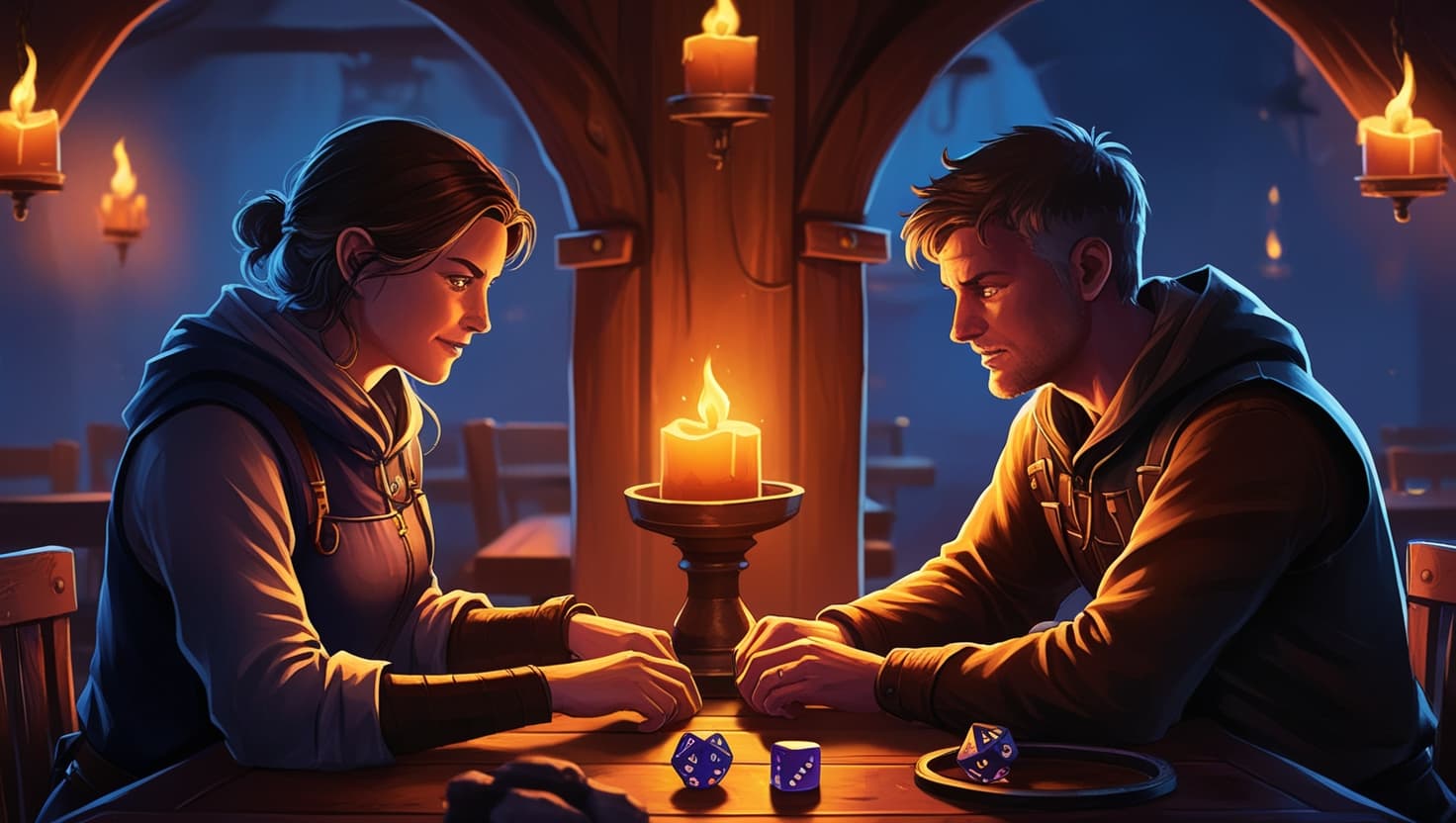
D&D for Two Players: How to Run a Duet Campaign That Actually Works
Four players, a DM, and everyone's schedule aligning on the same Tuesday night for 16 consecutive weeks. That's the fantasy. The reality for most D&D players is closer to: two people who actually want to play, and three ghosts who "definitely can make it next time."
So you stop waiting. You and one other person sit down to play D&D together. And then the question hits - can this even work? (If you can't find even one other person, playing D&D alone is also a real option.)
It can. Duet campaigns (one DM, one player) have been around since the hobby started. Gary Gygax ran them. Critical Role's Matt Mercer has talked about running them with Marisha Ray. The format isn't a compromise. It's a different game, and in some ways, a better one.
But it requires adjustments. A duet played like a standard 4-player campaign will feel hollow. Here's how to make it feel full.
Why D&D for Two Players Hits Different
The obvious benefit is scheduling. Two calendars are easier to sync than five. But that's table stakes.
The real advantage is narrative density. In a standard group, the DM splits attention across four characters, each getting roughly 25% of the spotlight. In a duet, the player gets 100%. Every NPC interaction, every plot hook, every dramatic moment revolves around one character's choices.
That changes the kind of stories you can tell. A duet campaign can sustain a political intrigue arc where the player is a spy embedded in a royal court. Try running that with four players - someone's going to get bored and start a bar fight.
It also changes the pace. No waiting for four players to debate whether to open the door. No 45-minute shopping sessions while one player haggles over a Rope of Climbing. A duet session covering the same narrative ground as a group session takes about half the time.
Duets are perfect for couples, parent-child pairs, or roommates who want to play but can't recruit a full party. The low logistics make it sustainable for months.
D&D for Two Players: The Sidekick Problem (and Solutions)
The biggest mechanical challenge in a duet: action economy. D&D's combat math assumes 3-5 player characters taking actions each round. One PC against four goblins isn't a fight - it's a mugging.
You have four options, ranked by how well they work:
Sidekick NPCs. Tasha's Cauldron of Everything has official sidekick rules - Warrior, Expert, and Spellcaster templates you can slap onto any creature. The player controls the sidekick in combat, the DM roleplays them out of combat. A 3rd-level Ranger with a Warrior sidekick feels like a functional two-person party. The sidekick gets simplified class features (no subclass choices, fewer spell slots) so the player isn't managing two full character sheets.
Multiple PCs. The player runs two characters. This works mechanically but splits the narrative focus that makes duets special. If your player is the type who enjoys tactical optimization and can keep two character voices distinct, go for it. If they want deep single-character immersion, skip this.
Rebalanced encounters. Cut monster count by half. Reduce HP by a third. Remove one legendary resistance from boss monsters. I ran a duet through Curse of Strahd and reduced every encounter to roughly 60% of published difficulty - the player's Paladin still nearly died twice, which felt right.
AI as the missing party members. This is the approach I've been testing in StoryRoll - the AI handles sidekick NPCs dynamically, adjusting their behavior based on the situation. The player's Warlock asks their AI-controlled Cleric sidekick to conserve spell slots for a boss fight ahead, and the AI actually does it. No DM cognitive load for running a second character, no simplified stat block needed.
- Sidekick source: Tasha's Cauldron of Everything, p. 142
- Sidekick types: Warrior (martial), Expert (skills/sneak attack), Spellcaster (healing/support)
- CR limit: Sidekick creature must be CR 1/2 or lower at creation
- Leveling: Sidekicks gain features at same rate as the PC
- Control split: Player handles combat actions, DM handles roleplay and personality
How to Build D&D Encounters for Two Players
Standard encounter building (DMG p. 82) doesn't work for duets. The XP multiplier system assumes 3-5 characters, and the math breaks at party size one.
Here's what actually works after running 30+ duet sessions:
Cap enemy count at three. Even with a sidekick, four-on-two creates too many attack rolls for the monsters. Action economy overwhelms single PCs fast. Three enemies is the ceiling for a Hard encounter.
Use fewer, stronger monsters instead of mobs. One Owlbear (CR 3) is a better duet fight than six Wolves (CR 1/4 each). The player makes meaningful tactical decisions against a single threat. Against a mob, they just ask "which one do I hit?" six times.
Give the PC environmental advantages. Chokepoints, high ground, cover, flammable terrain. A solo Eldritch Knight holding a narrow bridge against two Bugbears is a memorable fight. The same Knight in an open field against those Bugbears is dead in three rounds.
Telegraph deadly fights. In a group, someone usually survives to cast Revivify. In a duet, a TPK means one character dies and the campaign potentially ends. Foreshadow hard encounters so the player can prepare, retreat, or find alternate solutions.
Avoid monsters with save-or-suck effects in duet play. A single failed save against Hold Person ends the fight instantly when there's no ally to break concentration. Swap Banshee's Wail for extra damage. Replace a Mind Flayer's Mind Blast with a weaker version targeting one creature.
The Best D&D Modules for Two Players
Not every published adventure adapts well to duet play. The ones that work best have strong NPC support, flexible encounter scaling, and a story that benefits from focused attention on one hero.
Dragon of Icespire Peak (D&D Essentials Kit) was literally designed for this. It ships with sidekick rules, the quest-board structure lets the player choose their own path, and the encounters are tuned for smaller parties. The white dragon Cryovain makes a great recurring villain for a solo hero's arc. For more short-form options, see our list of the best D&D one-shots.
The Wild Beyond the Witchlight works because most of its encounters can be resolved without combat. A duet player navigating the Feywild through charm, deception, and bargains doesn't need four party members backing them up. The whimsical tone also suits intimate play.
Curse of Strahd requires heavy rebalancing but the payoff is worth it. The gothic horror atmosphere actually improves with a lone hero (or hero plus sidekick) stumbling through Barovia. The isolation that feels contrived with a group of five feels earned with one character.
Lost Mine of Phandelver needs work but it's short enough that the adaptation effort is manageable. Add Sildar Hallwinter as a permanent sidekick rather than a quest NPC, and cut the Cragmaw Hideout encounter count by half.
Roleplay in a Duet Campaign: Going Deeper Than Groups Allow
Here's where duets genuinely shine over group play.
In a four-player game, a DM might spend 10 minutes on a scene where the Rogue confronts their estranged father. The other three players are checking their phones, planning their next turn, or trying not to metagame. The emotional moment gets diluted.
In a duet, that scene gets as long as it needs. The DM can play the father as a fully realized character with complicated motivations. The player can sit in the discomfort of the conversation without feeling like they're hogging the spotlight. Nobody's waiting.
Some things that work in duets that fail in groups:
- Extended interrogation scenes where the player and NPC go back and forth for 20 minutes
- Downtime arcs where the character spends weeks building relationships in a town
- Internal monologue moments where the DM narrates what the character is feeling and the player responds in-character
- Dream sequences and vision quests tailored to one character's backstory
- Political maneuvering where the player makes alliances and betrayals across sessions
I ran a 12-session duet where the player's Bard was undercover in a thieves' guild. The entire campaign was social encounters, with exactly two combat scenes. In a group game, at least one player would've kicked down the door by session three.
When testing extended roleplay in StoryRoll's duet mode, the AI tracked relationship dynamics across sessions - an NPC who the player had previously lied to remembered the lie four sessions later and confronted them about it. That kind of narrative threading is easier when the AI only has one character's relationships to manage rather than four.
D&D for Two Players: Common Mistakes
Mistake: Running it like a group game with fewer players. A four-hour session with one player is exhausting for both sides. Duet sessions work best at 90 minutes to 2 hours. The intensity of constant spotlight means both DM and player burn out faster. If you're the one behind the screen, our first-time DM guide covers pacing and session structure that applies to duets too.
Mistake: Making the sidekick too interesting. The sidekick exists to fill a mechanical gap, not compete for narrative attention. Give them a simple personality (loyal soldier, nervous healer, sarcastic thief) and keep their backstory thin. The player's character is the protagonist.
Mistake: Removing all challenge. Some DMs over-correct on difficulty and make encounters trivially easy. Duet players still need to feel threatened. The solution is fewer deadly moments, not zero deadly moments. One near-death experience every three sessions keeps the stakes real.
Mistake: Forgetting that silence is fine. In a group, silence means someone's disengaged. In a duet, silence might mean the player is thinking deeply about a choice. Don't rush to fill every pause with DM narration.
Mistake: Not using the format for what it's good at. If you're running a straightforward dungeon crawl with no story hooks, you're wasting the duet format. Play to the strengths - character-driven narrative, NPC relationships, moral dilemmas, personal stakes.
Can Both Players Be PCs? (No-DM Duets)
The traditional duet assumes one DM and one player. But what if both of you want to play?
This is where the format gets experimental. Options include:
Trading DM duties scene by scene. Each person has a PC. When your character isn't the focus, you play the world. This requires trust and a willingness to be surprised by your own story. If neither of you wants to DM at all, check out our guide on playing D&D without a DM.
Using an oracle system. Solo RPG tools like Mythic Game Master Emulator provide randomized yes/no answers to replace DM decisions. Two players can use an oracle together, collaboratively narrating while the dice decide what happens next.
Using an AI as DM. Both players create characters and the AI runs the game. This is what StoryRoll was built for - I ran 50+ two-player sessions where both participants were PCs and the AI handled all DM responsibilities. Combat, NPCs, environmental descriptions, rule adjudication. The AI tracked initiative for both PCs, managed enemy turns, and even scaled encounter difficulty based on how the session was going. Two friends, two characters, zero prep.
Two-player, no-DM sessions in StoryRoll average about 45 minutes - roughly half the length of a traditional duet. The AI eliminates the prep time that normally falls on one player, so both people just show up and play.
Frequently Asked Questions
How many sessions should a duet campaign last?
No fixed number. Short arcs of 4-8 sessions work well because the intense focus can be draining over long campaigns. But I've seen duets run for 50+ sessions without losing momentum. Check in with your player every 8-10 sessions to see if the story needs a natural endpoint.
Do duet campaigns work for new players?
They're arguably the best way to learn D&D. A new player gets full DM attention, can ask questions without slowing down a group, and learns the rules organically through play rather than reading a 320-page book. Running a session zero is still valuable even with just two people - it sets expectations for tone, safety, and the kind of story you both want. Dragon of Icespire Peak with sidekick rules is the ideal starter duet.
What classes work best for a solo PC in a duet?
Self-sufficient classes that can handle multiple roles. Paladin (tanking + healing + damage), Ranger (tracking + damage + some healing with Goodberry), and Bard (social + healing + utility magic) all function well without a party. Avoid classes that depend on party synergy - a Mastermind Rogue's Help action needs allies, and a Life Cleric without a frontliner is just a person in heavy armor.
Can you play published adventures as duets?
Most published adventures can be adapted with effort. The key adjustments: add a sidekick, reduce encounter difficulty by 50-60%, and skip or streamline sections designed for party splitting (these don't work with one PC). Dragon of Icespire Peak and The Wild Beyond the Witchlight need the least modification.
D&D for two players isn't a lesser version of the "real" game. It's a format that trades breadth for depth - less tactical variety, more narrative intensity. The scheduling alone makes it worth trying: two calendars, one shared evening, no cancellation chains. If you've been waiting for a full party to start playing, stop waiting. Grab one person, pick up Dragon of Icespire Peak or boot up StoryRoll, and run the game your character deserves.
Written by StoryRoll
Founder of StoryRoll. Building AI-powered tabletop RPGs.
Related Posts
Best D&D Party Size: Why Four Players Beats Five, Six, and Chaos
Best D&D party size for most campaigns is four players. Here’s when three works better, when five is worth it, and when your table is just too big.
D&D 5e Concentration Checks: You're Failing Them Before You Even Roll
D&D 5e concentration checks are less about dice luck and more about positioning, spell choice, and damage timing. Here's how to stop dropping your best spells.
Best D&D Classes for Small Parties: Stop Building Like You Have Five Players
Best D&D classes for small parties need to cover multiple jobs at once. Here’s which 5e classes actually hold up in 1, 2, and 3 player groups.