How to Play D&D Alone: The Complete Solo D&D Guide (2026)
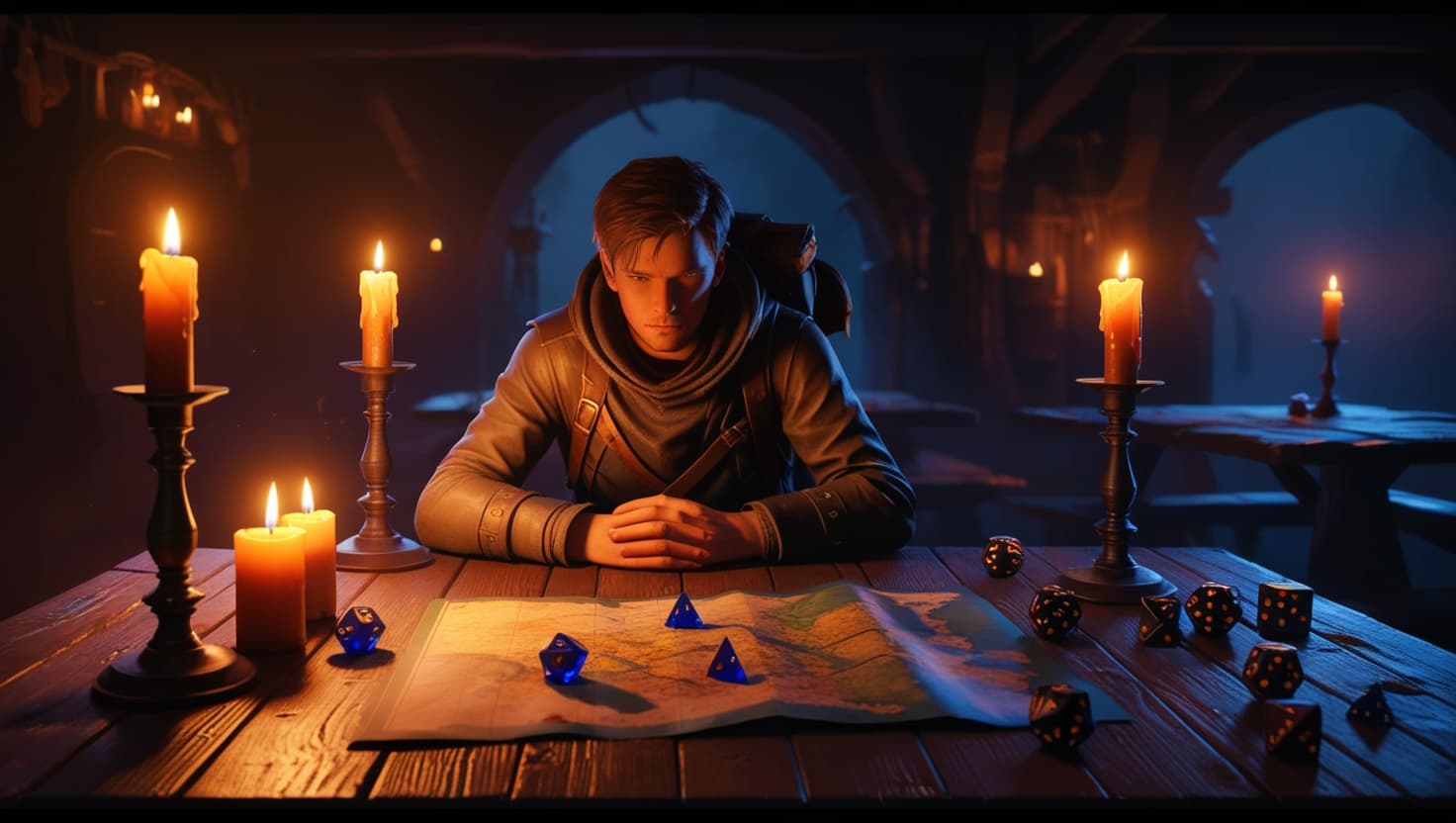
Last Tuesday at 11pm, I rolled a natural 1 on a Stealth check in a goblin-infested mine. No party to bail me out. No DM to fudge the roll. Just me, my ranger, and the sinking feeling that this was about to get ugly.
That's solo D&D. It's real, it's been around for decades, and in 2026 you've got more ways to do it than ever. Whether you're a seasoned player between groups or someone who wants to play D&D but doesn't have friends who play, this guide covers all the options - what works, what doesn't, and how to pick the right approach for you.
TL;DR: Solo D&D is real D&D. Five main methods: oracle systems, solo journaling games, gamebooks, pre-written modules, and AI-powered tools. Each has trade-offs. AI Dungeon Masters are the biggest shift since Mythic - the tech in 2026 is good enough to run real campaigns. The "best" method depends on what you want: creative control, mechanical crunch, or something that feels like playing with a real DM.
Which Solo D&D Method Should You Try First?
Before the deep dive, here's the fast answer. Most people don't need to study all five methods before they start - they need to pick one and play tonight.
- Want to play tonight with the least setup - use an AI Dungeon Master.
- Want maximum authorship and don't mind the work - use an oracle like Mythic.
- Want a known structure with limited surprises - use a solo module or gamebook.
- Want solo roleplaying but not necessarily D&D - use a purpose-built solo RPG like Ironsworn.
- Want group energy - treat solo play as a bridge between sessions, not a permanent replacement.
The rest of this guide is the detail behind each path - what it feels like, what it costs, and where it breaks down.
Method 1: Oracle Systems & GM Emulators
The OG approach to solo D&D, and still one of the best.
You play your character normally, but when you'd ask the DM a question ("Is the door locked?" "Does the guard notice me?"), you ask an oracle - a randomized system that gives yes/no answers with varying probability.
Mythic GM Emulator
The gold standard. Mythic Game Master Emulator has been around since 2006, and it's still the most popular oracle in the solo TTRPG community.
How it works:
- Set the chaos factor (1-9, representing how unpredictable the situation is).
- When you have a yes/no question, assign a probability (likely, 50/50, unlikely, etc.).
- Roll percentile dice and consult the fate chart.
- The system generates random events that throw curveballs into your story.
Mythic doesn't replace D&D - it replaces the DM's decision-making. You still use your D&D books, character sheet, and combat rules. Mythic just answers the questions you can't answer yourself without bias.
Pros:
- Maximum creative freedom
- Works with any TTRPG system, not just D&D
- The chaos factor and random events create surprising, emergent stories
- Cheap (one book), no screen or internet required
Cons:
- Steep learning curve - takes a few sessions to click
- You're doing a lot of heavy lifting. Player, DM, narrator, rules lawyer. It's mentally exhausting.
- Combat feels flat when you're running both sides
- Hard to surprise yourself, even with random events
Other Oracle Systems
Mythic isn't alone:
- MUNE (Minimal Universal NPC Emulator) - Lighter, free. Great for beginners.
- The GameMaster's Apprentice cards - A deck that serves as a multi-purpose oracle. Beautiful and tactile.
- Motif Story Engine - Focuses on narrative beats rather than yes/no questions.
- One Page Solo Engine - The entire system fits on one page. No, really.
If you like creative writing and don't mind doing the narrative work, oracle systems are incredible. The closest you'll get to "pure" solo D&D. And if social anxiety is part of why you're drawn to solo play, that's completely valid - our guide to playing D&D with social anxiety has tips for both solo and group contexts. If you have one person you're comfortable playing with, duet campaigns (two-player D&D) can be a great middle ground between solo and group play.
Method 2: Solo Journaling Games
This is where solo TTRPG gets literary.
Solo journaling games are designed from scratch for one player. Instead of retrofitting a multiplayer game, they build the solo experience into their DNA.
Ironsworn
If you haven't played Ironsworn, go download it. It's free. It's brilliant. And it was designed for solo play.
Ironsworn is a Powered by the Apocalypse game set in a dark, low-fantasy Norse-inspired world. The solo mode uses integrated oracles and progress tracks that give quests a tangible sense of momentum.
The key innovation: every move generates narrative. When you "Forge a Bond" with an NPC, you're writing the story of that relationship. When you "Face Danger," the dice tell you whether you succeed, fail, or succeed at a cost - and you narrate what that looks like.
Pros:
- Purpose-built for solo play, no hacking required
- Free PDF, excellent production quality
- Elegant, deeply integrated oracle system
- Emotional stories emerge naturally from the mechanics
- The sequel, Ironsworn: Starforged, takes the system to space
Cons:
- It's not D&D. Different setting, different mechanics, different feel.
- If you want your D&D character with D&D rules, this won't scratch that itch.
Other Solo Journaling Games
The solo TTRPG scene has exploded:
- Thousand Year Old Vampire - An immortal tracking memories across centuries. Haunting.
- The Wretched - Solo survival horror played with a Jenga tower.
- Quill - A letter-writing RPG. Meditative and weird in the best way.
- Ker Nethalas - Solo dungeon-crawling with a dark fantasy tone closer to D&D.
These games are wonderful, but they're their own thing. For a ranked tour of them, see the best solo RPG games of 2026. If you want D&D specifically - your spells, your monsters, your character sheet - you need a different approach.
Method 3: Gamebooks & Solo Adventures
Remember Fighting Fantasy? Lone Wolf? Someone else writes the adventure, you make choices and roll dice.
D&D-Specific Solo Adventures
There are actual solo modules for D&D:
- Death Knight's Shadow and Doomed to Repeat - 5e solo adventures with branching narratives
- DM Yourself by Tom Scutt - Run official modules (Curse of Strahd, Lost Mine of Phandelver) as a solo player
- 5e Solo Gamebooks by Paul Shortino - Multiple solo adventures for 5th edition
- Various adventures on the DMs Guild tagged "solo adventures"
Pros:
- Zero prep - just open and play
- Good pacing and balance from experienced designers
- Great for learning D&D rules and combat
- DM Yourself lets you play official campaigns solo
Cons:
- Limited replayability - once you've explored all branches, you're done
- You're following someone else's story, not creating your own
- Supply of quality solo 5e content is still small
Gamebooks are the "video game" end of the solo D&D spectrum - less creative investment, more immediate payoff.
Method 4: Running Pre-Written Modules Solo
Take a standard D&D module and run it yourself. It sounds weird, but it works.
Approaches
DM Yourself method: Read just enough to understand the current scene, use oracle rolls for details, avoid reading ahead. Trust the process.
DMPC approach: Run a full party. One character is your main, the others are supporting cast you play more mechanically. Works well for combat-heavy modules.
Journaling through a module: Read the module like a book, journal your character's experience, roll encounters and saves. Less "playing D&D," more "experiencing a D&D story through your character's eyes."
Pros:
- Huge library of existing content - decades of published modules
- Play iconic campaigns (Curse of Strahd, Tomb of Annihilation)
- Teaches DMing skills for when you find a group
Cons:
- Hard to avoid spoilers, even with discipline
- Managing a full party alone is bookkeeping-heavy
- Combat takes forever with 4+ characters and all the monsters
- Never quite feels like being a player - you're always behind the curtain
Method 5: AI-Powered Solo D&D
AI Dungeon Masters are the biggest shift in solo D&D since Mythic dropped two decades ago. The promise: an AI that can actually be your DM. Not a choose-your-own-adventure script. Not a random oracle. A Dungeon Master that responds to your actions, runs NPCs, describes scenes, manages combat, and adapts to your choices.
ChatGPT and General-Purpose LLMs
You can ask ChatGPT (or Claude, or Gemini) to DM a session. For a quick one-shot, it works better than you'd expect.
Paste a system prompt - "You are an experienced D&D 5e Dungeon Master, run a campaign for me, here's my character..." - and start playing.
Pros:
- Free or cheap
- Available right now
- Flexible tone, setting, and style
- Good for quick, experimental sessions
Cons:
- Terrible memory. Forgets your character's name after a few thousand words.
- Inconsistent rules. Will confidently say a level 3 wizard can cast Fireball. (They can't - that's level 5.)
- No mechanical backbone. Doesn't track HP, spell slots, or inventory.
- The "yes, and" problem. Trained to be agreeable, rarely challenges you or creates real consequences.
- No persistence. Close the chat and your campaign vanishes.
Great proof of concept, not a great product - we dug into exactly where it breaks in ChatGPT as a Dungeon Master.
AI Dungeon
AI Dungeon deserves credit as a pioneer - one of the first platforms to use AI for interactive fiction. In 2026, it's evolved with multiple AI models, community scenarios, and more structured play modes.
Pros:
- Established platform, large community
- Multiple AI models
- Good for freeform interactive fiction
Cons:
- More "interactive fiction" than D&D. No actual 5e mechanics.
- The AI still goes off the rails regularly
- Doesn't feel like a D&D table - feels like a text adventure
For a deeper comparison, check out our comparison of AI Dungeon Masters. You might also enjoy our broader solo TTRPG options or our look at solo vs multiplayer AI D&D.
StoryRoll
Full disclosure: we built StoryRoll. We built it because the existing options weren't cutting it for actual D&D players.
StoryRoll runs on real D&D mechanics. We track your character sheet, manage combat with actual initiative and action economy, calculate ability checks with proper modifiers, and enforce spell slot usage. (Want to build out a character before jumping in? The backstory generator is a good place to start.) Roll a 14 on Stealth against a goblin's passive Perception of 12? The goblin doesn't see you - because the math says so, not because the AI felt generous.
Persistent campaigns with real memory. Your world state, NPC relationships, and quest progress carry across sessions. The barkeep you befriended in session 2 remembers you in session 15.
Designed to feel like a real session. The pacing, the descriptions, the encounter structure - we're not reinventing D&D. We're reproducing the experience of playing with a good human DM, for the times when one isn't available.
AI can't fully replace a great human DM - not yet. Human DMs bring intuition, emotional intelligence, and years of shared context that AI is still catching up to. But for solo play, for those Tuesday nights when you just want to explore a dungeon with your ranger, StoryRoll gets you closer to the real thing than anything else we've tried.
Your First Solo Session, Step by Step
Pick the path that matches the method you chose above.
AI Dungeon Master Path (fastest)
- Sign up for a platform. StoryRoll runs D&D 5e rules with narration and scene art (we built it, so weigh that accordingly). AI Dungeon is more freeform.
- Create a character. Use the guided builder. Pick a Fighter or Rogue if you want something mechanically simple for a first run - your first character is a learning experience, not a lifelong commitment.
- Pick a setting and go. The AI introduces the world through play, so you don't need to read any lore. Just react to what happens.
- Play for 30 minutes. That's enough for character creation, an opening scene, and maybe a fight. If it clicks, keep going; if not, try a different character or setting before writing off the whole idea.
Oracle Path (most creative control)
- Get the tools. Download Mythic GME or grab the free Ironsworn PDF. Mythic's core system fits on about two pages.
- Make a character with the free D&D Basic Rules, or any system you already know.
- Set a scene. Write where your character is and what they want: "My ranger is tracking a missing merchant through the Silverwood, chasing rumors of bandits on the eastern road."
- Ask the oracle your first question. "Is the trail fresh?" Roll, interpret, build from there.
- Keep a journal. Brief notes keep the story consistent across sessions. A notebook, Google Doc, or Obsidian vault all work.
Journaling Path (most accessible)
- Pick a game. Thousand Year Old Vampire for something literary, The Wretched for horror, Alone Among the Stars for gentle sci-fi. Most are a few dollars on itch.io.
- Grab a pen and something to write in. That's the entire supply list.
- Follow the prompts. Each game tells you what to do, usually in about two pages of rules.
How to Choose Your Solo D&D Method
Oracle systems (Mythic) - You love creative writing, want maximum narrative control, and don't mind the heavy lifting.
Solo journaling games (Ironsworn) - You want a purpose-built solo experience and value elegant design.
Gamebooks/solo modules - You want structured, low-prep play, or you're learning D&D rules.
Pre-written modules - You want iconic D&D campaigns and don't mind bookkeeping.
AI tools (StoryRoll) - You want the closest thing to playing with a real DM, with actual 5e mechanics and persistent campaigns.
You don't have to pick just one. Many solo players mix methods - Mythic for overworld exploration, an AI DM for dungeon crawls, journaling between sessions. Solo D&D is a buffet. Take what you want.
What Solo D&D Feels Like (and Who It's For)
Solo D&D isn't group D&D with the people removed. It's a different experience that rewards different things.
You're the entire party. Run a single character for deeper roleplay, or a party of three to four for tactical combat. Start with one - it's simpler, and you can add companions later.
You control the pacing. No waiting for someone to decide their turn, no twenty-minute debate about the suspicious door. If your character would kick it down, kick it down. Solo sessions move fast.
You can be weird about it. Nobody's watching, so write the internal monologue, get attached to a shopkeeper, let a conversation with an NPC run for three pages.
It's probably not for you if the social table is what you love about D&D - the collective panic when the villain appears, the laughter when a plan falls apart. Solo play won't replicate that energy; it offers different rewards. And it isn't either/or: plenty of players run a solo campaign during the week and a group game on weekends, and the solo sessions make them sharper group players. If your real blocker is that nobody at your table wants to run the game, D&D without a DM compares solo, AI, and group options.
The most common solo D&D mistake: rerolling results you don't like. The whole point is that the oracle or AI hands you something unexpected and you figure out how to make it work in the fiction. If you only accept outcomes that match the story already in your head, you might as well be writing a novel. Let the dice surprise you.
Tips for Better Solo D&D
Keep a Campaign Journal
Even a few sentences per session. It tracks plot threads, remembers NPC names, and creates a record of your character's journey. Some of the best solo D&D content online is people sharing their campaign journals - it's a whole subgenre on r/Solo_Roleplaying.
Use Random Tables Liberally
Random tables inject surprise when you're making all the decisions. The DMG has solid tables for dungeons, encounters, and NPC traits. donjon and the d100 subreddit are gold mines.
Embrace "Yes, But" and "No, And"
When your oracle gives a result, don't take it at face value. "Yes" can be "yes, but there's a complication." "No" can be "no, and things just got worse." The best solo D&D stories come from leaning into complications.
Don't Fudge Your Dice
It's tempting. Nobody will know. But the magic of solo D&D comes from real risk. When your character drops to 0 HP in a solo dungeon with no healer, that tension is real - but only if you let it be. (My ranger learned this the hard way in that goblin mine.) If you don't have physical dice handy, our dice roller works in any browser - no fudging possible.
Set the Mood
Light a candle. Put on an ambient soundtrack - Tabletop Audio and Syrinscape are both excellent. Close the other browser tabs. Solo D&D is an exercise in imagination, and atmosphere goes a long way.
Start Small
Don't plan a 1-20 campaign on your first session. One dungeon. One mystery. Get comfortable with your method before committing to an epic saga. If you need a quick encounter to practice with, the encounter calculator can help you build a balanced fight for a solo character.
The Solo D&D Community
You're not actually alone. There's a thriving community sharing experiences, advice, and actual play journals:
- r/Solo_Roleplaying - The main subreddit. Friendly, good resources, active discussion.
- Me, Myself & Die - Trevor Devall's YouTube series that brought solo RPGs into the mainstream. Entertaining and a great introduction.
- Solo RPG Discord servers - Multiple active communities for real-time discussion.
Frequently Asked Questions
Can you play D&D alone?
Yes. You can play D&D solo with oracle systems like Mythic GME, solo adventure modules, journaling RPGs, or an AI Dungeon Master platform that runs narration, rules, and combat for you. It is a well-established way to play, not a workaround.
What is the easiest way to play D&D solo?
An AI Dungeon Master platform is the fastest path from zero to playing. You create a character, pick a setting, and the AI handles narration, rules, dice, and combat. No prep, no rulebook study, no oracle tables to learn, and your first session can start in a few minutes.
Do I need an oracle to play solo D&D?
No. You only need something that can surprise you in place of a DM. That can be an oracle like Mythic, a solo module's pre-written branches, random tables, or an AI DM. Oracles give the most creative control; an AI DM needs the least setup.
Can ChatGPT be a Dungeon Master?
It can run a short one-shot, but it struggles with a campaign: it forgets your character, gets 5e rules wrong, does not track HP or spell slots, and tends to say yes to everything. A purpose-built AI DM enforces the rules and remembers your world across sessions.
What is the difference between solo D&D and solo TTRPG?
Solo D&D means playing D&D 5e by yourself, with your character sheet, your spells, and your monsters. Solo TTRPG is the broader category that also includes purpose-built solo games like Ironsworn and journaling RPGs. If you specifically want D&D, you want solo D&D; if you are open to other systems, the wider solo TTRPG world has more options.
Ready to Try AI-Powered Solo D&D?
You don't have to pick the perfect method before you start. Choose the path that matches what you want tonight, play one scene, and adjust from there.
Solo D&D is real D&D, and in 2026 the tools are better than they've ever been - the creative depth of oracle systems, the structured simplicity of journaling games, and the zero-setup experience of an AI Dungeon Master. Try the fastest path first: an AI DM gets you playing in minutes. Want more control? Graduate to Mythic or Ironsworn once you've got the feel for it. Try StoryRoll free and run your first solo campaign tonight. Roll well. 🎲
Written by Anthony Goodman
Founder of StoryRoll. Building AI-powered tabletop RPGs.
Related Posts
Best AI for D&D in 2026: ChatGPT vs AI Dungeon vs StoryRoll and More
We compared the best AI tools for playing D&D in 2026 - from ChatGPT to purpose-built platforms. Here's an honest breakdown of what each one actually does well.
Best AI Dungeon Masters in 2026: Every Platform Compared
We tested every AI dungeon master platform we could find in 2026. Here's what's actually good, what's dead, and what's worth your time.
D&D Without a DM: 7 Ways to Play When You Can't Find a Group
Can't find a DM or a group? You've got more options than you think. Seven ways to play D&D without a dungeon master, ranked from quick-start to full campaign.