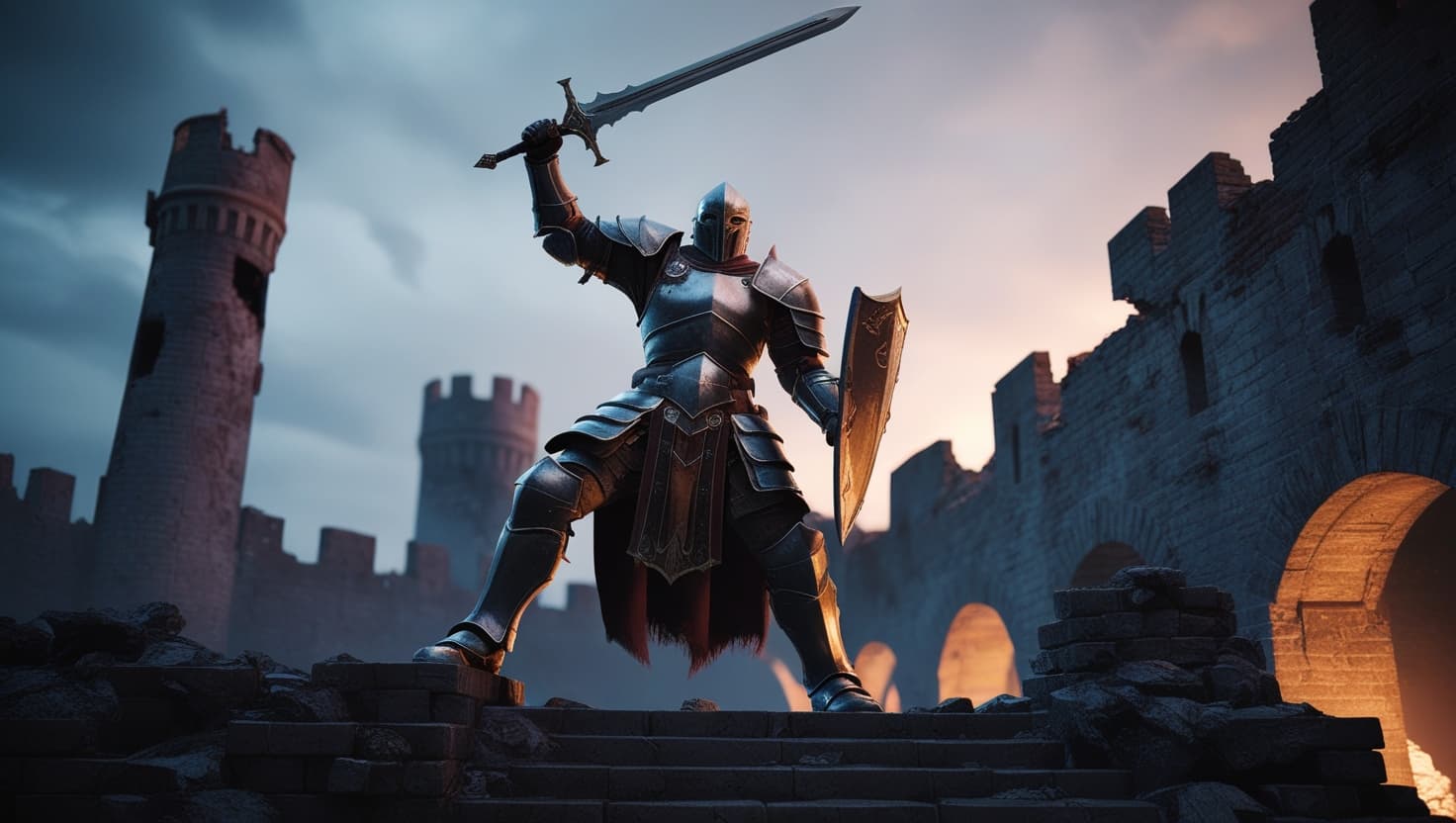
Playing a Fighter With an AI Game Master: The Definitive Guide
You rolled a Fighter. Good.
No spell slots to mismanage. No Wild Shape stat blocks to memorize. No existential crisis about whether you should have picked Warlock instead. Just a weapon, armor, and the satisfying knowledge that when the AI describes a room full of enemies, your response is always the same: "I attack."
But playing a Fighter well - especially with an AI Game Master - is more than just swinging a sword every turn. The class has surprising depth, and AI-run campaigns actually unlock parts of that depth that traditional games often skip.
Why Fighters Thrive in AI D&D
Here's something most class guides won't tell you: Fighters benefit more from AI Game Masters than almost any other class. Here's why.
The pacing advantage
In a traditional game with human GMs, Fighters often feel overshadowed during long roleplay segments or complex puzzle sequences. The spotlight naturally drifts toward spellcasters who can Detect Magic their way through problems or Bards who can talk their way past guards.
AI GMs don't have this bias. They respond to what you do, not what your class is "supposed" to do. A Fighter who says "I examine the mechanism on the door, looking for weak points in the metalwork" gets the same quality of response as a Wizard casting Identify. The AI treats your actions as valid regardless of whether you have a relevant class feature.
Consistent mechanical handling
Fighters have a lot of small, stacking bonuses that human GMs sometimes forget or hand-wave: Fighting Style damage, the exact timing of Action Surge, whether Interception applies before or after damage reduction. An AI GM tracks all of this consistently, which means your character sheet actually matters on every attack.
Combat narration that matches your fantasy
Tell the AI your Fighter is a grizzled mercenary and your combat descriptions shift to efficient, brutal strikes. Say you're a noble knight and suddenly your attacks carry flourishes and honor. The AI adapts its narration to your character concept, which is something Fighters - who define themselves more through fighting style than mechanics - benefit from enormously.
When you create your Fighter in StoryRoll, spend extra time on your character's fighting background. "Trained in a mercenary company" vs. "self-taught street fighter" vs. "academy-trained soldier" will all produce noticeably different combat narration from the AI.
Best Fighter Builds for AI Campaigns
Battle Master (The Tactical Pick)
Battle Master maneuvers are where Fighters get genuinely interesting, and AI GMs handle them beautifully. For a complete breakdown of the subclass, see our Best Battle Master Build guide. Each maneuver creates a distinct narrative moment:
- Trip Attack - the AI describes your enemy crashing to the ground, allies getting advantage
- Riposte - reactive strikes when enemies miss, making you feel like a duelist
- Disarming Attack - knocking weapons away creates environmental storytelling
- Menacing Attack - the AI plays out the fear effect in NPC behavior and dialogue
The superiority dice system is simple enough that you never slow down combat, but tactical enough that each fight feels different.
Champion (The Reliable Pick)
Champion doesn't get enough credit. Improved Critical (crits on 19-20) means the AI gets to narrate devastating hits more often, and those narrations are often the most memorable moments in a session. Remarkable Athlete helps with exploration checks that might otherwise require magic.
For solo play especially, Champion's simplicity lets you focus entirely on the narrative. You're not doing math - you're telling the AI what your character does, and the mechanics just work in the background.
Eldritch Knight (The Hybrid Pick)
If you want a taste of magic without the full spellcaster burden, Eldritch Knight gives you Shield (arguably the best reaction spell in the game), Absorb Elements, and eventually some offensive options. The AI handles the limited spell list well, and having Shield means you'll survive encounters that would drop a straight martial Fighter.
Quick Build: The Battle Master
- Race: Human (Variant) for a feat at level 1
- Fighting Style: Defense (+1 AC) or Dueling (+2 damage with one-handed)
- Key Maneuvers: Trip Attack, Riposte, Precision Attack
- Feat Pick: Sentinel (punish enemies who ignore you) or Great Weapon Master (risk/reward damage)
- Playstyle: Control the battlefield, punish positioning mistakes, protect allies
Best Campaign Templates for Fighters
Not all campaign settings play to your strengths equally. Here's what works.
D&D 5e: Classic Fantasy
The obvious pick. Dungeon crawls, dragon fights, war campaigns - Fighters were built for this. StoryRoll's D&D 5e mode handles all your class features natively, and the AI builds encounters that let martial characters shine alongside spellcasters.
Best campaign angles for Fighters:
- Mercenary company seeking a lost fortress
- Tournament arc leading into a larger threat
- War campaign where your military background matters
- Bodyguard storyline protecting an important NPC
Sci-Fi Mode: Reflavored Fighter
StoryRoll's Sci-Fi campaigns let you keep Fighter mechanics but wrap them in different fiction. Your longsword becomes a plasma blade. Your chain mail becomes tactical armor. Action Surge is an adrenaline injector.
This works well because Fighter mechanics are abstract enough to fit any genre. A Battle Master in space is a spec-ops tactician using combat maneuvers that are just as satisfying with a rifle as with a sword.
Fairy Tale Mode: The Knight Errant
Fairy Tale campaigns turn your Fighter into a classic storybook knight - rescuing villages, defeating monsters, earning a name through deeds. The AI leans into archetypes here, and Fighters map perfectly onto the "hero who wins through courage and steel" fantasy.
Fighters often struggle in intrigue-heavy campaigns where magic drives the plot. If you're going solo Fighter, lean toward action-oriented campaign concepts where your combat prowess is the primary tool for advancing the story.
Roleplaying a Fighter With an AI GM
The biggest misconception about Fighters is that they're boring to roleplay. That's only true if you treat combat as a math exercise.
Define your fighting philosophy
The AI will pick up on how you describe your approach to violence. Consider:
- Reluctant warrior - "I draw my sword slowly, giving them one last chance to walk away"
- Professional soldier - "I assess the tactical situation, identify the biggest threat, and engage"
- Berserker edge - "The moment I see them, my grip tightens. I charge"
- Protective defender - "I step in front of the party and raise my shield"
Each of these produces different AI narration, different NPC reactions, and different story beats. Your character's relationship with combat is the most defining thing about a Fighter - more than your subclass, more than your weapon choice.
Use downtime to build depth
Between combat encounters, tell the AI what your Fighter does. Maintain your weapons. Train. Talk to NPCs about past battles. The AI will weave these details into future narration - mention you sharpen your sword every night, and the AI might reference the gleam of your well-maintained blade when you draw it in a tense moment.
Lean into your physicality
Fighters interact with the world through action. Don't just say "I search the room." Say "I test the weight of the chandelier to see if it could support my weight" or "I put my shoulder against the stone door and push." The AI responds better to physical, specific actions than to generic ones, and Fighters are the class best positioned to do everything physically.
Example Session: Fighter in Action
Here's what a Fighter session actually looks like on StoryRoll:
You: I peer around the corner into the chamber. How many are there?
AI GM: The torchlight flickers across a wide stone chamber. Three goblin sentries crouch around a fire pit near the center, their shortbows propped against a crumbled pillar. A fourth - larger, wearing a crude iron helm - paces near the far passage. He carries a morning star and moves like he knows how to use it.
You: I mark the big one as my primary target. Can I reach him before the archers react if I use Action Surge?
AI GM: With Action Surge, absolutely. It's roughly forty feet across the chamber - one turn of dashing movement puts you right on him. The archers would get reactions, but you'd close the distance before they could ready a proper volley. Your call, soldier.
You: I go. Straight at the leader. If I cut the head off, the rest might break.
AI GM: You explode from cover, boots hammering stone. The goblins freeze - a half-second of shock that costs them. You're past the fire pit before the first archer scrambles for his bow. The iron-helmed leader sees you coming and raises his morning star, but you're already inside his reach.
Roll your attack.
Notice how the AI adapts to the Fighter's direct, tactical style. No spells. No tricks. Just reading the room, making a decision, and committing to it with speed and violence. That's the Fighter fantasy, and AI GMs deliver it consistently.
Common Mistakes (And How to Avoid Them)
Treating every encounter as combat. Fighters can fight everything, but that doesn't mean they should. The AI will reward creative approaches - intimidating enemies into surrender, using your military knowledge to negotiate, or finding structural weaknesses in a fortification.
Ignoring your Fighting Style. Your Fighting Style is a permanent part of your identity. If you took Defense, you're the immovable wall. If you took Archery, you're the sharpshooter. Play into it - the AI notices.
Forgetting Second Wind. In AI campaigns where you might not have a dedicated healer, Second Wind is your lifeline. Use it before you're desperate, not after.
Not describing your attacks. "I attack" is valid but boring. "I feint high and cut low" gives the AI something to work with. The more specific your inputs, the more cinematic the output.
Fighters and AI Game Masters are a natural pairing. The class's straightforward mechanics let you focus on story and tactics rather than bookkeeping, while the AI's consistent rule handling means every Fighting Style bonus, every maneuver, every Action Surge matters.
Start with a Battle Master if you want tactical depth, or Champion if you want pure narrative focus. Pick a campaign concept that puts combat at the center of the story. And describe your actions with specificity - that's where the magic happens, even for a class that doesn't cast spells.
Create your Fighter on StoryRoll and see how it feels when the GM never forgets your features.
Try These Free Tools
Streamline your Fighter's game day with these resources:
- Ability Score Calculator — Optimize your Strength or Dexterity build with point buy or standard array.
- Initiative Tracker — Keep combat order clear, especially in large encounters.
- Dice Roller — Roll attacks, damage, and superiority dice with our 3D roller.
Frequently Asked Questions
Is Fighter too simple for experienced D&D players in AI campaigns?
Not at all. Battle Master alone has more per-combat decision points than most spellcasters at low levels. And in AI campaigns, where narrative quality scales with the specificity of your actions, Fighters reward experienced players who know how to describe tactical choices in interesting ways.
How does multi-attack work with an AI Game Master?
StoryRoll handles Extra Attack automatically. At level 5 you get two attacks per turn, and the AI will prompt you for both. Each attack gets its own narration, so combat feels dynamic rather than repetitive.
Should I go strength or dexterity Fighter?
Both work well in AI campaigns. Strength Fighters in heavy armor feel like traditional knights and hit harder in melee. Dexterity Fighters are more versatile (good at range and in melee) and better at stealth-oriented campaigns. Pick based on the story you want to tell.
Can Fighters be effective in social encounters with an AI GM?
Yes, especially if you lean into your character's background. A soldier Fighter has authority in military contexts. A gladiator has fame. A noble has connections. The AI responds to how you frame your social approach, not just your Charisma modifier.
What level should I aim for in an AI campaign as a Fighter?
Fighters hit their first major power spike at level 5 (Extra Attack) and another at level 11 (third attack). Most StoryRoll campaigns run through these levels naturally over multiple sessions. The class feels good at every level, though - there's no "dead zone" where you're waiting for a key feature.
Related Class Guides
Exploring other classes for your next AI D&D campaign? Check out our other definitive guides:
Written by Anthony Goodman
Founder of StoryRoll. Building AI-powered tabletop RPGs.
Related Posts
Playing a Monk With an AI Game Master: The Definitive Guide
Ki Points are the tightest resource budget in D&D 5e - and an AI Game Master is built to track every last one. Here's how to play a Monk well.
Playing a Druid With an AI Game Master: The Definitive Guide
Wild Shape isn't just a combat button - it's a second character an AI Game Master can react to in real time. Here's how to play a Druid well.
Playing a Sorcerer With an AI Game Master: The Definitive Guide
Sorcerers don't study magic - they are magic, and every spell is a live decision. Here's how to play one well with an AI Game Master.