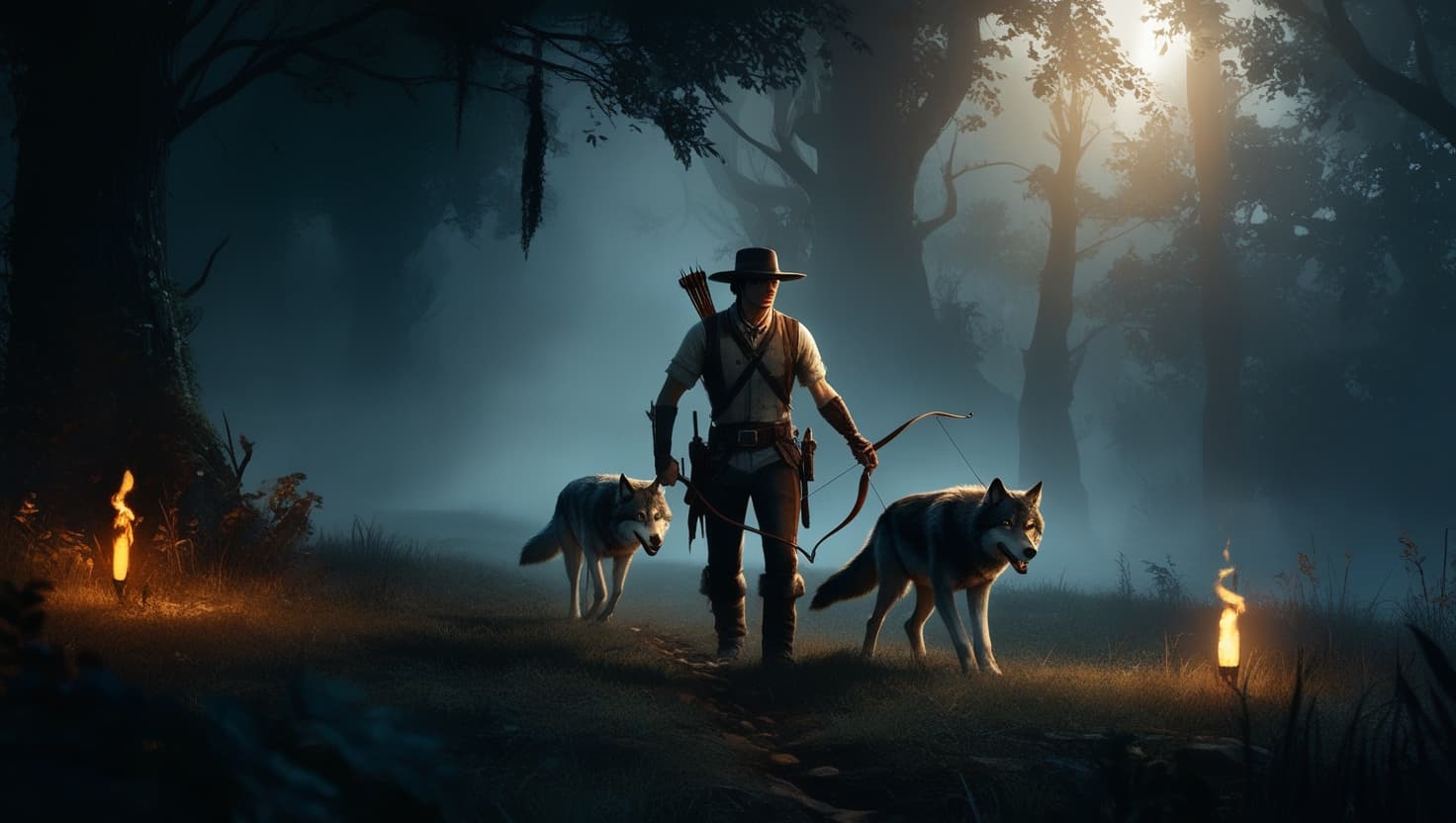
Playing a Ranger With an AI Game Master: The Definitive Guide
Let's address the elephant in the room: Rangers have a reputation problem.
In traditional D&D, half the class features depend on a GM who actually runs exploration, tracks rations, and cares about overland travel. Most human GMs hand-wave all of that. "You travel for three days and arrive at the dungeon." Cool. Thanks. Guess Natural Explorer was a waste of a class feature.
AI Game Masters don't hand-wave anything. And that changes everything for Rangers.
Why Rangers Thrive in AI D&D
Rangers were designed for a version of D&D that most tables never actually play - the version where wilderness travel is dangerous, food matters, getting lost is a real threat, and knowing the terrain gives you a genuine advantage. AI GMs play that version by default.
Exploration actually matters
When you tell the AI your Ranger is navigating through a dense forest, it doesn't skip to the destination. It describes the terrain, presents navigation choices, factors in weather, and creates encounters along the way. Your Ranger's survival skills become the difference between a smooth journey and a disaster.
Natural Explorer isn't a ribbon feature when the AI consistently asks "how do you navigate this stretch of swamp?" and your Ranger is the only one with an answer.
Tracking and scouting get real depth
In traditional games, tracking is often a single Survival check. "You follow the tracks. They lead north." Done.
An AI GM turns tracking into a scene. You find broken branches, disturbed soil, traces of blood. You can ask follow-up questions - how many creatures, how long ago, are they wounded, what direction did the wind carry their scent? The AI builds a trail that rewards investigation, and your Ranger's proficiencies make you the expert at reading it.
The wilderness responds to you
Tell the AI your Ranger communes with nature, and the forest becomes a character in your story. Animals behave differently around you. Weather patterns become readable. The AI weaves your connection to the wild into the narrative in ways that make the Ranger fantasy feel earned, not just stated on a character sheet.
When creating your Ranger in StoryRoll, describe your character's relationship with nature specifically. "Grew up in the northern pine forests" vs. "trained by druids in a coastal marsh" vs. "learned to survive alone in the underdark" will each produce dramatically different AI narration and encounter design.
Best Ranger Builds for AI Campaigns
Gloom Stalker (The Ambush Predator)
Gloom Stalker is widely considered the strongest Ranger subclass, and it's even better with an AI GM. Dread Ambusher gives you an extra attack and extra movement on the first round of combat - and the AI narrates that explosive opening with real dramatic weight.
- Dread Ambusher - the AI describes you materializing from shadows, striking before anyone processes your presence
- Umbral Sight - invisible to darkvision in darkness, which the AI uses to create genuinely tense stealth sequences
- Iron Mind - Wisdom save proficiency keeps you in control when the AI throws mind-affecting enemies at you
- Stalker's Flurry - miss an attack, get a free reroll, and the AI plays it as a quick recovery and counterstrike
The subclass rewards aggressive, first-strike tactics that make every combat opening feel cinematic.
Beast Master (The Companion Pick)
Beast Master has the biggest gap between traditional D&D and AI D&D. In a traditional game, your animal companion is a stat block that attacks when you tell it to. With an AI GM, your companion is a character.
The AI gives your wolf personality. It growls at NPCs it doesn't trust. It curls up near the fire at camp. It reacts to threats before you notice them. Beast Master goes from "mechanically underwhelming" to "the most immersive subclass in the game" purely because the AI treats your companion as a living creature.
Use the Tasha's Cauldron revised Beast Master (Primal Companion) for better action economy. The AI handles both versions, but the revised version lets your companion act more independently. For a full build walkthrough with race picks, companion choices, and level-by-level progression, see our Best Beast Master Ranger Build guide.
Hunter (The Reliable Pick)
Hunter gives you consistent damage upgrades without complex mechanics. Colossus Slayer (extra d8 against wounded enemies) fires constantly, Horde Breaker lets you cleave through groups, and the higher-level features scale your threat against both single targets and mobs.
For players who want the Ranger fantasy without managing a companion or relying on ambush tactics, Hunter is the straightforward choice that always delivers.
Quick Build: The Gloom Stalker
- Race: Wood Elf (Mask of the Wild + Perception boost) or Custom Lineage for a feat
- Fighting Style: Archery (+2 to ranged attacks) or Two-Weapon Fighting for melee
- Key Spells: Hunter's Mark, Pass Without Trace, Rope Trick
- Feat Pick: Sharpshooter (ranged devastation) or Alert (almost guaranteed first turn)
- Playstyle: Strike first, strike hard, vanish before retaliation
Best Campaign Templates for Rangers
D&D 5e: Classic Fantasy
Rangers were made for wilderness-heavy D&D campaigns, and StoryRoll's AI delivers exactly that. Hex crawls, overland journeys, frontier exploration - these are where Rangers dominate.
Best campaign angles for Rangers:
- Tracking a monster through uncharted wilderness
- Defending a frontier settlement from growing threats
- Exploring ancient ruins deep in hostile territory
- Guiding a caravan through dangerous lands (you're the reason everyone survives)
Sci-Fi Mode: The Scout
Reflavor your Ranger as a planetary scout, a wilderness survival specialist on alien worlds. Natural Explorer becomes environmental adaptation. Your animal companion becomes a bio-engineered creature or a scout drone. Hunter's Mark is a targeting HUD overlay.
Rangers map perfectly to the "lone operative on a hostile planet" fantasy. Think Colonial Marines meets survivalist - you're the one who reads the terrain, spots the ambush, and knows which alien plants will kill you.
Fairy Tale Mode: The Woodsman
Fairy tales are full of Rangers who just don't use the name. The huntsman who protects the lost children. The woodsman who knows every path in the enchanted forest. The lone guardian who stands between the village and the dark woods.
This mode leans hard into the Ranger's nature connection, and the AI plays up the mystical side of your bond with the wilderness. Talking animals, ancient trees that share secrets, paths that reveal themselves only to those who know where to look.
Rangers shine brightest in campaigns with significant travel and exploration. If you're planning a campaign that's mostly dungeon crawls or urban intrigue, consider pairing your Ranger with a wilderness-focused campaign concept - or lean into the Hunter/Gloom Stalker combat features that work anywhere.
Roleplaying a Ranger With an AI GM
Define your territory
Rangers are defined by where they come from and what they protect. The AI picks up on this immediately:
- Mountain sentinel - "I scan the ridgeline for movement. Up here, you see trouble coming from miles away"
- Forest warden - "I press my hand against the bark. Something passed through here recently - the trees feel disturbed"
- Coastal tracker - "I read the tide line. Those footprints were made at low tide - they're hours old"
- Urban bounty hunter - "I check the alley for signs of passage. Scuffed cobblestones, a dropped coin - someone left in a hurry"
Your territory defines your language, your instincts, and how the AI frames your expertise.
Let the wilderness speak through you
Rangers notice things other characters miss. Lean into this with the AI:
- Comment on weather changes before they happen
- Identify animal calls and what they mean
- Notice when the forest goes quiet (something's wrong)
- Read terrain for tactical advantages before combat starts
The AI will start feeding you environmental details proactively once it recognizes your Ranger as the party's eyes and ears.
Build your companion's personality (Beast Master)
If you're playing Beast Master, invest in your companion's character. Give it quirks. Does your hawk circle nervously before storms? Does your wolf refuse to enter certain ruins? Tell the AI these details, and it will use them as story hooks and foreshadowing.
Some of the best moments in AI D&D come from companion behavior that the AI generates based on context you've established. Your panther hissing at an NPC who later turns out to be a traitor. Your hawk leading you to water when you're lost. These moments feel organic because the AI is building on the relationship you've defined.
Example Session: Ranger in Action
Here's what a Ranger session actually looks like on StoryRoll:
You: Before we break camp, I want to scout ahead. I'll move quietly through the tree line and look for signs of the gnoll warband we've been tracking.
AI GM: You slip into the pines as dawn light filters through the canopy. The forest floor is soft with needles - good for quiet movement. About two hundred yards north, you find what you're looking for: a cluster of tracks in a muddy streambed. Clawed feet, heavy stride. At least eight creatures, moving in a loose formation. The tracks are fresh - the mud hasn't dried in the edges. They passed through here within the last few hours.
You: Can I tell which direction they're heading? And are there any signs of the missing villagers with them?
AI GM: The tracks lead northeast, toward the rocky ridge you spotted yesterday. Among the gnoll prints, you spot something else: smaller boot prints, dragging. Two sets, maybe three. The stride is uneven - stumbling, exhausted. There are rope fibers caught on a thornbush at knee height. They're bound and being marched.
You: They're alive. I mark the trail and head back to camp. We need to move fast - if they reach those ridgeline caves, we'll lose them.
AI GM: You notch a subtle trail marker into a pine trunk - a mark only a trained eye would recognize - and double back to camp. Your companions are just stirring. The fire has burned down to embers. You have maybe a four-hour lead before the gnolls reach defensible terrain. What do you tell the party?
Notice how the AI engages with the Ranger's specific skills - tracking, terrain reading, trail marking. None of this requires dice rolls or class features. It's the AI recognizing what a Ranger does and building a scene around that expertise.
Common Mistakes (And How to Avoid Them)
Ignoring exploration spells. Rangers get spells like Pass Without Trace, Goodberry, and Locate Creature that don't deal damage but solve real problems. In AI campaigns where travel and survival matter, these spells are often more valuable than Hunter's Mark.
Not using Favored Enemy knowledge. If you have Favored Enemy: Undead, tell the AI you're studying the undead you encounter. Ask about their weaknesses, behaviors, origins. The AI will reward your expertise with useful information that other characters wouldn't get.
Playing your companion as a stat block. If you're Beast Master, narrate what your companion does between combat. It scouts, it forages, it keeps watch. The more life you give it, the more the AI invests in it narratively.
Forgetting you're a half-caster. Rangers get spells. Use them. Spike Growth controls a battlefield. Conjure Animals swings encounters. Healing Spirit keeps the party moving between fights. Don't get so caught up in the martial fantasy that you forget you have a spell list.
Staying in one place. Rangers are built to move. If your campaign has stalled in a city or dungeon for too long, push the story toward the wilderness. Your class features are waiting for you out there.
Rangers and AI Game Masters are the pairing that finally proves the class was never underpowered - it was under-served. When exploration matters, when tracking tells a story, when the wilderness is a character and not just the space between dungeons, Rangers become exactly what they were always supposed to be: the indispensable guide who keeps everyone alive.
Start with Gloom Stalker if you want combat dominance, Beast Master if you want the deepest roleplaying experience, or Hunter if you want reliable performance without complexity. Pick a campaign that puts the wild at the center of the story. And describe your environment interactions with the specificity your Ranger deserves.
Create your Ranger on StoryRoll and discover what happens when the GM never skips the journey.
Try These Free Tools
Keep your Ranger sharp between sessions with these resources:
- Spell Slot Tracker — Track Hunter's Mark, Cure Wounds, and your other half-caster slots.
- Dice Roller — Roll attacks, Hunter's Mark damage, and companion actions.
- Backstory Generator — Build a wilderness-themed backstory with hooks your GM can use.
Frequently Asked Questions
Is Ranger underpowered in AI D&D?
No - and this is the biggest shift from traditional D&D. Ranger's "weak" features (Natural Explorer, Favored Terrain, Primeval Awareness) are only weak when GMs skip exploration. AI GMs don't skip exploration. Your survival and tracking abilities become genuinely useful class features rather than ribbons.
How does Hunter's Mark work with an AI Game Master?
StoryRoll tracks Hunter's Mark automatically - the bonus damage, the concentration, and the ability to transfer it to a new target when the marked creature drops to 0 HP. The AI also uses your mark narratively, describing how you've locked onto your quarry.
Should I use the original Ranger or the Tasha's revised version?
StoryRoll supports both. The Tasha's optional features (Deft Explorer, Favored Foe, Primal Awareness) are generally considered improvements and work well with the AI. If your table allows Tasha's, use them - especially Primal Companion for Beast Master.
What race pairs best with Ranger in AI campaigns?
Wood Elf is the classic pick (Perception, Mask of the Wild, extra movement in forests). Firbolg is thematically perfect and Speech of Beast and Leaf pairs beautifully with AI narration. Human Variant gives you a feat at level 1 - Sharpshooter or Alert are both excellent.
Can Rangers keep up with spellcasters in AI campaigns?
In combat, Gloom Stalker's burst damage rivals any class at low-to-mid levels. Outside combat, Rangers dominate wilderness scenarios that spellcasters can't solve with magic. The AI distributes challenges across combat, exploration, and social pillars - Rangers cover two of those three better than most classes.
Related Class Guides
Exploring other classes for your next AI D&D campaign? Check out our other definitive guides:
Written by Anthony Goodman
Founder of StoryRoll. Building AI-powered tabletop RPGs.
Related Posts
Playing a Monk With an AI Game Master: The Definitive Guide
Ki Points are the tightest resource budget in D&D 5e - and an AI Game Master is built to track every last one. Here's how to play a Monk well.
Playing a Druid With an AI Game Master: The Definitive Guide
Wild Shape isn't just a combat button - it's a second character an AI Game Master can react to in real time. Here's how to play a Druid well.
Playing a Sorcerer With an AI Game Master: The Definitive Guide
Sorcerers don't study magic - they are magic, and every spell is a live decision. Here's how to play one well with an AI Game Master.