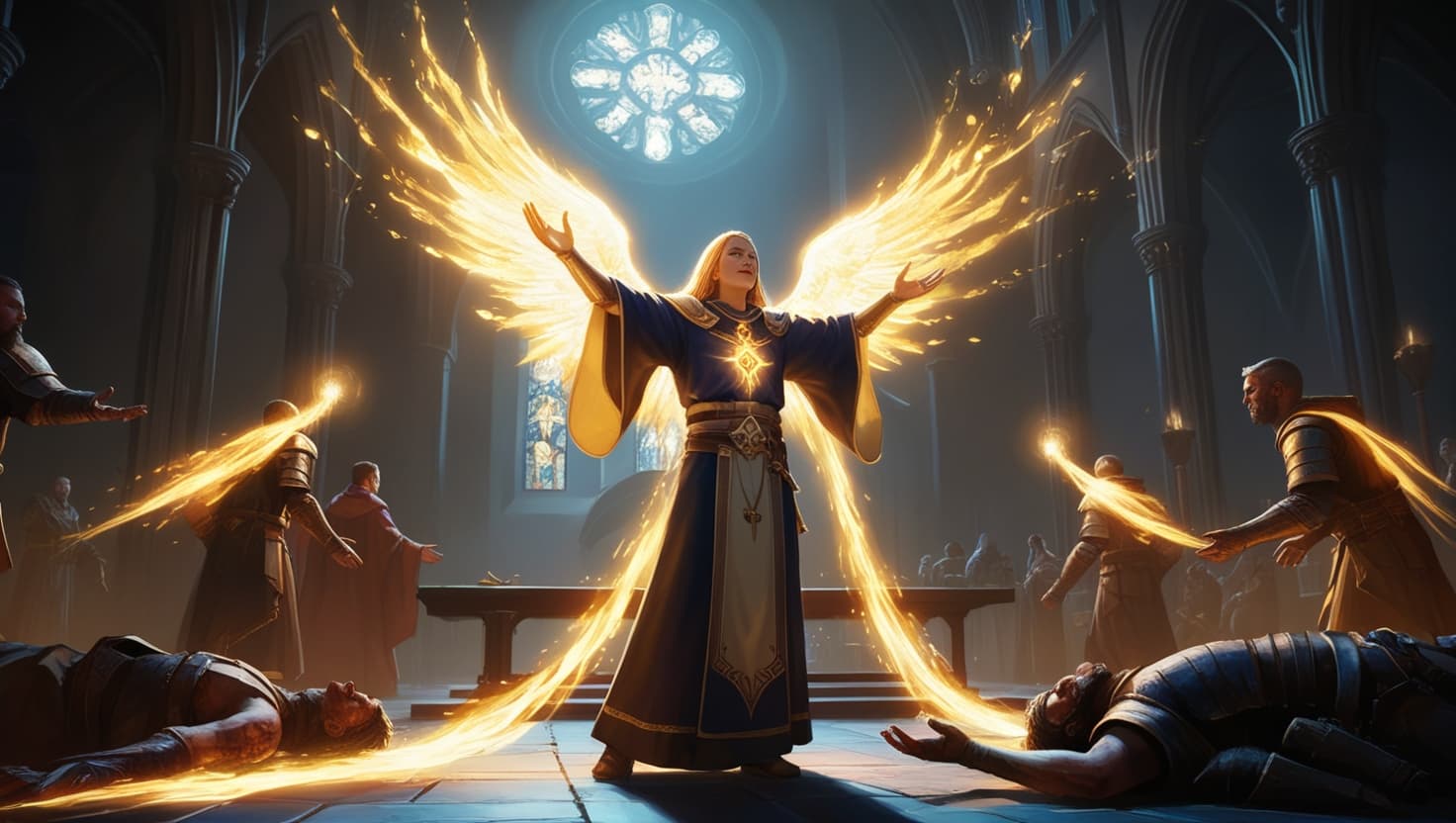
Playing a Cleric With an AI Game Master: The Definitive Guide
Everyone thinks they know what a Cleric does. Stands in the back. Casts Cure Wounds. Gets blamed when someone dies.
Here's what a Cleric actually does: walks into combat in full plate armor, drops Spirit Guardians (a 15-foot radius of divine damage to every enemy near you), summons a Spiritual Weapon (bonus action attack every turn, no concentration), and starts swinging a mace while enemies melt around you. Oh, and you can heal people too, if you feel like it.
Clerics are the most versatile class in D&D. And AI Game Masters don't just handle that versatility well - they make it shine.
Why Clerics Excel in AI D&D
The preparation advantage
Like Wizards, Clerics prepare spells from their full class list each day. Unlike Wizards, Clerics have access to their entire spell list from level 1 - no spellbook required. This means you can prepare the perfect answer for any situation, as long as you anticipated it during your last long rest.
AI GMs make this even better because they create varied encounters. One session might need Dispel Magic and Remove Curse. The next might need Silence and Zone of Truth. The AI doesn't recycle the same encounter types, so your preparation versatility is constantly rewarded.
Divine identity creates story
Every Cleric serves a deity (or a divine concept, in some settings). This gives the AI a rich narrative hook that no other class provides so naturally. Your deity's values create moral dilemmas. Your prayers create atmospheric moments. Your Channel Divinity carries narrative weight beyond its mechanical effect.
A Life Cleric who refuses to heal someone who's committed murder. A War Cleric who blesses weapons before battle with a specific ritual. A Trickery Cleric whose deity communicates through riddles and misdirection. The AI picks up on these character traits and weaves them into the story.
You can do everything (sort of)
Clerics have answers for combat (Spirit Guardians, Guiding Bolt), healing (Cure Wounds, Healing Word), utility (Dispel Magic, Remove Curse), support (Bless, Aid), exploration (Locate Object, Water Walk), and social encounters (Zone of Truth, Calm Emotions). The Cleric spell list draws heavily from abjuration for protective wards and necromancy for spells that manipulate life force - both healing and harming. No other class covers this many bases.
In AI campaigns, where you might face any combination of challenges in a single session, being the Swiss Army knife is a massive advantage.
Don't prepare only healing spells. The most common Cleric mistake is over-preparing for the healer role. Healing Word as a bonus action is usually enough in-combat healing. Your regular action should be Spirit Guardians, Guiding Bolt, or something that prevents damage by ending the fight faster.
Best Cleric Builds for AI Campaigns
Life Domain (The Classic)
Life Clerics heal better than anyone else in the game. Disciple of Life adds your spell level + 2 to every healing spell, which stacks with Healing Word for efficient bonus-action heals. At level 6, your healing spells also heal you.
But Life Clerics aren't just healers. You still get Spirit Guardians, Spiritual Weapon, and full plate armor. You're a tank who can undo damage as fast as enemies deal it.
Best for: Party play, especially with squishy allies. Solo if you want maximum survivability. For a complete build walkthrough with race picks, spell preparation, and level-by-level progression, see our Best Life Cleric Build guide.
Light Domain (The Blaster)
Light Clerics are the closest thing to a Wizard in plate armor. Domain spells include Fireball, Scorching Ray, and Wall of Fire. Warding Flare lets you impose disadvantage on attacks against you. At level 6, you can add radiant damage to your fire spells.
This is the Cleric for players who want to deal damage first and heal second. The AI GM will narrate your divine fire with appropriate reverence - there's something satisfying about a holy warrior who smites enemies with literal pillars of flame.
War Domain (The Front-Liner)
War Clerics attack more than they cast. War Priest gives you bonus action weapon attacks, and your domain spells buff your martial capabilities. You're a Fighter who can also cast spells, rather than a caster who can also fight.
In AI campaigns, War Clerics feel like paladins without the oath restrictions. You're in the thick of combat, dealing consistent damage, and pulling out spells when the situation demands something beyond what a sword can solve.
Trickery Domain (The Wildcard)
Trickery is the most fun domain in AI campaigns. Your Channel Divinity creates a duplicate of yourself, your domain spells include Disguise Self, Mirror Image, and Polymorph, and your deity encourages deception and misdirection.
AI GMs love Trickery Clerics because the subclass creates unpredictable situations. Send your duplicate into a room to trigger a trap. Disguise yourself as a guard. Use Pass Without Trace to make the entire party invisible to patrols. The AI plays along with all of it.
Quick Build: The Battle Priest
- Race: Dwarf (armor proficiency even without domain, Constitution bonus, Poison resistance)
- Domain: Life (survivability) or War (damage)
- Key Spells: Spirit Guardians, Spiritual Weapon, Healing Word, Bless
- Stat Priority: Wisdom > Constitution > Strength
- Playstyle: Front-line caster. Spirit Guardians up, Spiritual Weapon summoned, mace in hand.
Best Campaign Templates for Clerics
The Holy Quest
The obvious choice - and for good reason. Your deity sends you on a mission, you follow divine guidance, and the AI creates a story that weaves your faith into the narrative. Retrieve a sacred relic. Cleanse a corrupted temple. Stop a rival deity's followers from completing a dark ritual.
The AI GM handles divine communication well. Prayers might receive cryptic visions, feelings of warmth or cold, or direct guidance through omens. How your deity "speaks" to you depends on how you describe the relationship in your backstory.
Undead Campaign
Clerics were built to fight undead. Turn Undead is your signature ability, and the AI creates satisfying moments when you raise your holy symbol and watch skeletons crumble or zombies flee. Higher-level Destroy Undead eliminates weaker undead outright.
Understanding which necromancy spells are available to Clerics - and which ones your enemies might use against you - makes these campaigns even richer.
Campaign concepts:
- A plague of undeath spreading across a kingdom
- Entering a necromancer's domain to end their curse
- A haunted city where the dead don't stay buried
Moral Complexity
The most interesting Cleric campaigns put your faith in conflict with practical reality. The AI is excellent at creating situations where the "right" thing to do according to your deity conflicts with what's strategically optimal or emotionally easy.
A Life Cleric whose party wants to assassinate a tyrant. A Light Cleric asked to spare someone who's committed atrocities. A Knowledge Cleric who discovers a truth their temple would rather keep hidden.
These campaigns require you to define your character's faith clearly, and the AI will test it.
Tell the AI about your deity in your character's backstory - even if you make one up. "I worship Tyr, god of justice" gives the AI less material than "I follow Tyr. I believe every person deserves a fair trial, even monsters. My symbol is a balanced scale I wear on a chain around my neck." Details create story hooks.
Roleplaying a Cleric With an AI GM
Your faith is your character
Every class has a defining trait. For Wizards, it's intellect. For Rogues, it's cunning. For Clerics, it's faith. The question isn't "what god do you worship" - it's "what does that faith look like in practice?"
- The Devout - prays before meals, before battle, before sleep. Cites scripture. Sees divine will in everything.
- The Doubter - believes, but questions. Follows the god's path while wondering if they chose right.
- The Radical - interprets their deity's teachings in ways the church wouldn't approve of.
- The Quiet Faithful - doesn't preach, doesn't pray loudly. Just does what their god would want.
- The Chosen - doesn't feel worthy of divine power but can't deny it's real.
Each of these archetypes produces wildly different story beats with an AI GM. The Doubter gets tested. The Radical faces institutional opposition. The Chosen receives signs they can't ignore.
Heal strategically, not reflexively
In AI campaigns, combat healing is usually less efficient than dealing damage to end the fight faster. The enemy deals 15 damage per round. You can heal 10 per round, or you can cast Spirit Guardians and deal 15+ damage per round to every nearby enemy, ending the encounter two rounds sooner.
Healing Word (bonus action, ranged) is your emergency tool - use it to pick up unconscious allies. For everything else, be a warrior first, healer second.
Channel Divinity is your signature moment
Channel Divinity is a short-rest resource, which means you get it back frequently. Use it. Turn Undead when you're outnumbered by undead. Use your domain channel when the situation calls for it. The AI narrates these moments with divine gravitas - light blazing from your holy symbol, enemies recoiling, allies bolstered.
Don't save it for the "perfect moment." Use it when it's useful. You'll get it back.
Example Session: Cleric in Action
You: As we approach the ruined chapel, I kneel and pray. I ask my deity for guidance - is there still something sacred here, or has this place been fully corrupted?
AI GM: You press your palms together, murmuring the invocation of discernment. For a long moment, nothing. Then - a warmth in your chest. Not comfort, exactly. More like recognition. Something holy lingers here, deep beneath the corruption. Like a candle flame behind smoke. Your deity acknowledges what was lost - and what might be restored.
As your prayer fades, you notice something. The weeds growing through the chapel's broken floor avoid the altar. Everything else is overgrown, but a perfect circle around the stone altar remains bare. The corruption doesn't touch that spot.
You: I tell the party: "There's still consecrated ground here - the altar. If things go badly inside, fall back to that spot." I cast Detect Magic as I enter the chapel. What am I picking up?
AI GM: Heavy Necromancy magic saturates the building like damp rot. It's strongest in the basement - below the chapel floor. But the altar reads differently: faint Abjuration, old and steady. A protection that's been holding for years, maybe decades, against the encroaching darkness. It's weakening, though. Without renewal, it might fail within days.
Something moves in the shadows behind a collapsed pew. A low, rattling breath.
You: I raise my holy symbol. "In the name of the Morninglord - show yourself, or be judged."
AI GM: The shadows shift. Two shapes emerge - humanoid, desiccated, dressed in the rotting remains of priestly vestments. Once, they served the same god whose consecration protects the altar. Their eye sockets glow with pale, stolen light. They hiss at your symbol but do not flee. These undead were powerful in life, and death hasn't fully stripped their defiance.
You: Channel Divinity: Turn Undead. Let the light decide if they remember who they served.
The Cleric experience at its best: faith as narrative driver, divine magic as problem-solving tool, and undead as the natural enemy you were designed to face.
Common Mistakes (And How to Avoid Them)
Playing a pure healer. You're a full caster in heavy armor. Spirit Guardians deals more damage per round than most party members' attacks. Use your action offensively and save Healing Word for emergencies.
Forgetting concentration. Spirit Guardians requires concentration. So does Bless. So does Hold Person. You can only maintain one at a time. Pick your concentration spell at the start of combat and protect it.
Ignoring domain spells. Your domain gives you always-prepared spells that don't count against your preparation limit. These are free. Use them. Light Clerics get Fireball for free. Life Clerics get Beacon of Hope. Check your domain list.
Not using your armor. You have heavy armor proficiency (in most domains) and a shield. Your AC should be 18-20 from level 1. Stand in the front. You can take it.
Preparing too many situational spells. Resistance to specific damage types, niche divination spells, and highly conditional utility spells sound good in theory. In practice, prepare your core combat package (Spirit Guardians, Spiritual Weapon, Healing Word, Bless) first, then fill remaining slots with situational picks.
Clerics are the most self-sufficient class in D&D, and AI Game Masters bring out their full potential. The combination of heavy armor, full spellcasting, healing, and divine identity gives you tools for every situation the AI creates.
Start with Life Domain if you want the safety net, Light if you want to deal damage, War if you want to fight up close, or Trickery if you want to keep the AI guessing. Whatever you choose, define your faith clearly in your backstory - it's the single most important thing you can do for your Cleric's narrative.
Spirit Guardians + Spiritual Weapon is your default combat setup. Healing Word is your emergency button. Everything else is situational and wonderful.
The Cleric's secret weapon in AI D&D isn't any spell - it's the relationship with your deity. That relationship gives the AI a narrative engine that runs the entire campaign. Every prayer is a story beat. Every crisis of faith is a character moment. No other class gives the AI this much to work with.
Create your Cleric on StoryRoll and discover your divine calling.
Try These Free Tools
Level up your Cleric prep with these free resources:
- Spell Slot Tracker — Track your prepared spells and remaining slots across encounters.
- Spell List Filter — Browse and filter the full Cleric spell list by level, school, and concentration.
- Dice Roller — Roll Spirit Guardians damage, healing dice, and saving throws.
Frequently Asked Questions
Which healing spells should I always have prepared as a Cleric?
Healing Word is non-negotiable - it's a bonus action, ranged heal that picks up unconscious allies. Beyond that, Cure Wounds for out-of-combat healing and Revivify at level 5 for death insurance. Don't over-prepare healing at the expense of your offensive and utility spells.
How does Turn Undead work in AI campaigns?
You present your holy symbol, and every undead within 30 feet must make a Wisdom saving throw or be turned (forced to flee) for 1 minute. The AI handles the saves and narrates the divine power pushing back the undead. At higher levels, weaker undead are destroyed outright.
Can Clerics wear heavy armor from level 1?
Most domains grant heavy armor proficiency (Life, War, Forge, Nature, Tempest, Twilight, Order). Light, Knowledge, Trickery, Arcana, Grave, and Death domains give medium armor only. Check your domain's proficiencies - if you have heavy armor, use it. 18 AC with chain mail and a shield from level 1 is powerful.
How important is my deity choice for the story?
Very. The AI uses your deity's portfolio (what they're god of), alignment, and values to create story hooks, moral dilemmas, and divine communications. A Cleric of a war god gets different story beats than a Cleric of a knowledge god. Spend time on this choice - it shapes your entire campaign.
Is Cleric good for solo AI D&D?
Cleric might be the best solo class in the game. Heavy armor for survivability, healing spells for self-sufficiency, Spirit Guardians for damage, and utility magic for problem-solving. You don't need a party when you can tank, heal, and deal damage simultaneously.
Related Class Guides
Exploring other classes for your next AI D&D campaign? Check out our other definitive guides:
Written by Anthony Goodman
Founder of StoryRoll. Building AI-powered tabletop RPGs.
Related Posts
Playing a Monk With an AI Game Master: The Definitive Guide
Ki Points are the tightest resource budget in D&D 5e - and an AI Game Master is built to track every last one. Here's how to play a Monk well.
Playing a Druid With an AI Game Master: The Definitive Guide
Wild Shape isn't just a combat button - it's a second character an AI Game Master can react to in real time. Here's how to play a Druid well.
Playing a Sorcerer With an AI Game Master: The Definitive Guide
Sorcerers don't study magic - they are magic, and every spell is a live decision. Here's how to play one well with an AI Game Master.