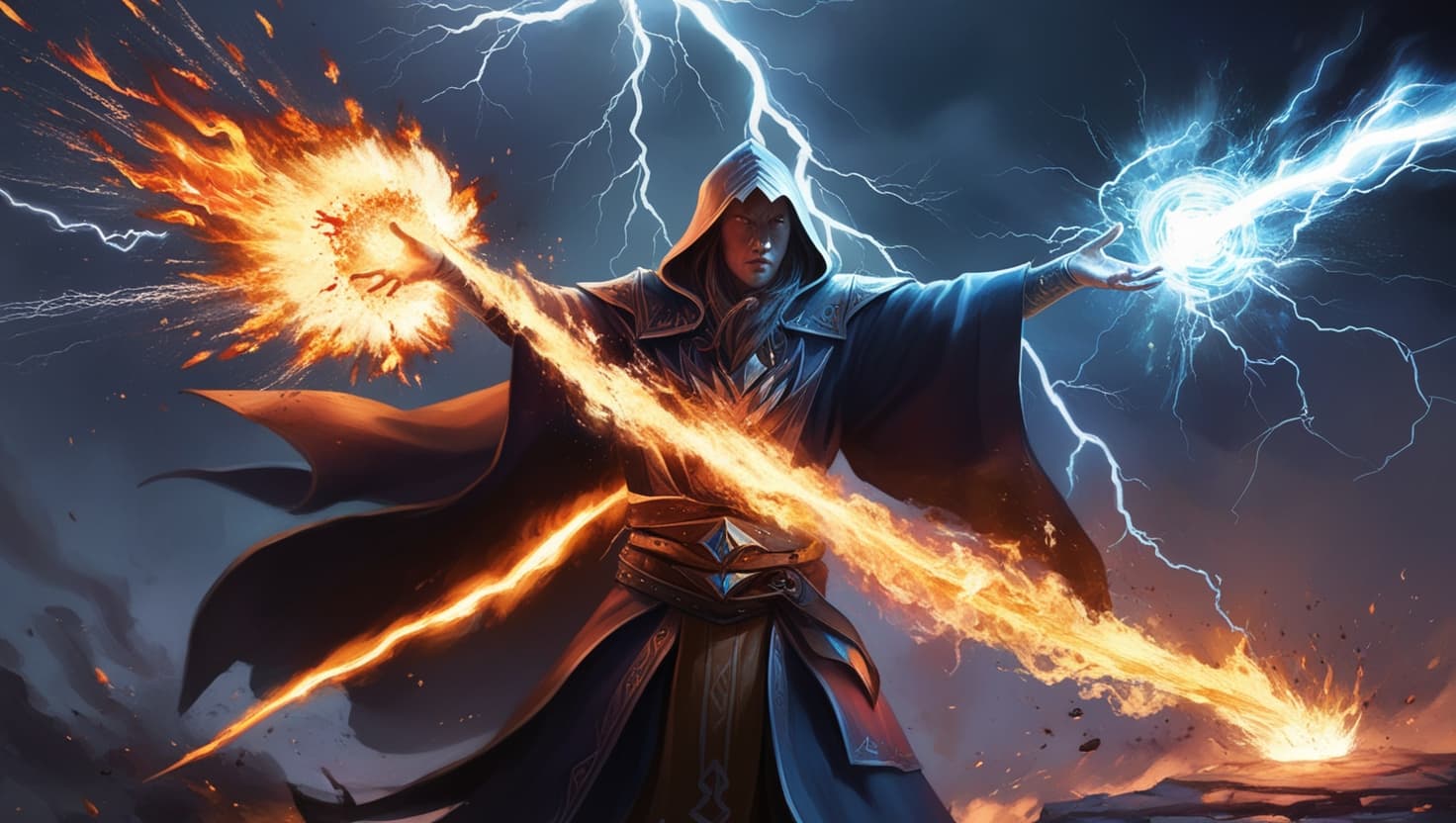
The 10 Best Evocation Spells in D&D 5e, Ranked
Evocation is the school of raw power. No subtlety, no tricks, no puppeting minds or rewriting reality. You point at something and it explodes, freezes, or gets struck by lightning. Every spellcaster in D&D has at least a few Evocation spells on their list, because sometimes the answer to a problem is just "more damage."
But not all Evocation spells are created equal. Some dominate encounters from the moment you learn them. Others look impressive on paper and underperform at the table. This ranking covers the spells actually worth your spell slots, preparation slots, and attention.
10. Sacred Flame
Cantrip | Cleric
Starting at the bottom because it's a cantrip, but Sacred Flame earns its spot. Dexterity save (many heavy enemies dump Dex), radiant damage (almost nothing resists it), and it ignores cover. That cover clause is the hidden gem - when enemies are crouching behind barricades, Sacred Flame doesn't care.
It falls behind other cantrips in raw damage scaling, and the lack of an attack roll means you can't crit. But for Clerics who need a reliable damage option between spell slots, it's always there.
9. Shatter
2nd Level | Bard, Sorcerer, Wizard
Thunder damage in a 10-foot radius. 3d8 isn't going to win any damage contests, but Shatter has a niche that keeps it relevant: it deals extra damage to objects and constructs. Animated armor, iron golems, that locked door your Rogue can't pick - Shatter handles all of them.
The real value is availability. Bards get this, which gives a class with almost no damage options a way to contribute in fights where Vicious Mockery isn't cutting it.
8. Spiritual Weapon
2nd Level | Cleric
Spiritual Weapon breaks the action economy. It's a bonus action to cast, a bonus action to attack on subsequent turns, requires no concentration, and lasts a full minute. That's a free d8 + spellcasting modifier every turn on top of whatever else you're doing.
It doesn't scale as dramatically as other spells on this list, and the damage type (force) is almost never resisted. The lack of concentration is what makes it absurd - you can run Spirit Guardians and Spiritual Weapon simultaneously, turning your Cleric into a walking damage aura with a floating mace.
7. Spirit Guardians
3rd Level | Cleric
Speaking of which. Spirit Guardians deals 3d8 radiant (or necrotic) damage to every enemy that starts its turn within 15 feet of you or enters the area. No attack roll from you - they make Wisdom saves, half damage on success. And it halves their movement speed.
Walk into a room full of enemies. Stand there. They take damage for existing near you. This spell does more total damage per combat than Fireball in most encounters, because it hits every single turn instead of once. The catch is concentration and the requirement to be in melee range, which is terrifying for a Cleric with medium armor.
Spirit Guardians plus Spiritual Weapon is the Cleric's bread-and-butter combo. Together they deal damage every turn using your bonus action and enemy turns, while your main action stays free for healing, dodging, or casting non-concentration spells.
6. Lightning Bolt
3rd Level | Sorcerer, Wizard
Lightning Bolt lives in Fireball's shadow. Same level, same damage (8d6), but a 100-foot line instead of a 20-foot sphere. That line is both its strength and weakness - you can't hit a cluster of enemies as easily, but you can thread it through a narrow corridor and hit everything in a row.
Where Lightning Bolt beats Fireball: indoor environments. Dungeons are full of hallways, corridors, and tight formations. A well-placed Lightning Bolt hits 4-5 enemies in a line that Fireball would miss (or would also catch your party). And lightning damage has fewer immunities than fire across the Monster Manual.
5. Cone of Cold
5th Level | Sorcerer, Wizard
8d8 cold damage in a 60-foot cone. Cone of Cold is your room-clearer - wider area than Fireball, higher average damage, and cold damage hits most things that fire doesn't. The 60-foot range means you're catching enemies across the entire encounter space.
The Constitution save is the only downside. Con is the one save that almost everything has a decent bonus in, so your hit rate is lower than Fireball's Dex save against large creatures. But when it lands, it lands hard. And it kills - creatures that drop to 0 HP from Cone of Cold become frozen statues, which is narratively incredible.
4. Wall of Fire
4th Level | Druid, Sorcerer, Wizard
Wall of Fire is battlefield control disguised as a damage spell. Create a 60-foot long wall of fire. One side deals 5d8 damage to creatures within 10 feet when the wall appears, and again to anything that starts its turn there or passes through it.
The tactical applications are enormous. Split an enemy group in half. Block a retreat route. Create a corridor enemies have to walk through to reach you, taking damage every time. AI Game Masters handle this well because they respect the wall as terrain - enemies won't casually walk through it unless they're desperate or immune to fire.
Concentration and a 4th-level slot are the costs. Worth every bit of it.
3. Eldritch Blast
Cantrip | Warlock
A cantrip at #3 might seem wrong. But Eldritch Blast isn't really a cantrip - it's the Warlock's entire combat identity. Multiple beams (up to 4 at level 17), each dealing 1d10 force damage, each targetable independently. Force damage is resisted by almost nothing in the entire game.
Then stack Invocations. Agonizing Blast adds Charisma modifier to each beam. Repelling Blast pushes targets 10 feet per hit. Lance of Lethargy reduces speed. Grasp of Hadar pulls them toward you. With the right build, Eldritch Blast is dealing 4d10+20 damage per turn with battlefield manipulation, using zero resources.
No other cantrip comes close. Most Warlocks cast Eldritch Blast more than every other spell combined, and that's not a flaw - it's the class working as designed.
Evocation By the Numbers
- Most damaging cantrip: Eldritch Blast (4d10 + modifiers at level 17)
- Most efficient AoE: Spirit Guardians (ongoing damage, no action required)
- Best single-target burst: Disintegrate (10d6+40, average 75)
- Widest area: Meteor Swarm (four 40-foot spheres, mile range)
- Most resisted damage type: Fire (40+ creatures immune)
- Least resisted damage type: Force (1 creature resistant in official content)
2. Meteor Swarm
9th Level | Sorcerer, Wizard
The biggest boom in D&D. Four meteors, each creating a 40-foot-radius explosion. 20d6 fire + 20d6 bludgeoning damage. Average 140 damage on a failed save, 70 on a success. A mile of range.
Meteor Swarm doesn't just kill things. It ends encounters. It destroys buildings. It reshapes the landscape. The bludgeoning damage component means fire-resistant creatures still take massive punishment.
The obvious limitation: you get one 9th-level slot per day, and you're spending it on this instead of Wish. That tradeoff is real. But when the situation calls for obliterating an army, a fortress, or a dragon and its entire lair, nothing else answers the question as completely.
1. Fireball
3rd Level | Sorcerer, Wizard
You knew it was coming.
Fireball isn't the highest-damage spell on this list. It's not the most tactical. Its damage type is the most commonly resisted in the game. And it's still #1 because no other spell defines a tier of play the way Fireball defines levels 5-10.
8d6 fire damage in a 20-foot-radius sphere. That's a 40-foot-diameter explosion hitting potentially every enemy in an encounter, available at the same level you get Extra Attack as a martial class. Fireball is the spell that makes Wizards and Sorcerers feel like they're worth the squishy hit die and the slow start.
It upscales efficiently (1d6 per slot level), has a 150-foot range, and ignites every flammable object that isn't worn or carried. It's the first spell most D&D players learn, the first spell most D&D players cast, and for many tables, the spell that defines the game.
The designers have openly admitted that Fireball is intentionally overpowered for its level. It was too iconic to nerf.
Honorable Mentions
Healing Word (1st level) - a bonus action ranged heal. The best emergency healing spell because it picks up downed allies from 30 feet away without costing your action.
Guiding Bolt (1st level) - 4d6 radiant damage and the next attack against the target has advantage. The best 1st-level damage spell in the game, and it stays useful for its advantage-granting effect at higher levels.
Disintegrate (6th level) - 10d6+40 force damage, average 75, and if it drops someone to 0 HP they're dust. No body, no Revivify. The save-or-suck element hurts its reliability, but the floor-to-ceiling damage range makes it a terrifying single-target nuke.
How StoryRoll Handles Evocation Spells
AI Game Masters handle Evocation well because these spells have clear mechanical effects. Fireball deals X damage in Y area - there's not much room for interpretation disagreements. But the real advantage is environmental narration.
StoryRoll describes what your spells do to the world. Fireball doesn't just deal 28 damage - it scorches the stone floor, ignites the tapestries, fills the room with smoke that reduces visibility. Lightning Bolt leaves a burnt line across the grass. Cone of Cold freezes the puddles and rimes the walls with frost.
This environmental detail isn't cosmetic. It creates tactical information. When the smoke from your Fireball obscures the far side of the room, enemies have cover. When your Cone of Cold freezes the wet floor, the AI might call for Dexterity checks on the surface. Your spells affect the world, and the world responds.
The AI also handles friendly fire honestly. If your Sorcerer drops a Fireball on a cluster of enemies and your Fighter is in the radius, the Fighter takes damage. No fudging, no "I'll assume you aimed it to miss your ally." Evocation Wizards with Sculpt Spells get to exclude allies, and the AI respects that class feature automatically.
Build your blaster on StoryRoll and see how AI-narrated explosions feel.
Evocation is the school for players who believe the best status effect is dead. These spells are straightforward, powerful, and satisfying in a way that no amount of clever Enchantment or Illusion work can replicate. When the dragon lands and everyone looks at the Wizard, Evocation is the reason they're looking.
The best Evocation spells share a common trait: efficiency. Fireball is efficient for its level. Spirit Guardians is efficient for sustained damage. Eldritch Blast is efficient for a resource-free option. Wall of Fire is efficient for area denial. Pick the right spell for the situation and watch the hit point totals drop.
If you're new to spellcasting, start with Evocation. You'll learn the rhythm of spell slots, positioning, and resource management while doing the most fun thing in D&D: setting things on fire.
Try These Free Tools
Get more out of your Evocation spells with these resources:
- Spell List Filter — Browse every Evocation spell by class and level to plan your prep.
- Spell Slot Tracker — Track Fireball, Spirit Guardians, and the rest of your slot budget.
- Dice Roller — Roll 8d6 Fireball damage, Sacred Flame saves, and everything in between.
Frequently Asked Questions
What is the strongest Evocation cantrip in D&D 5e?
Eldritch Blast, by a wide margin. With Invocations like Agonizing Blast, it deals more damage per turn than most leveled spells. For non-Warlocks, Fire Bolt (1d10 fire damage, 120-foot range) is the best general-purpose damage cantrip.
Is Evocation Wizard a good subclass?
Evocation Wizard is one of the easiest and most effective Wizard subclasses. Sculpt Spells at level 2 lets you drop area damage without hitting allies. Empowered Evocation at level 10 adds your Intelligence modifier to every damage roll. If you want to play a blaster, this is the subclass. Our complete Evocation Wizard build guide covers race picks, spell preparation, and level-by-level progression.
Why is Fireball better than Lightning Bolt?
They deal the same damage (8d6 at 3rd level), but Fireball hits a 20-foot-radius sphere while Lightning Bolt hits a 5-foot-wide, 100-foot line. The sphere hits more enemies in most situations. Lightning Bolt is better in narrow corridors or when you need to avoid hitting allies positioned to your sides.
What Evocation spells work against fire-immune creatures?
Cone of Cold (cold), Lightning Bolt (lightning), Shatter (thunder), and Eldritch Blast (force) all bypass fire immunity. Smart Evocation casters prepare at least one non-fire damage option for encounters where Fireball is useless.
Can you upcast Fireball?
Yes. Fireball deals an additional 1d6 damage per spell slot level above 3rd. A 5th-level Fireball deals 10d6 (average 35) damage. The scaling is efficient enough that upcasting Fireball remains competitive with higher-level damage options through mid-tier play.
Written by Anthony Goodman
Founder of StoryRoll. Building AI-powered tabletop RPGs.
Related Posts
Enchantment Spells Ranked: The Best (and Worst) in D&D 5e
Every Enchantment spell worth preparing in D&D 5e, ranked from useful to encounter-ending. Suggestion, Hold Monster, Dominate Person, and the rest of the school of the mind.
Transmutation Spells Ranked: The Best (and Worst) in D&D 5e
Every Transmutation spell worth preparing in D&D 5e, ranked from situational to game-breaking. Haste, Polymorph, Fly, and the rest of the school of change.
The 10 Best Divination Spells in D&D 5e, Ranked
Divination trades damage for something rarer: information. These are the spells worth your prepared list, from Detect Magic to True Seeing.