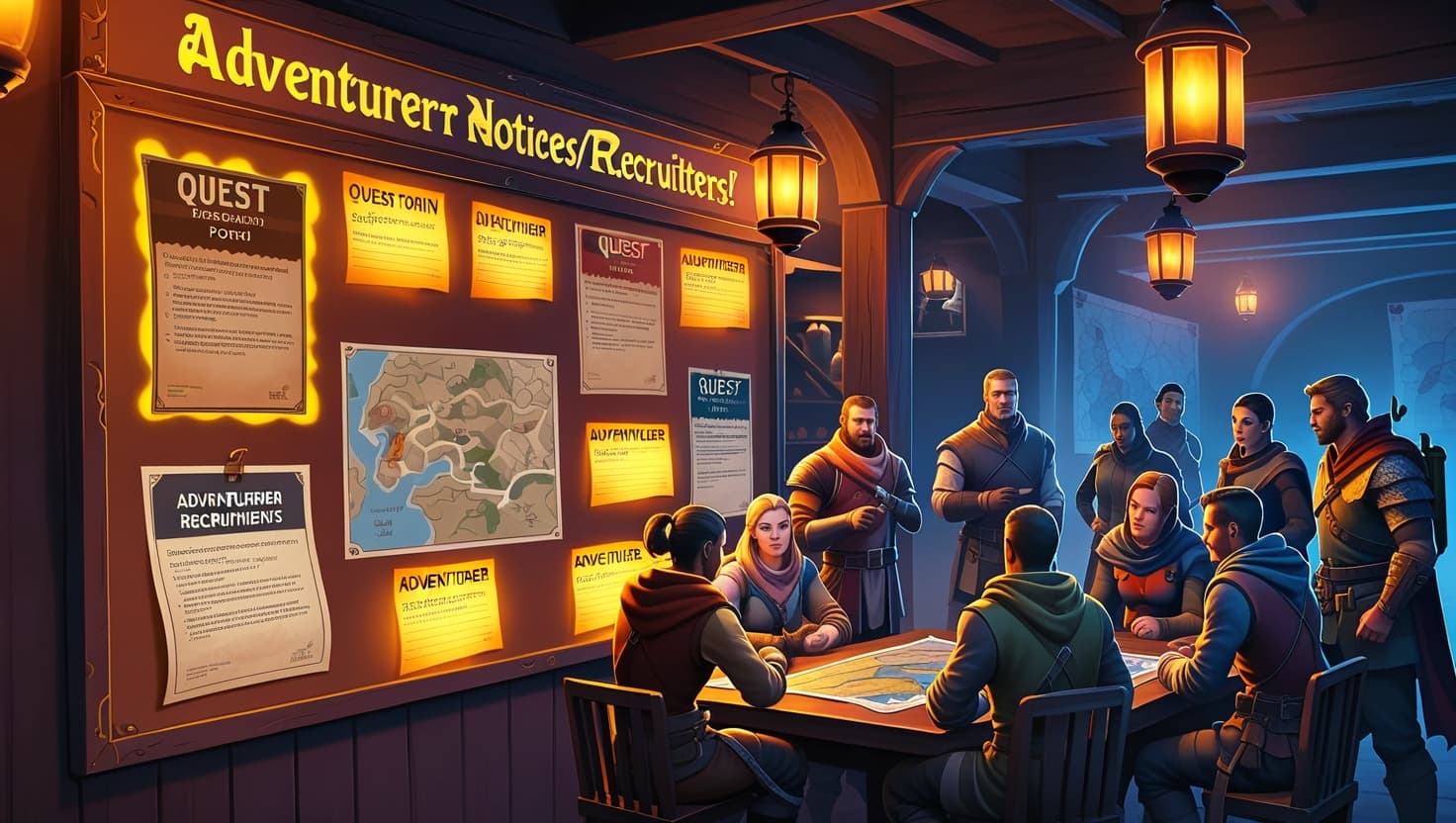
How to Find a D&D Group in 2026 (Even If You Know Zero People Who Play)
Fifty million people have played D&D. Finding four of them who are free on Thursday nights shouldn't require a blood sacrifice and a LinkedIn-level networking strategy. If you want to play D&D but don't know anyone who plays, you're not alone - it's the most common problem in the hobby.
And yet.
r/lfg - Reddit's 900,000-member "Looking for Group" community - gets thousands of posts a week from people trying to find a table. When a DM posts offering a game, they get 20 to 50+ applications within hours. When a player posts looking for a DM? Crickets. Maybe one reply. Usually zero.
The demand is real. The supply problem is structural. But it's 2026, and the number of ways to actually get into a game has never been higher. Some of them are obvious. A few are underrated. One of them didn't exist two years ago.
r/lfg and Reddit LFG Communities
This is where most people start, and for good reason. r/lfg is the largest TTRPG matchmaking community on the internet, with over 900,000 members actively posting games and looking for players.
The catch: it works very differently depending on which side of the screen you're on.
If you're a DM offering a game, you'll be drowning in applicants. Post a well-written listing with clear expectations (system, schedule, tone, experience level) and expect your inbox to fill up within a few hours.
If you're a player looking for a DM, the math is brutal. The DM-to-player ratio on Reddit skews heavily toward player surplus. Your post will compete with hundreds of others, and most DMs are already full.
The move nobody makes: Instead of posting "player looking for group," sort r/lfg by New and respond to DM posts within the first hour. Write 3-4 sentences about yourself, your experience, and what kind of game you enjoy. DMs pick players who put effort into their responses - a thoughtful reply beats "hey can I join?" every time.
Other subreddits worth checking: r/DnDLFG, r/roll20LFG, and your city's local subreddit (search "[city name] D&D" or "TTRPG"). Smaller communities often have better ratios because fewer people know about them.
Best for: Players who are willing to hustle, respond fast, and sell themselves a bit. DMs who want their pick of players.
D&D Discord Servers
Discord is where the actual groups form. Reddit is the job board; Discord is the office.
Large community servers like D&D Beyond's official Discord, Altrole (specifically built for teaching new players), and game-specific servers all have LFG channels. The advantage over Reddit is speed - you're already in the communication tool the group will use to schedule and play.
Some servers run organized play where games fire on a regular schedule with rotating DMs and players. This is wildly underrated for people who want to play without the commitment of a weekly campaign. Drop in, play a session, leave. No drama when your schedule changes.
The quality varies enormously. A 50,000-member server's LFG channel can be as noisy and low-signal as Reddit. A 500-member server focused on a specific playstyle might land you a perfect group in a week.
Best for: People comfortable with Discord who want to find groups that communicate in real-time. Especially good for one-shots and pickup games.
Your Local Game Store
Walk into a game store. Ask if they run D&D nights. Sit down at a table. Play D&D.
This is the method that somehow feels the most intimidating and is actually the easiest. Adventurers League - Wizards of the Coast's organized play program - runs at game stores worldwide. It's designed for drop-in play. You don't need to know anyone. You don't need a character (they'll help you make one). You just need to show up.
I'm going to say something mildly controversial: Adventurers League games are often mid. The adventure modules are hit-or-miss, the table dynamics are unpredictable with rotating strangers, and the rules constraints can feel limiting compared to a home game.
But that's not the point. The point is you're meeting real people who play D&D in your area. The connections you make at AL tables turn into home game invitations. Two months of showing up consistently is worth more than a year of Reddit posts.
Not just game stores: Libraries, community centers, and universities increasingly host TTRPG nights. Check your local library's event calendar - you might be surprised. College D&D clubs are also a goldmine if you're a student or near a campus.
Best for: Anyone who wants to meet players in person. The single best pipeline from "I know nobody" to "I have a regular group."
Roll20 and VTT LFG Forums
Roll20's built-in LFG tool is one of the oldest online group-finding methods, and it's still functional if clunky. You search by game system, schedule, and preferences, then apply to join listings.
The platform has the advantage of keeping everything in one place - once you find a group, you're already on the VTT you'll use to play. Foundry VTT doesn't have its own LFG, but communities like The Foundry Discord serve the same function.
Roll20's LFG suffers from the same DM supply problem as everywhere else, but the listings tend to be more detailed (since they're structured forms rather than freeform posts). You can filter by experience level, which helps beginners avoid tables that expect system mastery.
Best for: People who want an all-in-one solution and don't mind the Roll20 interface.
Paid DM Services (StartPlaying.games)
This is the option that makes TTRPG purists twitch, and I think it's legitimately great for specific situations.
StartPlaying.games is a marketplace where professional DMs list their games. You browse by system, schedule, genre, and price ($10-25/session is typical). You pay per session. The DM shows up prepared, experienced, and invested in your fun because you're literally their client.
Is it weird to pay for something the hobby has always done for free? A little. Is it weirder to spend six months failing to find a group when you could be playing next Tuesday for the price of a movie ticket? I'd argue yes.
Professional DMs also tend to be genuinely good at running games. They've done it hundreds of times. They know how to handle table dynamics, pace a session, and make new players feel welcome. If your first D&D experience is with a pro DM, you're getting a better introduction to the hobby than most people get from their friend's friend who "totally knows how to DM."
- StartPlaying.games - Largest marketplace, $10-25/session
- Outschool - D&D games for kids/teens, vetted DMs
- RPG Tutoring - One-on-one D&D coaching for beginners
Best for: People with more budget than time. New players who want a guaranteed good first experience. Groups of friends who want to play together but nobody wants to DM.
The "Convert a Friend" Strategy
Here's the method nobody writes about because it can't be SEO'd: convince someone you already know to play.
D&D's mainstream visibility has never been higher. Baldur's Gate 3 sold 15 million copies. Critical Role has hundreds of millions of views. Stranger Things put D&D in front of every Netflix subscriber on Earth. The cultural barrier to entry has basically evaporated.
The person in your life most likely to say yes probably already thinks D&D sounds interesting but assumes they need to find a group of experienced players to try it. They don't. They need you, a one-shot adventure, and an evening.
Run a beginner one-shot for 2-3 friends. Use pre-made characters. Keep it to 3 hours. If it clicks, you've got a group. If it doesn't, you've had a fun evening and lost nothing.
This is how most long-running D&D groups actually form. Not through LFG posts. Through someone saying "hey, want to try this?" at a dinner party.
Best for: Anyone with friends who are vaguely interested but haven't been asked directly.
Meetup.com and Local TTRPG Groups
Meetup still works. It's not flashy. The website looks like it was designed in 2014 (because it was). But in many cities, the most active D&D communities organize through Meetup groups.
Search for "D&D," "TTRPG," "tabletop RPG," or "board games" in your area. Many board game meetups include TTRPG tables. Some cities have dedicated D&D meetup groups that run multiple games a week.
The demographics tend to skew slightly older than Reddit or Discord - more working professionals, fewer college students. If that's your crowd, this might be your best bet.
Best for: Adults who prefer in-person play and structured social groups.
AI Dungeon Masters: Skip the Search Entirely
Every method above shares one constraint: you need a human Dungeon Master.
That's the bottleneck. That's always been the bottleneck. Not enough people want to DM, and the ones who do are already running games for their existing groups. The entire LFG ecosystem is essentially a DM allocation problem disguised as a social one.
AI Dungeon Masters remove the bottleneck entirely.
We built StoryRoll specifically for this problem. You pick a campaign, invite friends (or play solo), and the AI handles narration, NPCs, combat, dice mechanics, and even generates art for your scenes. No DM needed. No scheduling roulette. No ghosting after session two.
StoryRoll
Groups without a DM, solo players, people tired of the LFG grind
Full AI Dungeon Master with multiplayer support, real TTRPG mechanics, and AI-generated scene art. Start a campaign in under 2 minutes. Invite friends via link.
Is an AI DM the same as a human DM? No. A great human DM brings improvisation, emotional intelligence, and years of storytelling instinct that AI can't replicate. But the comparison isn't "AI DM vs. amazing human DM." For most people, the comparison is "AI DM vs. not playing at all."
And AI DM wins that comparison every single time.
Other AI options exist too - you can cobble something together with ChatGPT (our guide covers how), though it requires a lot of manual work and falls apart once you need dice mechanics or consistent world state.
Best for: People who've been stuck in LFG purgatory. Solo players. Groups of friends where nobody wants to DM. Anyone who just wants to play tonight.
What Actually Works: A Ranking
After helping thousands of players find games (and spending years trying to find groups ourselves), here's how these methods stack up in practice:
Tier 1 - Highest success rate:
- Local game store / Adventurers League (in-person connections compound)
- Convert a friend + run a one-shot (you control the whole process)
- AI DM platforms (zero dependency on finding a human DM)
Tier 2 - Works but requires effort:
- Discord LFG servers (fast-moving, need to be active)
- r/lfg and Reddit (volume play - cast a wide net, respond fast)
- Paid DM services (guaranteed but costs money)
Tier 3 - Situational:
- Roll20 LFG (functional, declining usage)
- Meetup.com (city-dependent)
- Facebook groups (hit-or-miss, trending older)
The best approach? Run two or three simultaneously. Post on r/lfg, join a Discord server, and show up at your game store's next D&D night. Or skip the entire pipeline and fire up an AI DM session tonight while you wait for the human options to materialize.
Tips for Actually Getting Picked
If you're a player competing for spots in online games, these details matter more than you think:
Write a real application. "I'm a player looking for a group" tells a DM nothing. Mention your experience level, what kind of games you enjoy (combat-heavy? roleplay-focused? silly? serious?), your availability, and one specific thing about the listing that interested you. Having a fleshed-out character concept helps too - the backstory generator can give you a compelling hook to include in your application.
Be flexible on schedule. The more narrow your availability window, the fewer games you qualify for. "I can only do Saturdays 6-10 PM EST" eliminates 90% of listings.
Don't ghost Session Zero. DMs track who shows up. If you commit to a Session Zero and no-show without notice, you're done with that DM and probably their network too. TTRPG communities are smaller than you think.
Try a system that isn't 5e. The DM shortage is most acute for D&D 5e specifically. Pathfinder, Call of Cthulhu, Mothership, Blades in the Dark - all have active communities with better DM-to-player ratios because fewer players are competing for spots.
Offer to DM. The nuclear option. If you can't find a DM, become one. It's less scary than it sounds. Run a beginner one-shot, use a published adventure so you don't have to write anything, and see if you like it. The hobby needs you. Our NPC name generator can stock your first session with memorable characters in seconds.
Finding a D&D group in 2026 is simultaneously easier and harder than it's ever been. Easier because the tools, communities, and alternatives have multiplied. Harder because demand has exploded while the DM supply hasn't kept pace. The players who actually get into games are the ones who try multiple channels, respond quickly to opportunities, and stay flexible. Or they sidestep the entire problem with an AI DM and start playing tonight. Either way - the game's out there. Go find it.
Frequently Asked Questions
How long does it take to find a D&D group?
It depends on your method and flexibility. Showing up at a local game store can get you playing the same week. Online LFG posts typically take 1-4 weeks of active searching. Paid DM services can get you into a game within days. AI DM platforms let you start immediately.
Is D&D Beyond good for finding groups?
D&D Beyond itself doesn't have a dedicated LFG feature, but the D&D Beyond Discord server has an active LFG channel. It's a decent supplementary option but not a primary group-finding tool.
Should I join an existing campaign or start a new one?
For beginners, joining a campaign at Session 1 or a one-shot is ideal - you're not walking into established dynamics and inside jokes. If the only openings are mid-campaign, ask the DM how they handle new player integration. Good DMs make it seamless.
What if I have social anxiety about joining a D&D group?
Start with online text-based games (many Roll20 and Discord games are play-by-post or text-only). AI DM platforms offer zero social pressure for your first sessions. Check out our guide for playing D&D with social anxiety for more specific advice.
What should I listen to while I search for a group?
While you're waiting for a group to come together, D&D podcasts are a great way to learn what good gameplay looks like and stay motivated. Hearing how other tables handle roleplay and combat will make you a more confident player when you do find your group.
Written by StoryRoll Team
Founder of StoryRoll. Building AI-powered tabletop RPGs.
Related Posts
How to Play D&D Online: Complete Beginner Guide (2026)
Never played D&D before? No group, no dice, no clue where to start? This step-by-step guide takes you from zero to your first online session in under 30 minutes.
How to Play D&D Online in 2026: The Definitive Guide
Everything you need to know about playing D&D online in 2026. Five proven methods - from virtual tabletops to AI Game Masters - with honest pros, cons, and a comparison table so you can pick what fits your group.
I Want to Play D&D But I Don't Know Anyone - Here's What I Did
I spent years wanting to play D&D but never had a group. Here's the honest story of every method I tried - and the one that finally worked.