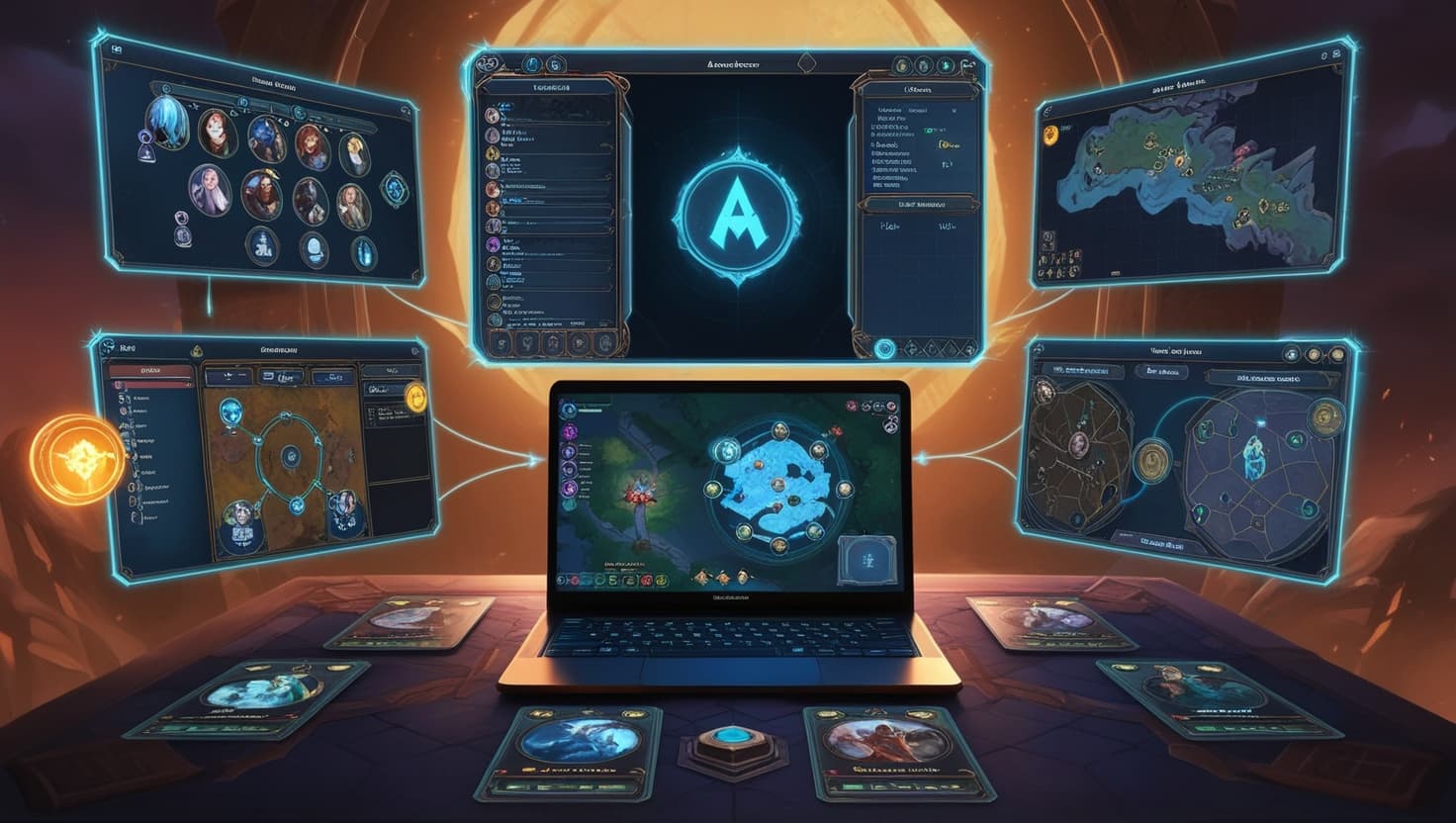
How to Play D&D Online in 2026: The Definitive Guide
You want to play D&D. Your friends want to play D&D. The problem - as always - is making it actually happen.
Maybe your group is scattered across three time zones. Maybe nobody wants to learn the rules well enough to run the game. Maybe you tried Roll20 once, spent two hours configuring a map, and never opened it again. Whatever the reason, the dream of a regular D&D game keeps dying somewhere between the group chat and the first session.
Good news: 2026 has more options for playing D&D online than any year before it. Some of those options didn't exist eighteen months ago. The challenge isn't finding a way to play - it's finding the right way for your specific group.
This guide covers five proven methods. Each has real trade-offs. We'll be honest about all of them, including the one we make.
Five ways to play D&D online in 2026:
- Virtual Tabletops (Roll20, Foundry VTT, Owlbear Rodeo) - digital maps, tokens, dice
- AI Game Master platforms (StoryRoll) - the AI runs the game, no GM needed
- Discord / Zoom theater of the mind - voice chat + imagination
- Play-by-post - asynchronous text-based games across time zones
- Hybrid (in-person + digital tools) - the best of both worlds
Method 1: Virtual Tabletops (VTTs)
Virtual tabletops are software that recreates the physical D&D table digitally: maps, tokens, character sheets, dice, fog of war. They're the most established way to play online, and for groups with an experienced Game Master, they're hard to beat.
The big three
Roll20 is the most popular VTT. It's browser-based, has a free tier that covers the basics, and a massive marketplace of pre-made adventures. The learning curve is moderate - a new GM can run a decent session after a couple hours of tutorials. The trade-off is a cluttered interface and a subscription model that adds up if you want the good features (dynamic lighting, advanced character sheets).
Foundry VTT is Roll20's power-user cousin. It's a one-time $50 purchase with no subscription. The module ecosystem is enormous and community-driven. But the setup is more involved - you're self-hosting software, installing modules, and configuring systems. For technically-inclined GMs who want full control, it's the gold standard. For everyone else, it's a rabbit hole.
Owlbear Rodeo takes the opposite approach: dead simple, entirely free, no account required. Share a link, drop tokens on a map, roll dice. It doesn't do character sheets or automation, but if all you need is a shared battle map, it's perfect.
For a deeper comparison, see our VTT tier list or our Roll20 vs Foundry vs StoryRoll breakdown.
Who VTTs are for
Groups that have a committed Game Master who enjoys the technical side of running games. Players who want tactical combat with proper maps and positioning. Long-running campaigns where the investment in setup pays off over dozens of sessions.
Who VTTs aren't for
Groups where nobody wants to GM. Groups that tried Roll20 and bounced off it. Groups that want to play tonight without two hours of prep first. If this sounds like you, keep reading.
Method 2: AI Game Master Platforms
This is the newest category, and it solves the oldest problem in D&D: someone has to run the game.
AI Game Master platforms use large language models to handle everything a traditional GM does - narration, NPC dialogue, rules enforcement, encounter design, and story adaptation based on player choices. The AI doesn't need to prep. It doesn't cancel. It's available whenever your group is.
How it works
On a platform like StoryRoll, you create a campaign, pick a setting (classic fantasy, sci-fi, fairy tale), and invite your friends. Everyone builds a character - or lets the AI help with a backstory generator - and you're playing within minutes. The AI narrates the world, voices NPCs, generates scene art as you explore, and handles combat with 3D dice and D&D 5e rules.
No one in your group needs to know the rules. The AI handles initiative, ability checks, saving throws, and damage calculations. If you're new to D&D, this is the lowest-friction way to experience it.
Multiplayer is the point. AI GM platforms aren't just for solo play. StoryRoll is built for groups - 2 to 5 players adventuring together in real time, with the AI adapting the story to everyone's choices.
What AI GMs do well
- No prep, no scheduling around a GM. The biggest barrier to D&D is removed entirely.
- Rules handled automatically. Nobody needs to memorize the Player's Handbook.
- Always available. Tuesday night works? So does Sunday morning. No calendar Tetris.
- Scene art and voice narration. Every important moment gets illustrated. The AI speaks aloud.
- Adaptive storytelling. The AI responds to what players actually do, not a pre-written script.
What they don't do (yet)
AI GMs are not the same experience as a brilliant human Game Master who's been running your campaign for two years. They don't remember your character's inside jokes from session 12 (though session memory is getting better). They don't do the funny voice for your favorite NPC that makes everyone laugh. If you have a great GM, keep them. AI platforms are for when you don't have one.
Who this is for
Groups that can't find a GM. Friends who've never played but want to try. Solo players who want a full RPG experience without a group. Anyone who wants to play tonight instead of next month.
Method 3: Discord / Zoom Theater of the Mind
No maps. No tokens. No software to learn. Just a voice call and everyone's imagination.
Theater of the mind is how D&D was played for decades before VTTs existed. The GM describes the scene, players say what their characters do, and dice decide what happens. You can run this on Discord (with a dice bot), Zoom, Google Meet, or any voice chat platform.
What you need
- A voice chat app (Discord is the most popular for D&D)
- A dice bot (Avrae for Discord handles D&D 5e character sheets and rolls)
- Someone willing to GM
- Pencil and paper (or a shared Google Doc for notes)
Pros
It's free. It's simple. It puts the focus on storytelling and roleplay over tactical combat. The GM doesn't need to spend hours building maps. And because there's less tech overhead, sessions often feel more natural and conversational.
Cons
You still need a GM. Without visual aids, complex combats can get confusing ("Wait, am I next to the ogre or behind the pillar?"). It requires a GM who's confident enough to run encounters without a map, and players who are comfortable imagining the scene.
If you're curious about this approach, our theater of the mind guide goes deeper into how to make it work.
Method 4: Play-by-Post
Play-by-post is D&D at the speed of texting. Players post their actions in a forum thread or Discord channel, the GM responds when they can, and the story unfolds over days or weeks instead of hours.
Where people play
- Discord servers - dedicated channels for each campaign, with dice bots
- Reddit - r/pbp has thousands of games looking for players
- Dedicated platforms - Role Gate, Tavern Keeper, and others built specifically for async play
Pros
Plays across any time zone. No scheduling needed - everyone posts when they can. Writing-focused players often produce more detailed, creative roleplay than they would in a live session. You can run multiple campaigns simultaneously because each one only takes a few minutes per day.
Cons
Combat takes forever. A single fight that would be 20 minutes at a live table can take two weeks in play-by-post. Games fizzle easily - it only takes one player to stop posting for momentum to die. And you still need a GM, one who's willing to write detailed narrative responses regularly.
Who this is for
Writers who love worldbuilding. Groups split across time zones who can't find a common session time. People who want D&D to be a background activity they engage with throughout the day.
Method 5: Hybrid (In-Person + Digital Tools)
Some groups play around a physical table but use digital tools to enhance the experience. This hybrid approach has gotten increasingly popular as the tools have gotten better.
Common hybrid setups
- TV or monitor as a battle map. A cheap TV laid flat (or mounted) displays maps from Owlbear Rodeo or a VTT while players use physical minis or tokens.
- D&D Beyond for character sheets. Everyone manages their character on a phone or tablet. The GM uses DDB's encounter tools.
- AI tools for prep. The GM uses AI to generate NPC dialogue, encounter ideas, or campaign outlines before the session.
Pros
Best of both worlds. You get the social energy of being in the same room with the organizational benefits of digital tools. Maps look gorgeous on a big screen. Character sheets update automatically.
Cons
You need everyone in the same physical location. Setup requires some hardware (TV, cables, stands). And you still need a GM.
The Comparison Table
Here's an honest side-by-side of all five methods:
| Method | Need a GM? | Setup Time | Cost | Best For |
|---|---|---|---|---|
| Virtual Tabletop | Yes | 2-6 hours | Free–$50+/year | Tactical combat, long campaigns |
| AI Game Master | No | 5-10 minutes | Free–$15/month | No-GM groups, beginners, spontaneous play |
| Discord/Zoom | Yes | 15-30 minutes | Free | Roleplay-heavy, low-tech groups |
| Play-by-Post | Yes | 10 minutes | Free | Cross-timezone, writing-focused |
| Hybrid | Yes | 1-2 hours | $0-200 (hardware) | Local groups wanting digital aids |
Notice a pattern? Four of five methods require someone to be the Game Master. If your group doesn't have one - and most groups don't - that narrows your options fast.
How to Choose the Right Method
Start with two questions:
1. Does anyone in your group want to GM?
If yes: great. You have all five options. Pick based on how much setup your GM wants to do and how your group prefers to play (tactical vs. narrative, synchronous vs. async).
If no: your realistic options are an AI Game Master platform or convincing someone to step up. We've written about how to find a group if you want to find a GM externally, but for your existing friend group, an AI platform is the path of least resistance.
2. When do you want to play?
If tonight: AI Game Master or Discord theater of the mind. Both can go from zero to playing in under 30 minutes. Everything else requires prep time.
If you're willing to invest a few sessions of setup: a VTT gives the richest experience once it's configured.
If scheduling is the problem: play-by-post eliminates the need for everyone to be online at the same time.
Getting Started Tonight
Whatever method you picked, here's how to start right now:
VTT route: Create a free Roll20 account, pick a free adventure module, and send your group the link. Budget an hour of your own time to learn the basics before session one.
AI Game Master route: Head to StoryRoll, create a campaign, and share the invite link with your friends. Pick your class - or just let the AI help you build a character from scratch. You'll be playing in under ten minutes.
Discord route: Create a server, add the Avrae dice bot, create a voice channel called "D&D Night," and tell whoever's GMing to read our one-shot guide for a low-prep first session.
Play-by-post route: Head to r/pbp on Reddit and browse open games, or start your own in a Discord server with a dedicated text channel.
Hybrid route: Pick up an inexpensive TV, download Owlbear Rodeo, and lay the screen flat on your table. Use physical dice and minis on top of the digital map.
The Real Barrier Was Never the Platform
Here's the truth nobody in the VTT comparison space wants to say: the technology was never the hard part. The hard part is getting a group of adults to commit to the same recurring time slot, with one of them volunteering dozens of prep hours, and maintaining that commitment for months.
Every method on this list solves the technology problem. Only some of them solve the people problem. AI Game Masters solve it by removing the biggest bottleneck - the GM. Play-by-post solves it by removing the scheduling constraint. Hybrid solves it by lowering the tech barrier when you're already together.
Pick the one that removes your biggest obstacle. Then stop researching and start playing.
Your adventure is waiting. Roll for initiative.
Written by StoryRoll Team
Founder of StoryRoll. Building AI-powered tabletop RPGs.
Related Posts
Do You Need a Virtual Tabletop to Play D&D Online?
Everyone assumes you need a VTT to play D&D online. But what if the best sessions you'll ever have don't involve a single battle map? Here's an honest look at when you need a VTT - and when you really don't.
Best Virtual Tabletops for D&D in 2026 (And When You Don't Need One)
Roll20, Foundry VTT, Owlbear Rodeo, Talespire, and more - ranked by what actually matters. Plus: the scenarios where a VTT is overkill and what to use instead.
The Easiest Ways to Play D&D Online (No Experience Needed)
Every way to play D&D online, ranked by how easy it actually is to get started. From self-hosted servers to 'just click a link and play' - find the option that fits your group.