How to Play D&D With Social Anxiety (And Actually Enjoy It)
The r/dndnext post has 2,000 upvotes. "Should I leave my group due to social anxiety?" And the top comment is some variation of: talk to your DM. Which is correct. And also the last thing someone with social anxiety wants to hear.
Here's what nobody writes in those threads: the specific, tactical stuff. What to do when your turn comes and your brain goes blank. How to pick a group that won't make things worse. Why some tables feel like therapy and others feel like a job interview. The mechanics of showing up when showing up is the hard part.
This is that post.
D&D and Social Anxiety - An Unexpected Match
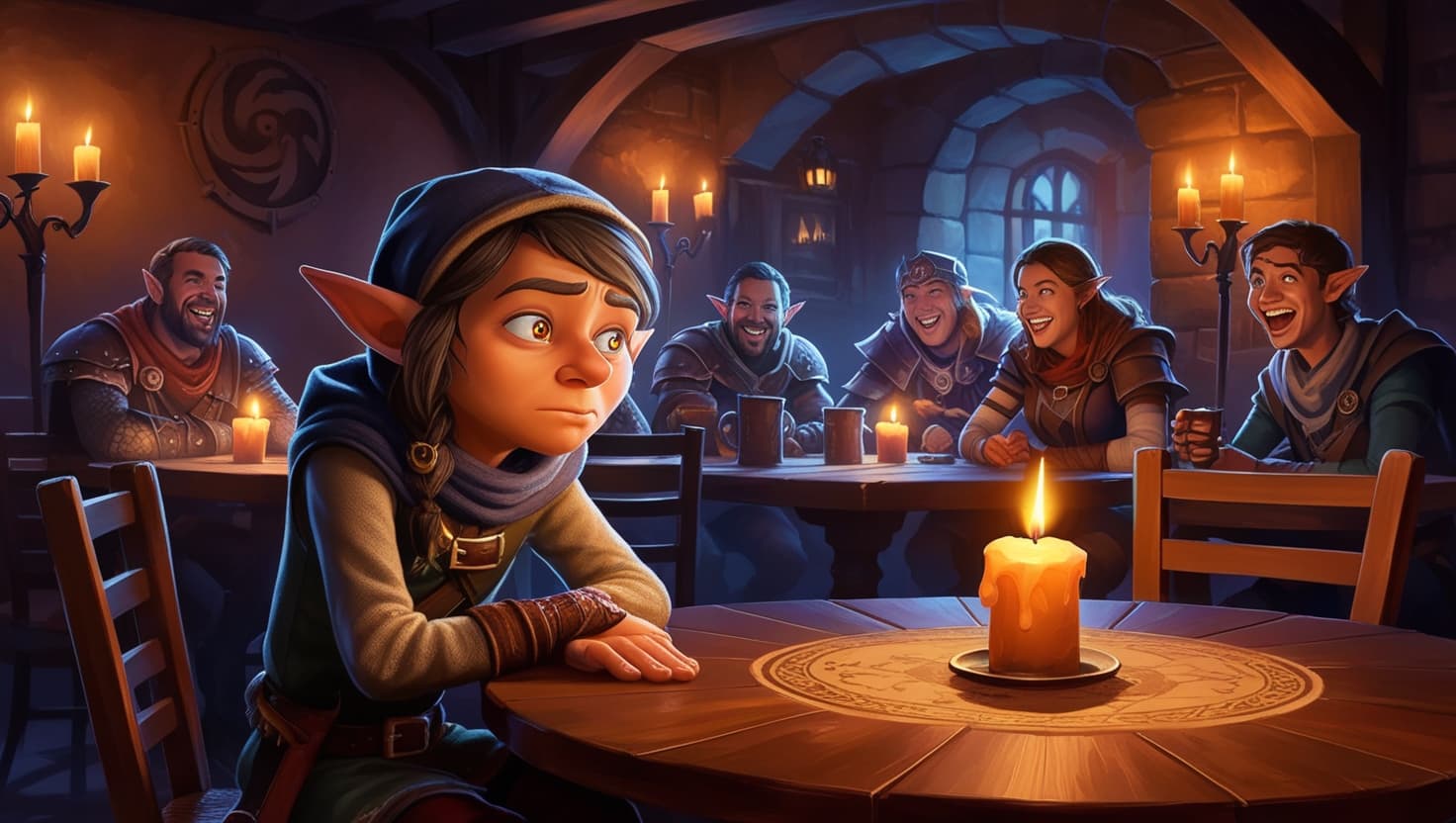
D&D is, on paper, a nightmare scenario for social anxiety. You're performing in front of people. Making decisions under pressure. Speaking in a fictional voice while adults watch you. It sounds like an improv class designed by a sadist.
But something weird happens at good tables: the anxiety shrinks.
A 2023 study published in Professional Psychology: Research and Practice found that therapeutic tabletop RPG groups showed measurable reductions in social anxiety symptoms over 10 weeks. The researchers credited three mechanisms: the "mask" effect of character play, the structured turn-taking that eliminates conversational ambiguity, and the shared vulnerability of everyone doing something slightly embarrassing together.
That tracks with what thousands of players report on Reddit, Discord, and therapy couches. D&D works for anxious people because of its structure, not despite it. You don't have to figure out when to talk - it's your turn. You don't have to be yourself - you're Thordak the barbarian. You don't have to carry a conversation - there's a plot.
Social anxiety vs. introversion: They're different things. Introverts lose energy in social settings but may not fear them. Social anxiety involves actual fear or dread of social judgment. You can be an extrovert with social anxiety. This post addresses anxiety specifically, though introverts will find useful stuff here too.
Finding a Group That Won't Make It Worse
The group matters more than the game. A bad table will convince you that D&D isn't for you. A good one will make you forget you were anxious.
What to look for:
- Small groups. 3-4 players max. Every additional person at the table increases social complexity exponentially. A party of three feels like hanging out. A party of seven feels like a town hall meeting.
- Session Zero. Any DM who runs a Session Zero is already thinking about player comfort. If a group skips it, that tells you something about their priorities.
- Explicit safety tools. Lines and veils, X-cards, whatever the specific mechanism - groups that use them tend to be groups that care about how players feel. This isn't about being "soft." It's about basic table maintenance.
- Text-based or play-by-post options. If voice chat is too much initially, text games exist. They're slower, but they remove the real-time performance pressure entirely. r/lfg and r/pbp have listings specifically for text games.
What to avoid:
- Groups that describe themselves as "no holds barred" or emphasize that they don't use safety tools. They're usually fine for the people already in them and terrible for anyone who needs accommodation.
- Open tables at game stores where you don't know anyone. These can work great once you're comfortable, but as a first experience with anxiety, the unpredictability is brutal.
- DMs who put players on the spot for not roleplaying "enough." Your comfort level is your comfort level.
How to Play D&D With Social Anxiety: The Tactical Stuff
Theory's nice. Here's what actually helps at the table.
Pick the Right Class
This sounds trivial. It isn't.
Some classes demand more spotlight time than others. A bard who's the party face needs to roleplay conversations constantly. A battlemaster fighter can contribute enormously by just saying "I attack the one on the left" and rolling dice. Neither is better D&D. But one requires less social bandwidth.
Lower-pressure classes: Fighter, Barbarian, Ranger, Monk. Heavy on combat decisions, lighter on social expectations. You can absolutely roleplay these deeply, but nobody will expect you to.
Higher-pressure classes: Bard, Warlock (Pact of the Chain gets you a familiar to hide behind, though), Sorcerer with subtle spell shenanigans. These classes often end up talking to NPCs because their abilities revolve around social interaction.
Pick whatever you want, obviously. But if anxiety is a factor, knowing which classes come with social expectations helps you prepare.
Pre-Write Your Character's Personality
Improvising is hard when your brain is screaming. So don't improvise - at least not at first.
Write down three phrases your character would say. "I don't trust this." "Let me check for traps first." "We should rest before going further." When your turn comes and you blank, you've got a script. Nobody will know. It just sounds like you're in character.
Write down your character's default reaction to conflict (fight, negotiate, avoid), their opinion on authority (respect it, resent it, ignore it), and one quirk that gives you something to fall back on. A character who compulsively counts things. A character who always speaks to animals before people. Something small that you can perform without having to invent on the spot.
The index card trick: Write your character's three go-to phrases, their personality traits, and their bond/flaw on an index card. Keep it next to your character sheet. When you freeze, glance down. It's not cheating - it's preparation.
Use Third-Person Narration
"My character says she doesn't trust the merchant" is just as valid as putting on a voice and saying "I don't trust ye, merchant." Both are roleplaying. One requires acting. The other requires describing. For anxious players, describing is usually easier.
Most DMs are perfectly fine with third-person narration. If yours insists on first-person voices from day one, that's a DM problem, not a you problem.
You can graduate to first-person over time. Or never. Plenty of veteran players narrate in third person because they prefer it. There's no progression ladder you're supposed to climb.
Know Your Turns in Advance
Anxiety spikes when you're put on the spot. Combat has a turn order. Use other people's turns to plan yours.
Know your three most common actions. For a fighter, that's probably: Attack, Second Wind, Action Surge. Know your spell slots if you're a caster. Have your dice ready. When the DM says your name, you've already decided. "I cast Guiding Bolt on the skeleton. That's... 14 to hit." Clean. Fast. No fumbling.
Outside combat, you can signal your DM that you'd prefer not to be the one talking to NPCs. A quick message before the session - "hey, I'm going to hang back on the social stuff today, can you direct NPC conversations to [other player]?" - works. Good DMs adjust without making it A Thing.
The Online Option
Playing online removes several anxiety triggers at once. No physical presence. No reading the room. Mute buttons exist.
Voice chat (Discord, etc.) is the most common format and still requires real-time talking, but you can turn off your camera, play from a comfortable space, and mute yourself when you need a breath. The barrier is lower than a physical table.
Text-based play - either real-time in something like Discord or asynchronous in play-by-post forums - eliminates the performance aspect almost entirely. You have time to think. You can edit before you send. Nobody sees you hesitate.
AI DM platforms are the most recent option. Tools like StoryRoll let you play D&D with an AI running the game. No strangers. No judgment. No one watching you fumble through a conversation with a fictional bartender. You can play alone or invite friends you already trust.
That's not a replacement for the social benefits of a full table - and the research on anxiety reduction specifically credits the group dynamic. But as a way to practice the mechanics, build confidence with roleplaying, and figure out what you enjoy before joining strangers? It's genuinely useful. (We built StoryRoll, so take that with the appropriate context. But we built it partly because we know this problem firsthand.)
- Small groups - 3-4 players reduces social complexity
- Pre-write phrases - Script your character's go-to lines
- Third-person narration - Describe actions instead of performing them
- Text-based games - Remove real-time pressure entirely
- Plan combat turns - Use others' turns to prepare yours
- Talk to your DM - A quick message about preferences goes far
When the Anxiety is About Roleplaying Itself
There's a specific flavor of D&D anxiety that isn't about the social setting - it's about the performance. The doing-a-voice thing. The pretending thing. The being-watched-while-pretending thing.
Two things worth knowing:
Most players don't do voices. The Critical Role effect has convinced a generation that D&D means professional voice acting. It doesn't. Matt Mercer is an outlier. The vast majority of D&D tables involve normal people talking normally about what their characters do. If your reference point for D&D is a show performed by actors, recalibrate.
You're allowed to be bad at it. The barbarian player who just says "I hit it" every combat? Having a great time. The wizard player who reads their spells off the sheet in a monotone? Contributing. The rogue who's been quiet for twenty minutes and then says one devastating thing? Iconic, actually. There's no minimum performance threshold.
The anxiety often imagines a spotlight that doesn't exist. At most tables, everyone is too busy thinking about their own character to scrutinize yours.
What DMs Should Know
If you're a DM reading this because a player mentioned their anxiety:
Don't make it a spectacle. Don't announce "we're going to be extra supportive for [player]." Just be a good DM.
- Direct questions to other players when you sense someone's struggling. Don't cold-call the anxious player.
- Offer choices instead of open-ended prompts. "Do you want to fight, negotiate, or sneak past?" is easier than "What do you do?"
- Text your players between sessions. "Hey, anything you want your character to do next session?" gives anxious players time to prepare instead of improvise.
- Keep your table small. Four is the magic number for a reason.
- Run a Session Zero. Ask about comfort levels. Believe the answers.
Don't play therapist. D&D can be therapeutic. It is not therapy. If a player's anxiety is severe enough that they're consistently distressed at your table, the kindest thing is to suggest professional support - not to redesign your game around their symptoms. You're a DM, not a clinician.
The Paradox Worth Sitting With
D&D asks you to be vulnerable in front of people. Social anxiety is, at its core, a fear of being vulnerable in front of people. That's the tension. And that's also why it works.
The game gives you armor. Literally - your character has armor. But also figuratively: there's a character between you and the table. When Thordak the barbarian charges into battle and screams a war cry, it's not you screaming. When Thordak says something awkward to the tavern keeper, it's not you being awkward. The character absorbs the social risk. Over time, the distance between you and the character might shrink. And that's when the anxiety starts losing ground.
Not every table will be the right one. Not every session will feel safe. That's true for everyone, not just anxious players. But the odds are better than you think. The D&D community has, in aggregate, gotten significantly better at this stuff over the past five years. Safety tools are mainstream. Inclusivity isn't a fringe position anymore. And the hobby is actively trying to welcome exactly the kind of people who are most nervous about showing up.
You don't have to do a voice. You don't have to be funny. You don't have to carry the party. You just have to show up, roll some dice, and let yourself be a little bit brave - through someone else first, if that's what it takes.
Social anxiety and D&D aren't opposites - they're a productive tension. The game's structure, character mask, and collaborative nature make it more accessible than most social activities, not less. Start with a small group (or solo with an AI DM), use third-person narration, pre-write your character's personality, and give yourself permission to participate at whatever level feels manageable. The table will still be there when you're ready to do more.
Try These Free Tools
Practice at your own pace before joining a table, or use these during a session to feel more prepared:
- Dice Roller — Get comfortable with dice rolls in a zero-pressure environment before game night.
- Backstory Generator — Build a character backstory ahead of time so you have personality details ready when roleplaying moments come up.
- Encounter Calculator — Understand encounter difficulty so you know what to expect in combat and can plan your turns in advance.
Frequently Asked Questions
Can you play D&D with social anxiety?
Yes. D&D's structured turn-taking, character roleplay "mask," and collaborative format make it more accessible than unstructured social activities. Millions of players with social anxiety play regularly - many credit the game with helping them manage their symptoms over time.
Is D&D good for social anxiety?
Research suggests yes. A 2023 study in Professional Psychology: Research and Practice found measurable anxiety reduction in therapeutic RPG groups over 10 weeks. The mechanisms include character-mediated social interaction, structured participation, and shared vulnerability among players.
What's the best D&D class for anxious players?
Classes with lower social expectations - Fighter, Barbarian, Ranger, Monk - let you contribute through combat without pressure to roleplay NPC conversations. But play whatever interests you. No class requires you to do voices or perform.
How do I tell my DM about my anxiety?
A quick text before the session works best: "Hey, I might hang back on social scenes. Can you direct NPC conversations to other players when I'm quiet?" Good DMs will adjust without making it a big deal. If your DM reacts poorly, that's information about the table, not about you.
Can I play D&D alone if groups are too stressful?
Yes. Solo TTRPG systems like Ironsworn and Mythic Game Master Emulator work without a group. AI DM platforms like StoryRoll let you play D&D scenarios alone or with trusted friends, removing the stranger-anxiety component entirely.
Written by StoryRoll Team
Founder of StoryRoll. Building AI-powered tabletop RPGs.
Related Posts
D&D Character Sheet Guide for Beginners: Every Section Explained
The D&D 5e character sheet looks like a tax form designed by a wizard. Here's what every box actually means, which ones matter most, and the mistakes that trip up every new player.
How to Build a D&D Character in 2026: Complete Beginner's Guide
Building your first D&D character doesn't have to be intimidating. This step-by-step guide walks you through race, class, ability scores, background, equipment, and personality, everything you need to show up ready to play.
20 D&D Character Backstory Ideas That Your GM Will Love
Staring at a blank character sheet? These 20 backstory ideas give you a jumping-off point your GM can actually use - organized by archetype, with class suggestions and built-in plot hooks.