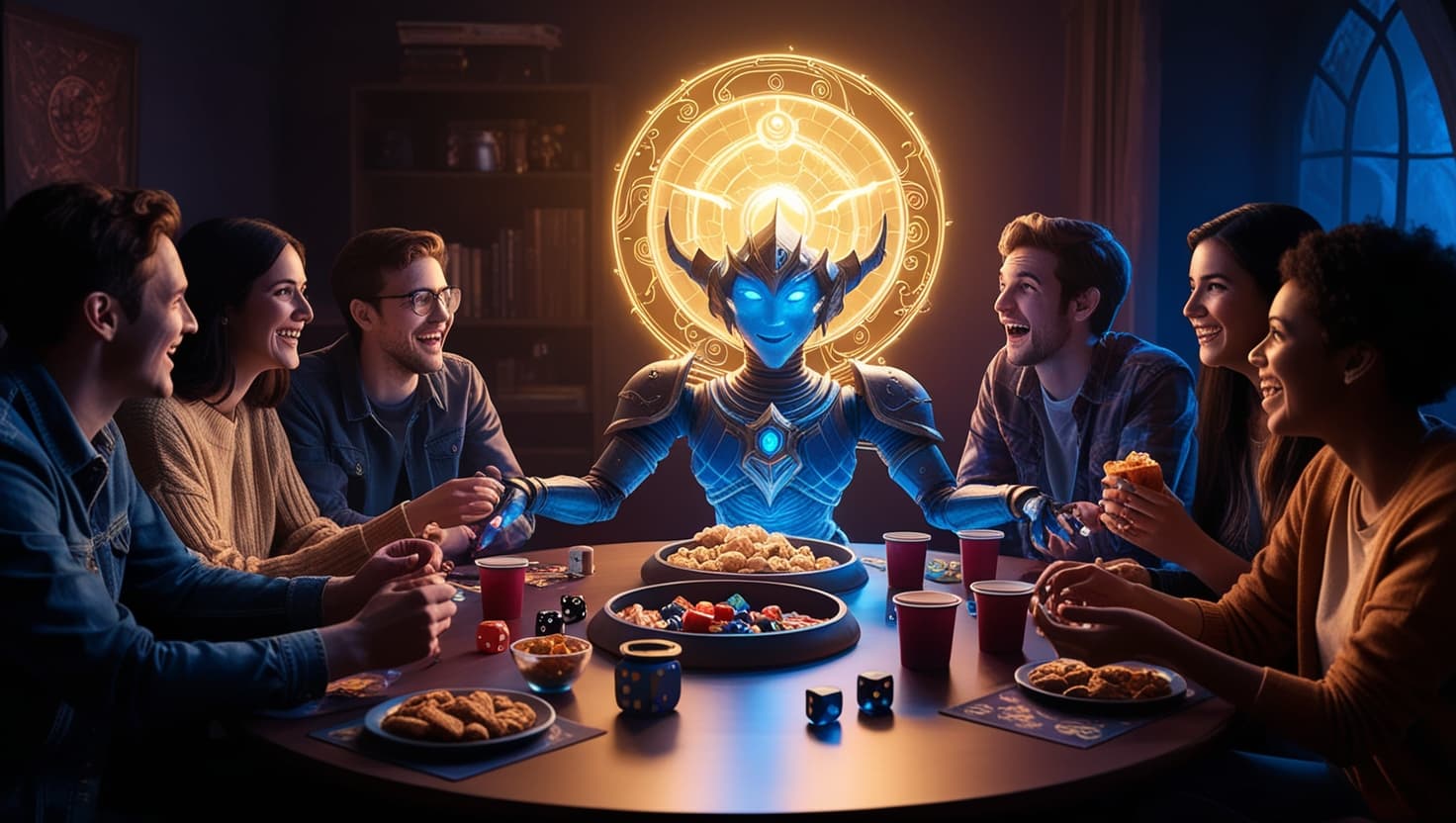
How to Host Your First AI D&D Game Night (Even If Nobody Knows the Rules)
You've got the group chat. You've got the friends. You've even got that one person who keeps saying "we should totally play D&D sometime." The problem is always the same: nobody wants to DM.
Dungeon Mastering is a second job. You're writing plot, voicing NPCs, tracking initiative, improvising when someone inevitably tries to seduce the dragon. Most people hear "you'd need to read this 320-page book first" and suddenly remember they're busy every Saturday forever.
So the game never happens.
Here's the fix: let an AI do it. An AI Dungeon Master handles the narration, the NPCs, the combat, the rules - all of it. You and your friends just show up and play.
This guide walks you through hosting your first AI D&D game night, start to finish. Total setup time: about ten minutes.
Step 1: Pick a Theme (30 Seconds)
Before you invite anyone, decide what kind of adventure you want. Most AI DM platforms offer a few genres. On StoryRoll, you get three:
- D&D Fantasy - Dungeons, dragons, taverns, swords. The classic. If your friends have even a passing familiarity with D&D, Lord of the Rings, or Baldur's Gate, start here.
- Sci-Fi - Space stations, alien diplomacy, laser rifles. Great if your group leans more Starfield or Mass Effect than medieval fantasy.
- Fairy Tale - Enchanted forests, talking animals, whimsical quests. This is the secret weapon for groups where someone has never touched a tabletop RPG. It's approachable, it's low-stakes, and nobody feels dumb asking questions.
Pro tip: If you're hosting a mixed group (some D&D veterans, some total newcomers), Fairy Tale is your best bet. Veterans get a fresh setting they haven't min-maxed, and newcomers don't feel like they're supposed to already know what a paladin is.
Step 2: Create a Campaign (2 Minutes)
This is where traditional D&D takes weeks of prep. An AI DM does it in about two minutes.
Here's the actual process:
- Open StoryRoll and tap "Create Campaign"
- Choose your theme (the one you picked in Step 1)
- Answer a few questions - the AI runs a quick Session Zero. It might ask what tone you want (serious epic vs. lighthearted romp), what kind of adventure hook interests you (dungeon crawl, mystery, political intrigue), and any themes to avoid.
- Done. The AI generates your world, your opening scenario, and your first scene. You have a campaign.
No stat blocks to write. No maps to draw. No reading three sourcebooks. You answered some questions and the AI built a world around your answers.
That Session Zero step matters more than it sounds. It means your campaign isn't generic. It's shaped by what you actually told the AI you wanted. If you said you're into mysteries, you're not going to get a "kill the goblins in the cave" quest. You'll get a murdered diplomat and three suspects with conflicting alibis.
Step 3: Send the Invite Link (1 Minute)
This is the part most people overthink.
StoryRoll generates a shareable invite link for your campaign. Copy it. Paste it into your group chat. That's it.
Your friends click the link, create a character (which takes about ninety seconds - the AI handles the heavy lifting), and they're in.
What to actually say in the group chat:
You don't need to write a pitch deck. Here's what works:
"Hey, we're playing D&D tonight at 8. No prep needed, an AI runs everything. Click this link to join and make a character - takes like 2 minutes: [link]"
That's it. Don't oversell it. Don't explain what an AI DM is. Don't send a wall of text about Session Zero mechanics. The less friction, the more people show up.
What if someone asks "do I need to know D&D?"
Tell them no. The AI handles all the rules. They just need to say what their character does, and the AI figures out the mechanics. If they say "I want to sneak past the guard," the AI rolls stealth for them, compares it to the guard's perception, and narrates what happens. Your friends don't even need to know what a stealth check is.
Step 4: Set the Vibe (5 Minutes, Optional but Worth It)
You can skip this step entirely and still have a great time. But if you want to go from "fun experiment" to "wait, when are we doing this again?", spend five minutes on atmosphere.
The basics:
- Pick a time and commit. "Let's play sometime" never happens. "Friday at 8 PM" happens. Put it in the group chat with a specific time.
- Suggest everyone grabs a drink. Sounds trivial. It's not. A beer or a coffee signals "this is social time, not homework."
- Play some ambient music. YouTube "tavern ambiance" or "sci-fi space station soundtrack." Even playing it from your phone speaker changes the mood.
If you want to be extra:
- Dim the lights. Especially for fantasy or horror campaigns.
- Have snacks. In-person game night? Pizza is traditional for a reason. Virtual? Just having food normalizes the hangout.
- Name a "recap person." After each session, someone summarizes what happened in 2-3 sentences in the group chat. This builds narrative investment and gives people who missed a session a way back in.
None of this is required. The AI DM will run a great game regardless. But the vibe is what turns a one-off experiment into a weekly tradition.
Step 5: Play the Game (60-90 Minutes)
Here's what the actual game night looks like:
First 10 minutes: Everyone creates characters. This happens fast - pick a name, choose a general archetype (fighter, healer, sneaky rogue), and the AI generates the rest. Stats, backstory, equipment, done. People will be surprised how quickly they go from "I don't have a character" to "I'm Thorne, a half-elf ranger who got kicked out of the Emerald Conclave for freeing a prisoner."
Next 10 minutes: The AI sets the scene. It describes where you are, what's happening, and why your characters are together. It generates art for the opening scene. This is usually when someone says "oh wait, this is actually cool."
The middle hour: You play. Someone tries to talk their way past a guard. Someone else picks a lock. Combat breaks out and the AI handles initiative order, attack rolls, damage - the whole thing. You just say what you want to do.
The AI adapts to your group's pace. If you're moving fast, it keeps the action coming. If you're spending 20 minutes arguing about whether to open the suspicious door (you will), it lets that happen.
Last 10 minutes: The AI brings you to a natural stopping point. A cliffhanger, a resolution, a "to be continued." It saves everything - character state, story progress, the map of the dungeon you half-explored. Next time you play, you pick up exactly where you left off.
What to Tell Your Friends Who've Never Played D&D
This is the biggest barrier. Not the technology, not the setup - it's the friend who says "I don't know how to play D&D."
Here's your cheat sheet for reassuring them:
"You don't need to know the rules." The AI handles dice rolls, combat mechanics, spell effects, all of it. Players just describe what they want to do in plain English.
"There's no wrong way to play." Want to fight the dragon? Talk to it? Try to ride it? All valid. The AI adapts. There's no script to follow.
"You won't slow anyone down." In traditional D&D, a new player can accidentally grind the game to a halt while they figure out their character sheet. With an AI DM, there's no character sheet to figure out. Everyone's on equal footing.
"It's basically improv with dice." This is the best one-line explanation. You describe what your character does, dice determine if it works, the AI narrates what happens. That's the whole game.
"It takes two minutes to join." Click the link, make a character, play. If they don't like it after 30 minutes, they can bail. No commitment, no awkwardness.
Common First-Session Moments
Every group hits a few of these. Consider them rites of passage:
- "Wait, it rolled dice for me?" - Yes. Real D20 mechanics. Not just a chatbot making stuff up. Here's how AI dungeon masters actually work.
- "Can I actually do that?" - Yes. The AI doesn't have a pre-written script. If you want to interrogate the barkeep's cat, you can try.
- "Hold on, it remembered what I said earlier?" - The AI tracks your character, your choices, and your story. It's not goldfish memory.
- "This art is from our game?" - The AI generates scene art based on what's actually happening. Your specific characters, your specific moment.
- Someone tries to derail the plot. - Every group has one. The AI handles it. It's been trained on centuries of "but what if I punch the quest-giver."
After the Session: Keep the Momentum
The first session went well. Now make it stick.
-
Set the next date immediately. Before everyone leaves, pick the next night. "Same time next week?" is all it takes. If you wait until the group chat, scheduling entropy takes over and it never happens.
-
Post a recap. A quick 3-4 sentence summary of what happened. Drop it in the group chat the next day. "Last night we infiltrated the Obsidian Spire, Kira almost died to a mimic disguised as a throne, and we found a map leading to something called the Hollow Archive." This keeps the story alive between sessions.
-
Share a screenshot. StoryRoll generates art during gameplay. Screenshot a good one and post it. This is the thing that makes people who couldn't make it say "wait, I want to play next time."
-
Don't over-organize. The beauty of an AI DM is zero prep. You don't need to assign homework, plan ahead, or coordinate character builds. Everyone just shows up and plays. Keep it that way.
The DM shortage is real - the data proves it. But that doesn't mean your group can't play. An AI DM means no one has to sacrifice their Saturday to prep. Everyone plays. Every time.
Try These Free Tools
Make your game night even smoother with these free tools:
- Dice Roller — Roll dice right in the browser for quick side checks or dramatic moments.
- Encounter Calculator — Curious how tough that fight was? Check encounter balance after the session.
- Initiative Tracker — Keep combat turns organized, even when the table gets chaotic.
Written by Anthony Goodman
Founder of StoryRoll. Building AI-powered tabletop RPGs.
Related Posts
How to Play D&D Online: Complete Beginner Guide (2026)
Never played D&D before? No group, no dice, no clue where to start? This step-by-step guide takes you from zero to your first online session in under 30 minutes.
The Complete Guide to Playing D&D Online With Friends (2026)
Every way to play D&D online with your friends - from virtual tabletops to AI dungeon masters. We break down the options, the trade-offs, and how to actually get a game going tonight.
How to Play D&D With Your Kids Using an AI Game Master
You do not need to learn to run a game to play D&D with your kids. Here is how an AI Game Master handles the prep so family game night actually happens.