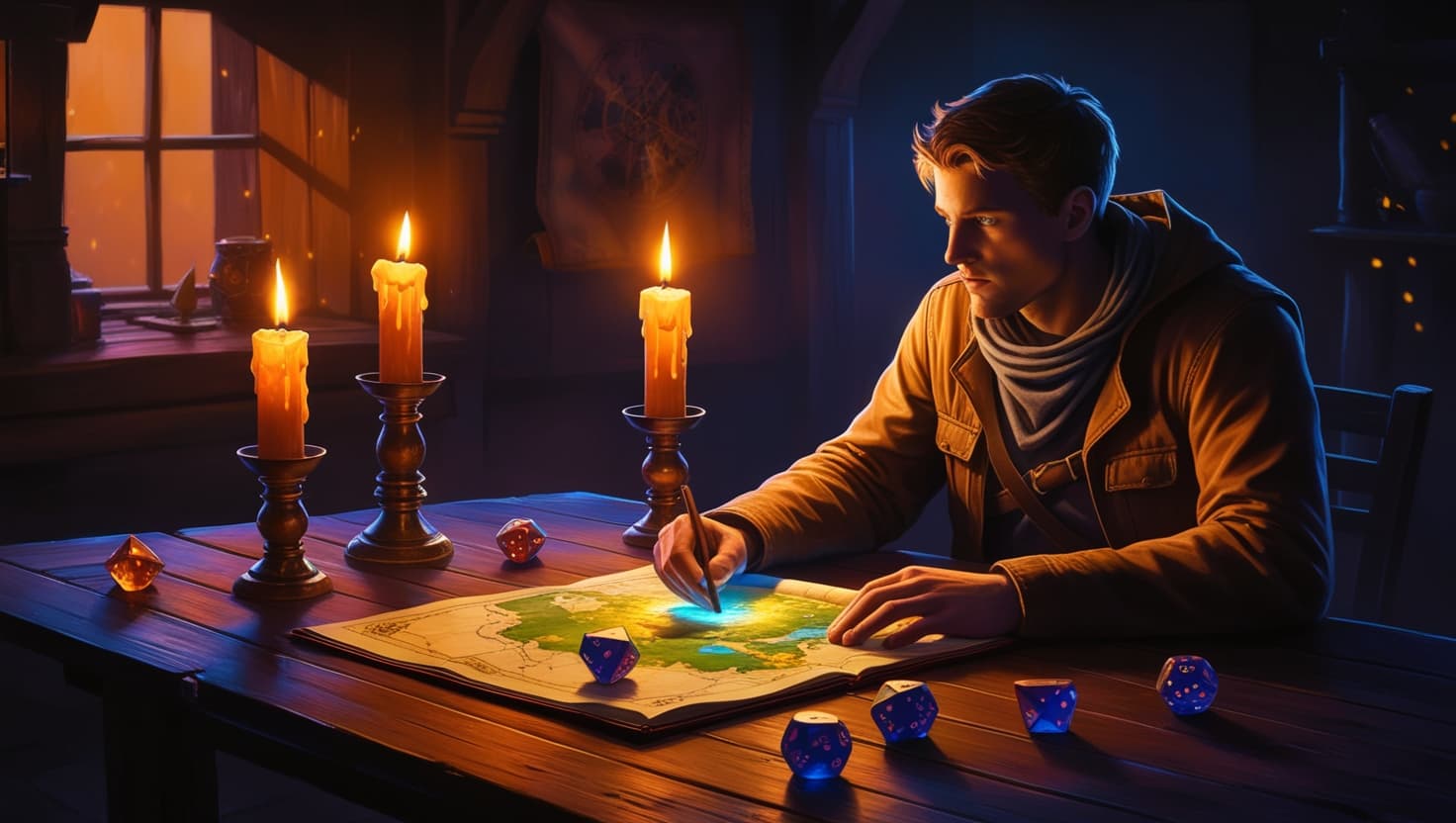
Solo D&D: How to Play Tabletop RPGs Alone (2026 Guide)
r/Solo_Roleplaying hit 80,000 subscribers last month. Three years ago it had 12,000. That's not a rounding error - that's a hobby segment exploding while nobody in mainstream gaming media was paying attention.
Solo D&D used to be the thing you did when your group fell apart. A consolation prize. You'd pull out some oracle tables, feel slightly embarrassed about it, and tell nobody. That framing is dead. People are choosing solo play on purpose, building elaborate campaigns that run for months, and writing about it like it's the most creatively satisfying version of the hobby they've found.
And honestly? For a lot of players, it is.
Why Solo D&D Took Off
The obvious answer is scheduling. Finding four adults who can commit to the same evening every two weeks is harder than any dungeon crawl. We wrote about this in our forever GM problem breakdown - the logistics of group D&D are brutal, and they've gotten worse as people's lives get busier.
But scheduling isn't the whole story.
Solo D&D grew because the tools got good enough to make it feel like a real game instead of an exercise in pretending. Oracle systems like the Mythic Game Master Emulator - a randomized yes/no framework that replaces GM decisions - have existed since 2006, and they work. Ironsworn built solo play into its core mechanics so well that some players prefer it to group sessions. And AI Game Master platforms showed up in 2024-2025 and removed the last major friction point: you don't need to learn a system at all.
There's also a personality angle nobody talks about enough. Some people just play better alone. They want to sit with a character for two hours without someone else cracking jokes about seducing the dragon. They want to make the risky choice without four other people vetoing it. They want to cry when their character's mentor dies, and not have to explain why they're emotional about imaginary people to a table of acquaintances.
Solo D&D isn't social D&D minus the people. It's a different experience that rewards different things. If you have one friend who's interested, duet campaigns (two-player D&D) split the difference between solo and group play - all the scheduling ease with the social connection.
New to D&D entirely? You don't need any prior experience to play solo. AI Game Master platforms handle rules, dice, and narration for you. If you want to understand the basics first, our complete beginner guide to online D&D covers what you need to know.
How to Play D&D by Yourself: Three Approaches
There's no single "right" way to play solo D&D. The method you pick depends on how much structure you want and how much work you're willing to do upfront.
Oracle Systems and GM Emulators
The veteran approach. You play your character normally, and when you'd ask a Game Master a question - "Is the door trapped?" "Does the merchant trust me?" - you ask an oracle instead. The oracle gives you a randomized answer weighted by probability. You interpret the result and keep the story moving.
The Mythic Game Master Emulator is the most popular oracle system, and it's been refined over almost two decades. It tracks "chaos factor" that shifts as your story gets more or less volatile, making outcomes feel organic rather than random. Other options include CRGE (Conjectural Roleplaying GM Emulator) and the free Ironsworn oracle tables.
Oracle play is deeply creative. You're building the world and the story in real-time, interpreting vague prompts into concrete fiction. It requires the most effort, but players who love it describe a flow state that other methods can't touch.
The tradeoff: there's a learning curve. Your first few sessions will feel awkward as you figure out when to consult the oracle, how to interpret ambiguous results, and how to keep the story coherent without a GM's guiding hand.
Journaling RPGs and Solo Modules
Journaling RPGs give you a structured framework and ask you to write the story. Thousand Year Old Vampire hands you a set of prompts and a vampire who's losing memories as centuries pass. You write diary entries. It's closer to creative writing than traditional D&D, but it scratches the same itch for many players.
Solo adventure modules are the opposite end - highly structured, almost like a choose-your-own-adventure book but with dice mechanics. They tell you which room you're in, what monsters appear, and what happens when you open the chest. Less creative freedom, more game.
Both have their place. Journaling RPGs are perfect for players who want narrative depth without mechanical complexity. Solo modules are great for people who want dungeon-crawling crunch without needing a GM to run it. Our solo TTRPG guide does a deeper comparison of specific systems if you want recommendations.
AI Game Masters
This is the newest method, and it's where most of the growth is happening.
An AI Game Master platform runs the entire game for you. Narration, NPC dialogue, combat encounters, dice mechanics, scene transitions - all handled by the AI. You describe what your character does, the AI responds with what happens next. Some platforms generate scene artwork as you play, add voice narration, and track your character sheet automatically.
The appeal is zero friction. You don't need to learn an oracle system. You don't need to own any books. You don't need to interpret random tables. You open the app, make a character, and play. The AI knows the rules better than most human GMs (it doesn't forget that grappling provokes an opportunity attack), and it never needs to pause to look something up.
The tradeoff: you have less creative control than oracle play. The AI is generating the world, and while you can push the story in any direction, you're collaborating with a system rather than building entirely from your own imagination. For some players that's a feature. For others it's a limitation.
Which method should you try first? If you've never played any tabletop RPG, start with an AI Game Master - it handles everything while you learn. If you're an experienced player who wants maximum creative control, try Mythic GME. If you want something between those extremes, Ironsworn is free and brilliantly designed for solo play.
Getting Started: Your First Solo D&D Session
Pick a method from above and follow the path that matches.
AI Game Master Path (Fastest)
-
Sign up for a platform. StoryRoll runs D&D 5e rules with voice narration and scene art (we built it, so take that recommendation accordingly). AI Dungeon is more freeform. Fables takes a different approach to the same idea.
-
Create a character. Use the platform's guided builder. Pick Fighter or Rogue if you want something mechanically simple for your first run. Don't agonize over optimization - your first character is a learning experience, not a lifelong commitment. Need inspiration? Our backstory generator can give you a starting concept to build from.
-
Pick a setting and go. Classic fantasy if you want familiar ground. The AI introduces the world through play, so you don't need to read any lore. Just react to what happens.
-
Play for 30 minutes. That's enough to get through character creation, an opening scene, maybe a combat encounter. If it clicks, keep going. If it doesn't, try a different character or setting before writing off the whole concept.
Oracle System Path (Most Creative Control)
-
Download Mythic GME or grab the free Ironsworn PDF. Read the oracle rules - Mythic's core system fits on two pages.
-
Create a D&D character using the Basic Rules (free on D&D Beyond) or use any system you already know.
-
Set a scene. Write down where your character is and what they want. "My ranger is tracking a missing merchant through the Silverwood. She's heard rumors of bandits on the eastern road."
-
Ask the oracle your first question. "Is the trail fresh?" Roll. Interpret. Build from there.
-
Keep a journal. Even brief notes help you track what's happened and maintain story consistency across sessions. Some players use apps like Notion or Obsidian. A notebook works too.
Journaling RPG Path (Most Accessible)
-
Pick a game. Thousand Year Old Vampire if you want something literary. The Wretched for horror. Alone Among the Stars for gentle sci-fi exploration. All available on itch.io for under $10.
-
Grab a pen and something to write in. That's your entire supply list.
-
Follow the prompts. Each game tells you what to do. Some use a deck of cards for randomization, some use dice. The rules are typically two pages.
Tools and Resources for Solo D&D Players
You don't need any of these to play, but they make sessions smoother.
- Dice Roller - Roll any dice combination in your browser. Handy for oracle play or when you want a quick roll outside your main platform.
- NPC Name Generator - Solo players create more NPCs than group players (you're populating the whole world). This saves you from naming every tavern keeper "Greg."
- Character Backstory Generator - Writer's block is real when you're both player and worldbuilder. Generate a concept and customize from there.
Communities Worth Joining
r/Solo_Roleplaying is the hub. 80,000+ members posting session recaps, system recommendations, oracle tips, and homebrew tools. Sort by top/all-time if you want to see what peak solo play looks like.
The Lone Adventurer Discord has active channels for every solo system and a beginner-questions space that's unusually welcoming.
Me, Myself, and Die on YouTube is the best actual-play series for solo RPGs. Trevor Devall runs Ironsworn campaigns with production quality that rivals group actual-play shows. Watch one episode and you'll understand why people get hooked.
Reference Material
The D&D 5e Basic Rules cover everything you need mechanically. For ability scores and character sheets, we've got explainers that break down the jargon. If you're considering whether you even need a virtual tabletop for solo play, our VTT comparison covers the options.
The Solo D&D Mindset Shift
Group D&D trains you to think about party dynamics, turn order, and social negotiation. Solo D&D is a different muscle.
You're the entire party. Some players run a single character. Others control a party of 3-4, switching perspectives between them. Both work - single character gives you deeper roleplay, a full party gives you tactical combat options. Try single character first. It's simpler, and you can always add companions later.
You control the pacing. No waiting for someone to decide what to do on their turn. No twenty-minute arguments about whether to open the suspicious door. If your character would kick the door down, kick it down. Solo sessions move fast.
You can be weird about it. In a group, some players hold back on deep roleplay because they feel self-conscious. Solo, there's nobody watching. Write your character's internal monologue. Have a conversation with an NPC that goes on for three pages. Get attached to a shopkeeper. Nobody's going to break immersion with a joke about their initiative roll.
The biggest adjustment: trusting the dice. In group play, the GM can fudge rolls to keep the story moving. Solo, the dice are law. Your character might die in session two. That randomness is what keeps solo D&D from becoming creative writing - you're playing a game, not telling yourself a story you already know the ending to.
Common solo D&D mistake: Rerolling results you don't like. The whole point is that the oracle or AI gives you something unexpected, and you figure out how to make it work in the fiction. If you only accept outcomes that match the story in your head, you might as well be writing a novel. Let the dice surprise you.
Who Solo D&D is For (and Who It's Not For)
Solo D&D is great for people who want creative control, hate scheduling logistics, enjoy introspective play, or simply don't have a group right now.
It's probably not for you if the social element is what you love about tabletop RPGs. If your best D&D memories involve the table erupting in laughter, or collectively panicking when the BBEG shows up, solo play won't replicate that energy. It offers different rewards.
And it's not an either/or choice. Plenty of players run a solo campaign during the week and a group game on weekends. The solo sessions make them better group players - they show up with more developed characters, sharper improv instincts, and a deeper understanding of the mechanics.
Frequently Asked Questions
Can you play D&D alone without a group?
Yes. Solo D&D is a well-established practice with dedicated systems, tools, and a community of tens of thousands. Oracle systems like Mythic Game Master Emulator, solo-designed RPGs like Ironsworn, and AI Game Master platforms like StoryRoll all let you run full campaigns by yourself. It's not a workaround - it's a distinct way to play that many prefer.
What is the easiest way to start playing solo D&D?
An AI Game Master platform is the fastest path from zero to playing. You create a character, pick a setting, and the AI handles narration, rules, dice rolls, and combat. No prep, no rulebook memorization, no oracle tables to learn. Your first session can start in five minutes.
Is solo D&D actually fun or just a fallback?
Solo D&D rewards different things than group play. You get deeper character development, complete creative freedom, and stories that move at your pace. The 80,000+ members of r/Solo_Roleplaying aren't there because they can't find a group - most play solo by choice. It's its own hobby within the hobby.
Do I need to buy anything to play D&D alone?
No. The D&D Basic Rules are free. Ironsworn is free. AI GM platforms like StoryRoll have free tiers. Digital dice are built into every platform. You can start your first solo session tonight without spending money.
What is the difference between solo D&D and a video game RPG?
Video game RPGs have preset stories, fixed dialogue options, and coded boundaries. Solo D&D has none of that. You can try anything you can describe - there's no invisible wall, no dialogue tree, no developer limiting your choices. The story emerges from your decisions and whatever randomization method you use (dice, oracle, AI).
Solo D&D has grown from a niche workaround into a legitimate pillar of the tabletop hobby. The tools are better than they've ever been - whether you want the creative depth of oracle systems, the structured simplicity of journaling RPGs, or the zero-friction experience of an AI Game Master.
If you're curious, try the fastest path first: an AI GM platform gets you playing in minutes. If you want more control, graduate to Mythic or Ironsworn once you've got a feel for solo play. And if you discover it's not your thing, that's fine too - but give it at least two sessions before deciding. The first one is always a little awkward.
Try StoryRoll free and run your first solo campaign tonight.
Written by Anthony Goodman
Founder of StoryRoll. Building AI-powered tabletop RPGs.
Related Posts
How to Play D&D Alone: The Complete Solo D&D Guide (2026)
You can play D&D alone - and in 2026, there are more ways to do it than ever. Every method from oracle tables to AI Dungeon Masters, with honest pros and cons.
How to Play D&D Online: Complete Beginner Guide (2026)
Never played D&D before? No group, no dice, no clue where to start? This step-by-step guide takes you from zero to your first online session in under 30 minutes.
D&D Magic Items Guide for Beginners: Rarity, Distribution, and the Good Stuff
Magic items are half the reason people play D&D. But the rules for how they work, how rare they are, and when players should get them are scattered across three books. Here's everything in one place.