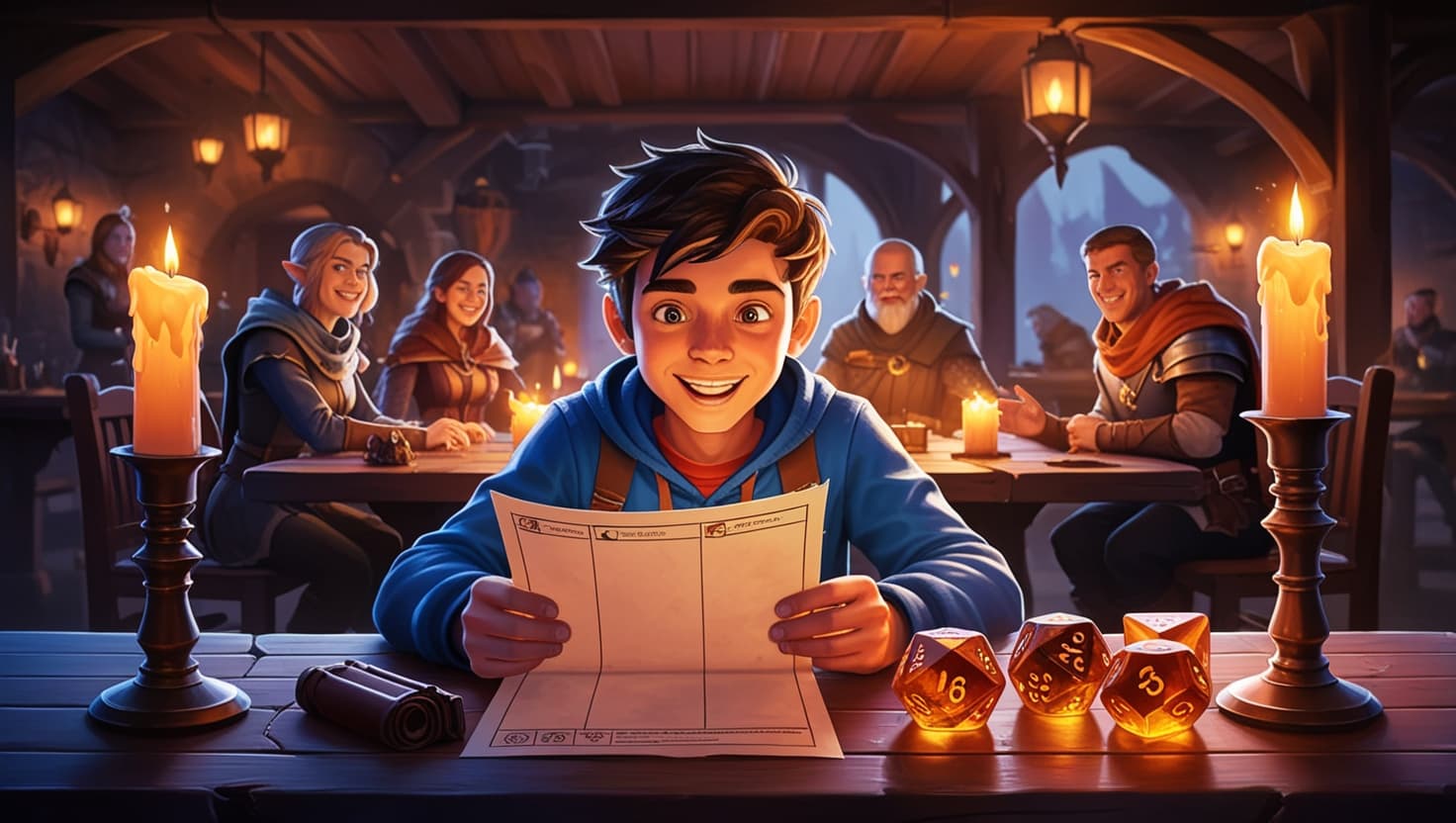
New to D&D? How to Start Playing With Zero Experience
Three years ago, a friend of mine binged all of Dimension 20 in two weeks, decided she needed D&D in her life immediately, and then did absolutely nothing about it for six months. Not because she lost interest. Because the gap between "I want to play Dungeons & Dragons" and "I am playing Dungeons & Dragons" felt enormous.
She's not unusual. The D&D subreddits are full of posts that boil down to the same thing: I want to play but I don't know how to start. And honestly? The hobby hasn't made it easy. Between the 300-page rulebooks, the assumption that you already know someone with a collection of miniatures, and the vague advice to "just find a group," there's a real barrier to entry that nobody talks about enough.
This guide is for the person who's seen D&D content online, thinks it looks incredible, and has no idea where to begin. No prior knowledge required. No group required. You can literally start tonight.
What D&D Actually Is (30-Second Version)
Dungeons & Dragons is a collaborative storytelling game. One person (the Dungeon Master, or DM) describes a world and situation. The other players say what their characters do. Dice determine whether those actions succeed or fail. That's it.
Everything else - the character sheets, the spell lists, the grid maps - is scaffolding around that core loop. Important scaffolding, eventually. But not on day one.
If you've ever played a video game RPG like Baldur's Gate 3, Skyrim, or even Final Fantasy, you already understand the basic concept. D&D is the original version, except there's no script. The story goes wherever the players take it.
What You Actually Need to Start
Here's what the internet will tell you: buy the Player's Handbook, find four friends, convince one of them to DM, buy dice, buy minis, buy a battle mat, and commit to weekly four-hour sessions for the next year. Here's what you actually need: an internet connection.
The D&D Basic Rules are free on D&D Beyond. They cover character creation, combat, spellcasting, and enough content to play for months. The 2024 Player's Handbook is excellent if you want to buy it later, but it's not a prerequisite. Nobody needs to spend $50 before rolling their first d20.
For dice, any free dice roller works. Physical dice are more fun - there's something about the clatter - but they're a want, not a need. If you do decide to invest in a set, our guide to the best D&D dice sets in 2026 covers every option from budget-friendly to premium.
A character sheet? D&D Beyond has a free digital character builder that walks you through every step. Pick a race, pick a class, assign some numbers, and you're done in fifteen minutes. If you want to understand how ability scores work before you start assigning them, our ability score calculator walks you through the math.
That's your shopping list. Free rules, free dice, free character sheet. Everything else is optional until you decide this is your hobby.
Pick a Class (Without Overthinking It)
New players get paralyzed by class choice. Twelve options, each with subclasses, and forum posts arguing about optimization. Ignore all of it.
If you want to hit things with a sword: Fighter. Straightforward in the best way. You get good at fighting, and you fight well. The Champion subclass is specifically designed for new players.
If you want to cast spells: Sorcerer. Your magic is innate - no spellbook management, no preparing spells each morning. You just have powers and you use them.
If you want to do a bit of everything: Bard. You can fight, cast spells, talk your way out of problems, and heal your friends. Jack of all trades, literally (it's one of their abilities).
If you want to be sneaky: Rogue. Stab things from the shadows, pick locks, scout ahead. Mechanically simple, endlessly satisfying.
Don't pick based on what's "meta." Pick based on what sounds fun when you imagine doing it. The strongest character at a D&D table is always the one whose player is having the best time.
And for the love of Tiamat, don't read a 40-page optimization guide before your first session. Play a character with a name and a vibe. If you want a head start on who your character actually is, the backstory generator can give you a solid foundation in a couple of clicks. The rules will make sense once you're using them.
How to Find People to Play With
This is the part where most newcomers stall out. You want to play, but you don't know anyone who plays, and approaching strangers feels weird.
r/lfg (Looking for Group) has over 900,000 members and dozens of new posts daily from DMs looking for players. Most games run online through Discord and a virtual tabletop like Roll20 or Foundry VTT. Filter for "beginner friendly" and you'll find groups that expect new players and are patient about rules questions.
Local game stores almost always run organized play nights - usually Adventurers League, which is D&D's drop-in format. You show up with a character (or make one there), sit at a table, and play a self-contained adventure. No long-term commitment required. It's awkward for about ten minutes, and then someone asks you to roll initiative and you forget to be nervous.
Discord servers for D&D communities often have LFG channels. The r/DnD Discord, the D&D Beyond Discord, and various actual play communities all have spaces for finding games.
One thing nobody prepares you for: your first group might not be great. That's normal. D&D chemistry is real, and sometimes the vibe just doesn't click. If your first experience feels off, try a different group before deciding the game isn't for you. The game is almost certainly for you. That specific table might not be.
Playing D&D Online vs In Person
Both work. They're different experiences, and neither is objectively better.
In person has the energy. Snacks on the table, dice physically rolling, everyone reacting to the same moment in real time. It's hard to replicate that digitally. The downside is scheduling - getting four adults in the same room on the same evening every week is a logistical miracle.
Online has the accessibility. You can find a group in any timezone, play from your couch, and use digital tools that handle the math for you. Roll20 and Foundry VTT both have free tiers. Discord handles voice. The downside is that it's easier to zone out when you're not physically at the table, and reading social cues through a screen is harder.
Most new players in 2026 start online. It's where the groups are, and the barrier to entry is lower. If you later find a local group, great. But don't wait for one.
You Don't Actually Need a Group
Here's something the D&D community has been slow to acknowledge: you can play D&D by yourself.
Solo D&D has exploded over the past few years. Some players use oracle systems like the Mythic Game Master Emulator - a randomized framework that replaces DM decisions with dice-driven prompts. Others use solo-specific RPGs like Ironsworn (free, excellent, and designed from the ground up for one player).
And increasingly, people are using AI.
AI dungeon masters - tools that use language models to run D&D sessions conversationally - have gotten genuinely capable. You describe what your character does, the AI responds as the world, and the story unfolds in real time. It's not identical to playing with a human DM. But for a new player who wants to learn the flow of the game without the pressure of a group? It's a remarkable entry point.
We built StoryRoll specifically for this. It's an AI-powered D&D platform that handles the rules, tracks your character, remembers your story, and runs combat with actual game mechanics - not just freeform text. Full disclosure: we're biased. But we built it because we wanted new players to be able to go from "curious about D&D" to "actively playing D&D" in under five minutes, without needing to recruit three friends first.
If solo play interests you, our complete solo D&D guide goes deep on every method available. Looking for a low-commitment first game? Check out the best one-shots for beginners, or get started on writing your first character backstory. And if you're comparing all the ways to play online, our easiest ways to play D&D online guide ranks every option from hardest to simplest.
Your First Session: What to Expect
Whether you're joining an online group or trying solo play, your first session will probably feel chaotic. That's fine. Everyone's first session feels chaotic. If you're going the AI route, here's what actually happens in your first AI D&D session - it's not what most people expect.
You'll forget rules. You'll have to look up what your abilities do mid-combat. You'll probably forget to add your proficiency bonus to at least three rolls. None of this matters. The DM (human or AI) will help, the other players will help, and by session two you'll have the basics down.
A few things that will help:
Know your character's abilities, roughly. You don't need to memorize every spell. Just read through your class features and have a general sense of what you can do. "I can cast three spells per day and one of them shoots fire" is enough preparation.
Ask questions. No experienced player is annoyed by a new player asking "what do I roll for that?" They're annoyed by the player who pretends to understand and then does something impossible. Ask early, ask often.
Make choices. The biggest trap for new players is passivity - sitting quietly and waiting to be told what to do. D&D rewards initiative. Walk into the suspicious room. Talk to the weird NPC. Attempt something dumb and see what happens. The worst outcome is usually the funniest story later.
Don't try to "win." D&D isn't a video game. There's no optimal path. The barbarian who fails a stealth check and accidentally alerts the entire goblin cave has created a better story than the rogue who perfectly executed the infiltration plan. Failure is content. Once you've got a few sessions under your belt, our guide on how to be a better D&D player has more tips for leveling up your table skills.
The Stuff You Can Buy Later (If You Want)
Once you've played a few sessions and you're hooked - because you probably will be - here's what's worth spending money on:
The 2024 Player's Handbook ($50). The full rules, all the classes, expanded options. Worth it once you know you're staying.
Physical dice ($8-15 for a set). The tactile experience matters more than you'd think. Every D&D player ends up with a dice collection they can't justify. Join us.
D&D Beyond subscription ($6/month). Digital character sheets, shared content with your group, encounter tools. The free tier works, but the subscription is quality of life.
A miniature of your character ($10-30). Completely unnecessary. Deeply satisfying. Hero Forge lets you custom-design one that actually looks like your character.
Everything else - battle mats, DM screens, premium modules - is for later. Or never. Plenty of people play for years with nothing but dice and imagination.
Frequently Asked Questions
Do I need to read the whole Player's Handbook before playing?
No. Read your character's race and class sections. Skim the combat chapter. That's enough. You'll learn the rest by playing. The Player's Handbook is a reference book, not a textbook - you look things up when they come up.
Can I play D&D with just two people?
Yes. One DM and one player works fine, though the DM might give you an NPC companion so you're not soloing every combat. Duet D&D (as it's called) is actually a fantastic way to learn because you get all the DM's attention.
Is D&D expensive?
It can be free. The Basic Rules, dice apps, and digital character sheets cost nothing. Even if you buy everything a new player could want, you're looking at maybe $75 total - less than a new video game, for something you can play for years.
What if I can't find a group?
Solo play is a real option now. AI dungeon masters like StoryRoll let you play full D&D campaigns by yourself, anytime. You can also check r/lfg, local game stores, and D&D Discord servers for groups actively seeking new players.
Is D&D hard to learn?
The basics take about 30 minutes. Make a character, learn what "roll a d20 and add your modifier" means, and you're playing. The advanced stuff (multiclassing, complex spells, grappling rules) comes naturally over months of play. Nobody masters D&D before their first session. Nobody needs to.
The gap between wanting to play D&D and playing D&D has never been smaller. Free rules, online groups, solo tools, AI dungeon masters - pick whichever path has the least friction and start there. You can always expand later. The important part is that first session, where you describe what your character does and something unexpected happens in response.
The gap between wanting to play D&D and playing D&D has never been smaller. Free rules, online groups, solo tools, AI dungeon masters - pick whichever path has the least friction and start there. Your character sheet is waiting. Go fill it out.
Next steps: find out what Session Zero is and why it matters, learn how to run one for your first campaign, pick up tips on how to be a better DM, discover how to write a D&D campaign, or browse our favorite D&D podcasts for inspiration between sessions.
Written by Anthony Goodman
Founder of StoryRoll. Building AI-powered tabletop RPGs.
Related Posts
Best D&D One-Shot Ideas for Beginners (2026)
12 one-shot ideas that work for new players, busy groups, and GMs who don't want to prep a 200-hour campaign. Premises, party sizes, and tips for running each one.
D&D Magic Items Guide for Beginners: Rarity, Distribution, and the Good Stuff
Magic items are half the reason people play D&D. But the rules for how they work, how rare they are, and when players should get them are scattered across three books. Here's everything in one place.
D&D Encounter Balancing Guide for New Game Masters
CR math alone won't save your encounters. This guide covers everything new GMs need to know about balancing D&D 5e encounters - from XP budgets and action economy to reading your table and adjusting mid-fight.