Cozy Solo RPG: What the Genre Gets Right (and What an AI Game Master Adds)
Somewhere in the last few years, "cozy" became its own solo RPG genre, sitting next to journaling and dungeon crawling as a real category with its own shelf. You run a tea shop on the border of the living and the dead. You brew potions for a village witch's regulars. You settle into a cottage for a season and write down what happens.
No combat. No death spiral. No grimdark fatigue. Just a gentle, low-stakes story you build one prompt at a time.
It is a genuinely good genre, and the games in it - One Day at a Thyme, Tinyoji, Apothecaria, Last Tea Shop - are well made on their own terms. University library guides now stock them alongside Ironsworn and Thousand Year Old Vampire. Kickstarter runs new ones regularly. Itch.io's cozy and solo-rpg tags are two of the more actively browsed corners of the site. This isn't an argument that any of these games are doing it wrong. It's an argument about what happens after the last page of the journal, and where a persistent AI Game Master fits once you get there.
What Makes a Solo RPG "Cozy"
Cozy solo RPGs share a few traits that separate them from the rest of the solo TTRPG shelf, which otherwise leans hard toward survival, horror, and grim fantasy.
- Low or no combat. Conflict is a difficult conversation, a bad harvest, a shop short on ingredients - not a monster.
- Small stakes, real feelings. Nobody dies. Somebody's still nervous about it.
- A gentle daily or seasonal rhythm. Games are often structured around a season, a shift, or a routine rather than a quest.
- Simple, approachable systems. Usually a handful of dice or a deck of cards, no character build to optimize.
- Journaling as the medium. You write the scene yourself, in prose, guided by prompts and an oracle.
That last point is the load-bearing one, and it's also where the genre's ceiling shows up.
Session length is usually part of the pitch too. Most cozy journaling games are built to fit in twenty minutes to an hour, sometimes broken into short daily entries, sometimes one longer sitting. That's a real strength when you want a complete story and don't want to schedule anything. It's also worth naming as a constraint before comparing it to something with a different shape.
Where Cozy Journaling Games Are Genuinely Great
Journaling RPGs like Tinyoji and One Day at a Thyme are well designed for exactly what they promise: a single, complete, reflective solo session. You get a purpose-built oracle, a clear prompt structure, and permission to write badly and enjoy it anyway. Apothecaria in particular earns its reputation - forage, brew, help the village, repeat, with the stakes staying exactly as small as they should. If you want a slow evening with a notebook and no other players, this end of the shelf is hard to beat, and it is well covered elsewhere on the solo RPG shelf if you want the full roundup.
They also ask nothing of you. No app, no account, no rulebook study. A journal, a d6, and twenty minutes.
Where the Genre Hits a Ceiling
The thing that makes a journaling RPG easy to start is the same thing that makes it hard to sustain: it's a vignette, not a world.
Most cozy journaling games are built for one sitting, or a short handful of them tied to a single premise - one season, one shop, one arc. There's no mechanism for a character to grow across dozens of unrelated sessions, no memory that connects a promise made in March to a consequence that lands in June, and no visual sense of the place beyond what you picture yourself. That's a deliberate design choice, not a flaw - but it means the genre's gentleness comes bundled with a short runway.
The nearest AI competitor in this exact space, Soliloquest, mostly plays the oracle's role rather than the storyteller's: it's a solo companion that surfaces prompts and randomness for you to write through, which is the same shape as the paper games, just digitized. It doesn't change what the ceiling is.
There's also a quieter cost that only shows up after a few sessions: an oracle table has a finite number of prompts, and a dedicated cozy game usually has a finite premise. Play Apothecaria for a dozen sittings and you start recognizing the shape of the tables underneath the writing. That's fine for a game designed to run its course and end. It's a real limit for anyone who wanted the village witch to still be a going concern six months from now.
None of this is a knock on journaling games. A short, self-contained, deeply personal story is the point, not a limitation to fix. The gap only shows up if what you actually want is for that story to keep going.
What an AI Game Master Adds to Cozy Solo Play
This is the part an AI Game Master is structurally good at, and it maps onto exactly what the journaling side of the genre doesn't do:
- It narrates the scene instead of asking you to write it. You still decide what your character does. The description, the NPC's reaction, the weather in the garden - that's the AI's job now, not yours.
- It remembers. A promise your character makes in one chapter can resurface three chapters later, because the campaign carries real memory forward instead of resetting with each session. Persistent memory is the specific thing that separates a real ongoing story from a chatbot that forgets what you told it an hour ago, and it's the exact piece a single-session journaling game was never built to need.
- Your character actually grows. Instead of one witch across one season, you're playing a character who can change, gain relationships, and carry consequences across a genuinely long campaign, the way solo play works more broadly once you're past the first session.
- You get to see the place. Scene art turns "a cottage on the edge of the woods" from a mental image into an actual picture, in a style built for the genre rather than borrowed from grimdark fantasy.
None of that requires giving up the low stakes. It just moves the ceiling.
StoryRoll's Fairy Tale Mode Was Built for This
StoryRoll runs four game modes, and Fairy Tale is the lightest of them by design - verified straight from the mode's own configuration, not a marketing gloss. Character creation is narrative instead of stat-driven: no ability scores, no spell slots, no equipment lists to manage. You describe your character in a sentence or two and start playing. Sessions are framed as chapters, the same shape a journaling game already uses, and the tone options run from whimsical through classic fairy tale to comedic, so you can dial the cottagecore all the way up if that's the read you want.
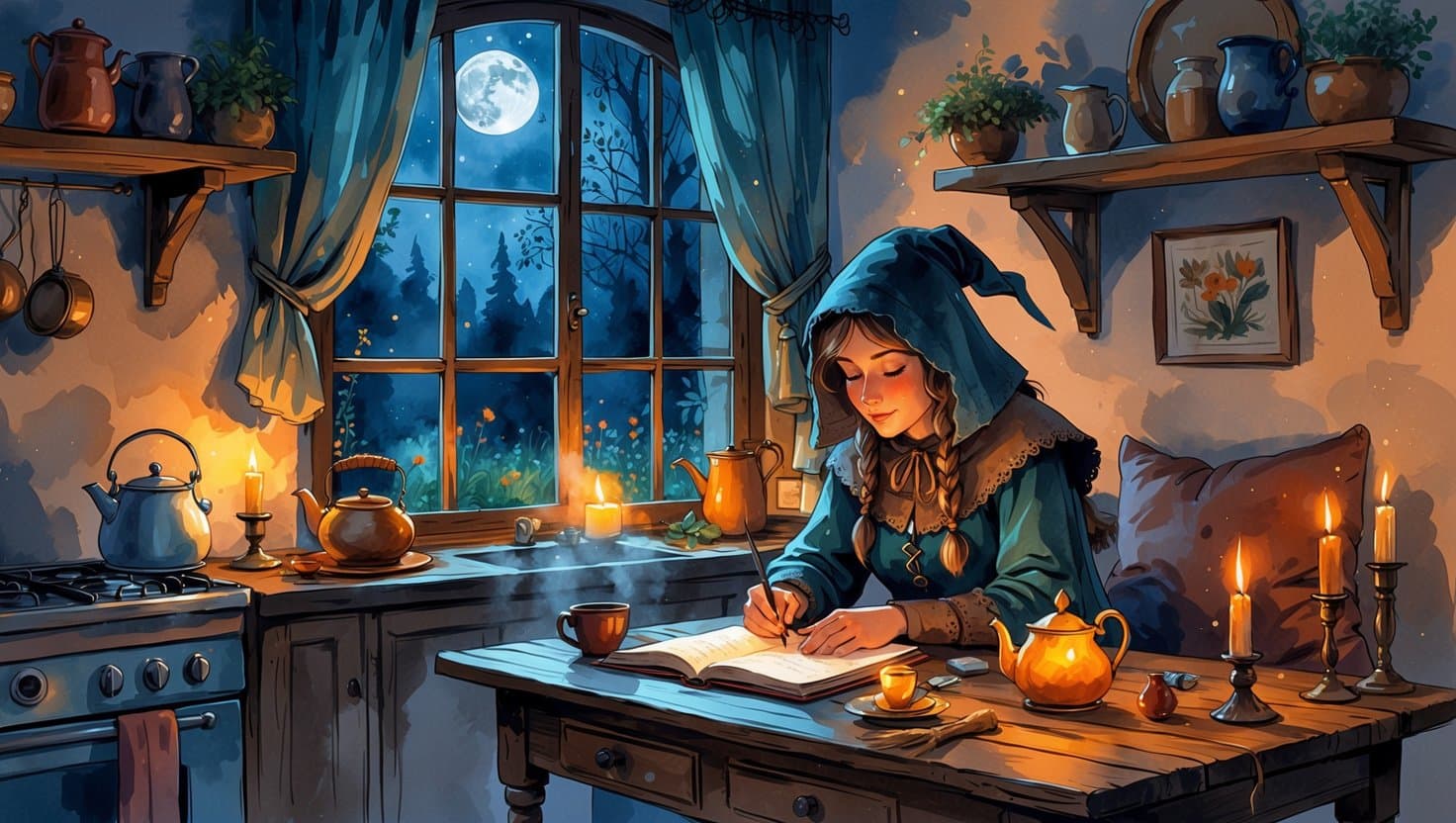
The default art style is soft watercolor, closer to a storybook plate than a loading screen, and it's what generates alongside the narration rather than something you have to request separately.
The vocabulary matches the genre on purpose. Fairy Tale mode calls a campaign a Story, a session a Chapter, and your character a Hero - the same language a journaling game already uses, minus the part where you're the one holding the pen for every scene. Session zero is simplified too, so setting up "a village witch who owes three favors she hasn't paid back yet" takes a couple of sentences, not a character sheet.
Picture the shape of it: a village witch character brews for the harvest festival over several chapters, remembers which neighbor still owes her a favor from two chapters back, and watches her garden's reputation actually build across a season she's still in the middle of - because the Narrator kept the thread the whole time. That's not a real session anyone played; it's the shape the mode is built to produce, using the mechanics described above.
Starting a Cozy Session Tonight
If the appeal of a cozy solo RPG was always the low barrier to entry, this doesn't raise it. Pick a narrative premise - the witch, the tea shop keeper, the woodcutter's daughter who's bad at endings - name the tone as whimsical or classic, and start the first chapter. There's no build to plan and no rulebook between you and the first scene, and unlike a journaling game, you don't need to keep your own notes on what happened last time. The campaign remembers, so the next session can just start with "where were we."
Cozy journaling RPGs are genuinely good at the thing they're for: one contained, reflective, low-stakes story you write yourself. They just weren't built to keep a character growing across months of chapters, remember a promise from three sessions back, or show you the cottage instead of describing it. An AI Game Master picks up exactly where that ceiling starts. Try StoryRoll's Fairy Tale mode and see how far a cozy story can actually go.
FAQ
What is a cozy solo RPG?
A cozy solo RPG is a solo tabletop game built around gentle, low-stakes stories - running a tea shop, tending a garden, helping a village - instead of combat and danger. Most are journaling games: you write your way through prompts, using dice or cards as an oracle.
What are the best cozy solo RPGs?
Well-regarded cozy solo RPGs include One Day at a Thyme, Tinyoji, Apothecaria, and Last Tea Shop. Each is a short, purpose-built journaling game with its own oracle system and gentle premise.
Can an AI Game Master run a cozy solo RPG?
Yes. An AI Game Master can run a cozy, low-stakes story the same way a journaling game does, but it narrates the scene for you, remembers what happened last time, and can keep the story going across many sessions instead of one sitting.
Do I need to know D&D rules to play a cozy solo RPG?
No. Most cozy solo RPGs use light, purpose-built systems, and StoryRoll's Fairy Tale mode uses narrative character creation with no ability scores or spell slots, so a rulebook is never the barrier.
What's the difference between a journaling RPG and an AI Game Master for cozy play?
A journaling RPG gives you an oracle and asks you to write the scene yourself. An AI Game Master writes the scene, plays every character in it, and can generate art for it, while you just say what you do next.
Written by StoryRoll
Founder of StoryRoll. Building AI-powered tabletop RPGs.
Related Posts
Fairy Tale One-Shot Ideas: 10 Tales You Can Run Tonight
10 fairy tale one-shot ideas built on bargains, trials, and taboos - no homebrew setting bible required. Premises, party sizes, and tips for running each one.
Best Oath of Devotion Paladin Build in 5e: The Classic Holy Knight for AI D&D
Oath of Devotion is the clearest, most classic Paladin build in 5e. Here's the optimal ability scores, race picks, and how Sacred Weapon timing shines under an AI Game Master.
Playing an Aasimar With an AI Game Master: The Complete Race Guide
Aasimar pairs Charisma-friendly racial traits with a once-per-long-rest transformation and a built-in heal. Here's how the traits work, which subrace to pick, and how to build one with an AI Game Master.