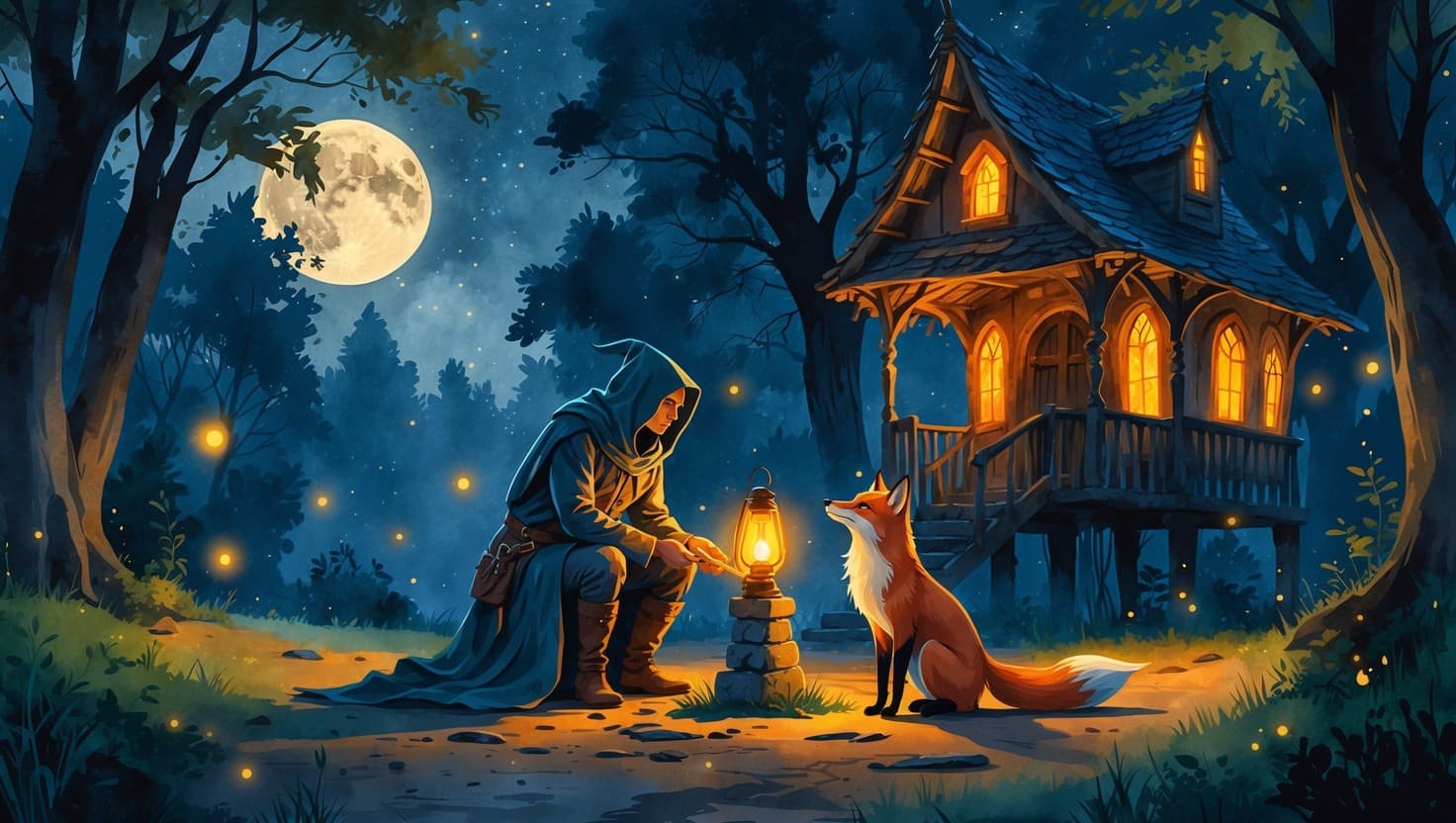
Fairy Tale One-Shot Ideas: 10 Tales You Can Run Tonight
Fairy tales have a shortcut built into them that most genres don't get: everyone already knows the rules. Nobody at the table needs the difference between a paladin and a cleric explained, because everyone already knows you don't break a promise to a witch, three tasks always come in threes, and the last door is the one you shouldn't open.
That shared vocabulary means less setup than almost any other genre, not more. No setting bible, no pantheon of gods with domains - just a bargain, a rule that can be broken, and someone about to break it. Here are 10 fairy tale one-shot ideas built on exactly that, each playable with any system and several solo, with none needing a rulebook written for the genre.
- The Bargain at the Crossroads - a deal with a price, party size 1-4
- The Three Trials - a test of character, party size 1-4
- The Miller's Boast - a lie that got out of hand, party size 2-4
- The Wolf's Toll - an escort with teeth, party size 1-3
- The Changeling's Return - a swapped child, years later, party size 2-4
- The Sleeping Curse - a deadline nobody can stop, party size 2-5
- The Glass Slipper Heist - a social infiltration, party size 3-5
- The Gingerbread House - hospitality as a trap, party size 1-3
- The Godmother's Debt - a wish with unpaid interest, party size 2-4
- The Kingdom Under Ice - a curse frozen mid-sentence, party size 3-5
1. The Bargain at the Crossroads
Difficulty: Easy | Play time: 2-3 hours | Party size: 1-4 | Best for: New players, first fairy tale one-shot
A fox, a raven, or a woman in a patchwork coat waits at a crossroads and offers exactly what the party needs: directions out of the woods, a cure for a sick child, the name of the one who cursed them. The price is never gold - it's a memory, a promise, or the thing they're least willing to give up.
This is the fairy tale equivalent of "the tavern owner has a job." The whole session is the negotiation: what the party offers, what they hold back, and what the bargainer does with it later. Keep the price specific and strange rather than generic ("your name" beats "your soul") - specific prices are the ones players remember and try to work around.
This one plays great solo. A single traveler negotiating alone at a crossroads, with nobody to talk them out of a bad deal, is exactly the tension the genre wants. An AI Game Master can hold the bargainer's exact wording and call it back three scenes later, which is the twist that makes it land.
2. The Three Trials
Difficulty: Easy-Medium | Play time: 2-3 hours | Party size: 1-4 | Best for: Groups who want structure without much prep
A gatekeeper, a suitor's contest, or a dying king sets three trials before whoever wants what's on the other side: a riddle, a feat of kindness, a test that looks like combat but isn't. Fail the first two and the third is what actually matters.
Structure it in three beats, one per trial, and give the third a real twist - the riddle's answer changes depending on who's asking, or the "feat of kindness" trial secretly punishes anyone who solves it with force. This is the storybook cousin of D&D's escort mission: simple enough for a first-time GM, flexible enough that the test can be anything from a riddle to a moral trap. The twist that always lands: the gatekeeper was testing for kindness, not cleverness, and the party's cleverest answer to trial one is why trial three goes badly.
3. The Miller's Boast
Difficulty: Medium | Play time: 2-4 hours | Party size: 2-4 | Best for: Groups who like consequences catching up with them
Someone made a boast they can't back up - their daughter can spin straw into gold, their son can outrun the wind - and a small, strange figure has arrived to collect on the impossible claim. The party has to either make the boast true or talk their way out of the deal before its patience runs out.
Decide before the session what the collector actually wants, and make it stranger than gold. A figure who wants a firstborn child reads as classic Grimm; one who wants only the true telling of the boaster's next lie reads as something stranger. Give it a real personality instead of a monster mask - oddly reasonable, exact with its terms, never breaking its own word - so the moment the party realizes what they agreed to lands twice as hard.
4. The Wolf's Toll
Difficulty: Medium | Play time: 2-3 hours | Party size: 1-3 | Best for: Small groups, tense negotiations
Someone has to cross the woods to bring help or news to a relative on the other side, and the woods have a toll collector who isn't interested in coin. The wolf on the road can be fought, but it knows every shortcut through the thorns, and killing it leaves the party with a pelt and no guide. Build the whole scenario as a negotiation wearing a monster costume: the wolf wants something odd but specific - a lock of hair, the truth about where the party is really going, the last bite in the basket.
Resist making the wolf purely evil. One that's hungry, lonely, or bound by its own bargain with someone worse is more frightening than a plain monster, because the party has to decide whether it deserves what it's asking for.
5. The Changeling's Return
Difficulty: Medium | Play time: 3-4 hours | Party size: 2-4 | Best for: Roleplay-heavy groups
Years ago, a child was swapped for something else at the edge of the woods. Now the changeling is grown, and it's come back - to reclaim something, to make peace, or to find out what it actually is. The family it left behind has to decide whether to welcome it, fear it, or send it away again.
This is a social scenario first and a combat one only if the party forces it there. Give the changeling a real reason for returning beyond "revenge," and the family a real grievance beyond "fear of the unknown," so the party's choice actually changes what the changeling becomes next. Let what it actually is unfold slowly - a habit that doesn't fit, a reaction to iron or salt - rather than announcing it in scene one.
6. The Sleeping Curse
Difficulty: Medium-Hard | Play time: 3-4 hours | Party size: 2-5 | Best for: Groups who want a real countdown clock
A curse has put someone - a princess, a village, an entire court - to sleep, with a deadline: true love's task, a hundred years, or something stranger the party has to figure out before it runs out. Unlike most curses, this one has a clock everyone in the room can see ticking.
The Sleeping Curse
Parties who want real time pressure
The party has to find the curse's exact terms - not the folk version everyone assumes, but the actual wording the witch or fae used - because breaking a curse the wrong way almost always makes it worse.
The best version makes "true love's kiss" a red herring or, better, a literal reading nobody expected: not romance, but the truest bond in the room, which might be a sibling, a rival, or the party's own hard-won trust in each other.
7. The Glass Slipper Heist
Difficulty: Medium | Play time: 3-4 hours | Party size: 3-5 | Best for: Groups who like social infiltration
A ball, a contest, or a royal announcement is the party's one chance to get close to someone who matters - a prince picking a bride, a queen choosing an heir. Someone in the party has exactly one night, one disguise, and one item that has to work perfectly or the whole plan falls apart at midnight.
Structure it like a heist: getting in (the disguise, the invitation, the fairy godmother's help), the event itself (dancing, conversation, not getting recognized), and the exit before the magic runs out. Make the deadline real, not soft, so running late actually costs something. The best twist: the "prize" they're infiltrating for isn't what it looks like from the outside, and they only learn that after committing to the plan.
8. The Gingerbread House
Difficulty: Hard | Play time: 2-3 hours | Party size: 1-3 | Best for: Small groups, horror fans
This one works best with a small party and a GM comfortable playing a host who's genuinely dangerous. Not a beginner pick, but one of the most tense structures a fairy tale one-shot can run.
Lost, hungry, and out of options, the party finds a house that solves both problems at once, and every kindness the host offers has a hook in it they don't notice until too late. Hospitality is sacred in a fairy tale, which is exactly what makes a host who weaponizes it so unsettling.
Have the host stay warm and reasonable the entire time - never cackling, never threatening - because a smiling stranger who keeps refilling your plate is scarier than one who admits what she's doing. Let the party notice the trap themselves, one detail at a time: a door that wasn't there this morning, a cage that fits suspiciously well. One or two travelers with nowhere else to go before nightfall is claustrophobic in exactly the right way.
9. The Godmother's Debt
Difficulty: Medium | Play time: 2-4 hours | Party size: 2-4 | Best for: Groups who want one clear objective
A wish was granted once, years ago, and now the one who granted it has come to collect - not payment, but a favor that has to be done exactly as asked, no more and no less. Every attempt to interpret her wording generously makes things worse.
Give the errand a real cost the party doesn't see coming: retrieving an object means taking it from someone who needs it more; delivering a message means breaking a different promise to do it. A debt that's purely inconvenient is a chore; one that forces a genuine choice is a story. Add a second party racing to settle a debt with the same godmother for built-in tension without a hard villain.
10. The Kingdom Under Ice
Difficulty: Medium-Hard | Play time: 3-5 hours | Party size: 3-5 | Best for: Groups who want a mystery baked in
A kingdom has been frozen mid-moment - the feast still on the table, the dancers still mid-step, a queen still speaking a sentence she never finished - and the party is the first to walk through it in longer than anyone can say. Something interrupted whatever curse did this, and it's still out there.
This premise is a mystery wearing a storybook coat: what actually happened at the exact moment the kingdom froze, and why did it stop instead of finishing? Resist explaining it up front - let the party piece it together from what's frozen mid-action, a guard reaching for a weapon, a letter half-folded. Give them one warm thing in the cold kingdom, a hearth still burning or a person still breathing, as an anchor and a clue.
How to Run a Fairy Tale One-Shot (Quick Tips)
You've got a premise from the list above. Here's how to keep it from sliding into a regular dungeon crawl, adapted from general one-shot advice and running a full fairy tale campaign for a single session:
Pick the tone before the premise. Whimsical, classic Grimm, dark fairy tale, or comedic all want different pacing and stakes. Decide out loud before the table starts, because a party expecting whimsy checks out the moment a taboo gets broken for real.
Lean on the three narrative laws. Promises bind, names have power, and things come in threes. A one-shot barely needs any other rule if these three are enforced consistently.
Start at the bargain, not the backstory. Not at a tavern, not with a long setup. Start at the crossroads, at the gingerbread house's door, at the moment the curse takes hold.
Give every gift a string attached. Magic items with strings attached work the same way in a one-shot - boots that only walk toward home, a purse always watched by whoever's counting the coins.
Set the ending before you start the trial. Premises with a mystery baked in (The Kingdom Under Ice, The Changeling's Return) are the easiest to let run long.
If building three trials, a talking fox, and a witch's exact wording sounds like more prep than one evening deserves, StoryRoll's Fairy Tale mode runs the whole tale for you - the Narrator, every Character the party meets, and the bargain's fine print - with narrative Hero creation instead of a character sheet. You describe what your Hero does; the Narrator keeps the tale's logic consistent from the crossroads to the last page.
Fairy Tale One-Shot Ideas by Tone
Whimsical: The Miller's Boast, The Glass Slipper Heist, The Bargain at the Crossroads
Classic: The Three Trials, The Godmother's Debt, The Changeling's Return
Dark fairy tale: The Gingerbread House, The Wolf's Toll, The Kingdom Under Ice
Solo-friendly: The Bargain at the Crossroads, The Three Trials, The Gingerbread House
A good fairy tale one-shot doesn't need more prep than a dungeon crawl - it needs a bargain, a trial, or a taboo, and the discipline to enforce its terms exactly as stated. Crossroads deals, sleeping curses, and gingerbread houses all do the same job the tavern rat problem does for D&D: give the party a reason to care before the first scene ends.
Pick one of these ten ideas, decide what the price actually is, and run it. Two or three hours from now, your table will understand exactly why nobody breaks a promise to a witch.
And if nobody wants to voice the talking fox? That's what an AI Game Master is for.
FAQ
What makes a good fairy tale one-shot idea?
A good fairy tale one-shot idea centers on a bargain, a trial, or a taboo rather than a dungeon to clear. The premise should explain itself in one sentence - a debt that's come due, a curse with a deadline, a promise someone regrets - because fairy tales run on narrative law, not combat objectives.
How long does a fairy tale one-shot take to run?
Plan for 2-3 hours, shorter than a typical dungeon-crawl one-shot. Fairy tales are built to be brief - the source material resolves in a handful of scenes - so premises like a riddle at the crossroads or a single bargain gone wrong fit comfortably into an evening.
Do I need a fairy tale rulebook to run one of these?
No. None of these premises need a rulebook built for the genre - you need a bargain, a rule that can be broken, and characters who react when it is. An AI Game Master like StoryRoll's Fairy Tale mode runs this narratively by default, so you describe what your Hero does and the Narrator keeps the tale's logic consistent without a spell list in sight.
What party size works best for a fairy tale one-shot?
Two to four Heroes is the sweet spot. Fairy tales usually follow a small cast - a knight, a trickster, a sibling searching for another sibling - and a larger party dilutes the personal stakes that make a bargain or a taboo land. Several of these premises work solo, since a single traveler up against a witch's terms is the genre's default shape.
Can kids play in a fairy tale one-shot?
Yes, and it's one of the easiest genres for a mixed-age table. Whimsical premises like The Miller's Boast or The Glass Slipper Heist keep stakes light and reward clever ideas over rules mastery. Save the darker ones - The Gingerbread House, The Kingdom Under Ice - for tables that want teeth.
Written by StoryRoll
Founder of StoryRoll. Building AI-powered tabletop RPGs.
Related Posts
Anime One-Shot Ideas: 10 Episodes You Can Run Tonight
10 anime one-shot ideas across shonen, isekai, mecha, magical girl, and dark anime - premises, party sizes, and tips for running each one tonight.
Sci-Fi One-Shot Ideas: 10 Missions You Can Run Tonight
10 sci-fi one-shot ideas that don't need a homebrew rulebook or a hundred hours of world-building. Premises, crew sizes, and tips for running each one.
Cozy Solo RPG: What the Genre Gets Right (and What an AI Game Master Adds)
Cozy solo RPG journaling games nail the low-stakes, gentle-stakes feeling. Here is what they do best, where they hit a ceiling, and what an AI Game Master adds on top.