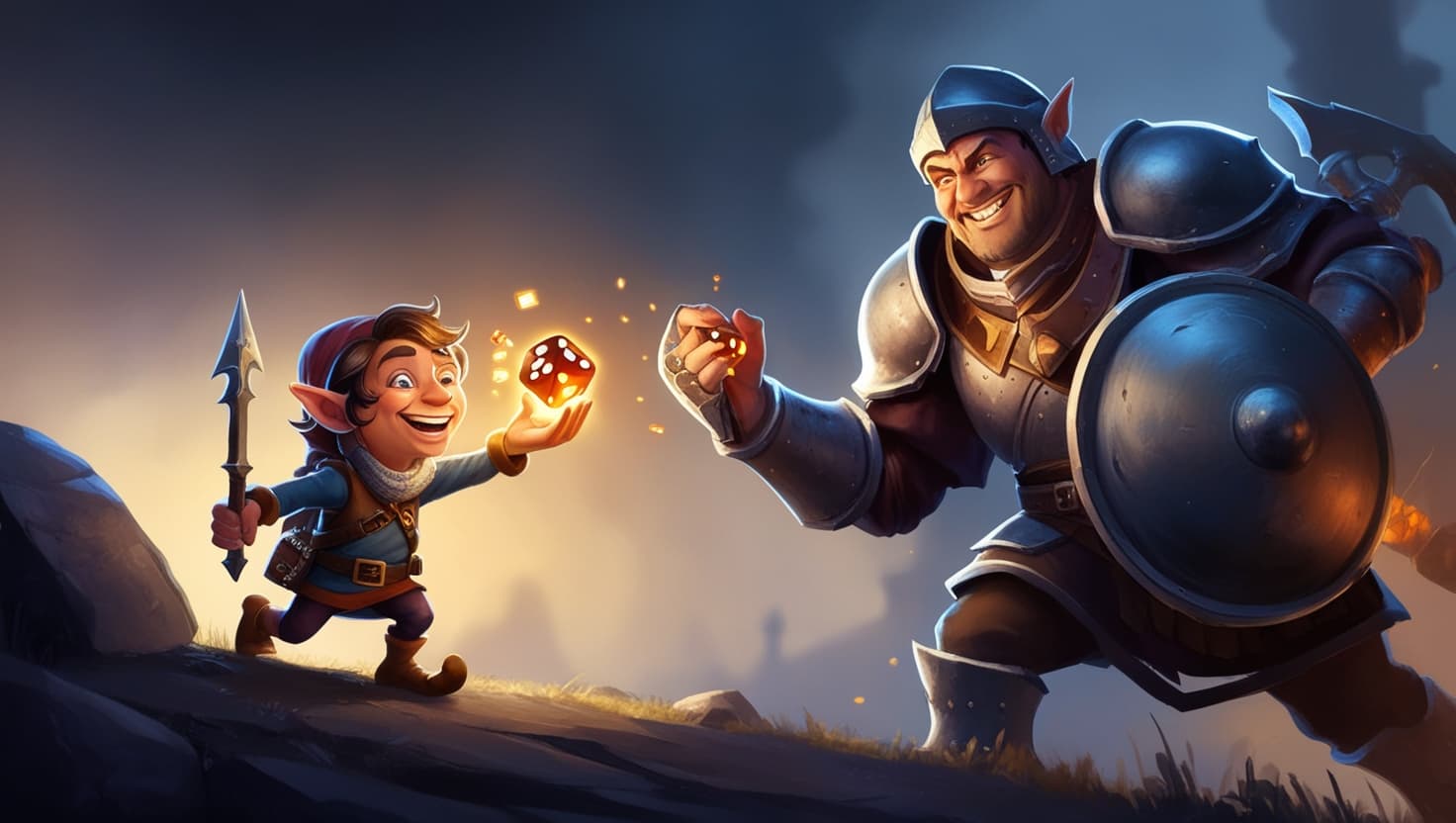
D&D Halfling Race Guide: Why the Small Folk Dominate AI Campaigns
Nobody picks halfling to be the hero. That's exactly why halfling players have more fun than everyone else at the table.
There's a reason Tolkien built his most famous stories around hobbits and not elves. The "small person in a big world" archetype works because it creates tension, humor, and triumph in every scene. And in AI-run campaigns, where the Game Master reacts dynamically to your character's identity, halflings generate some of the richest storytelling in the game.
Why Halflings Are Underrated (And Why AI GMs Fix That)
In traditional D&D, halflings sometimes get overshadowed. Players chase the flashy racial features - Dragonborn breath weapons, Tiefling spellcasting, Half-Orc crits. Halfling traits look modest on paper.
They're not modest. They're quietly some of the best features in the game.
Lucky is statistically broken
Rerolling natural 1s on attack rolls, ability checks, and saving throws sounds minor until you do the math. It effectively eliminates your worst 5% of outcomes on every single roll you make for the entire campaign. No other racial trait comes close to that consistency.
In AI campaigns, where every roll drives the narrative forward, Lucky means your halfling almost never faceplants at the worst possible moment. That clutch Stealth check to sneak past the dragon? You get a second chance if you roll a 1. The saving throw against a domination spell? Same. The AI narrates these moments beautifully - your halfling stumbles, catches a bootlace, and somehow turns the stumble into a dodge.
Brave makes you fearless (mechanically)
Advantage on saving throws against being frightened is one of those features that barely matters until it matters enormously. Dragons, liches, banshees, and dozens of other high-level threats rely on the frightened condition. Your halfling shrugs it off while the party's 20-Strength fighter is cowering.
AI Game Masters lean into this contrast. When the rest of the party freezes in terror, your three-foot-tall halfling steps forward. The AI plays up that moment every time, and it never gets old.
Naturally Stealthy (Lightfoot) is absurd
Lightfoot halflings can attempt to hide when obscured by a creature at least one size larger than them. In practice, this means you can hide behind any Medium-sized party member during combat. You're essentially invisible whenever you want to be, as long as a friend is nearby.
For Rogues, this is borderline game-breaking. Hide behind the Fighter, pop out, Sneak Attack, hide again. The AI tracks your hidden status consistently and narrates the "now you see me" routine with genuine flair.
Mention your halfling's height in your character backstory. AI Game Masters use physical details to create immersive narration - your halfling ducking under a table during a bar fight, needing a stool to reach a high shelf, or being underestimated by a guard who doesn't see you as a threat. These small details generate big roleplay moments.
Halfling Subraces: Lightfoot vs. Stout
Lightfoot Halfling
The stealth specialist. Naturally Stealthy is the headline, but the +1 Charisma bonus also makes Lightfoot halflings natural faces for the party.
Best for: Rogues, Bards, Rangers who scout ahead, any build that values stealth and social encounters.
AI campaign advantage: The AI tracks your hiding position behind allies precisely, and creates opportunities for you to exploit it - crowded marketplaces, narrow dungeon corridors, chaotic battlefields where you can slip between legs and strike unseen.
Stout Halfling
The durable pick. Stout Resilience gives you advantage on saves against poison and resistance to poison damage. The +1 Constitution bonus also boosts your hit points, which matter when you're already working with a d8 or smaller hit die.
Best for: Monks, Fighters, any halfling heading into dungeons full of venomous creatures, poisoned traps, or green dragon territory.
AI campaign advantage: Poison is one of the most common damage types in D&D, and AI Game Masters use it liberally - trapped chests, assassin NPCs, swamp encounters, tainted food. Stout halflings shrug off threats that sideline other characters for entire scenes.
Best Classes for Halflings
Rogue (The Perfect Pairing)
Dexterity-based, skill-heavy, stealth-reliant. Everything a halfling does well, the Rogue amplifies. Lucky protects your Thieves' Tools and Stealth checks from catastrophic 1s. Lightfoot's Naturally Stealthy gives you combat hiding that other Rogues need terrain for. Brave keeps you operational when enemies try to frighten you away from flanking position.
Ranger (The Wilderness Scout)
Halfling Rangers are thematically perfect - the small tracker who notices what everyone else misses. Dexterity fuels your ranged attacks and AC. Lucky saves your Survival and Perception checks. In AI campaigns, Ranger halflings excel as the party's advance scout, slipping through underbrush that would slow larger characters.
Bard (The Charming Underdog)
Lightfoot's Charisma bonus feeds directly into your spellcasting and social skills. But the real draw is narrative: a halfling Bard is immediately charming, and AI Game Masters write NPCs who respond to that charm. You're the one who talks down the angry mob, wins over the suspicious innkeeper, and convinces the dragon that eating you would be beneath its dignity.
Monk (The Unexpected Striker)
Dexterity and the Stout subrace's Constitution bonus make halfling Monks durable. Small size doesn't affect your unarmed strikes mechanically, but the AI narrates a halfling Monk as fast, unpredictable, and hard to pin down. Lucky on your many attack rolls (Flurry of Blows means four chances to roll a 1) adds up to meaningful statistical protection.
Quick Build: The Lucky Scout
- Race: Lightfoot Halfling
- Class: Rogue (Thief or Scout subclass)
- Key Stats: Dexterity 16, Charisma 14, Wisdom 12
- Expertise: Stealth + Perception
- Skills: Investigation, Sleight of Hand, Insight, Acrobatics
- Playstyle: Scout ahead using Naturally Stealthy, gather intel, report back, set up ambushes
Roleplaying a Halfling With an AI GM
Lean into curiosity
Halflings are naturally curious - it's baked into the lore. In AI campaigns, curiosity is rewarded. Investigate the strange noise. Open the weird box. Talk to the suspicious stranger. The AI creates content in response to your engagement, so a curious halfling sees more of the world than a cautious elf.
Play the "unlikely hero" card
Your character backstory should establish why a three-foot-tall person is adventuring in a world built for people twice their size. The AI Game Master picks up on this tension and weaves it into the narrative - NPCs underestimate you, environments challenge your size, and your victories land harder because nobody expected them.
Comfort-loving nature creates conflict
Halflings canonically love good food, warm hearths, and peaceful communities. An adventuring halfling is inherently in tension with their own nature. That conflict is roleplay gold. Complain about the rations. Miss your garden. Describe cooking a proper meal at camp while the party plans their assault on the necromancer's tower. The AI plays off these details to create moments of warmth between the danger.
Bravery despite size
Brave isn't just a mechanical feature - it's a character trait. Your halfling isn't fearless because they're tough. They're brave because they choose to act despite being small and squishy. Tell the AI this is part of your character, and watch it create moments where that bravery matters.
AI Game Masters track your roleplaying patterns. If you consistently play your halfling as curious and brave, the AI generates storylines that test and reward those traits. A halfling who always investigates strange sounds will eventually discover something that changes the campaign.
Campaign Template Ideas
D&D 5e: The Unexpected Hero
Classic halfling territory. Your quiet village is threatened, and you're the one who steps up. The AI builds a "Shire to Mordor" progression - start in comfort, escalate into danger, become the hero nobody predicted. Works beautifully for first-time players and veterans alike.
Sci-Fi: The Scrappy Pilot
In StoryRoll's Sci-Fi mode, translate the halfling archetype into a small-statured pilot or engineer. You fit into maintenance crawlways that bigger crew members can't reach. You're underestimated by alien species. Your ship is held together with duct tape and optimism. The AI leans into scrappy underdog energy hard.
Fairy Tale: The Clever Trickster
Fairy tales are full of small heroes who outsmart bigger opponents - Tom Thumb, Thumbelina, the Brave Little Tailor. In Fairy Tale mode, your halfling is a trickster who wins through wit, luck, and audacity. The AI draws on folklore patterns to create puzzles and challenges that reward cleverness over strength.
Common Mistakes (And How to Avoid Them)
Forgetting you're small. Halflings use smaller weapons (no Heavy weapons without disadvantage) and move 25 feet per round instead of 30. Plan for this. Take ranged options or grab the Mobile feat to close the speed gap.
Playing a generic character. Halflings have a rich cultural identity - communal, food-loving, deceptively brave. If you play yours as "short human," you're leaving free roleplay material on the table. Give the AI something to work with.
Ignoring Lucky. It's passive, so it's easy to forget. StoryRoll tracks it automatically, but in your narration, acknowledge it. "My halfling stumbles but catches herself" is more interesting than just accepting the reroll silently.
Choosing Stout when you want stealth (or vice versa). The subraces are meaningfully different. If your build needs hiding, go Lightfoot. If your build needs durability, go Stout. Don't pick based on flavor alone - the mechanical gap matters.
Trying to be the tank. You have small hit dice and light armor proficiency (in most classes). Use positioning, stealth, and Lucky to avoid damage rather than soaking it. Let the half-orc take the hits.
Halflings are the quiet overachievers of D&D 5e, and AI campaigns bring out their best qualities. Lucky provides unmatched consistency. Brave keeps you in fights that shut down other characters. And the "unlikely hero" narrative practically writes itself when you hand it to an AI Game Master.
Start with Lightfoot if you want stealth and social prowess, Stout if you want resilience and dungeon survivability. Pair with Rogue for the mechanically optimal build, Bard for the most fun roleplay, or Ranger for the best exploration experience.
The secret of playing a halfling is simple: the world underestimates you, and you prove it wrong. Every session. AI Game Masters never get tired of telling that story.
Create your Halfling character on StoryRoll and show them what small folk can do.
Try These Free Tools
Get your Halfling adventure-ready with these free resources:
- Ability Score Calculator — Factor in your Halfling's Dexterity bonus and optimize your build.
- Backstory Generator — Generate a cozy homeland, a reason to leave it, and the trouble that followed.
- Dice Roller — Roll stats and see Lucky in action with our 3D dice roller.
Frequently Asked Questions
Are halflings good for beginners in AI D&D?
Excellent. Lucky smooths out the frustration of bad rolls, the racial traits are all passive (no complex abilities to track), and the "curious adventurer" archetype gives new players a natural motivation to engage with the world. The AI GM does the heavy lifting on narrative - you just need to be curious and brave.
How does halfling size affect gameplay with an AI GM?
The AI tracks your Small size and creates situations around it. You can fit through narrow passages, hide in spaces larger characters can't, and move through the space of any Medium or larger creature. Occasionally your size creates challenges - reaching high shelves, using Heavy weapons, keeping pace with longer-legged allies - but the AI plays these as character moments, not punishments.
Can I play a halfling in solo AI campaigns?
Yes, and halflings are strong solo picks. Lucky reduces the variance that can end solo runs (one bad roll without a party to bail you out). Lightfoot's Naturally Stealthy works with summoned creatures or NPCs the AI provides. And the "small hero alone in a big world" narrative is compelling enough to carry a full solo campaign.
What background works best for a halfling?
Folk Hero (the community champion), Urchin (street-smart survivor), and Outlander (the wandering halfling) all give you strong hooks that AI Game Masters expand into full storylines. Criminal also works well for Rogue builds - a halfling fence or cat burglar is a classic archetype.
Should I take a feat or ability score increase at level 4?
Lucky (the feat) stacking with Lucky (the racial trait) gives you absurd roll protection. Mobile fixes your 25-foot speed and adds hit-and-run capability. Alert (+5 initiative with your high Dex) means you almost always act first. Any of these three are worth taking before maxing Dexterity, depending on your playstyle.
Written by Anthony Goodman
Founder of StoryRoll. Building AI-powered tabletop RPGs.
Related Posts
Playing an Aasimar With an AI Game Master: The Complete Race Guide
Aasimar pairs Charisma-friendly racial traits with a once-per-long-rest transformation and a built-in heal. Here's how the traits work, which subrace to pick, and how to build one with an AI Game Master.
Playing a Half-Orc With an AI Game Master: The Complete Race Guide
Half-Orcs pair +2 Strength/+1 Constitution with Relentless Endurance and Savage Attacks, two of the best survival and damage traits in D&D 5e. Here's how to build one and roleplay it with an AI Game Master.
Playing a Gnome With an AI Game Master: The Complete Race Guide
Gnomes pair a +2 Intelligence bonus with magic-resistant Gnome Cunning and a choice between fey illusion tricks and tinkerer's gadgets. Here's how to build one and roleplay it with an AI Game Master.