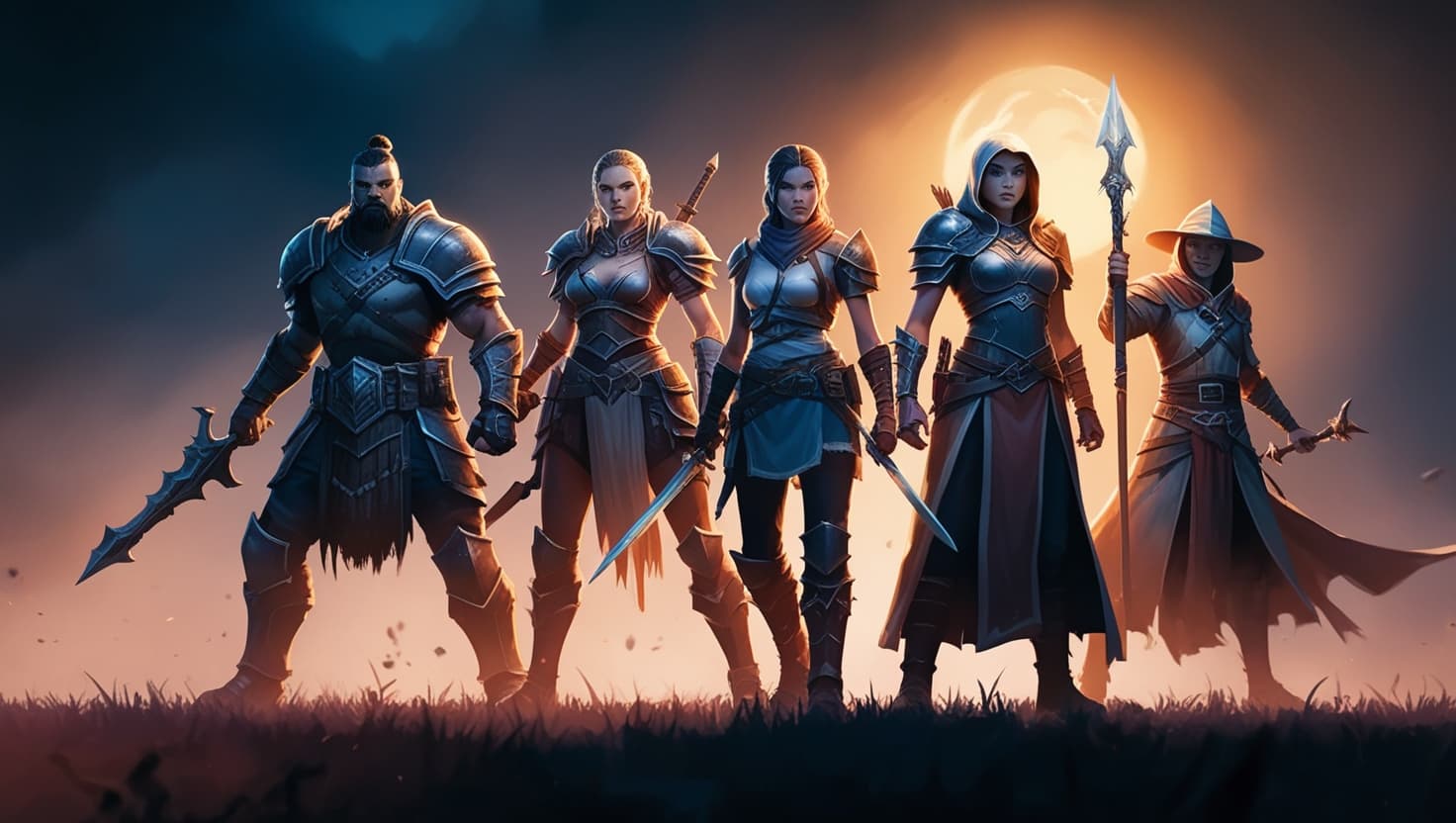
D&D Party Composition Guide: Best Team Builds for 2026
"We need a healer." Four words that have delayed more Session Ones than scheduling conflicts. Someone always wants to play a rogue. Nobody wants to play a cleric. And the party walks into the first dungeon with three strikers and a bard who took zero healing spells. (Not sure if your party actually needs a dedicated healer? Check out Do You Need a Healer in D&D 5e? - the answer might surprise you.)
D&D 5e is forgiving enough that almost any party can work. But "can survive" and "plays well" are different things. A balanced party doesn't just live longer - it has more fun. Everyone gets moments to shine. Combat has rhythm instead of chaos. And the GM doesn't have to secretly nerf every encounter because your group brought four glass cannons.
This guide covers what actually matters in party composition: the roles, the best class combos for different group sizes, the mistakes that get parties killed, and how to build a team that handles anything the GM throws at it.
The Four Core Roles in D&D
Every effective party covers four functions. Individual classes often fill more than one, which is what makes composition interesting. A well-built three-player party can outperform a poorly-built five-player one.
1. Tank (Frontline / Defender)
The tank stands between the monsters and everyone else. They absorb hits, control positioning, and force enemies to deal with them instead of the squishy wizard in the back row.
What makes a good tank:
- High AC (heavy armor, shields)
- High hit points (d10 or d12 hit dice)
- Abilities that punish enemies for ignoring them (Sentinel feat, Compelled Duel, Reckless Attack)
Best tank classes:
- Fighter - highest AC potential, most attacks, Action Surge for emergencies
- Paladin - heavy armor plus self-healing plus Aura of Protection for the whole party
- Barbarian - massive HP pool, Rage halves physical damage, Reckless Attack draws aggro naturally
The best tanks don't just have high HP - they have "stickiness." The Sentinel feat, which stops enemies from moving when you hit them with an opportunity attack, turns any frontliner into a wall. A Barbarian with Sentinel is nearly impossible to walk past.
2. Healer (Support)
The healer keeps the party standing. In 5e, healing is less about topping off health bars and more about picking up unconscious allies before they fail death saves.
What makes a good healer:
- Access to Healing Word (bonus action, ranged - the single best healing spell in 5e)
- Condition removal (Lesser Restoration, Remove Curse)
- Buff spells that prevent damage in the first place (Bless, Shield of Faith)
Best healer classes:
- Cleric - the gold standard. Every subclass heals. Life Domain is the best at it, but any Cleric covers the role.
- Druid - strong healing spell list plus Goodberry for out-of-combat recovery
- Bard - Healing Word plus Bardic Inspiration makes them excellent hybrid supports
3. DPS / Striker
The striker ends fights fast. The longer combat drags, the more resources the party burns. A good striker turns three-round fights into two-round fights.
What makes a good striker:
- High single-target damage (Sneak Attack, Eldritch Blast + Agonizing Blast, Action Surge)
- Reliable damage every round (not just nova turns)
- Ability to target vulnerable enemies (ranged options, mobility)
Best striker classes:
- Rogue - Sneak Attack damage scales hard, plus Cunning Action keeps them alive
- Warlock - Eldritch Blast is the best damage cantrip in the game, and Hex adds d6 per hit
- Ranger - Hunter's Mark plus Extra Attack plus ranged superiority
- Fighter - Action Surge turns are the highest single-round damage in the game
4. Utility / Controller
The utility player solves the problems that swords can't. They scout ahead, disable groups of enemies, unlock doors, decipher texts, and make sure the party isn't surprised.
What makes a good utility player:
- Area control spells (Web, Hypnotic Pattern, Wall of Force)
- Skill proficiencies (Investigation, Perception, Arcana, Thieves' Tools)
- Information-gathering abilities (Detect Magic, Identify, Divination spells)
Best utility classes:
- Wizard - largest spell list in the game (browse it with our spell list filter), ritual casting, Arcane Recovery
- Bard - Jack of All Trades plus Expertise plus full caster spell list
- Artificer - tool proficiencies, infusions, and the party's Swiss Army knife
- Rogue - Expertise in four skills, Reliable Talent at level 11, Thieves' Tools mastery
Notice how some classes appear in multiple roles? That's the key to good composition. A Bard can heal, deal damage, and handle utility. A Paladin tanks and heals. Choosing classes that cover multiple roles is how small parties compete with large ones.
Best Party Compositions by Group Size
The 3-Player Party
Three players is tight. Every character needs to cover at least two roles, and you'll feel gaps if you don't plan carefully.
Top 3-player compositions:
1. Paladin + Bard + Rogue (Recommended)
- Paladin covers tank + healer
- Bard covers utility + backup healer + face skills
- Rogue covers striker + skills
- Why it works: two characters can heal, the Rogue handles traps and scouting, and social encounters are covered by the Bard and Paladin's Charisma
2. Fighter + Druid + Warlock
- Fighter covers tank + striker (Action Surge)
- Druid covers healer + utility + off-tank (Wild Shape)
- Warlock covers striker + utility (invocations)
- Why it works: Moon Druid is almost a second tank, giving the Fighter breathing room
3. Barbarian + Cleric + Ranger
- Barbarian covers tank + striker (Reckless Attack)
- Cleric covers healer + utility
- Ranger covers striker + scout + skills
- Why it works: simple and hard to mess up. Every role is clearly assigned.
Avoid three-player parties with no healing at all. In a four or five-player group, you can get away with healing potions and short rests. With three players, one bad combat round without healing access can snowball into a TPK.
The 4-Player Party
Four is the sweet spot. The game is balanced around four players, encounter math assumes it, and published adventures target it.
Top 4-player compositions:
1. Fighter + Cleric + Wizard + Rogue (The Classic)
- Every role covered cleanly
- No overlapping weaknesses
- The baseline the game is balanced around
- Subclass choices add flavor without sacrificing function
2. Paladin + Druid + Warlock + Rogue
- Paladin's Aura of Protection helps the whole party
- Druid provides healing, utility, and off-tank Wild Shape
- Warlock delivers consistent ranged damage
- Rogue handles skills and burst damage
- Why it works: extremely resilient. Two characters can heal, two can frontline in a pinch.
3. Barbarian + Bard + Ranger + Wizard
- Barbarian tanks and does melee DPS
- Bard heals, buffs, and handles social encounters
- Ranger provides ranged damage and exploration utility
- Wizard controls the battlefield and solves arcane problems
- Why it works: covers exploration, social, and combat pillars equally
The 5-Player Party
With five players, you have luxury. You can afford specialists and still cover every role.
Top 5-player compositions:
1. Fighter + Cleric + Wizard + Rogue + Ranger
- The classic four plus a fifth who adds ranged damage and exploration skills
- Double skill coverage (Rogue + Ranger) means nothing gets past the party
- Ranger's nature magic complements the Wizard's arcane list
2. Paladin + Cleric + Warlock + Bard + Barbarian
- Heavy Charisma party - dominates social encounters
- Two full healers means the party is nearly unkillable
- Barbarian and Paladin create an impenetrable frontline
- Why it works: overwhelming sustain and social power, with Warlock providing ranged firepower
3. Fighter + Druid + Wizard + Rogue + Monk
- Monk adds a second melee threat with stunning capability
- Stunning Strike can completely shut down single-boss encounters
- Wizard + Druid covers arcane and nature magic
- Why it works: extremely high action economy with Fighter's Extra Attacks, Rogue's bonus actions, and Monk's Flurry of Blows
Party Composition Quick Rules:
- 3 players: Every character must cover 2+ roles. Prioritize a healer hybrid.
- 4 players: Cover all four roles. One healer is enough if they have Healing Word.
- 5 players: You can afford specialists. Double up on whatever role your group enjoys most.
- Any size: At least one character needs Perception proficiency. At least one needs to be the face (Charisma skills).
The Classes Ranked by Versatility
Some classes fit into almost any party. Others need specific support. Here's how they stack up for composition flexibility:
Tier 1 - Fits Anywhere:
- Paladin - tank, healer, face, striker. The most self-sufficient class in 5e.
- Bard - healer, utility, face, support. Jack of All Trades is literal.
- Cleric - healer, tank (in heavy armor domains), utility. Every party wants one.
Tier 2 - Highly Flexible:
- Druid - healer, off-tank (Wild Shape), utility, controller. Moon Druid is basically two characters.
- Fighter - tank, striker. Subclass choice determines everything else.
- Ranger - striker, scout, utility. Gloom Stalker is tier 1 if your campaign has darkness.
Tier 3 - Strong in Role:
- Rogue - striker, skills. Incredible at what they do, but narrow.
- Wizard - utility, controller. Best spell list, but needs protection.
- Warlock - striker, utility (invocations). Consistent but specialized.
Tier 4 - Needs Support:
- Barbarian - pure tank/striker. Amazing at it, but brings nothing out of combat.
- Sorcerer - striker/controller. Fewer spells known than Wizard, less versatile.
- Monk - striker/skirmisher. Fun but doesn't fill gaps the way other classes do.
Don't read this tier list as a power ranking. A Barbarian is an absolute wrecking ball in combat - they just don't help with out-of-combat challenges. If your party already has utility covered, a Barbarian is a perfect addition. Context matters more than tier.
Common Party Building Mistakes
Mistake 1: No Frontliner
If nobody can take a hit, every fight becomes a scramble. Enemies charge past the midline, squishies drop, and the healer spends every spell slot on emergency healing instead of buffs.
Fix: At least one character needs heavy armor or Rage-level damage resistance. If nobody wants to play a traditional tank, a Moon Druid or Hexblade Warlock with medium armor can fill the gap.
Mistake 2: No Healing at All
"We'll just buy healing potions" works until you face three encounters in a row and the shops are two days away. Potions cost 50 gold each, take an action to drink, and only heal 2d4+2.
Fix: Someone takes Healing Word. That's it. One spell on one character solves the problem. Bards, Clerics, and Druids all get it at level 1. Even a one-level multiclass dip into Cleric gives full armor, a shield, and Healing Word.
Mistake 3: Everyone Plays the Same Role
Four strikers kill things fast - until they face a puzzle, a social encounter, or any fight that lasts more than two rounds. Four tanks are nearly unkillable but take ten rounds to finish anything.
Fix: Talk about party roles during character creation. This doesn't mean forcing choices - it means having the conversation. "I want to play a Rogue" is great. "We already have two Rogues" is important context.
Mistake 4: Ignoring Skills
Combat gets the spotlight, but D&D has three pillars: combat, exploration, and social interaction. A party where nobody has Perception, Investigation, or Persuasion will miss traps, fail to gather information, and lose every negotiation.
Fix: Spread skill proficiencies across the party. Ideally, someone covers Perception (the most-rolled skill in the game), someone covers social skills (Persuasion/Deception), and someone handles technical skills (Investigation/Arcana/Thieves' Tools).
Mistake 5: Building for Optimization Instead of Fun
The mathematically optimal party isn't always the most enjoyable one. If everyone picks classes they don't want to play just to "cover roles," the campaign dies of apathy before it dies to monsters.
Fix: Start with what everyone wants to play. Then adjust. If three people want strikers, the fourth can play a Paladin (tank + healer) and the party is fine. It's better to have an enthusiastic suboptimal party than a bored optimal one. Our guide on how to be a better D&D player goes deeper on the mindset shifts that make any party work, regardless of composition.
The best party composition starts with a conversation, not a spreadsheet. Ask what everyone wants to play, identify the gaps, and then see who's willing to adjust. If nobody wants to heal, buy potions and lean into short rests. The game is flexible enough to handle it - you just need to know the tradeoffs.
How AI Game Masters Adapt to Your Party
One advantage of AI-powered tabletop RPGs is that the Game Master can dynamically adjust encounters based on your party's actual composition. A human GM can do this too, but it requires prep time and system knowledge. An AI does it automatically.
Here's how that works in practice:
Encounter scaling: If your party is three strikers and no healer, the AI adjusts enemy count and CR to match your actual combat ceiling, not the theoretical one. You'll face encounters balanced for your group, not for the "standard" four-player party the published module assumes.
Skill coverage gaps: If nobody has high Perception, the AI doesn't just throw invisible traps you'll never detect. It creates alternative discovery methods - a nervous NPC who hints at danger, environmental clues that key off different skills, or combat encounters that replace the trap-heavy corridor.
Role adaptation: In an AI GM campaign, if your Bard decides to focus on damage instead of healing, the AI notices the party's healing capacity dropped and adjusts pacing - more short rest opportunities, more healing potions in loot tables, slightly lower average damage from enemies.
This isn't about making the game easier. It's about making the game playable regardless of what your group brings to the table.
Traditional D&D encounters assume a "standard" party of four with a tank, healer, striker, and utility caster. When your party deviates - and most parties do - an AI Game Master that rebalances in real time means you play the characters you want without the GM scrambling to adjust behind the screen.
Building Your Party: A Step-by-Step Process
If you're starting a new campaign and want to build a balanced party, follow this:
Step 1: Everyone picks a class they're excited about. No restrictions. Just vibes.
Step 2: Map roles. List the four roles (tank, healer, striker, utility) and see which ones your picks already cover.
Step 3: Identify gaps. Missing a healer? Missing a frontliner? Note it.
Step 4: See who's flexible. Often someone has two or three classes they're considering. If one of their alternates fills a gap, problem solved.
Step 5: Use subclasses to patch. A Celestial Warlock heals. A War Cleric tanks. An Arcane Trickster Rogue handles utility magic. Subclass choice can fill gaps without changing anyone's core concept. If you're not sure how to distribute ability scores for a hybrid role, the ability score calculator can show you the tradeoffs.
Step 6: Accept imperfection. If you've done steps 1-5 and still have a gap, that's fine. Play the characters you want. The GM - human or AI - will adjust.
Class Guides to Help You Choose
Already know your party needs a specific role? Check out our class deep-dives:
- Fighter Guide - the most versatile martial class
- Rogue Guide - stealth, skills, and burst damage
- Wizard Guide - the ultimate utility caster
- Cleric Guide - much more than a heal bot
- Ranger Guide - exploration and ranged combat
Build Your Dream Party Today
You've got the theory. Now play it out. StoryRoll lets you build a character, assemble a party, and start a campaign in minutes - no scheduling, no prep, no waiting for a GM. The AI Game Master adapts encounters to whatever composition you bring, so you play the characters you want without worrying about "the meta."
Whether you're running the classic Fighter-Cleric-Wizard-Rogue or four Bards in a trench coat, the adventure starts when you do.
Join the waitlist - we're onboarding new players every week.
TL;DR - Quick Reference
The 4 Core Roles:
- Tank - Fighter, Paladin, Barbarian
- Healer - Cleric, Druid, Bard
- Striker - Rogue, Warlock, Ranger, Fighter
- Utility - Wizard, Bard, Artificer, Rogue
Best 4-Player Party: Fighter + Cleric + Wizard + Rogue
Golden Rule: Cover healer + tank first. Everything else is flexible.
If nobody wants to heal: Buy potions, take short rests, pick subclasses with self-healing (Celestial Warlock, Champion Fighter).
That's the complete guide to D&D party composition. Build smart, play what you love, and let the AI handle the encounter math. See you at the table.
Written by Anthony Goodman
Founder of StoryRoll. Building AI-powered tabletop RPGs.
Related Posts
Enchantment Spells Ranked: The Best (and Worst) in D&D 5e
Every Enchantment spell worth preparing in D&D 5e, ranked from useful to encounter-ending. Suggestion, Hold Monster, Dominate Person, and the rest of the school of the mind.
Transmutation Spells Ranked: The Best (and Worst) in D&D 5e
Every Transmutation spell worth preparing in D&D 5e, ranked from situational to game-breaking. Haste, Polymorph, Fly, and the rest of the school of change.
The 10 Best Divination Spells in D&D 5e, Ranked
Divination trades damage for something rarer: information. These are the spells worth your prepared list, from Detect Magic to True Seeing.