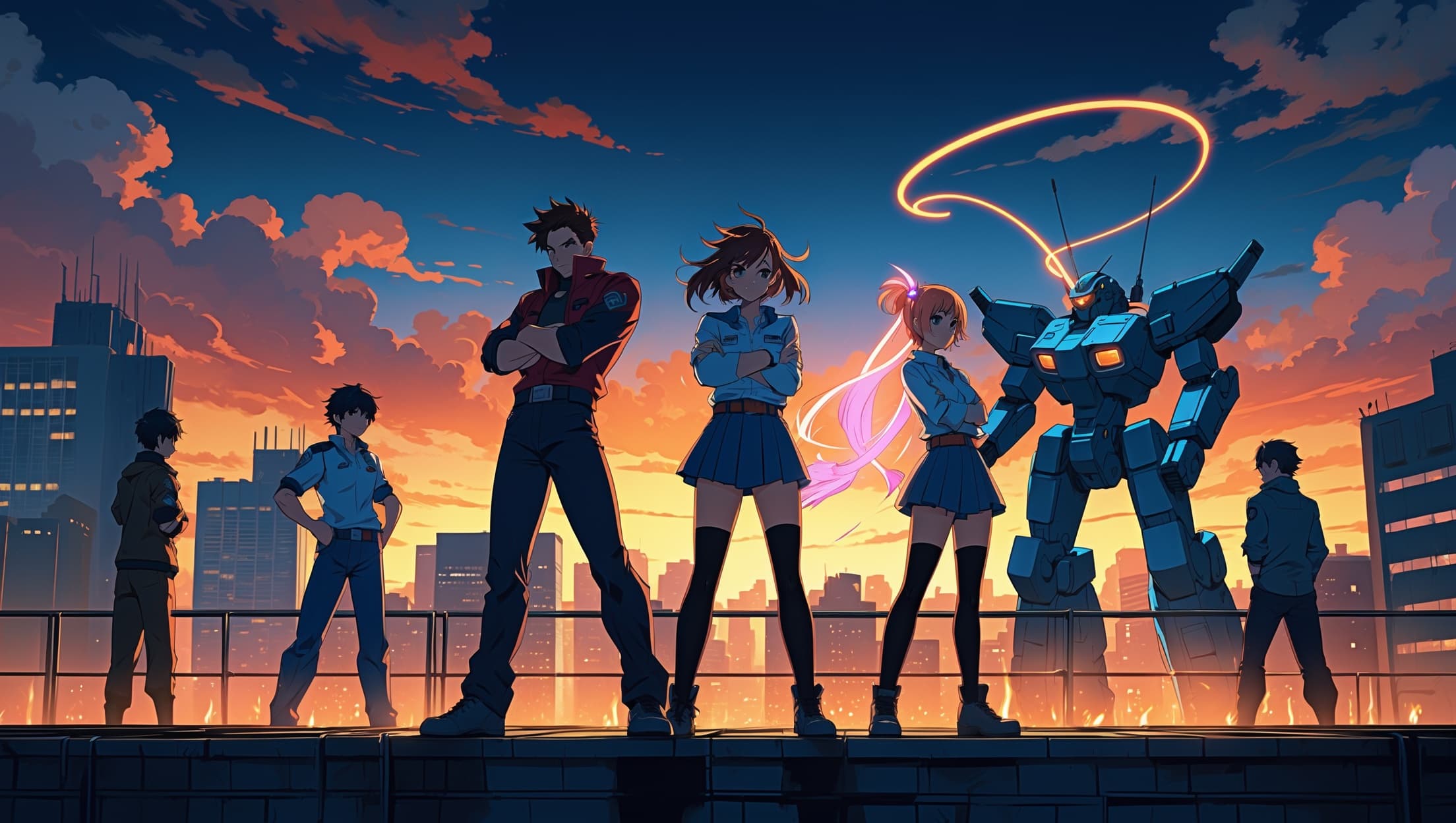
Anime One-Shot Ideas: 10 Episodes You Can Run Tonight
D&D one-shots have a shared shorthand: a tavern job, a dungeon, a boss at the bottom. Anime doesn't get that shorthand, because "anime" isn't one genre. A shonen tournament and a dark anime tragedy both get called anime one-shot ideas, and running one like the other is the fastest way to flatten it into generic fantasy combat with a different paint job.
The fix isn't a universal anime one-shot template. It's picking the sub-genre's real engine first - the rival, the transported hero, the mech, the transformation, the debt - and building the premise around that instead of around a fight. Here are 10 anime one-shot ideas across shonen, isekai, mecha, magical girl, and dark anime, each built to run in a single Episode with no dedicated rulebook required.
- The Rooftop Rematch - shonen rival duel, party size 1-3
- One More Round - shonen tournament upset, party size 2-5
- Cheat Skill, Wrong Body - isekai fish-out-of-water, party size 1-3
- The Guild's Lowest Rank - isekai underdog proof, party size 2-4
- First Sortie - mecha rookie pilot, party size 1-4
- The Ace's Shadow - mecha legacy pressure, party size 2-5
- Transformation Under Deadline - magical girl origin, party size 1-3
- The Team's Newest Member - magical girl squad, party size 3-5
- The Debt That Isn't Money - dark anime bargain, party size 1-3
- The Last Clean Day - dark anime countdown, party size 2-4
1. The Rooftop Rematch
Difficulty: Easy | Play time: 2 hours | Party size: 1-3 | Best for: New players, first shonen one-shot
A rival who beat the Protagonist once, cleanly, wants a rematch before the sun goes down - on a rooftop, an empty gym, an abandoned lot nobody else knows about. Neither of them tells anyone else it's happening. The whole session is the build-up and the fight, with the outcome mattering less than what each side learns about the other.
Keep the rival specific: a training method they swear by, a reason they need to win that has nothing to do with the Protagonist personally, a tell they don't know they have. The best version ends with the loser understanding the winner better, not just losing.
This one plays great solo. A single Protagonist walking into a rematch with nobody to talk strategy with beforehand is exactly the tension shonen wants. An AI Game Master can hold the rival's exact words from their first fight and quote them back mid-rematch, which is the kind of callback that makes a rivalry feel real.
2. One More Round
Difficulty: Medium | Play time: 2-3 hours | Party size: 2-5 | Best for: Groups who want a tournament bracket without the whole season
A local tournament is down to its final rounds, and the Protagonists are the underdogs nobody picked to make it this far. Structure the session as three short matches instead of one long grind: an easy win that shows off what the party can do, a hard-fought near-loss that costs something, and a final round against whoever's been favored to win since the bracket was announced.
One More Round
Groups who like a bracket with real stakes
Give the favorite a real reason to be favored, not just a bigger stat line. A technique the party hasn't seen, a calm that never cracks, a crowd that's already decided how this ends. The upset lands harder when the favorite earned the title.
3. Cheat Skill, Wrong Body
Difficulty: Easy-Medium | Play time: 2-3 hours | Party size: 1-3 | Best for: Groups who like fish-out-of-water comedy and stakes together
A Protagonist wakes up in a new world with one absurdly overpowered ability and none of the local knowledge to use it safely. The session is built on the gap between power and competence: the cheat skill solves the fight in front of them and creates three new problems nobody warned them about.
Pick the cheat skill first, then build the world's one rule that makes it dangerous rather than free. A Protagonist who can copy any technique they've seen once is unstoppable in a fight and a walking liability at a formal banquet where copying the wrong gesture is an insult. Isekai runs best when the unfair power and the culture-shock comedy pull in opposite directions at the same time.
4. The Guild's Lowest Rank
Difficulty: Medium | Play time: 3-4 hours | Party size: 2-4 | Best for: Groups who want a slower-burn underdog arc
The party's Protagonists have been dumped in the guild's lowest rank, handed the jobs nobody else wants, and everyone around them has already decided who they are. A routine, low-rank job goes sideways into something the top-ranked adventurers should have been sent to handle instead.
The genre's real engine here isn't the power level, it's the misjudgment. Let every NPC underestimate the party right up until the moment they can't anymore, and give the party at least one quiet witness who notices the truth before the rest of the guild does.
Resolve it with the party proving themselves on the job's own terms, not with a guild master's dramatic apology. Isekai audiences trust earned respect over a speech.
5. First Sortie
Difficulty: Medium | Play time: 2-3 hours | Party size: 1-4 | Best for: Groups who want a tense debut battle
A rookie pilot gets pulled into a machine they've barely trained on because the actual pilot is down and the threat isn't waiting. The whole session is the first real sortie: the machine doesn't handle the way the simulator did, command is shouting contradictory orders, and every choice the Protagonist makes in the cockpit is the character actually being defined in real time.
Make the mech's limitations as important as its power. A weapon that overheats after two shots, a shield that only covers one side, fuel that's already running low before the fight starts - constraints turn a sortie into a puzzle instead of a straight slugfest, which is what makes mecha one-shots memorable instead of just loud.
6. The Ace's Shadow
Difficulty: Medium-Hard | Play time: 3-4 hours | Party size: 2-5 | Best for: Groups who want pressure from a legacy, not just an enemy
The unit's new pilots are flying the same model their squadron's legendary ace flew before they died or disappeared, and everyone from command to the enemy keeps comparing the newcomers to a ghost. A mission goes wrong in a way that forces the party to either lean on the ace's old tactics or throw them out and find their own.
Resist making the ace a flawless legend. One with a documented mistake, a call that got someone killed, or a reputation the party discovers is partly myth gives the party something real to measure themselves against instead of an impossible shadow.
7. Transformation Under Deadline
Difficulty: Easy-Medium | Play time: 2-3 hours | Party size: 1-3 | Best for: New players, first magical girl one-shot
A Protagonist gets their powers - a wand, a mascot, a transformation phrase - at the worst possible moment, seconds before something is already attacking. There's no training montage, no calm first use. The whole session is figuring out what the power does while it's already being tested.
The dual-identity tension is the real engine, not the fight. Give the Protagonist a mundane commitment happening at the exact same time as the crisis - a recital, a exam, a promise to a friend - so every transformation costs something in their normal life, not just in the fight.
8. The Team's Newest Member
Difficulty: Medium | Play time: 3-4 hours | Party size: 3-5 | Best for: Groups who like team dynamics and found family
An established magical girl team, already mid-season with its own inside jokes and unresolved tension, gets a new member dropped into it right before a fight bigger than anything they've handled solo. The new Protagonist has to earn trust from a team that already has its own rhythm, while the team has to make room for someone who doesn't know their shorthand yet.
The Team's Newest Member
Groups who want every character to get a moment
Give each existing team member one specific friction point with the newcomer - not generic suspicion, but something concrete: a role the new member seems to be taking, a past failure the team is still processing, a power that outshines someone's specialty. The team-up moment during the fight should resolve exactly one of those frictions, not all of them at once.
9. The Debt That Isn't Money
Difficulty: Hard | Play time: 2-3 hours | Party size: 1-3 | Best for: Small groups comfortable with real stakes
A Protagonist owes someone - a broker, a fixer, a thing that isn't entirely human - for a power, a cure, or a second chance they took without reading the terms. Collection day arrives mid-session, and the price is never framed as evil outright. It's reasonable, exact, and quietly worse than the Protagonist remembers agreeing to.
Play the collector calm and precise rather than menacing. A debt collector who's polite, patient, and completely unmovable on the terms is more unsettling than a villain who gloats, because the party can't argue their way out of a deal that was never unclear to begin with.
10. The Last Clean Day
Difficulty: Medium-Hard | Play time: 3-4 hours | Party size: 2-4 | Best for: Groups who want a countdown with teeth
The party knows, going in, that something irreversible happens by the end of the day - a curse completes, a corruption spreads past the point of no return, a choice has to be made that can't be unmade. The session is everything that happens in the hours before it, and whether the party spends that time trying to stop it or making peace with it.
Decide the stakes with the table before the session starts, not mid-scene. Permanent consequences only land as drama when everyone agreed to the possibility going in - sprung on players without warning, they read as a punishment instead of a story.
Give the party one genuinely warm scene inside the countdown - a meal together, an old joke, a moment that has nothing to do with the crisis. Dark anime works because the warmth is real, not because the ending is bleak.
How to Run an Anime One-Shot (Quick Tips)
You've got a premise. Here's how to keep it from sliding into generic fantasy combat with anime names, adapted from general one-shot advice and the genre-specific breakdowns for shonen, magical girl, and dark anime campaigns, compressed into a single Episode.
Pick the sub-genre's engine before the premise. A rival, a transported hero, a mech's limitations, a transformation's cost, a debt's fine print - name the load-bearing piece out loud before you build anything else.
Start at the moment the engine kicks in. Not at a briefing, not with backstory. Start at the rooftop, the summoning circle, the cockpit, the transformation, the collector's knock.
Give the Protagonist's power a real cost or limit. Unlimited power with no downside reads as generic fantasy no matter how it's described. A cheat skill with a social cost, a mech that overheats, a transformation on a deadline - the limit is what makes the power interesting.
Match your party's archetypes to the sub-genre. A Hot-Blooded Protagonist and a Rival carry shonen. A Transported Everyman carries isekai. An Ace Pilot needs a machine to pilot. Pick two or three archetypes that pull against each other rather than one of everything.
End on the beat the sub-genre promises. Shonen ends on growth. Isekai ends on the twist the Protagonist didn't see coming. Mecha ends on the cost of the sortie. Magical girl ends on the team, not just the win. Dark anime ends on what the day actually cost.
If matching an Archetype to a sub-genre, wiring up a rival's callback, or tracking a mech's fuel gauge sounds like more prep than one evening deserves, StoryRoll's Anime mode runs the whole Episode for you - the Narrator, every Character the party meets, and the sub-genre's tone - with narrative Protagonist creation instead of a stat block. You describe what your Protagonist does; the Narrator keeps the Episode's stakes consistent from the cold open to the credits.
Anime One-Shot Ideas by Sub-Genre
Shonen: The Rooftop Rematch, One More Round
Isekai: Cheat Skill Wrong Body, The Guild's Lowest Rank
Mecha: First Sortie, The Ace's Shadow
Magical girl: Transformation Under Deadline, The Team's Newest Member
Dark anime: The Debt That Isn't Money, The Last Clean Day
Solo-friendly: The Rooftop Rematch, Cheat Skill Wrong Body, First Sortie, Transformation Under Deadline, The Debt That Isn't Money
An anime one-shot doesn't fail because the fight was too short or the premise was too small. It fails when the sub-genre's real engine gets swapped out for generic fantasy combat with a different coat of paint. Name the rival, the transported hero's unfair power, the mech's limit, the transformation's cost, or the debt's exact terms before you build anything else, and the rest of the one-shot follows from there.
Pick one of these ten ideas, commit to its sub-genre's engine, and run it. Two or three hours from now, your table will know exactly why the rooftop rematch mattered more than the fight itself.
And if nobody wants to voice the rival, the mascot, or the debt collector? That's what an AI Game Master is for.
FAQ
What makes a good anime one-shot idea?
A good anime one-shot idea commits to one sub-genre's engine instead of running generic fantasy combat with anime names. A shonen premise needs a rival. An isekai premise needs a fish-out-of-water twist. A magical girl premise needs an identity worth protecting. Pick the engine first, then build the scene around it.
How long does an anime one-shot take to run?
Plan for 2-3 hours for most of these premises, similar to a tight D&D one-shot. Tournament and rival-duel premises can run in 2 hours flat. Team-based premises like the magical girl and mecha ideas run closer to 3-4 hours once everyone gets a scene.
Do I need a dedicated anime RPG system to run one of these?
No. None of these premises need a rulebook built for the genre - you need a rival, a transformation, or a secret worth keeping, and characters who react when it's tested. An AI Game Master like StoryRoll's Anime mode runs this narratively by default, so you describe what your Protagonist does and the Narrator keeps the Episode's stakes consistent without a stat block in sight.
What party size works best for an anime one-shot?
Two to four Protagonists is the sweet spot for most of these premises. Rival duels and dark anime premises often work best with a single Protagonist facing the moment alone. Team-based premises like the magical girl squad or the mecha unit want three to five so every seat has a role.
Which anime sub-genre is easiest to run as a first one-shot?
Shonen. The engine is the simplest to hold in your head at the table: a rival, a training beat, a rematch. Isekai and mecha need one or two extra rules of the world explained up front. Magical girl and dark anime ask more of the GM emotionally, since both lean on identity and consequence rather than a straightforward fight.
Can an AI Game Master run an anime one-shot?
Yes. StoryRoll's Anime mode covers shonen, isekai, mecha, magical girl, and dark anime as dedicated tones, with narrative Protagonist creation instead of ability scores or spell slots. You describe your Protagonist and their Archetype, and the Narrator runs the Episode - the rival, the transformation, the mech, the debt - and keeps it consistent from the cold open to the credits.
Written by StoryRoll
Founder of StoryRoll. Building AI-powered tabletop RPGs.
Related Posts
Fairy Tale One-Shot Ideas: 10 Tales You Can Run Tonight
10 fairy tale one-shot ideas built on bargains, trials, and taboos - no homebrew setting bible required. Premises, party sizes, and tips for running each one.
Sci-Fi One-Shot Ideas: 10 Missions You Can Run Tonight
10 sci-fi one-shot ideas that don't need a homebrew rulebook or a hundred hours of world-building. Premises, crew sizes, and tips for running each one.
Anime RPG Character Archetypes: Build a Protagonist Without a Rulebook
The anime RPG character archetypes that actually carry a story, matched to shonen, isekai, mecha, magical girl and dark anime, without a homebrew class list.