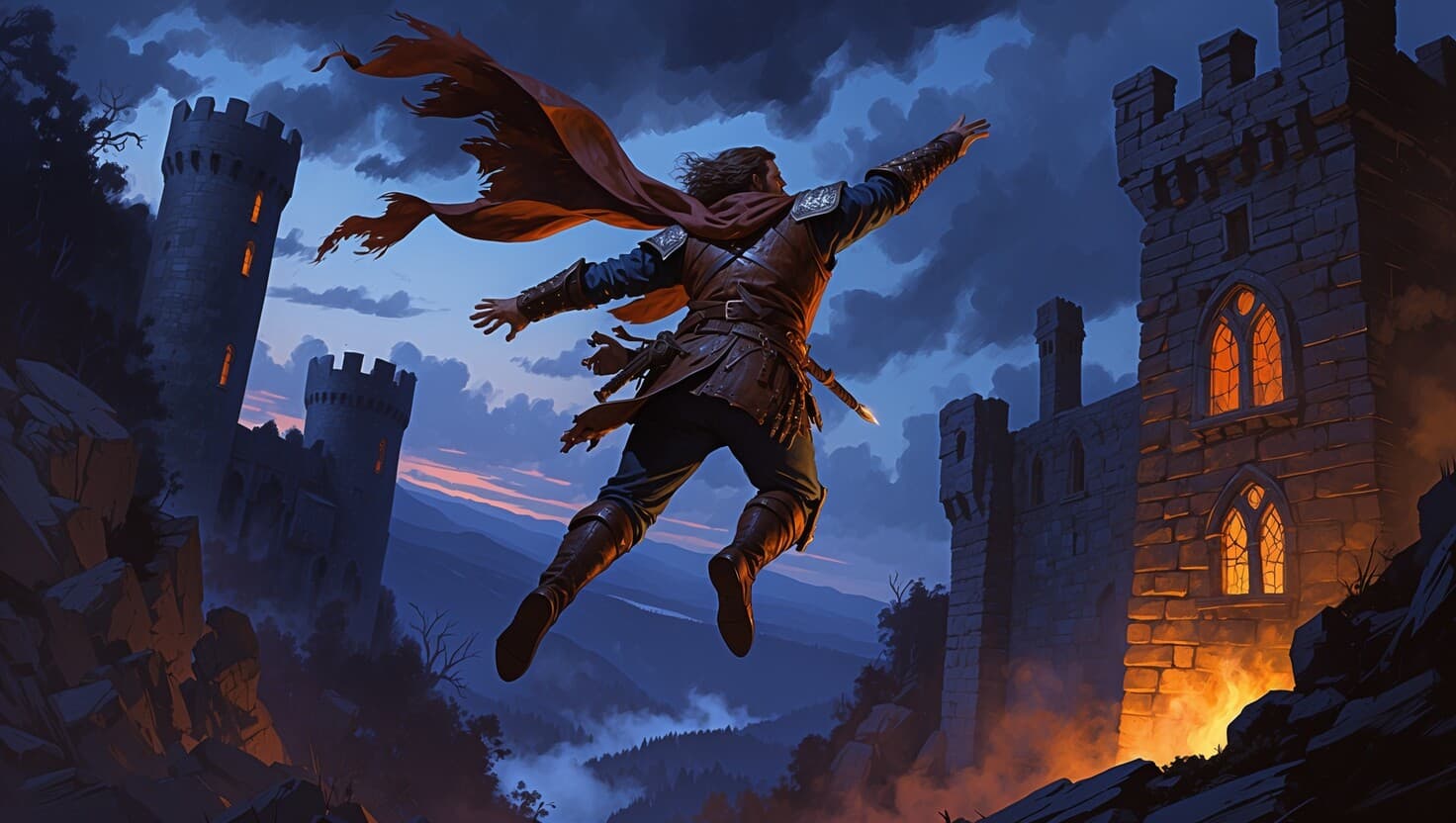
Falling Damage 5e: The Cap Everyone Forgets
Falling damage 5e is four sentences in the Player's Handbook, which is roughly four sentences shorter than most of the rules on this list that get misplayed every week. And it still gets misplayed every week, because the part everyone remembers is the setup, not the limit.
Everyone knows the 1d6-per-10-feet part. It's intuitive, it's easy to say out loud at the table, and it makes a satisfying noise when a character topples off a bridge. What tables forget is where that math stops, what happens on the way down, and what lands you flat on your back once you hit the ground. Falling damage 5e isn't complicated. It's just a rule that nobody rereads after the first session, so the parts past the first sentence quietly evaporate.
What Falling Damage 5e Actually Says
Strip it down and there are really four pieces, not one:
The dice. A creature takes 1d6 bludgeoning damage for every 10 feet it falls, to a maximum of 20d6.
The cap. 20d6 is the ceiling, full stop. That cap is reached at 200 feet, and it doesn't move no matter how much farther the fall continues.
The floor. A fall of less than 10 feet deals no damage at all. You don't round up, and you don't deal a token 1d6 for "basically falling."
The landing. A creature that takes damage from the fall lands prone, on top of whatever damage it just took.
The damage from falling damage 5e applies at the end of the fall, not the moment the fall begins. That single word, "end," is doing a lot of work: it's the reason feather fall and Slow Fall both still work even if the fall already started.
None of those four pieces is hard in isolation. The trouble starts because most tables only fully absorb the first one and run the other three on instinct, and instinct is exactly where falling damage 5e goes wrong.
The Mistake: Treating It as Uncapped
Here's the myth: a long enough fall just keeps stacking 1d6 for every 10 feet, forever, so a fall off a 1,000-foot cliff should deal something like 100d6 and turn a character into paste before the dice even finish rolling.
Here's the actual rule. Falling damage 5e tops out at 20d6, and it tops out there at 200 feet. A fall from 300 feet, 1,000 feet, or off the edge of a floating fortress all deal exactly the same 20d6, because the rule was never designed to model terminal velocity. It was designed to make falling dangerous without needing a second table to adjudicate height past a certain point.
This matters most at the exact moment it tends to come up: a dramatic, high-stakes fall off something genuinely enormous. A Game Master who's forgotten the cap either lowballs it by guessing a "reasonable" number that undersells the real danger, or overshoots it into instant-death territory that the rule was never built to produce. Both outcomes miss what the designers actually intended: falling is supposed to be a real threat, not an auto-kill, and 20d6 (average 70) is brutal against most characters without being an automatic end to the scene.
- The math: 1d6 bludgeoning per 10 feet fallen.
- The cap: 20d6 maximum, reached at 200 feet, no matter how much farther the fall goes.
- The floor: less than 10 feet fallen deals no damage at all.
- The landing: taking fall damage means landing prone.
- The timing: damage applies at the end of the fall, which is why mid-fall reactions still work.
- Falling onto something: not covered by the core rule. It's Game Master judgment, same as a falling object.
Short Falls Still Confuse Tables
The other end of the rule gets just as much friction. A character hops off a 6-foot ledge, and someone at the table reaches for a d6 anyway, because "falling" sounds like it should always cost something.
It doesn't. Falling damage 5e draws a hard line at 10 feet. Below that, there's no damage, no saving throw, and no prone landing forced by the fall itself. A short drop off a wagon, a low wall, or a one-story window sill is free. The rule isn't trying to punish every instance of leaving the ground; it's trying to punish the specific moment a fall becomes genuinely dangerous, and ten feet is where the Player's Handbook draws that line.
There's no Dexterity save written into falling damage 5e to reduce or avoid the damage. The only ways to soften a fall are specific features and spells (Slow Fall, feather fall, and similar effects), not a generic save every creature gets to roll.
Monks, Feather Fall, and the Timing Trick
This is where "damage applies at the end of the fall" stops being a technicality and starts being the whole point.
A Monk's Slow Fall lets them use their reaction, when they're not incapacitated, to reduce falling damage by an amount equal to five times their Monk level. At level 6, that's a flat 30 off the total. At level 12, it's 60, which erases a 200-foot, 20d6 fall (average 70) down to something a character can shrug off and keep fighting. Slow Fall reduces the damage. It doesn't grant immunity, and whatever's left after the reduction can still land the Monk prone.
Feather fall works differently, and it's the clearer example of why the "end of the fall" timing matters. It's a reaction spell, castable on yourself or up to five falling creatures within 60 feet, and it works even if the fall is already underway, because the rule hasn't actually applied any damage yet. A wizard who gets shoved off a cliff on round one can still cast feather fall on round one, mid-plummet, and land on the ground for 0 damage and no prone condition. If falling damage 5e applied the instant you left the ground, feather fall would need to be cast before the fall started every time, which would make it far less useful than it actually is.
Falling Onto Things Isn't in the Core Rule
One gap that trips up tables planning a dramatic set piece: the core rule covers a creature falling onto the ground. It does not cover a creature falling onto another creature, or a heavy object falling onto someone below it. Both are explicitly left to the table to adjudicate, the same way the Dungeon Master's Guide leaves falling-object damage to GM judgment rather than a fixed formula.
That's not a flaw in falling damage 5e. It's a deliberate gap, and it's worth deciding how your table handles it before the first time a player tries to drop a boulder, or a monster, on something below. A reasonable default many tables use: split the falling creature's damage between both parties, or treat the thing being landed on as taking the same dice the faller would have taken, adjusted for size. There's no official number here, so whatever you pick, pick it once and stick with it.
Why Falling Damage 5e Still Trips Up Tables
A few reasons this keeps happening at tables that have been running 5e for years:
- The rule reads like one sentence, but it's four rules in a trench coat. The dice, the cap, the floor, and the landing all get compressed into a short paragraph, so it's easy to absorb the first clause and skim past the rest.
- It barely comes up, and when it does, it's chaotic. Most campaigns go dozens of sessions between meaningful falls, so the rule never gets the repetition that turns it into muscle memory the way attack rolls do.
- "Falling forever" matches intuition better than the real rule. A cap feels like it should be the exception, not the default, which is exactly backward from how falling damage 5e is actually written.
None of that makes falling damage 5e complicated. It makes it a rule that's easy to half-remember under pressure, which is worse than not knowing it at all, because half-remembering means every table quietly runs its own unofficial version.
Where an AI Game Master Helps With Falling Damage 5e
This is a rule that benefits less from memorization and more from something applying the same math the same way every single time, especially in the exact moment it matters most: mid-combat, with a player already shoving dice around and asking how bad a fall is about to be. A Game Master running the scene already knows the cap tops out at 20d6, already knows a fall under 10 feet is free, and already knows that damage lands at the end of the fall, which means a reaction spell or feature announced mid-plummet still gets applied correctly instead of getting waved off as "too late."
That doesn't take the drama out of a fall. Whether to shove the enemy off the tower, dive after a falling ally, or risk the climb in the first place is still entirely the player's call. What changes is that the number that comes back, whether it's 3d6 off a short drop or the full 20d6 off a collapsing bridge, matches the rule as written instead of drifting toward whatever feels dramatic in the moment.
Frequently Asked Questions
How much fall damage do you take in D&D 5e?
1d6 bludgeoning damage for every 10 feet fallen, applied as a single pool of dice at the end of the fall. A 50-foot fall is 5d6. A 200-foot fall is 20d6.
Is there a maximum amount of fall damage in 5e?
Yes. Falling damage 5e caps at 20d6, reached at 200 feet. A character who falls off a 2,000-foot cliff takes exactly the same 20d6 as one who falls 200 feet.
Do you take fall damage from a short fall in 5e?
No. A fall of less than 10 feet deals no damage at all. The 1d6-per-10-feet math only starts once you clear that first 10-foot threshold.
Does falling make you prone in 5e?
Yes, if you take damage from the fall. A creature that takes fall damage lands prone, which is its own separate problem in the middle of a fight. A creature that avoids the damage entirely, through a feature or spell, doesn't end up prone either.
Can a Monk avoid fall damage in 5e?
Mostly. Slow Fall lets a Monk use their reaction to reduce fall damage by five times their Monk level, which erases most falls outright at mid levels and later. It reduces the damage; it doesn't grant immunity or stop the prone landing on whatever's left.
Can you cast feather fall after you've already started falling in 5e?
Yes, as long as you haven't hit the ground yet. Fall damage applies at the end of the fall, not the instant you start falling, which is exactly the window feather fall is built to use. It's a reaction, cast on yourself or up to four others, and it works even if you're already most of the way down.
Falling damage 5e is 1d6 per 10 feet, capped at 20d6, with no damage under 10 feet and a prone landing attached to any fall that actually hurts. The cap is the piece tables forget first, and it's the one that matters most the moment a fall is supposed to feel genuinely dangerous without being an automatic death sentence. Get the four pieces straight, remember that the damage lands at the end of the fall rather than the start, and the rule stops being a point of table arguments and starts being exactly as threatening as it was designed to be.
For more on the conditions and combat edge cases that falling interacts with, see prone, shove, mounted combat, and the Monk class guide for more on how Slow Fall fits into the rest of the kit.
Written by StoryRoll
Founder of StoryRoll. Building AI-powered tabletop RPGs.
Related Posts
Critical Hits in D&D 5e: The Rule Everyone Misremembers
A critical hit in D&D 5e doubles your damage dice, not your damage. Here's the rule most tables misremember, and what actually doubles on a crit.
Mounted Combat 5e: The Half-Page Rule Everyone Misplays
Mounted combat 5e fits on half a page, and most tables still get it backward: warhorses can't trample, and falling off is a real risk.
Diagonal Movement 5e: The Grid Rule Almost Nobody Agrees On
Diagonal movement 5e has two official answers, and most tables are quietly using the wrong one for their own map. Here is what the rules actually say.