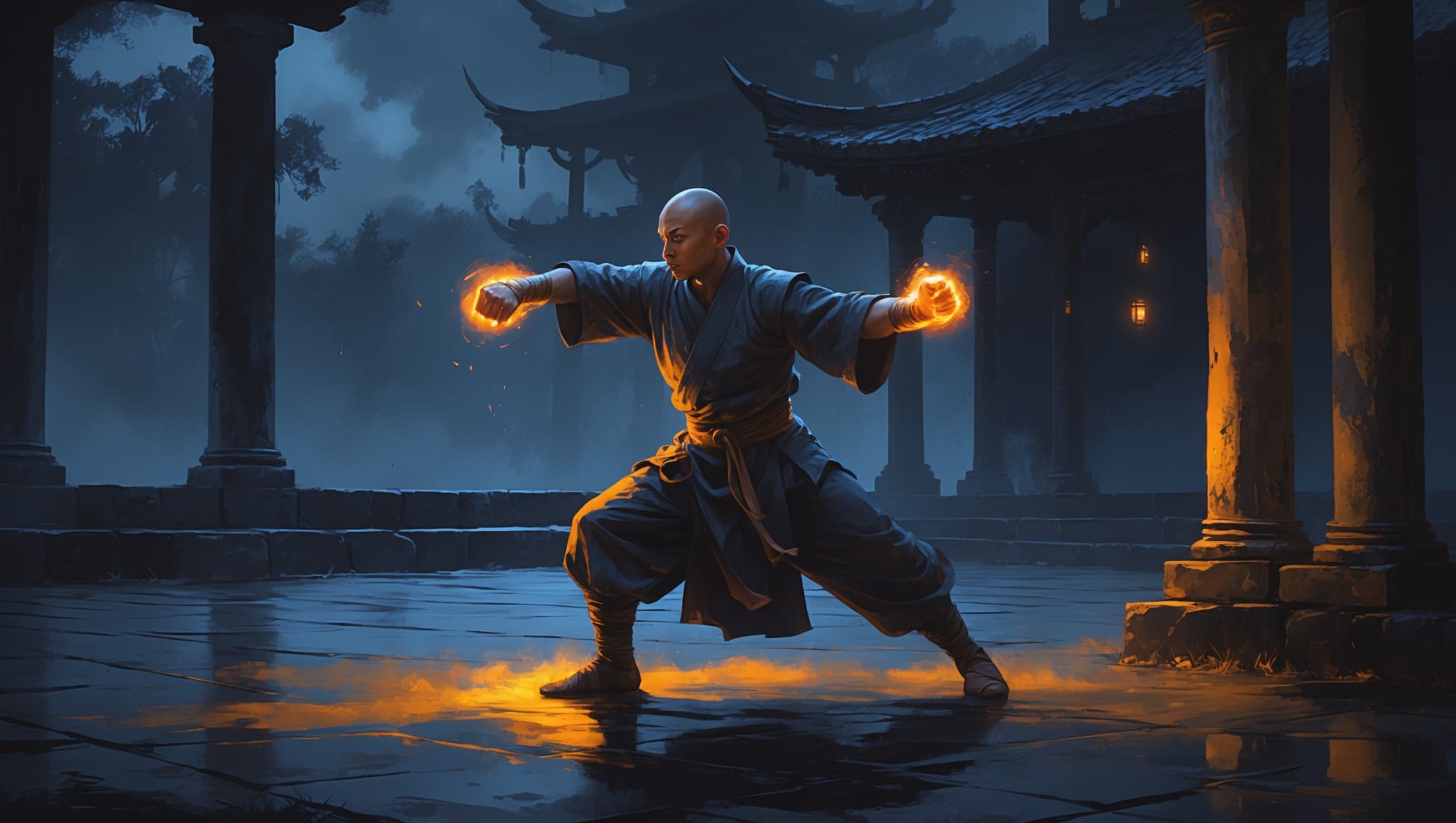
Playing a Monk With an AI Game Master: The Definitive Guide
A Fighter swings until something falls down. A Wizard spends a slot and moves on. A Monk counts.
Every Flurry of Blows, every Stunning Strike, every dash across a battlefield that should've cost an action - it all comes out of the same small, precise pool of Ki Points, and running out at the wrong moment is the difference between controlling a fight and just being in one. That precision is exactly why Monks are one of the best classes for AI-run D&D: an AI Game Master doesn't lose count.
Why Monks Excel in AI D&D
Ki Points are a tracked resource, not a rough estimate
Every Monk feature that matters - Flurry of Blows, Patient Defense, Step of the Wind, Stunning Strike - draws from the same Ki pool, and the math has to be exact. Spend a point you don't have, or forget one you already spent three rounds ago, and the whole turn is wrong. Human GMs running a table lose this thread constantly. An AI GM doesn't - StoryRoll's character sheet keeps a running total of your Ki, applies the cost the instant you use a feature, and resets the pool correctly on a short rest, so the tightest economy in the game stays tight instead of getting fudged in your favor (or against it).
That reliability changes how you play. You can spend your last Ki Point on a genuine gamble - one more Stunning Strike against the boss before you're out - because you trust the number in front of you is actually correct, not a guess the table's been carrying since round two.
Stunning Strike is a real save-or-suffer decision every fight
Stunning Strike lets you force a Constitution saving throw on a creature you hit, and a failed save leaves it Stunned - unable to act, automatically failing Strength and Dexterity saves, and taking attacks against it with advantage. Against an AI GM that plays high-Constitution enemies at full competence instead of pulling punches, landing that save is a real swing in a fight's outcome, and missing it is a real cost: one more Ki Point gone for nothing.
That tension is the class's whole combat identity. A Monk who spams Stunning Strike on every hit burns through Ki fast for diminishing returns against enemies who keep making the save; a Monk who saves it for the moment a fight actually turns on one creature gets far more value per point spent.
Unarmored Movement and Martial Arts make you the fight's tempo
No armor, no weapon requirement, a bonus-action unarmed strike after every attack, and a movement speed that climbs every few levels - a Monk isn't built to stand and trade, it's built to decide where and when a fight happens. Against an AI GM that varies terrain, enemy positioning, and escape routes, that mobility is a constant tactical lever: disengage from a losing exchange, reposition to protect a squishier ally, or close distance on a fleeing target nobody else in the party can catch.
Tell the AI what your Monk's discipline actually looks like in motion - controlled and economical, or fast and almost frantic - not just "I attack twice." StoryRoll's AI picks up on that texture and starts narrating your combat rounds with it, instead of describing every Monk's Flurry of Blows the same way.
Best Monastic Traditions for AI Campaigns
Way of the Open Hand (The Controller)
Open Hand is the textbook Monk build, and it's still the strongest all-around pick for AI campaigns. Open Hand Technique triggers whenever you hit with Flurry of Blows, letting you knock the target prone, shove it up to 15 feet, or deny it reactions until your next turn - no extra Ki cost, no save required on your end, just a straight mechanical win layered onto damage you were already dealing.
Against an AI GM that plays smart, mobile enemies, that control is worth more than raw damage. A prone spellcaster loses its next spell's positioning. A shoved enemy loses its turn closing distance again. An enemy denied reactions can't punish your allies for moving past it.
Best for: Players who want Stunning Strike and battlefield control as their main combat identity.
Way of Shadow (The Infiltrator)
Way of Shadow trades some of Open Hand's straightforward power for a genuinely different toolkit: Shadow Arts lets you spend Ki to cast Darkness, Pass Without Trace, or Silence, and Shadow Step lets you teleport between two dim or dark areas as a bonus action, striking with advantage the instant you arrive.
An AI GM built around consistent lighting, guard patrols, and environmental detail rewards this Tradition specifically - Shadow Step turns "there's a patch of darkness across the room" into a real tactical option instead of set dressing, and the AI will track exactly which spaces qualify.
Best for: Solo play built around stealth and infiltration, players who want a genuinely different rhythm from straight melee.
Way of Mercy (The Battlefield Medic)
Way of Mercy runs the class's control kit and a healer's toolkit off the same Ki pool. Hand of Harm adds necrotic damage to an unarmed strike; Hand of Healing spends the same Ki to restore hit points at range as an action. Implements of Mercy give you a healer's kit and herbalism kit you're always proficient with, so the class works even outside combat.
The real decision an AI GM forces on a Mercy Monk is which Hand to use and when - burn Ki to keep an ally standing, or burn it to put a dangerous target down faster. Neither choice is free, and a smart AI GM's encounter pacing makes you feel that tradeoff round to round instead of letting you do both without cost.
Best for: Parties without a dedicated healer, players who want to be the striker and the safety net in one build.
Quick Build: The Precise Fist
- Race: Any race with a Dexterity or Wisdom bonus works, but Wood Elf and Human (Variant) are natural fits for the class's speed and skill needs
- Tradition: Way of the Open Hand (control-focused Stunning Strike) or Way of Mercy (healer-striker hybrid)
- Key Feature: Stunning Strike, saved for the one enemy actually worth locking down each fight
- Stat Priority: Dexterity > Wisdom > Constitution
- Playstyle: Track your Ki like it's the scarcest resource on your sheet, because it is - spend on control and mobility when the fight calls for it, not on reflex.
Best Campaign Templates for Monks
The Monastery That Isn't There Anymore
Whatever taught your Monk their discipline - a temple, an order, a single teacher - is gone, and every stance, every Ki technique you use is something you're keeping alive alone now. The AI can seed other survivors, rival claimants to a lost tradition, or the slow, scene-by-scene work of deciding whether to rebuild what was lost or let it end with you.
The Bodyguard's Vow
Your Monk owes a life debt - saved by someone, sworn to someone, bound to protect a specific person or cause no matter the cost. The AI treats that vow as a standing constraint on your choices, not a backstory line: it can put your ward in danger specifically to test whether the vow still holds, and build tension out of every moment you have to choose between the mission and the promise.
The Empty Cup
Your Monk is chasing something close to enlightenment - stillness, detachment, the end of a specific internal struggle - and hasn't gotten there yet. The AI can build a campaign that keeps testing exactly the thing your Monk is trying to let go of: anger, attachment, fear, pride, whichever flaw you name as the obstacle, showing up again and again in different shapes until you either overcome it or the story shows you what it actually costs to fake having done so.
Monks often flatten into "the fast one who punches." Give the AI more to work with by naming the specific discipline or philosophy behind your fighting style - not just a Tradition, but what your Monk actually believes stillness or Ki or Stunning Strike means - and the narration around your combat will reflect that instead of generic martial-arts flavor text.
Roleplaying a Monk With an AI GM
Your discipline is a belief system, not a fighting style
The real question isn't "which Tradition did you pick" - it's "what is your Monk actually chasing, and what happens when they get it, or don't?"
- The Seeker of Stillness - pursuing a calm they haven't fully reached, tested hardest in exactly the moments it matters most.
- The Reformed Brawler - fought with fists before they had discipline, and still catches old instincts trying to take over.
- The Wandering Teacher - quietly instructs anyone willing to learn, and keeps getting pulled into other people's problems because of it.
- The Broken Disciple - failed a vow once and carries it, using every fight since as a kind of ongoing penance.
- The Living Weapon - trained or made to fight before they were anything else, working out session by session which parts of them are actually theirs.
Each of these hands the AI different material. The Broken Disciple gets NPCs who eventually learn what they failed at and react accordingly. The Wandering Teacher accumulates a found-family thread almost by accident. Pick one, name it for the AI, and let it show up in how your combat and downtime scenes both get written.
Spend Ki out loud, not silently
Don't just tell the AI "I use Stunning Strike." Narrate the choice: is this a calculated read of exactly where to hit, or an instinctive strike your training takes over and makes for you? That framing changes how the AI describes the moment the target locks up - and what your Monk looks like doing it.
Use downtime to show the discipline outside of combat
A Monk who's only precise mid-fight is half a character. Between scenes, tell the AI how your Monk meditates, trains, or moves through the world when nothing's trying to kill them. The AI carries those details forward - mention that you always eat standing up, or that you count your own breaths when you're anxious, and expect an NPC to eventually notice.
Example Session: Monk in Action
You: The bandit captain's the real threat here - if she gets a spell off, this goes bad fast. I close the distance and go for Stunning Strike.
AI GM: You cross the space between you almost too fast to track, your first strike landing clean across her ribs. She staggers, breath catching mid-syllable of whatever she was about to cast - roll her Constitution save against your Ki save DC.
You: She fails. I follow up with Flurry of Blows while she's locked up.
AI GM: Her eyes go glassy, body rigid mid-stumble - the spell dies in her throat. You spend the opening ruthlessly, two more strikes landing before she can even try to recover, and she goes down hard, gasping, weapon still half-raised like her body hasn't caught up to what just happened.
You: I don't finish her. I step back and call for the rest of her crew to drop their weapons - she's proof of what happens if they don't.
AI GM: The bandits' nerve breaks fast, three weapons hitting the dirt almost at once, but the fourth one - younger, hands shaking - doesn't move, caught between fear of you and fear of whoever's waiting for this crew to fail. That hesitation is his, not hers, and what he decides next is entirely on him.
Notice what the AI is tracking beyond the numbers: the exact moment the save fails and the fight's whole shape changes, and an NPC given a real, separate decision instead of every bandit reacting identically once the captain's down.
Common Mistakes (And How to Avoid Them)
Spending Stunning Strike on every single hit. Ki runs out fast, and a failed save against a high-Constitution enemy is a point spent for nothing. Save it for the fight or the enemy where control actually changes the outcome.
Ignoring your Constitution score entirely. Monk is the most stat-dependent class in the game - Dexterity and Wisdom get the attention, but a Monk with no Constitution investment drops to a lucky hit that a better-built one shrugs off.
Treating Unarmored Movement as just extra speed. The bonus movement is a tactical tool for positioning, protecting allies, and controlling engagement range - not just a number that lets you get to the fight faster.
Playing every Tradition's features as purely mechanical. "I Stunning Strike" or "I Shadow Step" without any texture wastes half of what the feature is for. Describe what it actually looks like when your Monk does it.
Forgetting Deflect Missiles and other reactive features exist. It's easy to default to your action economy and forget a reaction is sitting unused - especially against an AI GM that includes ranged attackers in its encounters specifically because Monks can answer them.
Monks are built for exactly the kind of precision an AI Game Master handles well: a tight resource economy tracked correctly every round, save-or-suffer decisions that actually matter because the AI plays enemies at full strength, and a mobility kit that turns positioning into a constant tactical lever instead of an afterthought. Way of the Open Hand gives you the most reliable control in the game. Way of Shadow rewards a genuinely different, stealth-first rhythm. Way of Mercy makes you the striker and the healer on one Ki budget.
Start with Open Hand if you want straightforward control, Shadow if you want stealth and mobility as your identity, or Mercy if your party needs a healer who can also throw a punch. Either way, tell the AI what your discipline actually means to your character - StoryRoll runs with a Monk who believes something far better than it runs with a generic martial artist.
Create your Monk on StoryRoll and find out what happens when the AI never loses count of your Ki.
Try These Free Tools
Get your Monk ready for the table with these free resources:
- Ability Score Calculator: balance Dexterity, Wisdom, and Constitution with point buy or standard array for the game's most stat-dependent class.
- Condition Tracker: keep Stunned, Prone, and other Open Hand Technique effects straight without breaking the scene.
- Dice Roller: roll Martial Arts dice, Flurry of Blows, and Ki saves in seconds.
Frequently Asked Questions
Is Monk a good class for AI D&D?
Yes - Monk rewards exactly the kind of precise, turn-by-turn tracking an AI Game Master is good at. Ki Points, Stunning Strike saves, and Martial Arts dice all need to be tallied correctly every round, and a human GM juggling five other players often loses that thread. An AI GM doesn't, which means the class's tightest mechanics stay sharp instead of getting hand-waved.
What Monastic Tradition works best with an AI Game Master?
Way of the Open Hand is the strongest all-around pick - Stunning Strike backed by Open Hand Technique gives you a reliable way to shut down a dangerous enemy for a round, and an AI GM that plays enemies at full competence makes that control valuable every single fight. Way of Shadow rewards players who want stealth and mobility as their main toolkit. Way of Mercy is the best pick if you want to be the party's striker and healer on a single Ki budget.
Can I play a Monk solo with an AI GM?
Yes, though it takes more careful play than a Barbarian or a Fighter. A Monk's high AC, extra attack from Martial Arts, and mobility from Unarmored Movement let you control which fights you're actually in, and Stunning Strike can single-handedly neutralize the one enemy that would otherwise end a solo run. Way of Mercy in particular gives a solo Monk in-combat healing nothing else in the kit provides.
How does the AI track Ki Points and Stunning Strike?
StoryRoll tracks your current Ki Point total, what you've spent it on this turn, and resets your pool correctly on a short rest, so you're never stuck doing the math mid-scene. When you use Stunning Strike, the AI runs the target's Constitution save against your Ki save DC and applies the Stunned condition automatically if it fails - no separate lookup required.
Is Monk too complicated for beginners in AI campaigns?
It's the most stat-dependent class in the game - Monk wants Dexterity, Wisdom, and Constitution all reasonably high, which is more to juggle than a single-stat Fighter or Barbarian. But the AI absorbs most of that complexity for you: it applies Unarmored Defense, tracks Ki spend, and resolves Flurry of Blows and Stunning Strike correctly every time, so a new player mainly needs to decide what to do, not calculate whether they're allowed to.
What campaign setting works best for a Monk?
D&D 5e is the natural home, especially anything with a martial-arts, wandering-warrior, or monastery backdrop. StoryRoll's Sci-Fi mode also reflavors Monk mechanics cleanly - Ki becomes a trained combat discipline or a bio-enhancement reserve, and Stunning Strike, Flurry of Blows, and Unarmored Defense all carry over untouched.
Related Class Guides
Exploring other classes for your next AI D&D campaign? Check out our other definitive guides:
- Playing a Fighter With an AI Game Master
- Playing a Rogue With an AI Game Master
- Playing a Ranger With an AI Game Master
- Playing a Barbarian With an AI Game Master
- Playing a Druid With an AI Game Master
- Playing a Cleric With an AI Game Master
- Playing a Paladin With an AI Game Master
- Playing a Wizard With an AI Game Master
Written by StoryRoll
Founder of StoryRoll. Building AI-powered tabletop RPGs.
Related Posts
Playing a Druid With an AI Game Master: The Definitive Guide
Wild Shape isn't just a combat button - it's a second character an AI Game Master can react to in real time. Here's how to play a Druid well.
Playing a Sorcerer With an AI Game Master: The Definitive Guide
Sorcerers don't study magic - they are magic, and every spell is a live decision. Here's how to play one well with an AI Game Master.
Playing a Barbarian With an AI Game Master: The Definitive Guide
Barbarians aren't just big damage - Rage is a character trait an AI Game Master can track and test session after session. Here's how to play one well.