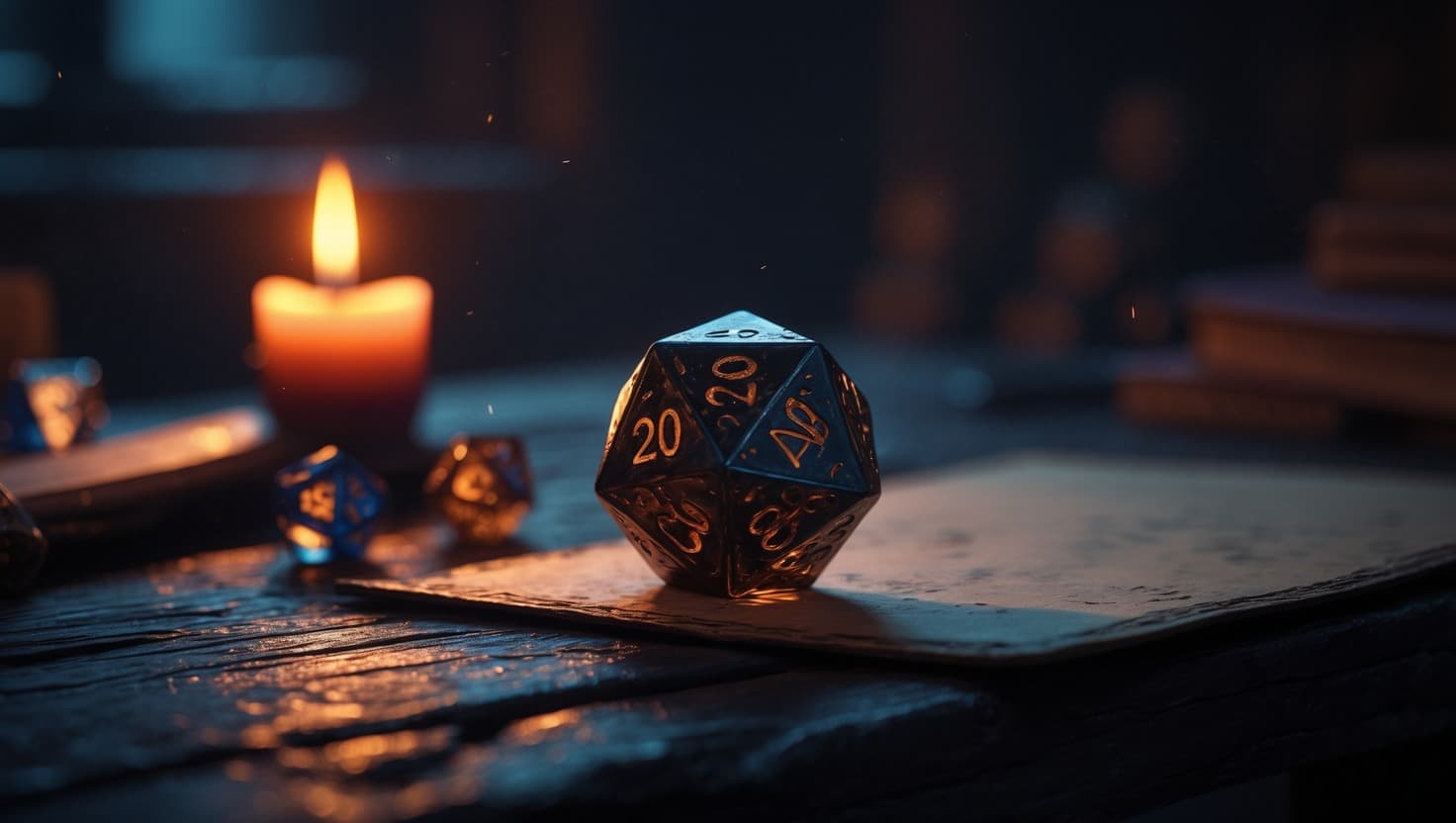
Does a Natural 20 Always Succeed on a Skill Check in D&D 5e?
The rogue rolls a natural 20 trying to pick a lock that the GM privately decided requires a magic key. Half the table assumes the door swings open. The GM knows it doesn't. Nobody is wrong about D&D in general, and the argument that follows has happened at more tables than anyone wants to admit.
Here's the rule, in full: a natural 20 is an automatic hit on an attack roll. That's it. That's the entire automatic-success clause. Ability checks, which is what every skill check actually is, aren't attack rolls, and the rulebook never extends the same treatment to them.
What a Natural 20 Actually Does on a Skill Check
Rolling the die is the same action whether you're swinging a sword or trying to recall ancient history, but what the number means afterward is not. On an attack roll, a 20 is special: it always hits, regardless of the target's AC, and it triggers a critical hit. That's a specific, named rule tied to attack rolls and nothing else.
A skill check is an ability check with a proficiency bonus added if you're proficient in the relevant skill. Ability checks don't have an automatic-success rule anywhere in the Player's Handbook. A natural 20 on a Strength (Athletics) check to force a door, or a Charisma (Persuasion) check to talk your way past a guard, is just a 20. Add your modifiers, compare the total to the DC, and the outcome depends on whether that total meets or beats the number the GM set. The same is true in reverse for the DC itself: if you haven't thought through how DCs get set in the first place, how to set DCs in 5e is worth reading alongside this, since a natural 20 is only as meaningful as the DC it's being compared against.
- Attack rolls: a natural 20 is always an automatic hit and triggers a critical hit. This is an explicit, named rule.
- Skill checks and other ability checks: a natural 20 is just a 20 plus modifiers, compared to the DC like any other roll. No automatic success rule exists.
- Saving throws: same as ability checks, no automatic success, with one narrow exception for death saving throws, which do succeed automatically on a natural 20.
- Natural 1: mirrors the natural 20. Automatic miss on an attack roll, but just a low number on a skill check or saving throw.
Where This Myth Actually Comes From
Nobody picks up this misconception out of nowhere. It has a few real sources, and they all reinforce each other.
The first is sequencing. Most new players learn attack rolls before they internalize how skill checks differ, since combat is usually the loudest, most explained part of a first session. "A 20 always hits" becomes the first rule anyone really absorbs about the d20, and it's a short, understandable jump from there to assuming a 20 always succeeds at anything.
The second is Baldur's Gate 3, and it's a bigger factor than most GMs give it credit for. The game runs a well-known house rule where a natural 20 is an automatic success on ability checks and a natural 1 is an automatic failure. It's a good rule for a video game, since there's no table to discuss nuance with and a dramatic crit or fumble reads well on screen. A huge number of players came to tabletop 5e through Baldur's Gate 3 first, and they arrive at a real table already trained on a rule that the Player's Handbook doesn't actually contain.
The third is older editions and general tabletop folklore. House-ruling a natural 20 as an auto-success on skill checks has circulated informally for decades, long before 5e existed, which means plenty of experienced players and even some GMs picked up the habit from a previous table and never checked whether 5e's actual rules matched what they were taught.
None of these sources make anyone wrong for expecting it. They explain why the myth is this widespread, not why it's correct.
The House Rule Version Is Fine. Running It By Accident Isn't.
None of this means auto-success on a natural 20 is a bad way to play. It's a genuinely popular house rule for a reason: it feels great, it rewards a dramatic roll, and in most everyday situations it barely changes anything, since a natural 20 plus a reasonable modifier clears most DCs anyway.
The actual problem shows up when a table is running this house rule without anyone deciding to. One GM learned it from Baldur's Gate 3 and applies it without saying so. A guest GM running the same group doesn't know the house rule exists and rules the lock stays shut on the same natural 20 that would have opened it the week before. Nobody agreed on anything; the rule just drifted in based on whoever happened to be narrating.
If your table wants the auto-success house rule: say so out loud in session zero, and agree on the one exception that matters: does it apply against a DC that's genuinely impossible for the character, like persuading a hostile ancient dragon to spare you in two sentences? Most tables that use this house rule draw the line there rather than letting a natural 20 override the fiction completely.
Picture the lock-picking rogue again, but with the rule named ahead of time. If the table agreed a natural 20 auto-succeeds on skill checks, the door opens, no argument, because everyone bought into that outcome before the dice hit the table. If the table didn't agree to it, the GM compares the total to the DC like any other roll, explains that the task required a key the rogue doesn't have, and the natural 20 still represents the best attempt a character with that skill level could make, even though the lock holds. Both are legitimate tables. The only bad version is the one where the rogue's player and the GM were quietly running different rules the whole time.
Natural 1 Gets the Same Myth, Just Flipped
Everything above applies symmetrically to natural 1s, and the symmetry is worth stating directly because tables that auto-succeed on 20 often auto-fail on 1 without separately deciding to.
A natural 1 on an attack roll is always a miss. That part is official and explicit. A natural 1 on a skill check, by contrast, is just a 1, plus whatever modifiers the character has. A master locksmith with a towering Dexterity (Thieves' Tools) bonus can roll a natural 1 and still clear a low DC, because the rule never singles out the 1 as an automatic failure for ability checks any more than it singles out the 20 as an automatic success.
This matters for the same reason the auto-success house rule does: a highly skilled character fumbling routine tasks on a bad roll feels bad at the table, and it feels especially bad when nobody agreed the group was playing with that rule. If a GM wants dramatic fumbles on skill checks, that's a fine house rule too, as long as it's named the same way the auto-success version should be.
Where the Myth Actually Breaks Games
This isn't just a pedantic rules footnote. The gap between the myth and the real rule causes specific, repeatable problems at the table.
Impossible tasks stop feeling impossible. If a natural 20 always works, a player persuading an enemy general to surrender unconditionally with one Persuasion roll undercuts every bit of setup the GM built around that NPC. The check still succeeding turns a character into a stakes-free button rather than a person making a hard argument.
Investigation and social encounters lose their shape. A mystery built around multiple clues, several of which are meant to require a specific skill or a specific source, can collapse the moment any natural 20 on any check is treated as unlocking everything. Advantage and disadvantage get argued over constantly for similar reasons: small rules that feel intuitive turn out to have precise, narrower definitions than the table's gut assumes, and skipping the precise version changes outcomes more than anyone expects. The same discipline that keeps advantage from silently stacking keeps a natural 20 from silently becoming a skeleton key.
Inconsistency between sessions erodes trust. A player who gets a free win on a lucky roll one week and a flat failure the next, with no rule change announced in between, starts to feel like the dice stopped mattering, or worse, like the ruling depends on who's at the table rather than what's actually written down. If your group runs skill challenges made of several linked checks, this inconsistency compounds, since a single mis-ruled natural 20 can shortcut an entire multi-step challenge that was designed to take several rolls.
The fix isn't memorizing more rules text mid-session. It's deciding that question once, out loud, before it comes up at the table for the first time, the same way you'd settle passive Perception thresholds before anyone starts arguing about who noticed the trap.
Why an AI Game Master Doesn't Drift on This
The actual failure mode here is rarely bad faith. It's drift: a GM who read the rule correctly in month one forgets the exact wording by month six, a guest GM fills in with different assumptions, or two players who learned the game from different sources quietly disagree about what that roll means and never say so out loud.
This is one of the places an AI Game Master holds up better than it might seem like it should. Once a table tells StoryRoll's narrator which version it wants, official DC comparison with no automatic success, or the Baldur's Gate 3 style auto-success house rule, that's the rule every one of those rolls gets, session one through session forty, with no drift from fatigue, no forgetting what was decided three months ago, and no guest GM quietly running a different table. The ruling doesn't depend on who happens to be narrating that week, because the same narrator is running every week.
Frequently Asked Questions
Does a natural 20 always succeed on a skill check in D&D 5e?
No. The rules as written only give natural 20s automatic success on attack rolls and death saving throws. On an ability check, including every skill check, a natural 20 is just a 20 plus your modifiers, compared against the DC like any other roll.
Does a natural 1 always fail a skill check in D&D 5e?
No, for the same reason a natural 20 doesn't automatically succeed. Rolling a 1 on an ability check just means a 1 plus your modifiers. A high enough modifier can still clear a low DC even on a natural 1.
Why do so many players think a natural 20 auto-succeeds on skill checks?
Mostly because attack rolls train the instinct first. New players learn that a 20 always hits before they learn ability checks work differently, and video games like Baldur's Gate 3 use an auto-success house rule by default, which a lot of players assume is the tabletop rule too.
Is treating a natural 20 as an automatic success on skill checks a valid house rule?
Yes, as a named house rule, not the base rule. Plenty of tables use it on purpose because it feels good and rarely breaks anything. The problem isn't the house rule, it's running it without anyone agreeing to it first.
What should actually happen on a natural 20 skill check against an impossible task?
Under the official rule, nothing special, since the DC still has to be met. Many GMs handle this by having a natural 20 produce the best plausible outcome within the fiction even on a failure, like learning something useful while still not picking the lock, instead of a flat success.
Can an AI Game Master handle natural 20 skill checks consistently?
Yes. StoryRoll's AI Game Master applies whichever rule a table has set, official DC comparison or a house-ruled auto-success, the same way every time, so the ruling doesn't quietly change depending on who's running the session that week.
A natural 20 is an automatic hit on an attack roll and nothing else gets that treatment by default. On a skill check, it's just a high number compared to a DC, and the popular auto-success version, Baldur's Gate 3 included, is a house rule worth naming out loud if your table wants it. Decide which version you're playing before the rogue rolls that 20 on the locked door, and the argument never happens at all.
Written by StoryRoll
Founder of StoryRoll. Building AI-powered tabletop RPGs.
Related Posts
Passive Perception 5e: Most Tables Use It Wrong
Passive perception 5e is not a backup roll button. Learn when to use it, when to roll, and why constant perception checks slow your game down.
Diagonal Movement 5e: The Grid Rule Almost Nobody Agrees On
Diagonal movement 5e has two official answers, and most tables are quietly using the wrong one for their own map. Here is what the rules actually say.
Surprise Round 5e: Why It Isn't a Real D&D 5e Rule
There's no such thing as a surprise round in D&D 5e. The surprised condition restricts one creature's own turn, and the 2024 rules changed what that restriction actually does.