Solo vs Multiplayer AI D&D: Which One Is Right for You?
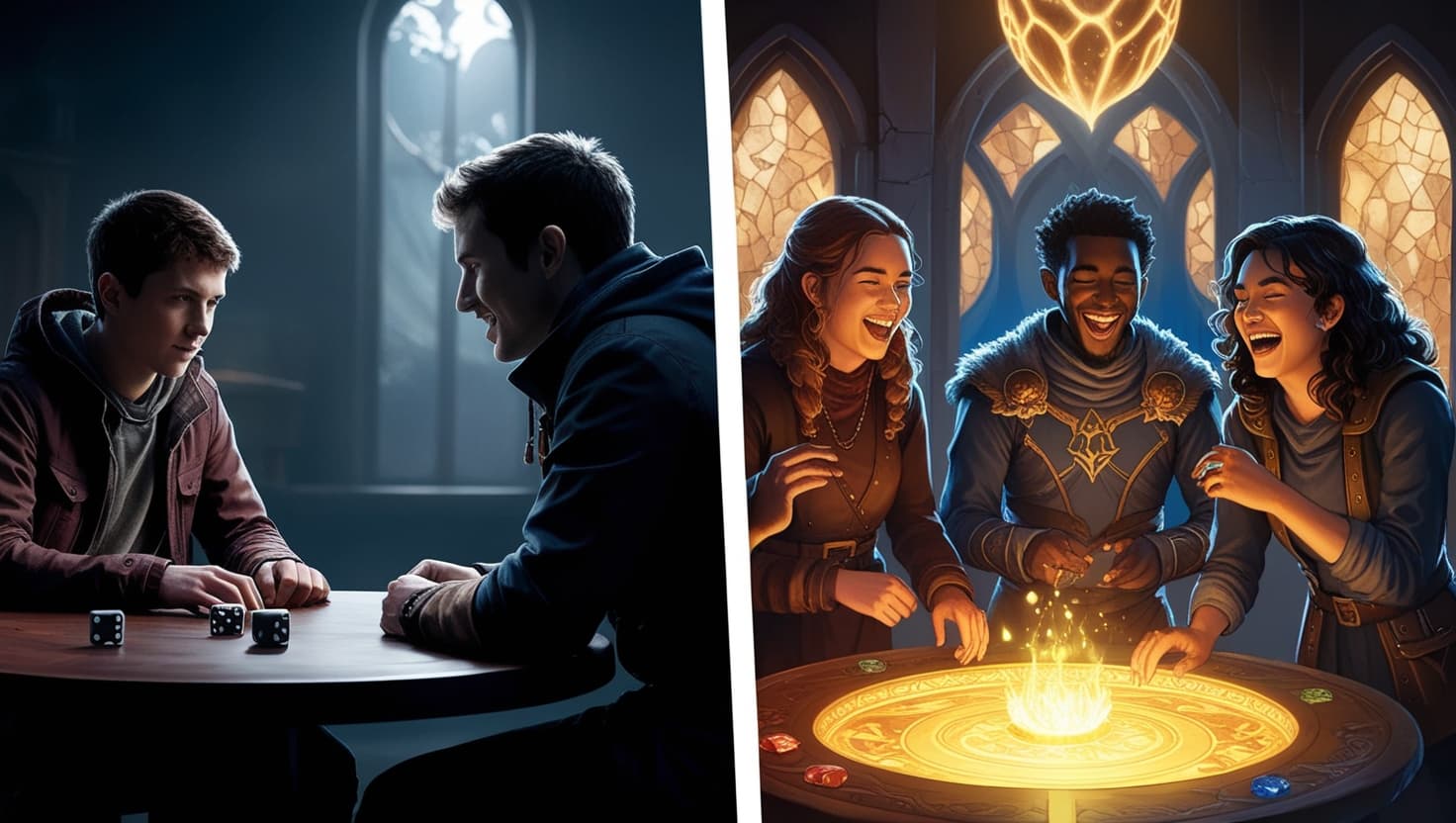
Last Tuesday at 11 PM, I fed ChatGPT a prompt about a haunted lighthouse and played a solo session for 45 minutes. It was great. My character died in a collapsing stairwell and I felt nothing.
Two days later, my friend's bard tried to seduce a dragon in our multiplayer AI D&D session. Four of us laughed so hard someone's mic clipped. The dragon ate the bard. We still bring it up.
Same hobby. Same AI technology. Completely different experiences.
Solo AI D&D Deserves More Credit Than It Gets
Too many "solo vs multiplayer" articles are thinly veiled sales pitches for the multiplayer product. This isn't that.
Solo AI RPGs - ChatGPT, AI Dungeon, dedicated AI DM tools - are genuinely fun. Instant access to a fantasy world. No scheduling, no social pressure, no waiting for Dave to finish arguing about flanking. You type, the world responds.
Any genre, any setting, any tone. Grimdark political intrigue at 1 AM on a Wednesday? Done. A goofy one-shot where you play a sentient cheese wheel? Nobody judges you. The freedom is real.
But here's what solo can't do.
What Changes When Other People Show Up
The Table Itself
The best moments in tabletop RPGs aren't planned. They're the sidebar "wait, what if we just set the building on fire?" brainstorms. The collective groan on a natural 1. The plan so stupid it might actually work.
Solo AI D&D gives you a story. Multiplayer gives you a table. When your group plays with an AI DM, you still get that messy, chaotic energy - someone cracks a joke in voice chat, someone else suggests something unhinged, the AI adapts to what the group decides. That collaborative chaos is the thing people miss most when they can't find a regular group.
Consequences That Land on Real People
In solo, your choices affect your character. In multiplayer, your choices affect other people's characters. That distinction carries more weight than it sounds.
Betray the quest-giver solo? Plot twist. Betray the quest-giver in multiplayer? Your friend's paladin has a faith crisis, someone else loses their reward, and the rogue starts planning to steal your share. Consequences ripple through real humans who care about the outcome.
Characters You Couldn't Have Invented
AI NPCs have gotten good. But a human player controlling a character is different in kind, not degree. They make choices that surprise you because another person's brain works differently than yours. They have their own agenda, their own humor, their own inexplicable attachment to the NPC everyone else agreed was sketchy.
The barbarian who refuses to fight because of a vow. The wizard who keeps casting Prestidigitation to clean everyone's boots. The rogue who is definitely stealing from the party but nobody can prove it. No AI generates that kind of specific, stubborn, human weirdness.
Shared Memory vs. Solo Memory
After a solo session, you have a chat log and some good moments that live in your head alone.
After a multiplayer session, you have folklore. "Remember when the bridge collapsed and only the gnome made the save?" becomes an inside joke, a reference point, a piece of shared history that someone brings up two months later in a completely different context.
Solo gives you a journal. Multiplayer gives you stories that exist between people.
When Solo Wins
Multiplayer isn't universally better. Pretending otherwise would be dishonest.
Weeknight decompression. Sometimes you want 30 minutes in a fantasy world before bed. No coordination, no social energy, no guilt about cutting it short.
Experimentation. Bizarre character concept? System you've never tried? Setting that might be terrible? Solo lets you fail privately. No wasted group time.
Learning the ropes. New to D&D or AI play? Solo is zero-pressure. Make mistakes at your own pace.
Time zone chaos. Group scattered across three continents. Solo doesn't care.
Processing speed. Some people think better alone - weighing options, looking up spells, reading descriptions carefully without feeling like they're holding anyone up.
None of these are consolation prizes. They're real advantages.
Most experienced players don't pick one mode permanently. Solo for quiet nights and experimentation. Multiplayer when you want the social energy. The two complement each other.
What Multiplayer AI D&D Looks Like in Practice
Session Zero (10-15 minutes). Group decides on tone, setting, boundaries. Same as with a human DM. The AI takes preferences and builds accordingly.
Character Creation (15-30 minutes). Building together. Filling party gaps, connecting backstories, arguing about who heals. The AI generates backstory hooks tied to the world, but the real fun is negotiation between players.
Play (1-3 hours). The AI narrates scenes, voices NPCs, tracks combat, adapts to group decisions. Unlike solo, it's managing spotlight time and responding to plans four people devised together. The AI handles the parts that make DMing hard (prep, improv, rule tracking). The humans handle the parts that make D&D great (creativity, banter, terrible puns).
The Actual Problem Both Modes Solve
The real tension was never solo vs multiplayer. It's that millions of people want to play D&D with friends but can't find a DM. The 2024 D&D survey found roughly five players for every willing DM. That math hasn't improved.
Solo AI D&D got popular because it solved a real problem - not because people preferred playing alone. Most solo players would love a regular group. They just don't have one.
AI DM multiplayer changes the equation. When AI handles the DM role, anyone can start a game. No prep, no burnout, no cancelled sessions. You need friends and an internet connection. That's it.
Try These Free Tools
Whether you play solo or with a group, these free tools come in handy:
- Dice Roller — Roll any dice combination instantly for quick checks or side games.
- Encounter Calculator — See how balanced a combat encounter is for solo or full-party play.
- NPC Name Generator — Generate names for the characters you meet on your adventures.
Frequently Asked Questions
Can you play multiplayer D&D with an AI dungeon master?
Yes. Platforms like StoryRoll support real-time multiplayer sessions where an AI handles the DM role - narrating scenes, running NPCs, managing combat, and tracking game state for multiple players simultaneously. Each player acts on their own device, and the AI coordinates the shared narrative.
Is solo or multiplayer AI D&D better?
Neither is objectively better. Solo excels at convenience, experimentation, and personal narrative. Multiplayer excels at social dynamics, shared memories, and collaborative problem-solving. Most players benefit from doing both depending on their mood and availability.
How many players can play AI D&D together?
Most AI DM platforms support 2-4 players in a session. Larger groups are technically possible but the AI's ability to manage spotlight time and narrative coherence degrades beyond 4-5 players, similar to how human DMs struggle with oversized tables.
Do I need D&D experience to play multiplayer AI D&D?
No. AI DM platforms handle rules, dice rolling, and mechanics. Knowing D&D helps with tactical decisions, but plenty of players jump in with zero tabletop experience. The AI explains what's happening and what your options are.
Solo for unwinding alone - it's great at what it does. Multiplayer for the nights you want to laugh until someone's mic clips. Both modes serve different needs, and the best version of AI D&D in your life probably includes both. For more on ways to play D&D without a DM or a complete solo D&D guide, we've got you covered. If you want to try either mode, StoryRoll is free to start.
Written by Anthony Goodman
Founder of StoryRoll. Building AI-powered tabletop RPGs.
Related Posts
Best AI RPG Apps in 2026: Find the Right AI Dungeon Master for You
We compared 7 AI RPG apps so you don't have to. From solo text adventures to multiplayer AI-powered D&D sessions, here's what actually works in 2026.
Your Isekai AI Roleplay Doesn't Have a Character Sheet
Isekai and anime AI roleplay apps are great at voice and vibe. Almost none of them track a character sheet, roll dice, or make an outcome actually count.
Best AI Game Master in 2026: Every Platform Compared
Looking for the best AI game master in 2026? We compared StoryRoll, Fables.gg, AI Realm, AI Dungeon, AIDungeonMaster.ai, RoleForge, LoreKeeper, and raw LLMs.