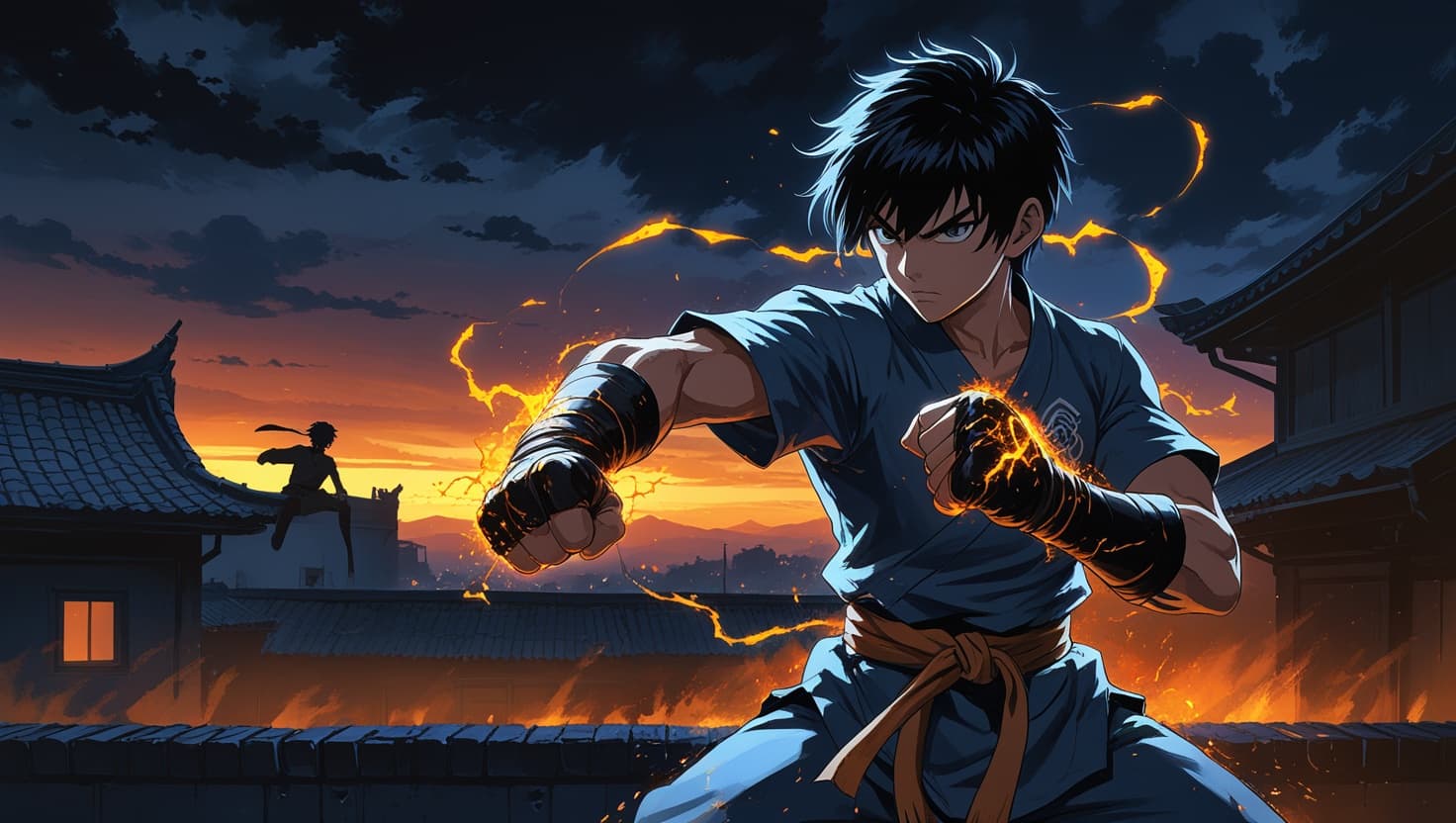
How to Run a Shonen Campaign (Without It Turning Into a Stat Grind)
Most shonen campaigns start strong and go flat the same way. Session one has a clean premise: an underdog with a hidden talent, a rival who beats them decisively, a mentor who sees potential nobody else does. By session six, it's just fantasy combat with bigger numbers. The rival hasn't shown up in three sessions. Power-ups happen because the character hit a new level, not because anything happened in the story. The tournament became a string of fights with no throughline.
The genre didn't run out of ideas. The table dropped the parts that make it shonen and kept the parts that make it a normal dungeon crawl with a training montage bolted on.
Here's how to run a shonen campaign that keeps its real engine running.
A Shonen Campaign Runs on Rivals and Earned Power, Not Bigger Numbers
Strip away the tournaments and the training montages, and a shonen story is about one thing: a character who wasn't strong enough, doing the work to become strong enough, against a specific measuring stick. That measuring stick is a person, not a number on a character sheet.
Build these load-bearing pieces in before the first real fight, not after:
- A rival who loses to no one but the protagonist. The rival needs their own arc, their own losses, their own reasons for pushing the protagonist to improve. If the rival is just a recurring boss fight, the rivalry reads as a random encounter instead of the plot.
- A loss that means something. The story needs at least one real defeat early, ideally against the rival, that exposes a specific gap - a technique the protagonist doesn't have, a fear they haven't faced, a weakness the mentor already knew about. A shonen campaign without an early loss has nowhere to grow from.
- A training arc that produces something concrete. Not "you feel stronger now," but a specific technique, a refined weakness, a new application of an existing power. The training arc is where the story earns the next fight's outcome.
- A power system with real limits. Unlimited power with no cost or ceiling collapses the tension immediately. Decide early what the character's power can't do yet, and let the campaign's arc be the story of closing that gap.
None of this needs new mechanics bolted onto whatever system you're running. It needs table time spent on the rival and the training beat, not just the fight that follows them.
Structure the Campaign as Escalating Arcs, Not a Dungeon Crawl
Shonen anime almost never treats its arcs as interchangeable. Each one raises the stakes past the last and leaves the cast changed going into the next. Borrowing that shape directly gives a table a reliable campaign structure instead of reinventing the premise every few sessions.
- Introduction arc. Establish the protagonist's starting skill level, introduce the rival with a fight the protagonist loses, and plant the mentor figure who can see what the character is capable of.
- Local tournament or trial arc. A contained event - a tournament, an exam, a qualifying trial - that forces the whole cast to show what they've trained. This is where secondary rivalries and team dynamics get established alongside the main rival thread.
- Regional threat arc. The tournament's world turns out to be smaller than a bigger danger. A faction, an organization, or a stronger enemy raises the stakes past personal rivalry into something the team has to face together.
- World-stakes arc. The final escalation. The rival either joins the fight against the larger threat or becomes its final obstacle, and the protagonist's growth across every prior arc gets tested at once.
- Introduction: establish skill level, introduce the rival, plant the mentor.
- Tournament/trial: a contained event that forces visible growth.
- Regional threat: the tournament's stakes turn out to be smaller than expected.
- World stakes: the final arc tests everything trained for so far.
Power Scaling Without It Turning Into a Math Problem
The fastest way to kill a shonen campaign's tension is letting power grow passively, session after session, with no story attached to the increase. If the numbers go up whether or not anything happened, the training arc stops meaning anything.
Tie every power gain to a specific in-story beat instead of a flat level-up:
- Loss before growth, every time. A character shouldn't get meaningfully stronger without first losing to something that exposed the gap. This is the genre's actual pacing engine, not an optional flourish.
- Milestone leveling over XP-by-encounter. Advance the character at the end of an arc, not after every fight. It keeps growth attached to "you finished training and passed your trial" instead of "you killed enough things."
- Name the specific improvement. "Stronger" is a sentence. "Can now sustain the technique for a full exchange instead of one hit" is a mechanic. Even in a narrative-first system, write the improvement down somewhere the table can reference it later.
- Keep a ceiling in view. The rival, the mentor, or the current arc's antagonist should represent a power level the protagonist genuinely can't match yet. That gap is what the next arc's training closes.
Save the protagonist's biggest power-up for right after their worst loss in the campaign, not their easiest win. The genre rewards struggle with growth, not the other way around.
Designing a Rival Worth Recurring
A one-off tough enemy is a boss fight. A rival is a recurring cast member with their own goals, and the difference is what makes a shonen campaign feel like shonen instead of a series of increasingly hard combat encounters.
Give the rival a reason to keep showing up that has nothing to do with convenience. Maybe they're chasing the same title the protagonist is. Maybe they lost something the protagonist represents a path back to. Maybe their own mentor set them against the protagonist specifically, and neither of them fully agrees with the assignment. The rival should have scenes that don't involve the protagonist at all - their own training, their own setbacks - so their eventual growth reads as earned instead of scripted to match the plot's needs.
The best rival arcs end in a shift, not a defeat. A rival who joins the team, who becomes a genuine ally after enough shared struggle, or who steps aside because they found a different goal, tends to land harder than one who simply loses the final fight and disappears.
The Team Is Where the Tournament Arc Earns Its Stakes
A shonen protagonist rarely trains alone, and a shonen campaign shouldn't run that way either. The team's collective growth across a tournament or trial arc is what makes the world-stakes arc feel earned instead of sudden.
A few ways to build that in deliberately:
- Give every character their own measuring stick, not just the protagonist's rival. A teammate with their own rival, their own training arc, and their own moment in the tournament spotlight keeps the structure from being a one-person show.
- Let the tournament format force cooperation and competition at once. Team characters sometimes have to face each other in early rounds, which creates real tension without anyone needing to be a villain.
- Build in a moment where the team's plan fails and the protagonist has to trust someone else's approach. Shonen stories are full of moments where the strongest character isn't the one who solves the problem. Let that happen at the table too.
Where an AI Game Master Helps a Shonen Campaign Specifically
The hardest part of running a shonen campaign consistently isn't the fights - it's remembering that the rival from session two is supposed to show up again in session nine, and making sure the training arc's specific improvement actually shows up in the rematch instead of getting hand-waved because the table forgot what was trained.
StoryRoll's Anime mode has a dedicated shonen tone alongside isekai, mecha, magical girl, and dark anime, and the narrator introduces a rival NPC early and keeps them recurring throughout the campaign rather than letting them quietly drop out of the story. Sessions track as Episodes with cliffhanger energy, and the overarching plot threads track as Arcs, so a tournament arc's setup pays off instead of getting lost between sessions. Power systems are original to each campaign - the narrator never borrows specific franchise terminology - and a campaign's powerSystem gets its own term and lore that carries through every dramatic moment consistently. StoryRoll's built-in "Academy of the Awakened" starter campaign is a working example of the structure: a shonen-tone story built around a power called Resonance, a tournament called the Crucible, and a class of rivals training toward it together.
That doesn't replace the table work described above - naming what the rival is chasing, deciding what the loss exposed, writing down what training actually fixed still needs someone to do it. It closes the gap between "this rivalry matters" in session one and the rivalry still mattering by the finale.
Frequently Asked Questions
What is a shonen campaign?
A shonen campaign is a tabletop RPG campaign built on the anime shonen genre: an underdog protagonist who trains, loses, and grows stronger against a recurring rival, structured around tournament arcs and training arcs instead of a dungeon crawl.
What makes a shonen campaign different from a normal fantasy campaign?
Power has to be earned on screen, not just granted by a level-up. A shonen campaign runs on a recurring rival who tracks the protagonist's growth, training beats that show what specifically improved, and an escalating structure - local tournament, regional threat, world-ending stakes - instead of a series of unrelated dungeons.
Do I need a special RPG system to run a shonen campaign?
No. Dedicated games exist, but you can run the genre in D&D 5e or a lighter narrative system as long as you build in the genre's real structure: a recurring rival, training arcs that precede power gains, and a tournament or arc format that escalates the stakes.
How should power scaling work in a shonen campaign?
Tie every power gain to a specific story beat - a loss that exposed a weakness, a training arc that addressed it, a rematch that tests it - instead of a passive level-up between sessions. Milestone leveling at the end of an arc works better than XP-by-encounter, because it keeps growth attached to the story instead of the math.
Can an AI Game Master run a shonen campaign?
Yes. StoryRoll's Anime mode has a dedicated shonen tone alongside isekai, mecha, magical girl, and dark anime, and it introduces a rival NPC early and keeps them recurring automatically across Arcs and Episodes, so the rivalry doesn't quietly disappear after session three.
What's the difference between a shonen campaign and an isekai campaign?
Shonen centers on a rival and earned power growth through training and tournament-style escalation, usually starting from the protagonist's own world. Isekai centers on being transported into a new world with its own rules, often with game-like systems the protagonist has to learn. The two overlap constantly in anime, and a table can blend them, but the load-bearing structure is different.
A shonen campaign isn't a fantasy campaign with power-ups instead of loot. It runs on a recurring rival, power that's earned through a loss and a training arc, and a structure that escalates from a local tournament to world-ending stakes instead of a string of unrelated dungeons. If your table's shonen game has quietly turned into a stat grind, the fix isn't a bigger boss - it's bringing back the rival, naming what the training actually fixed, and letting the loss before the growth actually sting.
If you're building out other corners of the anime genre, see how isekai and shonen AI roleplay compares to a real character sheet, how to run a magical girl campaign without it collapsing into generic combat, and how to build memorable NPCs your rival and mentor can actually live up to.
Written by StoryRoll
Founder of StoryRoll. Building AI-powered tabletop RPGs.
Related Posts
How to Run a Mecha Campaign (Without It Turning Into a Vehicle Combat Spreadsheet)
A mecha campaign lives or dies on the pilot inside the machine, not the hardware. Here is how to keep the genre's real stakes running at the table.
How to Run a Dark Anime Campaign (Without It Turning Into Either Shonen or Shock Value)
A dark anime campaign fails in one of two directions: it plays it safe and becomes shonen with a black coat of paint, or it chases shock value and burns out in three sessions. Here's the middle path.
How to Run a Magical Girl Campaign (Without It Turning Into Generic Anime Combat)
A magical girl campaign lives or dies on identity, found family, and emotional stakes - not spell lists. Here is how to keep the genre's real engine running.