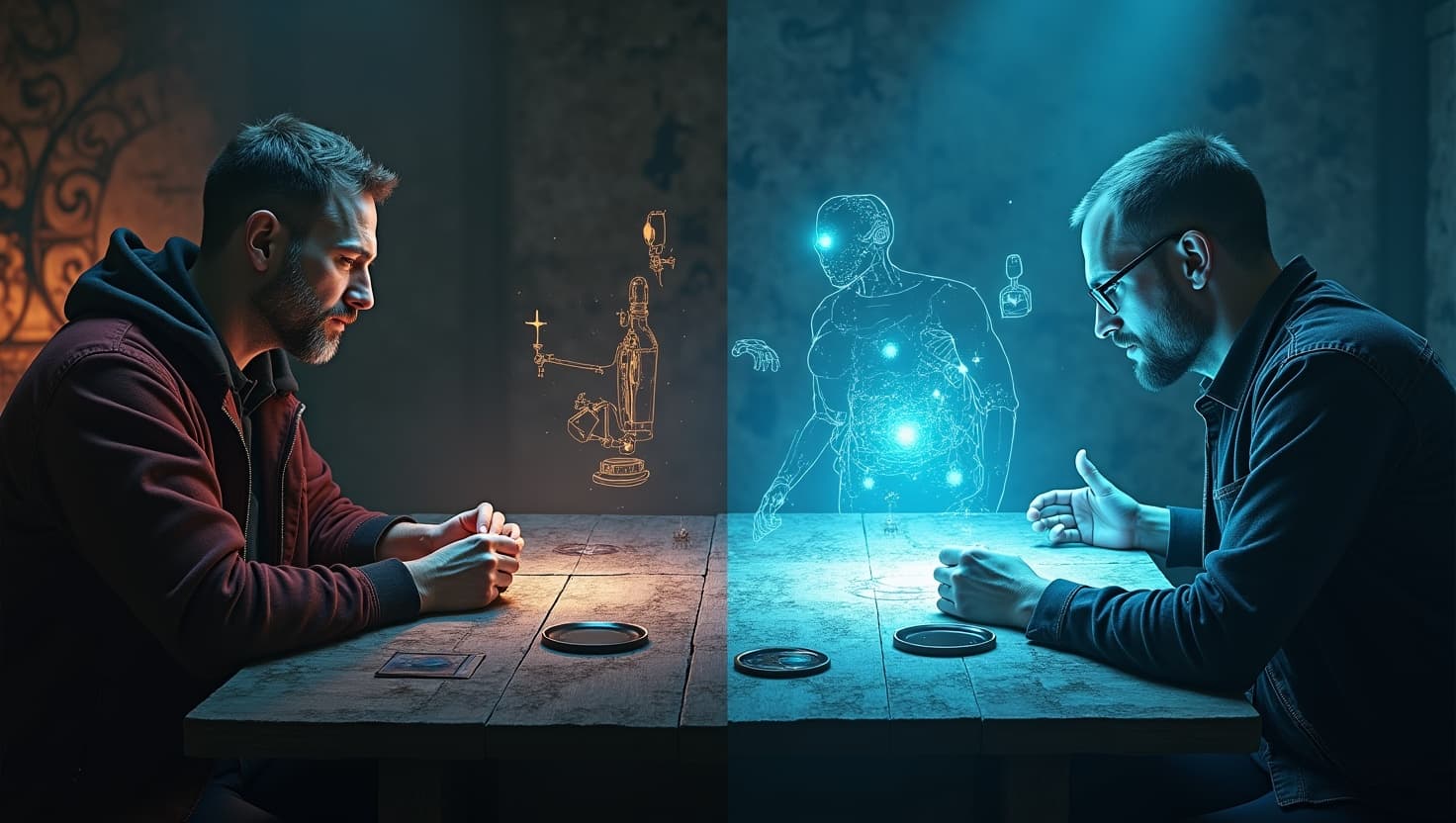
AI Copilot vs AI Dungeon Master - What's the Difference?
The TTRPG world is swimming in AI tools right now. Some promise to help your DM. Others promise to be your DM. And the marketing from both camps can sound nearly identical.
But there's a real, practical difference between an AI copilot and an AI Dungeon Master - and picking the wrong one means you'll either get less help than you expected or lose something you didn't want to give up.
Here's how to tell them apart, and how to figure out which one you actually need.
What Is an AI Copilot for DMs?
An AI copilot sits beside your human Dungeon Master. Think of it as a prep assistant, improv partner, and reference librarian rolled into one.
What a copilot does:
- Generates NPC names, backstories, and dialogue on the fly
- Creates encounter ideas and random tables
- Helps with session prep (adventure outlines, location descriptions, plot hooks)
- Suggests stat blocks or rule clarifications mid-session
- Produces maps, handouts, or reference art
What a copilot doesn't do:
- Run the actual game
- Narrate scenes in real time
- Track initiative, HP, or combat mechanics
- Make rulings during play
- Manage the story arc across sessions
Tools like Macer.ai have leaned into this positioning, describing themselves as a "copilot for Dungeon Masters." The human DM stays in charge. The AI handles the busy work.
The copilot assumption: You already have a DM. You just want to make their life easier.
What Is an AI Dungeon Master?
An AI Dungeon Master replaces the human DM entirely. It doesn't assist - it runs the game.
What an AI DM does:
- Narrates scenes, describes environments, voices NPCs
- Manages combat (initiative, dice rolls, damage, conditions)
- Tracks game state across sessions (who's alive, what happened, where you are)
- Generates art for scenes as they happen
- Adapts the story based on player choices
- Runs Session Zero (theme selection, character creation, world building)
What an AI DM doesn't do:
- Read the room the way a human can
- Improvise based on years of knowing your group
- Create the deeply personal, emergent moments that come from human creativity
- Replace the social magic of a friend behind the screen
Platforms like StoryRoll take this approach. There's no human DM in the loop. The AI handles narration, mechanics, art, and story - and multiple players join the same session together.
The AI DM assumption: You don't have a DM, or your DM wants to finally play.
The Real Question: Do You Have a DM?
This is the fork in the road that most "which AI tool should I use" articles miss. The answer to one question determines everything:
Do you already have a human Dungeon Master?
| Situation | What you need | Why |
|---|---|---|
| You have a DM who wants to prep faster | AI copilot | Augments their workflow without replacing their role |
| You have a DM who's burned out on prep | AI copilot (maybe) | Could reduce the burden enough to keep them going |
| Your DM quit and nobody wants to step up | AI Dungeon Master | No human DM = you need an AI that runs the whole game |
| You have friends who want to play but none of you have DMed | AI Dungeon Master | Zero DM experience required |
| You're a Forever DM who wants to be a player for once | AI Dungeon Master | You can't copilot yourself out of the chair |
| You play solo and want a richer experience than ChatGPT | Either (depends) | Copilots help you build worlds; AI DMs run sessions |
The critical distinction: copilots make existing DMs better. AI Dungeon Masters make DMs unnecessary.
Neither is universally "better." They serve different people in different situations.
Why This Distinction Matters More Than You Think
The TTRPG community has a structural problem: there aren't enough Dungeon Masters to go around.
On r/lfg (900,000+ members), DM-wanted posts regularly get dozens of applicants and zero offers. One poster found a single DM listing that received 56 applications for 6 spots. The demand-supply ratio is brutal.
AI copilots don't fix this. They make existing DMs more efficient - which is genuinely useful - but they don't create new DMs. If your group of five friends has zero people willing to DM, a copilot tool has no one to copilot for.
AI Dungeon Masters address the supply problem directly. They don't make DMs better; they make DMs optional. That's a fundamentally different value proposition.
Where AI Copilots Shine
Let's be fair about what copilots do well, because for the right user, they're excellent.
1. Prep reduction is real. A DM who spends 4 hours prepping a session can cut that to 1-2 hours with good AI assistance. NPC generation, encounter balancing, and location descriptions are exactly the kind of structured tasks AI handles well.
2. Mid-session improv support. When players go wildly off-script (and they will), having an AI that can generate a shopkeeper's personality in 10 seconds is genuinely useful.
3. Creative partnership. Some DMs don't want to outsource the game - they want a brainstorming partner. AI copilots are great sounding boards for adventure design, puzzle creation, and world building.
4. The DM stays human. For groups that value the human element above all else - the DM's personal touches, inside jokes, custom storylines built around characters over years - a copilot preserves that while reducing the grind.
Best for: Experienced DMs who love running games but hate the prep tax.
Where AI Dungeon Masters Shine
1. No DM required. Literally. The biggest advantage is the most obvious one. Five friends can sit down, create characters, and start playing in minutes without anyone needing to know the rules, prep an adventure, or volunteer for the DM chair.
2. The Forever DM finally plays. If you've been running games for years and never gotten to be a player, an AI DM lets you roll a character and experience the game from the other side. No copilot can give you that.
3. Instant availability. No scheduling around the DM's prep time. No cancellations because the DM is burned out. The AI is ready whenever your group is.
4. Consistent mechanics. AI DMs that implement actual TTRPG rules (dice rolls, combat resolution, ability checks) deliver consistent mechanical experiences. No rule arguments, no forgotten modifiers, no "I'll look that up later."
5. Art generation as you play. Some AI DM platforms generate scene art in real time - your tavern, your dragon, your character's critical hit moment. That's not something a copilot typically does during live play.
Best for: Groups without a DM, Forever DMs who want to play, friend groups curious about D&D but intimidated by the learning curve.
The Honest Limitations of Each
No point pretending either approach is perfect. Here's where each falls short - and for a deeper dive, see our honest comparison of AI DMs and human DMs.
AI Copilots:
- Still require a human DM (the bottleneck they don't solve)
- Can slow down gameplay if the DM is constantly alt-tabbing to an AI tool
- Generated content needs human curation - raw AI output is often generic
- Adds another subscription to an already tool-heavy DM workflow
AI Dungeon Masters:
- Can't read the room or pick up on player energy
- Won't create the deeply personal story moments a great human DM builds over months
- Limited by the platform's implemented rules and systems
- The "social magic" of a friend behind the screen is different (not worse, just different)
Can You Use Both?
Yes, actually.
A DM running a weekly campaign might use an AI copilot for prep and mid-session assistance. That same DM might also join an AI-run session on off weeks to finally experience the player side.
They're not competing products for the same use case. They're different tools for different problems:
- Copilot: "I'm a DM and I want help."
- AI DM: "We don't have a DM and we want to play."
Some groups even rotate. The regular DM runs sessions 1, 2, and 3 with copilot assistance. Session 4 is an AI DM one-shot where everybody plays.
How to Choose
Choose an AI copilot if:
- You already have a willing DM
- Your DM's main pain point is prep time, not motivation
- Your group values the human DM's personal touch above all else
- You want AI as a behind-the-scenes tool, not a visible presence in the game
Choose an AI Dungeon Master if:
- You don't have a DM and can't find one
- Your DM is burned out and wants to step back (or step into a player role)
- You have a friend group that wants to try D&D but nobody wants to learn to DM
- You want to play right now without waiting for someone to prep
- You play solo and want more structure than a chatbot conversation
The simplest test: If removing the AI tool means nobody runs the game, you need an AI DM. If removing it means the DM just has more work to do, you need a copilot.
The Bigger Picture
The AI-in-TTRPG conversation often gets framed as "AI replacing human DMs" versus "AI should only assist." But that framing misses the point.
Most people who use AI Dungeon Masters aren't choosing AI over a human DM. They're choosing AI over not playing at all. The alternative isn't "human DM or AI DM." It's "AI DM or no game."
Meanwhile, AI copilots aren't threatening human DMs. They're making the humans who already DM more sustainable in the role. Less burnout, less prep, more energy for the creative parts.
Both tools grow the TTRPG hobby. Copilots keep existing tables alive. AI DMs create new tables that wouldn't exist otherwise. That's not a competition. That's an ecosystem.
For a broader look at the full landscape, we've compared every AI DM platform and ranked the best AI RPG apps in 2026 side by side.
Try These Free Tools
Whether you use an AI copilot or a full AI Dungeon Master, these free tools are handy for any session:
- Dice Roller — Roll any dice combination for quick checks and combat.
- Encounter Calculator — Build balanced encounters for any party level.
- Backstory Generator — Create a character backstory in seconds, for players or NPCs.
Interested in trying an AI Dungeon Master? StoryRoll runs the entire game - narration, combat, art, and multiplayer - so your group can play without needing a DM. Start a free campaign →
Written by Anthony Goodman
Founder of StoryRoll. Building AI-powered tabletop RPGs.
Related Posts
AI DM vs Human DM: An Honest Comparison
Can an AI Dungeon Master replace a human? Here's an honest look at what AI DMs do well, where human DMs still win, and when each makes sense for your table.
Best AI RPG Apps in 2026: Find the Right AI Dungeon Master for You
We compared 7 AI RPG apps so you don't have to. From solo text adventures to multiplayer AI-powered D&D sessions, here's what actually works in 2026.
Best Online D&D Platforms in 2026: VTTs, AI DMs & More Compared
Compare Roll20, Foundry VTT, Owlbear Rodeo, Fables, AI Dungeon, and StoryRoll. Feature grid, pricing, and honest pros/cons for every way to play D&D online.