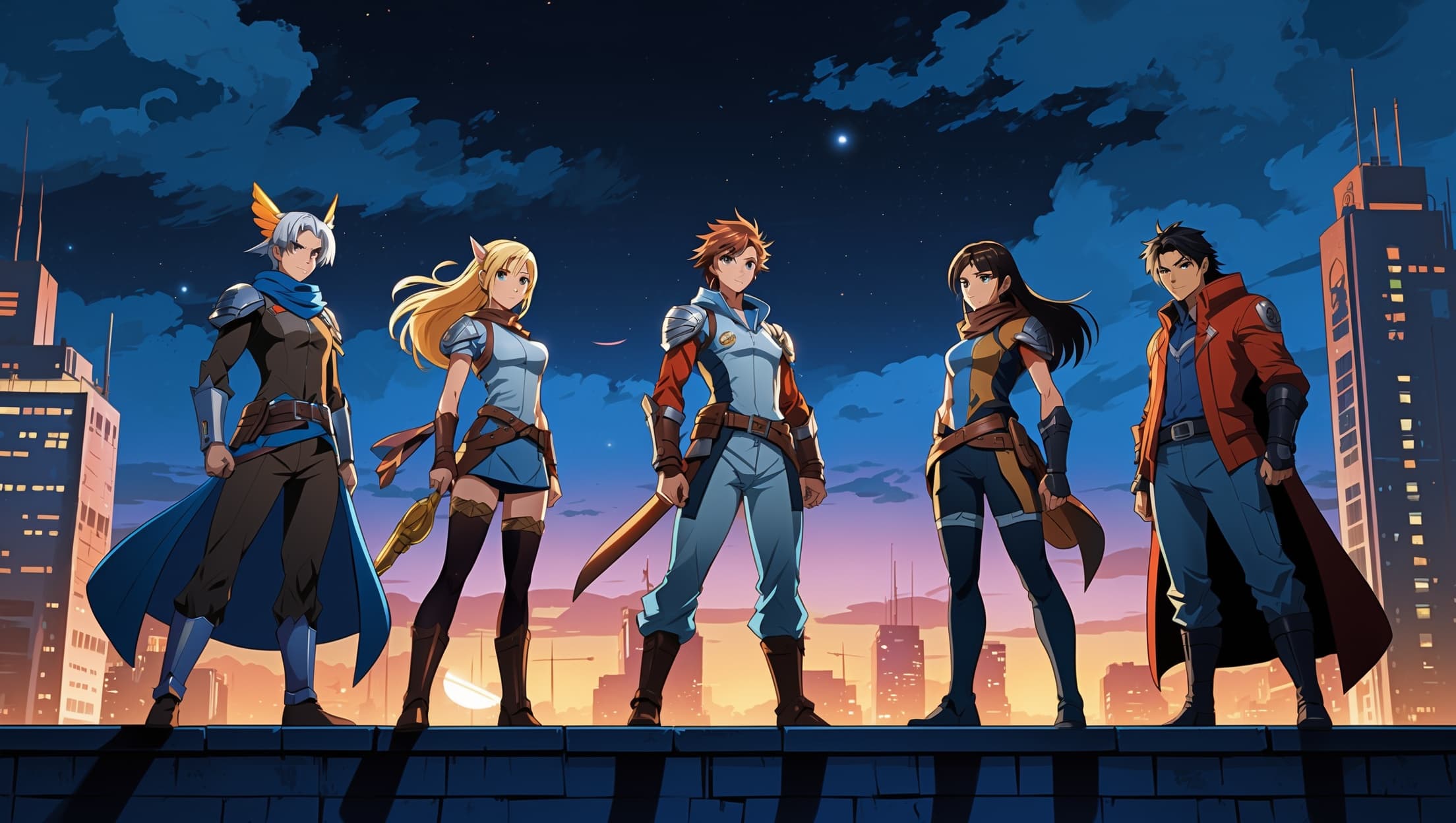
Anime RPG Character Archetypes: Build a Protagonist Without a Rulebook
Search for anime character archetypes and you get two kinds of results. The first is a trope wiki: exhaustive, well-researched, and built for people writing essays about Naruto, not for people trying to build a character for tonight's session. The second is a generic fantasy class list with a cel-shaded portrait pasted on top, still running on ability scores and spell slots underneath. Neither one answers the actual question: what do you build when you want the training arc, the power-up, and the rival fight, and you want it to actually play like anime instead of D&D with a different skin?
Anime RPG character archetypes solve a different problem than fantasy classes do. A fantasy class answers "what can my character do in combat." An anime archetype answers "what is this character's arc, and what does the story owe them by the end of it." Here's what those anime RPG character archetypes actually are, how to match them to the sub-genre you're playing, and how to build one without opening a second tab to learn a rulebook first.
The Problem With Anime Character Building Right Now
Most anime character guides online are written for readers, not players. They catalog personality types across hundreds of series, which is genuinely useful if you're trying to understand why Bakugo works as a character. It's the wrong tool if you're sitting down to build your own Protagonist for a campaign starting in ten minutes.
The other common failure is the reskin. A "anime mode" that swaps "fighter" for "swordsman" and calls it done still tracks hit points and spell slots exactly like a fantasy game. The character might have an anime name and an anime portrait, but nothing about how the story unfolds or how the AI narrates it changed. The training arc, the rival dynamic, the power-up that arrives at the worst possible moment, none of that comes from a stat block. It comes from the archetype.
An anime RPG character archetype is defined by its arc, not its stats. That's true whether you're building one for a homebrew tabletop session or for an AI-run Series.
The Archetypes That Actually Carry an Anime Story
These seven anime RPG character archetypes cover almost every anime you've watched, across almost every sub-genre. You don't need all seven in one cast, two or three that fit your sub-genre and pull against each other is a complete party.
Hot-Blooded Protagonist: Relentless, stubborn, and powered by conviction more than raw skill. Gets stronger specifically because giving up isn't an option.
Rival: The foil. Same general skill set as the protagonist, different philosophy, and a running scoreboard neither of them will admit to keeping.
Mentor: Teaches the one lesson the protagonist needs, then usually turns out to be flawed, outdated, or hiding something about their own past defeat.
Transported Everyman: Pulled into a new world that runs on different rules, usually with an unfair advantage nobody else understands yet.
Ace Pilot: Bonded to a machine that's an extension of their nerve as much as their skill. The fight is never just about the pilot.
Chosen Guardian: Handed power and a duty at the same time, and has to grow into both before the story lets them rest.
Fallen One: Carries a cursed or forbidden power that works, and the story never lets them forget what it costs.
Hot-Blooded Protagonist
The archetype that drives shonen. A Hot-Blooded Protagonist isn't the most talented person in the room, they're the one who refuses to stay down. Their power grows in direct proportion to how much they've already lost, which is why the best training arcs put them through something that should break them first.
This archetype pairs naturally with almost anything else on this list. Give them a Rival and you get Dragon Ball. Give them a Mentor and you get the training montage. Give them a whole team of contrasting archetypes and you get most long-running shonen series ever made.
Rival
Every Hot-Blooded Protagonist needs someone to measure themselves against, and the Rival is built for exactly that. They usually share the protagonist's general skill set and started from a similar place, which is what makes the comparison sting. The best Rivals aren't villains, they're proof of what the protagonist could become if they made one different choice.
A Rival who loses early and comes back later having learned something the protagonist hasn't is one of the most reliable arcs in the genre. Don't be afraid to let your Rival win a round.
Mentor
The Mentor teaches the protagonist the one skill or lesson the plot actually needs, then complicates it. Anime mentors are rarely simple wise-elder figures. They're often haunted by an old failure, holding back information for a reason that seems good until it isn't, or flatly wrong about something the protagonist has to figure out on their own.
Playing a Mentor archetype well means resisting the urge to have all the answers. The most memorable ones are the ones the protagonist eventually has to surpass, not just learn from.
Transported Everyman
This is the isekai archetype: an ordinary person pulled into a world that runs on different physics, magic systems, or social rules, usually with a power or advantage that makes no sense back home. The engine of the whole sub-genre is the gap between how the world used to work and how it works now, and the Transported Everyman is the character who has to close that gap in real time.
The archetype works best when the character brings something from their old life that turns out to matter in the new one. A modern skill, a strange piece of knowledge, or just the instinct to keep going when the new world's own people have given up.
Ace Pilot
The mecha sub-genre needs a character built around their relationship with a machine, and the Ace Pilot is that character. The best version of this archetype treats the machine as a second body rather than a vehicle, so that damage to it, upgrades to it, and moments where it fails all land as personal stakes rather than equipment loss.
An Ace Pilot's arc usually runs through trust, in the machine, in a commanding officer, or in whoever built the thing they're piloting. Take that trust away at the wrong moment and you have a mecha story.
Chosen Guardian
Magical girl stories run on a character who's handed real power and a real duty at the same time, often before they're ready for either. The Chosen Guardian archetype's arc is about growing into that responsibility without losing what made them worth choosing in the first place.
This archetype tends to produce the most emotionally direct stories on this list, because the stakes are rarely abstract. There's a specific thing being protected, and a specific cost to failing.
Fallen One
Dark anime wants a character whose power comes with a price the story won't let them forget. A Fallen One archetype might carry a curse, a forbidden technique, or a compromise they made that keeps paying interest. Unlike the Hot-Blooded Protagonist, their strength isn't purely a triumph, it's a bargain, and the best dark anime scripts keep reminding the audience and the character what that bargain actually cost.
Matching Archetypes to Anime Sub-Genres
Anime RPG character archetypes work best when they're matched to the kind of story they were built for. StoryRoll's Anime Adventure mode covers five sub-genres, shonen, isekai, mecha, magical girl, and dark anime, and each one has a natural archetype pairing:
- Shonen wants a Hot-Blooded Protagonist, usually paired with a Rival and a Mentor who teaches one real lesson before stepping back.
- Isekai wants a Transported Everyman at the center. Everything else in the cast exists to make the new world feel real around them.
- Mecha wants an Ace Pilot, and a supporting cast built around whoever else has a stake in that machine surviving the next fight.
- Magical girl wants a Chosen Guardian, often alongside a second Guardian who took the same power and made a different choice with it.
- Dark anime wants a Fallen One, and works best when at least one other character in the cast represents what the protagonist gave up.
None of these pairings are rules. A Rival who gets Transported alongside the protagonist, or a Fallen One flying a mecha, is a genuinely interesting combination precisely because it isn't the default. The archetypes are a starting point for what the story owes the character, not a cage.
Building One Without a Rulebook
The reason anime archetypes keep getting flattened into fantasy class lists is that most platforms only know how to run one kind of character sheet. StoryRoll's Anime Adventure mode skips that entirely. There's no ability-score array and no spell-slot tracking, you describe your Protagonist, pick the Archetype and Origin that fit, and the AI narrator carries the Season from there, tracking power-ups, rivalries, and arc beats the way an actual anime does instead of the way a fantasy RPG does.
That matters most at the table, not on paper. A Rival built as a class reskin still just rolls initiative and swings a weapon. A Rival built as an archetype shows up at the right moment with a callback to the last time they lost, because the AI Game Master is tracking the arc, not just the stat block.
Anime RPG character archetypes work because they describe what a character's arc owes the audience, not what they can do on a turn. Pick two or three that fit your sub-genre, whether that's Hot-Blooded Protagonist and Rival for a shonen Season, Transported Everyman for an isekai one, or Ace Pilot for mecha, and you have a cast that plays like anime instead of fantasy wearing an anime filter. The archetype tells the AI narrator what the story owes the character. The narrator handles the rest.
Frequently Asked Questions
What are the best character archetypes for an anime RPG?
The archetypes that carry almost every anime story are the Hot-Blooded Protagonist, the Rival, the Mentor, the Transported Everyman, the Ace Pilot, the Chosen Guardian, and the Fallen One. Most tables only need three or four covering different pillars of the story rather than all seven at once.
Do I need a rulebook to build an anime RPG character?
No, not if your platform treats anime as its own narrative mode instead of reskinned D&D. StoryRoll's Anime Adventure mode uses narrative character creation - you describe your Protagonist and the Archetype they fit, and the AI narrator handles power-ups, rivalries, and season arcs without ability scores or spell slots.
How do I match an anime character archetype to a sub-genre like isekai or mecha?
Match the archetype to the story engine, not the other way around. The Transported Everyman drives isekai because the whole premise is a fish out of water gaining unfair power. The Ace Pilot only works if there's a machine to pilot, which is why it belongs to mecha. Shonen wants a Hot-Blooded Protagonist paired with a Rival. Magical girl wants a Chosen Guardian. Dark anime wants a Fallen One willing to pay a real cost.
Can I combine anime archetypes, like a Rival who becomes a Mentor?
Yes, and it's one of the most common moves in the genre itself. A Rival who loses to the protagonist and comes back later to teach them what they learned from that loss is a well-worn arc precisely because it works. Combining archetypes usually produces a more interesting character than picking one and stopping.
Which anime archetype works best for solo play?
The Transported Everyman and the Fallen One both work well solo, because their central tension is internal rather than dependent on a rival or a team to bounce off of. A lone protagonist figuring out cheat skills in a new world, or a cursed character weighing what their power costs them, gives an AI Game Master plenty to build scenes around without needing a full cast.
How does an anime RPG character differ from a D&D character?
Structurally, an anime Protagonist describes an Archetype and an Origin rather than a class with ability scores and spell slots. There's no feat chain or multiclassing math to plan. The character is defined by what arc they're in and what they want by the end of the Season, and the AI narrator carries the mechanics from there.
Related Reading
Written by StoryRoll
Founder of StoryRoll. Building AI-powered tabletop RPGs.
Related Posts
Fairy Tale RPG Character Archetypes: Build a Hero Without a Rulebook
The fairy tale RPG character archetypes that actually carry a story, pulled from the folklore that invented them, and how to build one without a class list.
Sci-Fi RPG Character Archetypes: Build a Crew Without a Rulebook
Sci-fi character archetypes explained: the roles that actually carry a crew, and how to build one narratively without learning a homebrew rulebook first.
Anime Power System Ideas: How to Build an Original One (Not a Reskin)
Every homebrew anime campaign starts strong and ends up as Naruto with the names changed. Here is how to design an original power system that holds up past session three.