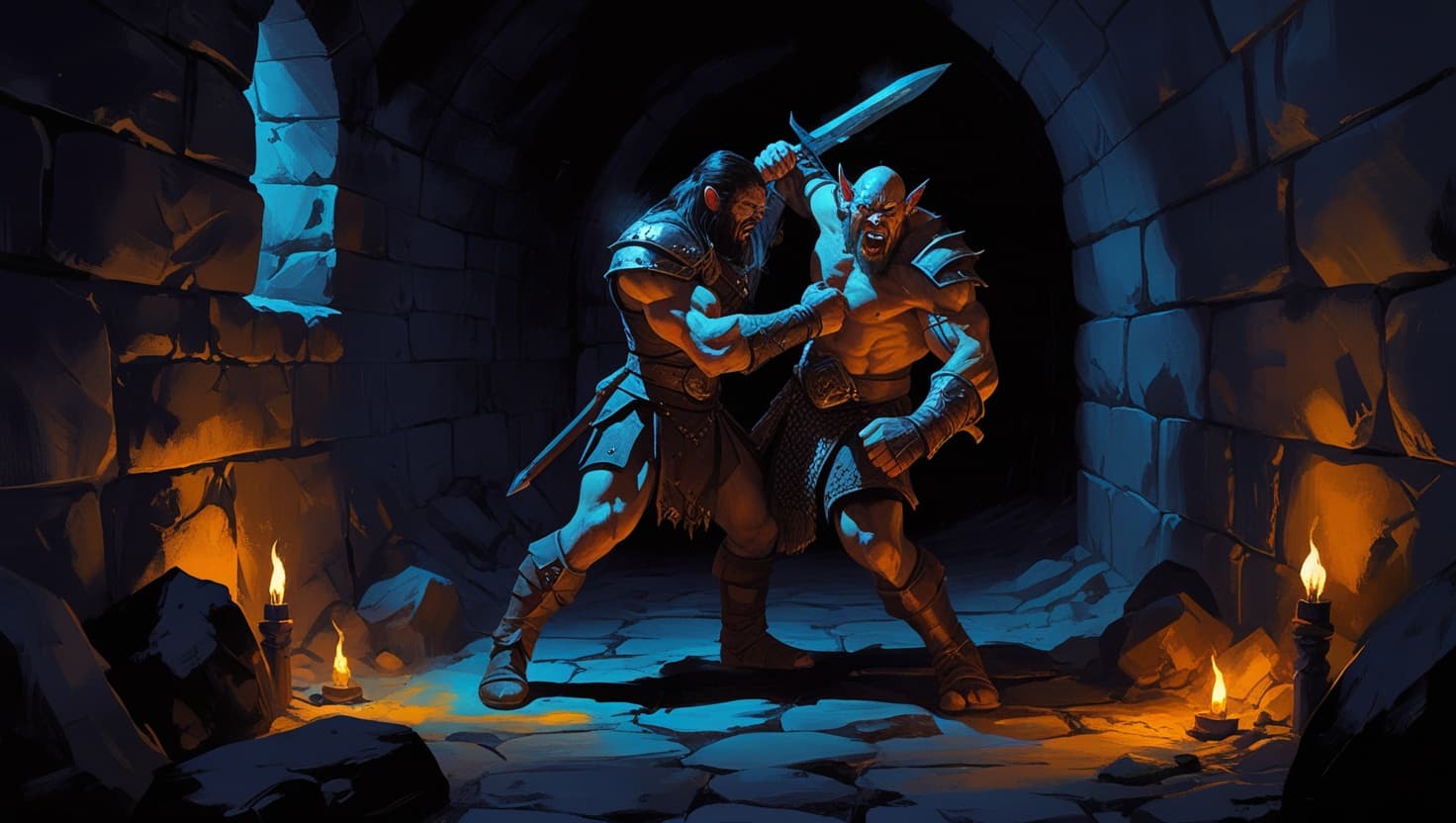
Grappling 5e: Why It Turns Into a Stalemate
Grappling 5e looks like a small, tactical option. A fighter grabs a fleeing goblin, a barbarian pins a cultist to a table, a monk holds a door shut with their body weight. It reads like flavor. Then it hits the table, and combat stops moving.
Here's the pattern almost every group runs into. One creature grapples another. On the grappled creature's turn, it spends its entire action trying to break free. It fails. Next round, the grappler does something else, or just holds on, and the grappled creature tries to escape again. Nothing dies. Nothing moves. Two combatants are locked in a loop that eats real table time and produces zero narrative progress, while everyone else in the fight either watches or, if they're smart, quietly wins the encounter around the two people stuck wrestling.
That's not a misplay. It's what grappling 5e actually does when nobody at the table knows the follow-up options that break the loop.
Grappling 5e: The Actual Rule
Here's the whole mechanic, stripped down to what matters.
Grapple is a special melee attack. You don't roll to hit. Instead, when you would normally make an attack as part of the Attack action, you can choose to attempt a grapple in its place: you make a Strength (Athletics) check, contested by the target's choice of Strength (Athletics) or Dexterity (Acrobatics). Win the contest, and the target is grappled.
A few requirements gate this before you get there. The target can't be more than one size larger than you, so a Medium character can grapple a Large creature but not a Huge one without help. You need at least one hand free, since grappling requires an empty hand to do the grabbing. And it costs one of your attacks, not your whole turn, so a character with Extra Attack still has attacks left over after grappling.
Once the grapple succeeds, the target's speed drops to 0 and can't increase for as long as the grapple holds. That's the entire mechanical effect. No damage, no disadvantage on attacks by default, nothing except a creature that can no longer move under its own power.
Grappling doesn't stop the target from attacking, casting spells, or otherwise acting normally. A grappled wizard can still cast fireball. The only thing grappling 5e directly removes is movement.
Escaping a Grapple in 5e
Breaking free from grappling 5e works the same way in reverse. On its turn, the grappled creature can use its action to attempt a Strength (Athletics) or Dexterity (Acrobatics) check, contested by the grappler's Strength (Athletics) check. Win, and the grapple ends immediately.
There's no cap on attempts. A creature can keep trying every single round for as long as the fight lasts. And that's precisely where the stalemate comes from: escaping costs the grappled creature its entire action, every time, while the grappler pays nothing to keep holding on beyond the attack that started it. The grappler isn't even required to do anything on their turn to maintain the grapple. They can attack someone else, cast a spell, or just stand there, and the hold persists until the grappled creature wins a contest or something else breaks it.
That asymmetry is the whole rule working as designed. A grapple is supposed to be a genuine tempo swing, taking one enemy fully out of the fight for the price of a single attack. The problem isn't the rule. It's that most tables stop there, treat the grapple as a dead-end standoff, and never use the opening it creates.
Grappling and Shoving 5e Together
This is the part of grappling 5e that actually resolves the stalemate, and it's the piece most groups never connect.
Shove is a second special melee attack, built the same way grapple is: it replaces one of your attacks instead of a normal weapon swing. You make a Strength (Athletics) check contested by the target's Strength (Athletics) or Dexterity (Acrobatics), same as grappling. Win, and you choose one of two outcomes: push the target 5 feet away, or knock it prone.
A character with more than one attack can do both to the same target in the same turn. Grapple with the first attack to zero out the target's speed, then shove with the second attack to knock it prone. A prone creature already grappled can't use its own movement to stand back up in a useful way while its speed is locked at 0, and every melee attacker standing next to it now has advantage on their attacks, because attacking a prone target from within 5 feet grants exactly that.
- Grapple: replaces one attack, contested Athletics check, target's speed becomes 0.
- Shove: replaces one attack, contested Athletics check, target is pushed 5 feet or knocked prone.
- Combo: Extra Attack lets one character grapple then shove the same target in one turn.
- Escape: grappled creature's action, contested check, no attempt limit.
- 2024 change: grapple and shove became saving throws instead of contested checks.
This is the move that turns a grapple from a solo standoff into an actual party tactic. One character locks a dangerous enemy in place and knocks it down, and the rest of the party gets advantage on every attack against it while it burns full actions just trying to stand back up to neutral footing, let alone actually escape.
Why Grappling 5e Still Grinds Fights to a Halt
Even with the shove combo on the table, grappling 5e causes three specific problems that slow a session down, and they're worth naming so you can catch them.
The grappler becomes a passenger. A character who grapples and does nothing else with their turn is spending an entire round to lock down one enemy, and if the party doesn't immediately capitalize on that opening, the grappler's turn produced no forward progress. This is fine occasionally. It's a drag when it happens because nobody at the table remembered the grappled creature was even still stuck.
Dragging a grappled creature is slower than people expect. A grappler can move at their normal speed while dragging a grappled creature of their size or smaller, but the grappled creature counts as difficult terrain for that movement, cutting the grappler's effective speed roughly in half unless they're two or more sizes larger. Groups that don't know this rule either let grapplers drag enemies around at full speed, which is wrong, or assume dragging is impossible entirely, which is also wrong and removes a legitimate tactic.
Nobody remembers the grapple is still active. Three rounds into a chaotic fight, with initiative, HP, spell slots, and narration all competing for attention, a grappled creature's speed-0 status is exactly the kind of detail that quietly disappears. The grappled monster suddenly "moves" again because the table forgot, or a player who's still grappled keeps trying to reposition as if they weren't locked in place.
None of these are failures of understanding the rule. They're failures of tracking it consistently across a fight that has a dozen other things competing for the same attention.
The 2024 Rules Changed the Grappling 5e Math
If your table is running the 2024 Player's Handbook rather than the original 2014 version, grappling 5e and shoving work differently under the hood, even though the end results look similar. Instead of a contested Athletics check, the attacker's target makes a Strength or Dexterity saving throw against a DC equal to 8 plus the attacker's Strength modifier plus their proficiency bonus. That flips the math from "roll and compare" to "beat a fixed number," which changes how reliable grapples and shoves are for high-Strength characters against low-Strength targets.
Most existing guides, most home games, and this guide are written around the 2014 contested-check version, since that's still what the majority of tables are actually running. Worth confirming which ruleset your table uses before you settle an argument at the table with a rule from the wrong book.
Where an AI Game Master Actually Helps
Grappling 5e is a state-tracking problem wearing a rules-knowledge costume. The mechanics themselves are short. What's hard is remembering, turn after turn, exactly which creature is grappled, that its speed is still 0, and applying the right proficiency bonus every time someone rolls to escape or re-grapple.
That's the part StoryRoll is built to hold onto. Grappled and restrained conditions stay attached to the right creature for as long as the grapple lasts, the escape check gets resolved with the correct Athletics or Acrobatics math every time, and a character's speed doesn't quietly reset to normal because the last three rounds were full of combat narration. The tactical decisions, like whether to grapple, shove, drag, or just cut your losses and attack normally, stay entirely yours. What changes is that the rule doesn't slip through the cracks the way it does when one person is juggling everything else happening in a fight.
Frequently Asked Questions
How does grappling work in 5e?
To grapple in 5e, you use one of your attacks to make a special melee attack instead of a normal weapon attack. Instead of an attack roll, you make a Strength (Athletics) check contested by the target's Strength (Athletics) or Dexterity (Acrobatics) check. If you win, the target is grappled: its speed becomes 0, and it can't benefit from any speed bonus until the grapple ends. You need a free hand, and the target can't be more than one size larger than you.
How do you escape a grapple in 5e?
On your turn, you can use your action to make a Strength (Athletics) or Dexterity (Acrobatics) check contested by the grappler's Strength (Athletics) check. If you win, you escape and are no longer grappled. There's no limit on how many times you can try, but each attempt costs your entire action, which is exactly what makes grappling 5e such a good action-economy trap for whoever gets caught.
Can you grapple and shove someone in the same turn in 5e?
Yes. Grapple and Shove are both special melee attacks that replace a normal attack, so a character with Extra Attack can use one attack to grapple and a second attack to shove the same target prone. A grappled, prone target has speed 0 and grants advantage to every melee attacker standing next to it, which is the real reason grapple-shove combos show up so often in optimized builds.
Why does grappling 5e slow combat down?
Grappling turns into a stalemate because holding a grapple costs the grappler nothing beyond the initial attack, while breaking free costs the grappled creature its entire action every single round. One creature can lock down an enemy indefinitely for the price of one turn, and if nobody else at the table is capitalizing on that opening, the fight just idles instead of resolving.
Did the 2024 D&D rules change how grappling works?
Yes. The 2024 Player's Handbook changed grappling from a contested Athletics check to a save: the target makes a Strength or Dexterity saving throw against a DC of 8 plus your Strength modifier plus your proficiency bonus. Most tables and most existing content, including this guide, still run the original 2014 contested-check version, so check which ruleset your table uses before you argue about it.
Does an AI Game Master track grapple status correctly?
That's exactly the kind of state a human GM tends to lose track of over a long fight. StoryRoll keeps grappled and restrained conditions attached to the right creature turn after turn, applies the correct proficiency math on every escape attempt, and doesn't quietly forget that a character's speed is still zero three rounds later.
Grappling 5e is genuinely simple on its own: contested Athletics check, target's speed drops to 0, escape costs a full action with no attempt limit. The stalemate isn't a flaw in the rule, it's what happens when a table treats a grapple as a dead end instead of the opening it's designed to be. Pair it with a shove for the prone-and-locked-down combo, remember dragging costs extra speed, and don't let the grappled status quietly vanish three rounds later. The rule rewards a table that's actually tracking it.
If you want to see how the rest of 5e combat holds up under the same scrutiny, opportunity attacks, flanking, cover rules, and initiative all have the same shape: clean rules on paper, constant slippage at a live table.
Written by StoryRoll
Founder of StoryRoll. Building AI-powered tabletop RPGs.
Related Posts
Diagonal Movement 5e: The Grid Rule Almost Nobody Agrees On
Diagonal movement 5e has two official answers, and most tables are quietly using the wrong one for their own map. Here is what the rules actually say.
Surprise Round 5e: Why It Isn't a Real D&D 5e Rule
There's no such thing as a surprise round in D&D 5e. The surprised condition restricts one creature's own turn, and the 2024 rules changed what that restriction actually does.
Shove in D&D 5e: The Attack Most Tables Get Wrong
Shove 5e is a free melee attack most tables forget they have, and the two tables that remember it usually run it wrong. Here's the actual rule.