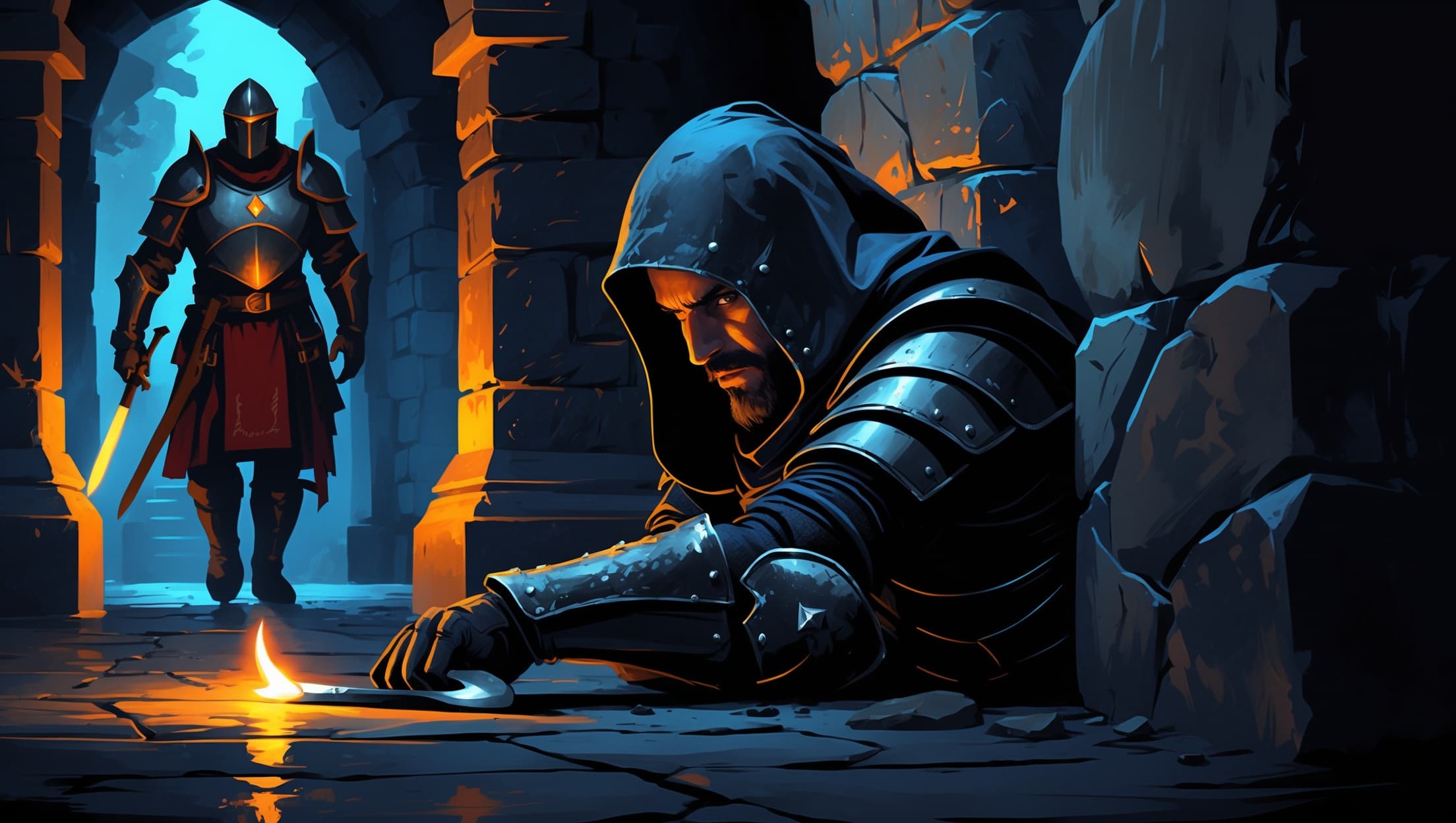
Hide Action 5e: The Rule Nobody at the Table Agrees On
A rogue slips behind a support pillar, whispers "I'm hiding," and rolls Stealth. What happens next depends entirely on which year of D&D the table thinks it's playing. Half the group remembers hiding as a contest against passive Perception that resets every round. The other half half-remembers something about an Invisible condition from the new books and isn't sure how it interacts with the wizard's actual Invisibility spell three seats over. Nobody's wrong, exactly. They're just running two different rulebooks at the same table.
That's the real story of the hide action 5e rules. It wasn't tweaked in the 2024 core books, it was rebuilt from the ground up, and the rebuild is good. It's also different enough from the 2014 version that most of the internet's rules explainers, and a lot of experienced GMs, are still describing a mechanic that doesn't exist anymore.
Hide Action 5e: What the 2024 Rules Actually Say
Here's the current version, stripped to the mechanics.
To attempt the Hide action, you need two things to be true before you roll anything: you must be Heavily Obscured, or behind Three-Quarters Cover or Total Cover, and you must be out of the line of sight of every enemy you're trying to hide from. Skip either condition and there's nothing to roll. A rogue crouching behind a waist-high crate that only grants Half Cover doesn't get to attempt the hide action 5e check at all, because Half Cover doesn't clear the bar.
If both conditions hold, you make a Dexterity (Stealth) check against a flat DC 15. That's new. The 2014 rules ran hiding as a contest, your Stealth roll against the searching creature's passive Perception, recalculated more or less on demand. The 2024 version decouples the two rolls entirely. You clear a fixed number to hide in the first place, and your result becomes something else: the DC anyone else has to beat to find you later.
DC 15 is fixed for the attempt itself. Nothing about a creature's Perception score changes whether you succeed at hiding. It only changes how hard you are to find afterward, and only if someone bothers to look.
That second part is where most tables lose the thread.
The Invisible Condition Is Doing Double Duty
Succeed on that Stealth check and you gain the Invisible condition. Not "hidden." Not "unseen." Invisible, the same named condition a wizard's Invisibility spell grants, with the same core package: attacks against you have disadvantage, your attacks have advantage, and you get advantage on an Initiative roll made while the condition is active.
This is a clean piece of design. The 2014 rules scattered "hidden," "unseen attacker," and "invisible" across three loosely connected sections that didn't always agree with each other. Folding them into one condition means a table only has to learn one set of combat math instead of three near-identical ones.
It's also exactly why tables keep arguing. A player hears "I'm Invisible" from the rogue who ducked behind a pillar and assumes it works like the spell, indefinitely, until someone deals with it. It doesn't. The condition from hiding ends the moment you attack or force a saving throw, full stop, same as it always did. A rogue who successfully hides and then stabs someone is visible again the instant that dagger connects, spell or no spell. The label is shared. The duration is not.
- To attempt: Heavily Obscured or 3/4+ Cover, out of every enemy's line of sight, then DC 15 Dexterity (Stealth).
- On success: gain the Invisible condition; your check total becomes the DC to find you.
- Condition ends: the instant you attack or force a saving throw.
- To find you: an enemy takes the Search action, Wisdom (Perception) vs. your banked DC.
How Someone Actually Finds You Now
Here's the part that trips up even tables that read the new rules carefully.
Finding a hidden creature isn't automatic and it isn't passive anymore. A guard doesn't just get to compare their passive Perception to your roll every round for free. Someone has to spend their turn taking the Search action, and only then do they roll Wisdom (Perception) against the DC you locked in when you hid. If nobody searches, you stay hidden, mechanically, even if that seems a little generous in the fiction.
This is a genuine departure, not a rules footnote. Under the old system, a sufficiently perceptive monster could passively notice a middling Stealth roll without doing anything. Under the current system, that monster has to actively look, and looking costs a turn it isn't spending attacking or moving. A lot of GMs, myself included the first several times I ran this, keep defaulting to "well, their passive Perception is 16, so they notice," because that reflex is years deep. It's also no longer how the rule works.
If you're running combat and a creature's passive Perception beats a hidden character's Stealth DC, that alone does nothing under the 2024 rules. The creature still has to spend its turn on the Search action to get a roll.
The Cover Requirement Is Stricter Than Most Tables Play It
This is the second consistent friction point, and it's less about the math and more about what counts as a valid hiding spot in the first place.
Three-Quarters Cover or Total Cover is a specific, defined threshold. It's not "there's a barrel nearby" or "I'm kind of in the shadows." A lot of tables, out of habit from looser 2014-era rulings, let players attempt to hide behind anything that sounds reasonable, a chair, a low wall, a friendly NPC standing in the way. The 2024 rules are stricter on purpose. If the obstruction only grants Half Cover, or if even one enemy still has a clean line of sight to you, the hide action 5e attempt doesn't happen. There's nothing to roll.
That's a real tightening, and it's worth a table conversation before it comes up mid-fight and derails a round. I'd rather a group agree on what counts as sufficient cover during session zero than argue about a crate's exact dimensions while initiative is ticking. Decide once, out of combat, what counts as Three-Quarters Cover on your maps, and the hide action 5e ruling stops being a live debate every time someone ducks behind furniture.
Why This Keeps Causing Arguments Mid-Session
None of the individual pieces here are hard. DC 15, Invisible condition, Search action, cover threshold. Four ideas, each explainable in a sentence. The problem is holding all four in your head at once, for every creature that's hiding, while also tracking initiative, HP, and whatever the party's actually doing in the fiction.
A GM running a fight with two hidden PCs and one hidden monster needs to remember three separate banked DC numbers, which condition applies to which creature, and whether any of them attacked yet this round and therefore lost it. That's before anyone at the table brings up "wait, doesn't the wizard's spell work differently?" It does. And now you're explaining two versions of the same word in the middle of combat.
Compare that to opportunity attacks, or flanking, or any of the other rules that quietly fall apart under table chaos. The hide action 5e problem is worse in one specific way: it's not just a trigger someone forgets to check. It's state that has to persist correctly across multiple rounds, tied to a number nobody wrote down.
Some groups solve this by writing the DC on an index card next to the initiative tracker. That works, right up until the card gets shuffled or someone forgets to update it after a second hide attempt. Low-tech fixes for a bookkeeping problem tend to fail the same way the bookkeeping did in the first place.
Where an AI Game Master Actually Helps With the Hide Action
This is precisely the kind of rule that benefits from something other than a person's memory holding the state. StoryRoll's AI Game Master handles the hide action 5e bookkeeping directly: it tracks each hidden creature's banked Stealth DC on its own, keeps the Invisible-from-hiding condition separate from an actual Invisibility spell even though they share a name, and knows the condition breaks the moment that creature attacks, without anyone at the table having to flag it out loud.
It also doesn't let a guard "just notice" a hidden rogue because the guard has a high passive Perception. If nothing in the scene calls for a Search action, nothing rolls against your Stealth DC. That distinction, active searching versus ambient awareness, is exactly the one most human-run tables blur under pressure. An AI Game Master doesn't get tired mid-session and default to the old rule out of habit.
None of that removes the tactical decision from the player. A rogue still has to find real cover, still has to break line of sight from every enemy, still loses the condition the moment they swing. What changes is that the bookkeeping behind those choices stays accurate for the whole fight, not just the round it happened in.
Frequently Asked Questions
What is the Hide action in D&D 5e?
The Hide action in D&D 5e lets a creature attempt to conceal itself from enemies. In the 2024 rules, you must be Heavily Obscured or behind Three-Quarters or Total Cover, and out of every enemy's line of sight, then succeed on a DC 15 Dexterity (Stealth) check.
What changed with the hide action in the 2024 D&D rules?
The 2024 rules replaced the old contested Stealth-versus-passive-Perception system with a fixed DC 15 check to attempt hiding, folded the result into the Invisible condition instead of a separate "unseen attacker" rule, and made finding a hidden creature require the Search action against your banked Stealth total.
How do you find a hidden creature in 5e now?
An observer takes the Search action and makes a Wisdom (Perception) check against the DC set by the hidden creature's original Stealth check. That fixed number, not a fresh contest, is what a searcher has to beat.
Is hiding the same as being invisible in D&D 5e?
They share the same condition name, Invisible, and the same core benefits: attacks against you have disadvantage, your attacks have advantage. But they don't end the same way. A creature that used the Hide action loses the condition the instant it attacks or forces a saving throw; a creature under an actual Invisibility spell keeps it until the spell ends.
Can you hide from a creature that can already see you?
No. You need to be out of the line of sight of every enemy you're trying to hide from before you can even attempt the Hide action. If one guard has a clear line on you, the Hide action fails against that guard regardless of your Stealth roll.
The hide action 5e rules didn't get patched in 2024, they got rebuilt: a fixed DC 15 to attempt, a stricter cover requirement, the Invisible condition standing in for three old scattered mechanics, and detection moved from passive Perception to an active Search action against a number you banked when you hid. Every piece is simple on its own. Keeping all four straight, for multiple hidden creatures, across several rounds of combat, is the part that breaks down at a real table. If your group keeps arguing about whether the rogue is "still hidden" three rounds later, that's not a rules-knowledge problem. It's a state-tracking problem, and it's worth having something other than memory handle it.
If 5e's cleaner-on-paper rules keep getting messy in practice, you're not alone. Opportunity attacks, flanking, and passive perception all have the same pattern: simple rule, constant slippage once a real fight is underway. If you're building a character around this rule specifically, the thief rogue build guide and the full rundown of D&D 5e conditions are the natural next stops.
Written by StoryRoll
Founder of StoryRoll. Building AI-powered tabletop RPGs.
Related Posts
Prone in D&D 5e: Why 'Melee vs. Ranged' Isn't the Actual Rule
The prone condition in D&D 5e isn't a melee-vs-ranged rule. It's a distance rule, and the difference changes how reach weapons and close-range shots actually resolve.
Diagonal Movement 5e: The Grid Rule Almost Nobody Agrees On
Diagonal movement 5e has two official answers, and most tables are quietly using the wrong one for their own map. Here is what the rules actually say.
Surprise Round 5e: Why It Isn't a Real D&D 5e Rule
There's no such thing as a surprise round in D&D 5e. The surprised condition restricts one creature's own turn, and the 2024 rules changed what that restriction actually does.