How to Make D&D Combat More Interesting: It's Not the System's Fault
Round 3. The goblin has 4 hit points left. The fighter says "I attack." The DM says "roll." The fighter rolls a 17. "That hits. Roll damage." Eight damage. "It dies." Next.
This is what most D&D combat sounds like. And it's the reason half the table pulls out their phone during initiative.
The weird part? The combat system isn't the problem. Fifth Edition's action economy is perfectly fine for creating tense, memorable fights. The problem is that most of us - DMs and players both - strip all the interesting parts out and run combat like it's a spreadsheet with turn order.
Every table I've played at has at least one fight story that people retell for years. The time the barbarian tackled the necromancer off a cliff. The time the bard convinced the dragon's minions to switch sides mid-fight. Those moments didn't come from the system being different. They came from someone at the table treating combat like storytelling instead of arithmetic.
Here's what actually makes that happen.
The Environment Is a Weapon You're Not Using
Flat, featureless rooms are combat killers. A 30x30 room with nothing in it reduces every turn to "I move here. I attack." There's nothing to interact with, nothing to use, nothing to care about.
Now put the fight on a rope bridge over a river of lava. Suddenly:
- The paladin has to choose between charging the ogre and staying near the ropes keeping the bridge stable
- The rogue can cut a rope to tilt the bridge and send enemies sliding
- The wizard's fireball has consequences beyond damage math
- Everyone has a reason to care about positioning
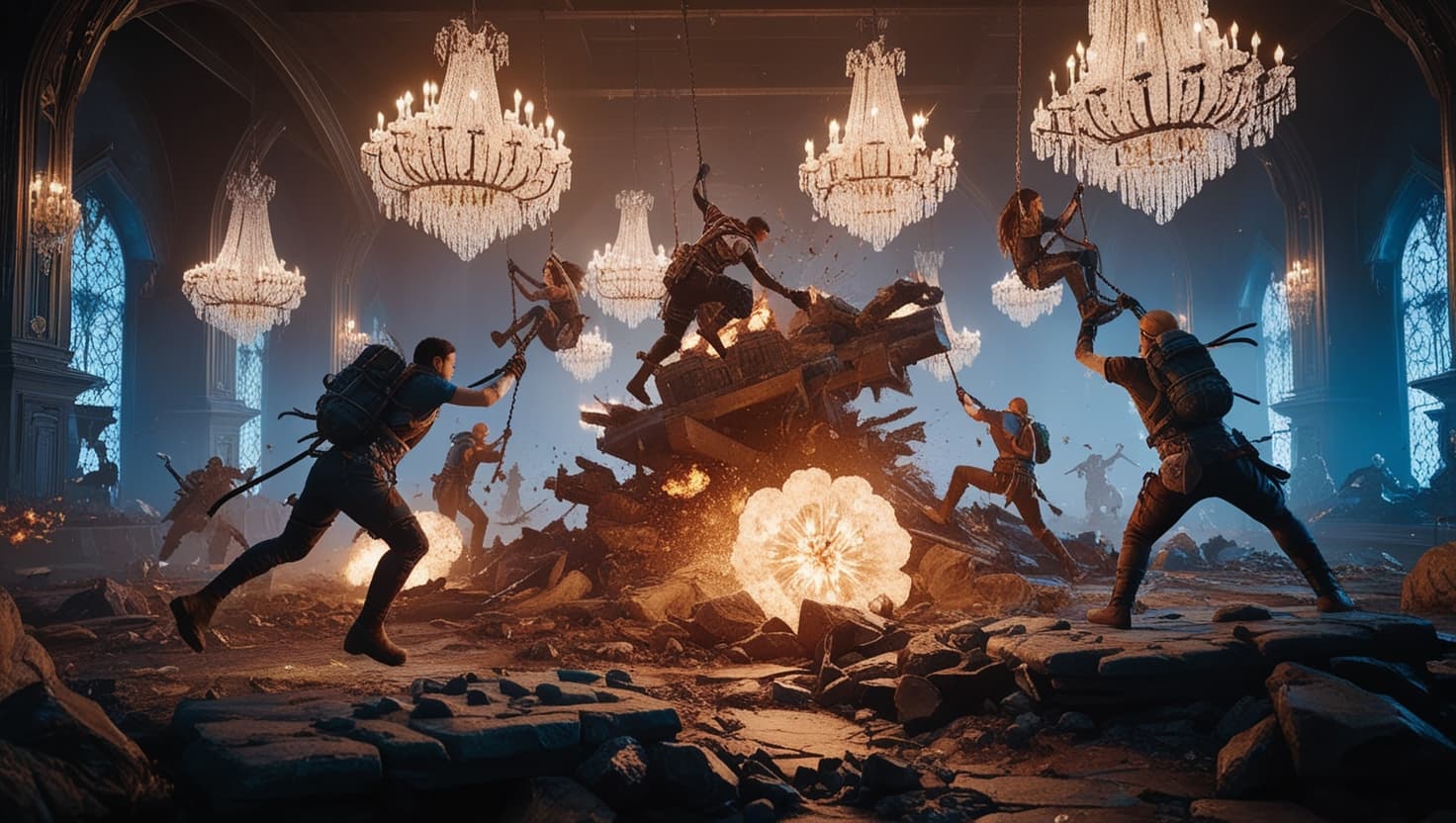
You don't need lava. A tavern fight with tables to flip, bottles to throw, and a chandelier to swing from does the same thing. A forest ambush with thick undergrowth, climbable trees, and a stream creates choices. A dungeon corridor with a trapped floor tile that both sides know about turns movement into a puzzle.
The rule: if you can describe the combat location in one sentence and it doesn't change how anyone would fight, the location isn't contributing.
Before your next combat encounter, write down three things in the environment that players could interact with. Not traps you've designed - just objects. A well. A pile of crates. A frozen pond. Then wait for the players to surprise you.
Monsters That Want Things
The default monster behavior in D&D is "attack the nearest player until dead." This is boring, and it also doesn't make any sense.
Animals fight for food and flee when injured. Bandits fight for money and surrender when outmatched. Cultists fight for a goal - maybe they're stalling while the ritual completes. A dragon doesn't want to kill four adventurers. It wants its hoard protected and its ego unbruised.
When monsters have motivations, combat gets unpredictable:
- Wolves circle, isolate the weakest-looking target, and bolt if two of the pack go down. The fight isn't "kill all wolves." It's "protect the wounded cleric long enough for the pack to lose interest."
- A bandit captain wants captives, not corpses. She targets the healer with a net. Her archers shoot to pin down, not to kill. The stakes shift from "don't die" to "don't get captured."
- A troll fixates on whoever hurt it last. It's not tactical - it's angry. Players can exploit that. Bait it into a bad position. The fighter hits it to draw aggro while the rogue flanks.
- An intelligent villain retreats at half health. They'll be back with more allies and better information. The fight has consequences beyond this round.
If every monster just hits the nearest PC and fights to the death, your players will eventually stop caring about tactics. Why bother being clever when the enemy isn't?
Make Rounds Matter Beyond Damage
Here's a test for your combat encounters: if you removed all the narration and just tracked hit point totals, would the fight feel any different?
If the answer is yes, your combat is fine. If the answer is no, you're running a math problem.
Rounds should change things. Each round, something in the fight should be different from the last:
- The building is on fire and the flames spread each round
- Reinforcements are arriving in 3 rounds and the party knows it
- The hostage is being dragged toward a portal that closes in 5 rounds
- The floor is crumbling - one tile falls away each round
- The enemy wizard is casting a ritual that completes in 4 rounds unless someone breaks her concentration
Time pressure turns combat from "we'll get there eventually" into "we have to do this NOW." The difference between "kill the bandits" and "kill the bandits before they light the signal fire" is everything.
Even without a countdown, escalation works. The second phase starts when the boss hits half health and the room changes. New enemies emerge from the shadows. The terrain shifts. Whatever was working in round 1 stops working in round 4.
Narrate Like You Mean It
"You hit. 8 damage."
Versus:
"Your sword catches the hobgoblin across the shoulder, and it staggers back into the brazier behind it, scattering embers across the stone floor. It snarls something in Goblin - probably not a compliment."
Same mechanical outcome. Wildly different experience.
You don't need to narrate every attack like it's a movie trailer. But the completely dry "you hit, take damage" approach is the fastest way to make combat feel like a chore. Find a middle ground:
- On a hit: one sentence describing where the blow lands and how the enemy reacts
- On a miss: one sentence describing why it missed - the enemy dodged, the armor deflected, the footing was bad
- On a critical hit: go big. Two sentences. Something breaks. Something changes.
- On a kill: make it memorable. This is the payoff for the fight.
And this isn't just DM work. Players should narrate too. "I attack the goblin" is functional. "I drive my shield into the goblin's spear to knock it aside and follow with a downward slash" is the same action, same roll, but it turns the player from a dice-roller into a storyteller.
The "Why Are We Fighting?" Problem
Some fights don't need to exist.
Random encounters with no narrative purpose, combats that are clearly unloseable, fights that exist because "the party hasn't rolled initiative in a while" - these are filler. And players can feel it.
Before building an encounter, answer one question: what happens if the party loses this fight?
If the answer is "nothing meaningful," the fight probably shouldn't be there. Or it should be restructured so something IS at stake.
Stakes don't have to be death. They can be:
- Resource drain. The fight is winnable, but it costs spell slots, hit points, and potions that the party needs for what's ahead. Skill challenges can serve this purpose too - draining resources through non-combat tension.
- Information. The enemies know something. If they all die, that intel dies with them.
- Reputation. The town is watching. How the party handles this fight changes how NPCs treat them.
- Time. While the party fights these guards, the villain gets further ahead.
- Moral cost. These enemies aren't evil. They're desperate, or misguided, or following orders from someone the party respects. Winning the fight means doing something uncomfortable.
When fights have stakes beyond "the monsters die or we die," players engage differently. They negotiate. They take prisoners. They try creative solutions. Combat becomes a story beat instead of a pause in the story.
Speed Kills (Boredom)
Long combat is boring combat. Not always, but usually.
A fight that takes 90 minutes in real time had better be a climactic boss battle. If it's four ghouls in a hallway, something went wrong.
Practical speed fixes:
- Soft turn timer. Not a hard rule, but a table norm: if your turn takes more than 30 seconds, you're overthinking. Start thinking about your move during other players' turns.
- Preroll damage. When a player declares an attack, they roll the d20 and the damage die at the same time. Saves 5-10 seconds per roll. Over a whole combat, that's minutes.
- Group monster initiative. All the goblins go on one initiative count. Cuts DM turns in half.
- Minions. Some enemies have 1 hit point. Any hit kills them. Players feel powerful mowing through them, and the DM doesn't track twenty different HP pools.
- Cut losing fights short. If the combat is clearly decided but still has 3 rounds of cleanup hits left, narrate the ending. "You finish off the remaining bandits without much trouble. One tries to run; the ranger drops him with an arrow. What do you do with the bodies?"
The goal is density, not duration. A 15-minute fight where every round matters is better than a 45-minute fight where the outcome was obvious after round 2.
Matt Colville's "Action Oriented Monsters" concept is worth looking up if you run a lot of boss fights. It gives solo monsters bonus actions that trigger on specific initiative counts, solving the "one monster vs. five players means the monster gets wrecked in two rounds" problem without inflating HP pools.
Let Combat Change the Story
The worst thing about forgettable combat is the reset. The fight ends, everyone heals up, and nothing is different. The fiction doesn't acknowledge that violence just happened.
Good combat leaves marks:
- The wizard's spell set a section of the library on fire. Those books are gone. That information is lost.
- The barbarian killed the guard captain. His soldiers saw it happen. The city is now hostile.
- The rogue took a critical hit from the assassin's poisoned blade. She's poisoned - disadvantaged on attacks and ability checks - and the antidote isn't going to be cheap.
- The paladin broke her oath by attacking the surrendering prisoner. Her powers flicker. Something fundamental changed.
When combat has consequences that extend beyond the initiative tracker, players start treating fights as serious decisions rather than speed bumps between story scenes. And if your non-combat encounters feel flat by comparison, it might be a design issue - read why D&D puzzles fail for the common traps GMs fall into when building non-combat challenges.
Practice Encounters Without Prep
One reason combat gets stale is that DMs fall into patterns. Same terrain, same monster tactics, same encounter structure. You build what you've built before because prep time is limited and experiments might fail.
This is where AI dungeon masters are a useful tool. Try throwing a wild magic sorcerer into your next encounter for instant unpredictability - every spell has a chance to reshape the battlefield in ways nobody planned for. StoryRoll lets you throw yourself into combat encounters that adapt in real time - the AI describes dynamic terrain, runs monsters with actual tactics, and tracks consequences of your choices without you having to build any of it.
For DMs, it's a sandbox for testing encounter ideas. What happens if I give the bandits a hostage? How does a running fight through a collapsing mine play out? You can try ten concepts in an hour and bring the best ones to your table.
For players, solo combat in StoryRoll is practice for tactical thinking, creative problem-solving, and the kind of combat narration that makes fights feel alive. You don't get better at interesting combat by reading about it. You get better by doing it.
Boring D&D combat isn't a system problem. It's a design problem.
Give your fights terrain that matters. Give your monsters brains. Give your rounds a ticking clock. Give your narration some texture. And give the outcome consequences that the party has to live with.
The system already supports all of this. It's waiting for someone at the table to stop treating initiative like a spreadsheet and start treating it like the most dangerous scene in the story.
Want to improve the other side of the DM screen? Read How to Be a Better D&D Player. Running your first short adventure? Check out How to Run a One-Shot. Or jump into a combat encounter right now with StoryRoll's AI Game Master →
Free tools: Encounter Difficulty Calculator · Initiative Tracker
Related guides: How to Be a Better GM · Creating Memorable NPCs · Character Backstory Guide
Written by Anthony Goodman
Founder of StoryRoll. Building AI-powered tabletop RPGs.
Related Posts
D&D 5e Conditions Explained: A Complete Guide
Every D&D 5e condition explained in plain language - what they do mechanically, how they interact, and practical tips for Game Masters who want to use them well.
D&D Encounter Building Tips for New GMs: From Boring Fights to Memorable Moments
A practical guide to building D&D encounters that actually challenge and excite your players. Covers action economy, terrain, pacing, enemy variety, and using encounter calculators - written for GMs who are tired of one-sided stomps and lifeless combats.
How to Run Combat in D&D 5e: The Complete Guide for Game Masters
Running combat in D&D 5e doesn't have to be slow or confusing. This guide walks you through initiative, action economy, movement, conditions, and practical tips to keep fights fast, fair, and memorable.