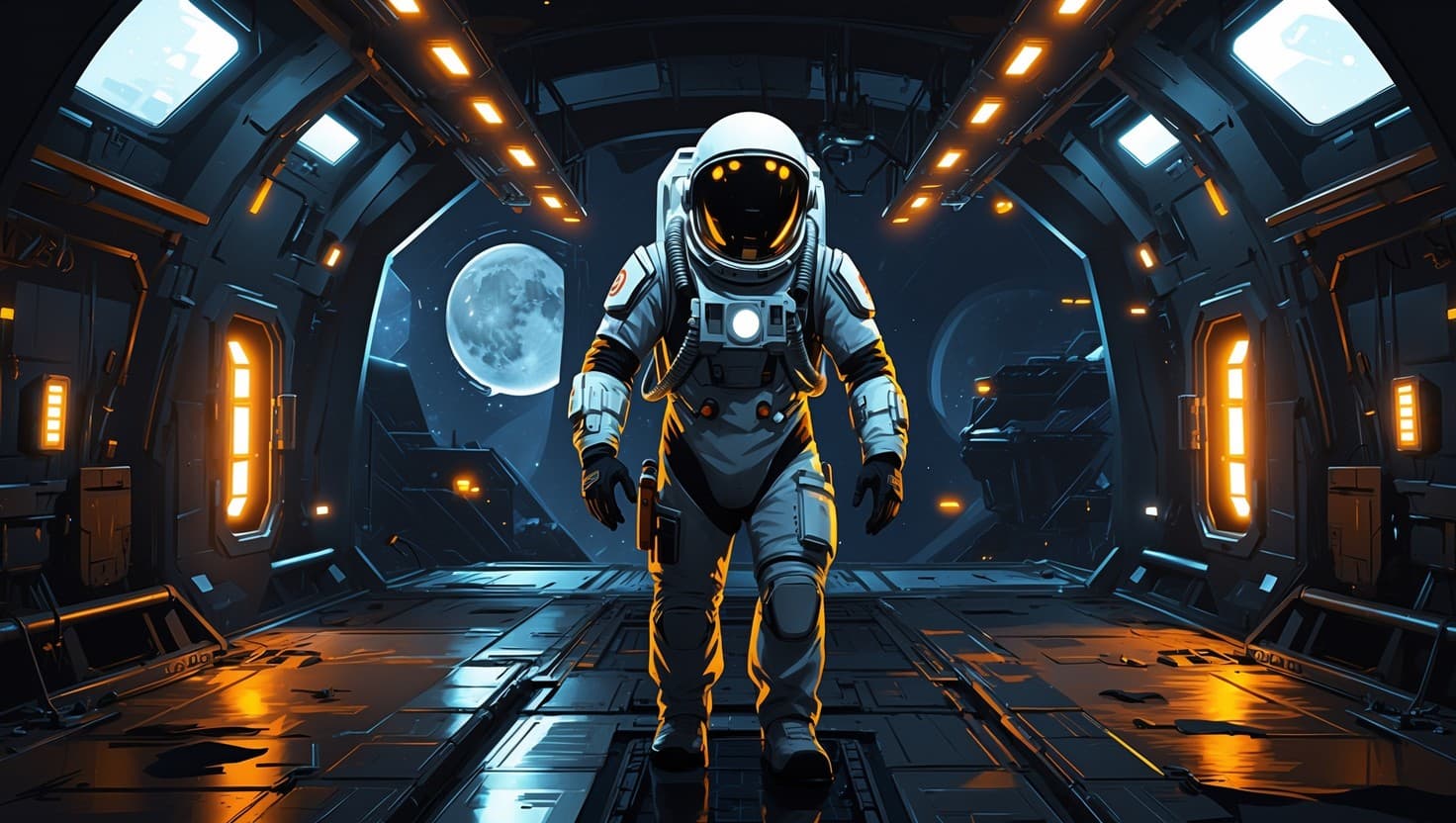
How to Play a Sci-Fi Campaign With an AI Game Master (No Group Needed)
Every AI roleplay platform lists sci-fi as a genre. Almost none of them explain how to actually play one.
Open the genre picker on most AI RPG tools and the genre sits there next to fantasy and horror, one option among many, usually just fantasy's spells and swords swapped for blasters and starships. That's not a real campaign. That's a reskin. Here's how to run the actual thing: a Mission with its own stakes, its own terminology, and a Ship AI that behaves like a genuine sci-fi narrator instead of a wizard in a spacesuit.
Why Sci-Fi Needs Its Own Session Zero
Fantasy and sci-fi campaigns ask players to care about different things. A fantasy party wants to know the deity, the region, the local threat. This kind of crew wants to know the ship, the chain of command, and how far help is if something goes wrong.
StoryRoll's Sci-Fi mode reflects that with its own vocabulary instead of borrowing D&D's: your campaign is a Mission, your character is a Crew Member, the person who organized the group is the Captain, and the narrator role is the Ship AI - not a Game Master in a different costume, but a distinct narrative voice that frames everything through the ship's systems and priorities. Sessions are Mission Logs, quests are Objectives, NPCs are Contacts, and locations are Sectors.
That's not cosmetic. When the AI narrates in terms of the Ship AI reporting sensor readings or the Captain issuing an Objective, the fiction holds together in a way that "your wizard casts Fireball in space" never quite does.
When you set up your Mission, tell the AI what your ship actually is - a scavenged freighter held together with debt and optimism plays very differently from a military cruiser with an actual chain of command. That single detail shapes every Contact and Objective that follows.
Pick Your Sub-Genre Before You Pick Your Plot
It's a wide genre, and StoryRoll's Sci-Fi mode supports five distinct tones. Picking one before character creation saves you from a table where half the crew wants Star Wars and the other half wants The Expanse.
Space Opera: Big factions, bigger stakes, a Star Wars-adjacent feel. The easiest entry point if your group has never played the genre before - everyone already understands the shape of this story.
Hard Sci-Fi: Technology and physics matter, consequences are grounded, and clever engineering solves as many problems as force does. Best for players who want the details to hold up.
Cyberpunk: Corporate intrigue, morally grey choices, a world run by people who own more than they should. Great for social-pillar-heavy crews.
Comedic: Sci-fi tropes played for laughs - the ship's coffee maker is sentient and resentful, the away mission always goes slightly wrong.
Horror: Isolation, dwindling resources, something on the ship that shouldn't be there. Works best with a smaller crew and a Captain willing to let tension build.
None of these are locked in forever, but naming one before your first Mission Log gives the AI a consistent register to narrate in from scene one.
Solo or Crew: Both Work
This mode doesn't require a full crew to feel complete. A single Crew Member on an investigation, survival, or first-contact Mission carries the same weight solo that a solo D&D character carries in a dungeon - our guide to playing D&D alone covers the broader solo-play case, and most of the same logic applies here with a Ship AI standing in for the Game Master role.
Solo play here tends to lean into isolation naturally - a lone Crew Member investigating a distress signal, or the last surviving officer on a damaged ship, is a genre staple rather than a workaround. If you want a crew, StoryRoll handles multiplayer Missions the same way it handles a D&D party: everyone creates a Crew Member, and the Ship AI tracks all of their Objectives and Contacts across sessions.
Setting Up Your First Mission
- Pick your sub-genre. Space opera if you're new to sci-fi as a group; hard sci-fi, cyberpunk, comedic, or horror if you already know what you want.
- Define your ship (or lack of one). A dedicated vessel, a borrowed shuttle, or no ship at all if your Mission is station-bound - all valid starting points.
- Create your Crew Member. Character creation here is narrative, not stat-heavy: describe who they are and what they want, the same way you would for a Fairy Tale mode hero, and the AI builds the rest.
- Run a short Session Zero. Tell the Ship AI your tone, your ship's situation, and anything you want to avoid. This is the same discipline as any session zero, just aimed at Sectors and Contacts instead of taverns and NPCs.
- Start your first Mission Log. The AI opens the scene - a distress call, a Captain's briefing, a ship waking up from cryo-sleep with something wrong. React from there.
Mission Hooks That Actually Work
Some starting scenarios lean into what the Ship AI narrator does well:
- A distress signal from a Sector that shouldn't have anyone left in it.
- The Captain reassigns your Objective mid-Mission, and the new orders don't add up.
- Your ship's Ship AI starts reporting sensor readings that contradict what your Crew Member is seeing with their own eyes.
- A Contact offers information in exchange for something your crew hasn't decided whether to give up.
- First contact with a Contact whose motives are genuinely unclear, not villain-coded from the first line.
Cyberpunk and horror tones both benefit from a smaller crew - two or three Crew Members rather than a full party. Space opera and comedic tones scale better to larger groups, where more voices means more factions to bounce off of.
Picture a First Mission
Here's roughly how an opening scene tends to play out in hard sci-fi mode.
Your Crew Member is an engineer on a scavenged freighter, three days out from the nearest station, when the Ship AI reports a hull breach in an unused cargo Sector. You decide to suit up and investigate rather than seal the Sector and move on. The AI narrates the walk through the dark corridor, the readouts on your suit, the moment your light catches something that definitely wasn't on the manifest.
Whatever you decide next - report it to the Captain immediately, investigate further alone, or quietly pocket whatever it is - becomes the Objective that drives the rest of the Mission. Nothing about that scene required a rulebook. It required a situation and a decision, which is the same shape every good tabletop scene takes.
Common Mistakes When Starting a Sci-Fi Campaign
Treating it as fantasy with a coat of paint. If your Sector descriptions could be swapped for a fantasy location with a find-and-replace, the Ship AI isn't being used the way the mode is built for. Lean into the terminology - Objectives, Contacts, Sectors - and let it shape how you think about the story, not just what you call things.
Skipping the sub-genre decision. A crew that never agreed whether this is space opera or hard sci-fi ends up arguing about tone mid-Mission instead of enjoying the story.
Ignoring your Ship AI as a character. The vessel itself - its quirks, its damage history, its personality if you give it one - is one of the best worldbuilding tools sci-fi offers that fantasy doesn't have an equivalent for. Use it.
Assuming you need a full crew to start. A solo Crew Member on an investigation Mission is a complete campaign, not a placeholder until you find more players.
This genre works as an AI Game Master category exactly to the degree the platform commits to it as its own thing: its own terminology, its own tone options, a Ship AI that narrates like a real sci-fi story instead of fantasy with lasers. Pick a sub-genre before your first Mission Log, define your ship, and let the Objectives and Contacts pile up from there. Solo or with a full crew, the same structure holds.
Start a Mission on StoryRoll and find out what your Ship AI has been picking up on sensors.
Try These Free Tools
Useful for any Mission:
- Dice Roller - Roll for skill checks and combat outcomes right in the browser.
- Initiative Tracker - Keep a firefight organized when more than one Crew Member is in the scene.
- Skill Check Reference - A quick lookup for what to roll when the Ship AI calls for a check.
Frequently Asked Questions
Can an AI Game Master run a real sci-fi campaign, not just fantasy with lasers?
Yes, if the platform builds sci-fi as its own mode rather than a reskin. StoryRoll's Sci-Fi mode uses its own terminology (Mission, Crew Member, Ship AI, Sector) and its own tone options, so a space station standoff plays differently than a dungeon fight, not just a fantasy encounter with different nouns.
What sci-fi sub-genre should I pick for my first campaign?
Space opera is the easiest starting point: big stakes, factions, and a Star Wars-adjacent feel that most players already understand intuitively. Hard sci-fi rewards players who want technology and physics to matter. Cyberpunk suits morally grey, corporate-intrigue stories. Pick based on what you actually want to watch happen, not which sounds most impressive.
Can I play a sci-fi campaign solo?
Yes. A single Crew Member works well solo, especially in an investigation or survival-focused Mission where you are reacting to the ship and the situation rather than coordinating a party. Solo sci-fi plays a lot like solo D&D, just with different pressure sources.
Do I need to know real science to play hard sci-fi?
No. You need to know what your character cares about. The AI Game Master supplies the technical detail and keeps it consistent; your job is deciding what your Crew Member does with the information, not fact-checking orbital mechanics.
How is Sci-Fi mode different from just running D&D with space flavor?
Terminology and structure both change. Ability scores and spell slots disappear in favor of narrative character creation. Missions replace campaigns, Sectors replace locations, and Ship AI replaces the narrator role. It is built as its own genre, not D&D wearing a helmet.
Related Reading
Written by StoryRoll
Founder of StoryRoll. Building AI-powered tabletop RPGs.
Related Posts
Sci-Fi One-Shot Ideas: 10 Missions You Can Run Tonight
10 sci-fi one-shot ideas that don't need a homebrew rulebook or a hundred hours of world-building. Premises, crew sizes, and tips for running each one.
Sci-Fi RPG Character Archetypes: Build a Crew Without a Rulebook
Sci-fi character archetypes explained: the roles that actually carry a crew, and how to build one narratively without learning a homebrew rulebook first.
How to Run a Dark Anime Campaign (Without It Turning Into Either Shonen or Shock Value)
A dark anime campaign fails in one of two directions: it plays it safe and becomes shonen with a black coat of paint, or it chases shock value and burns out in three sessions. Here's the middle path.