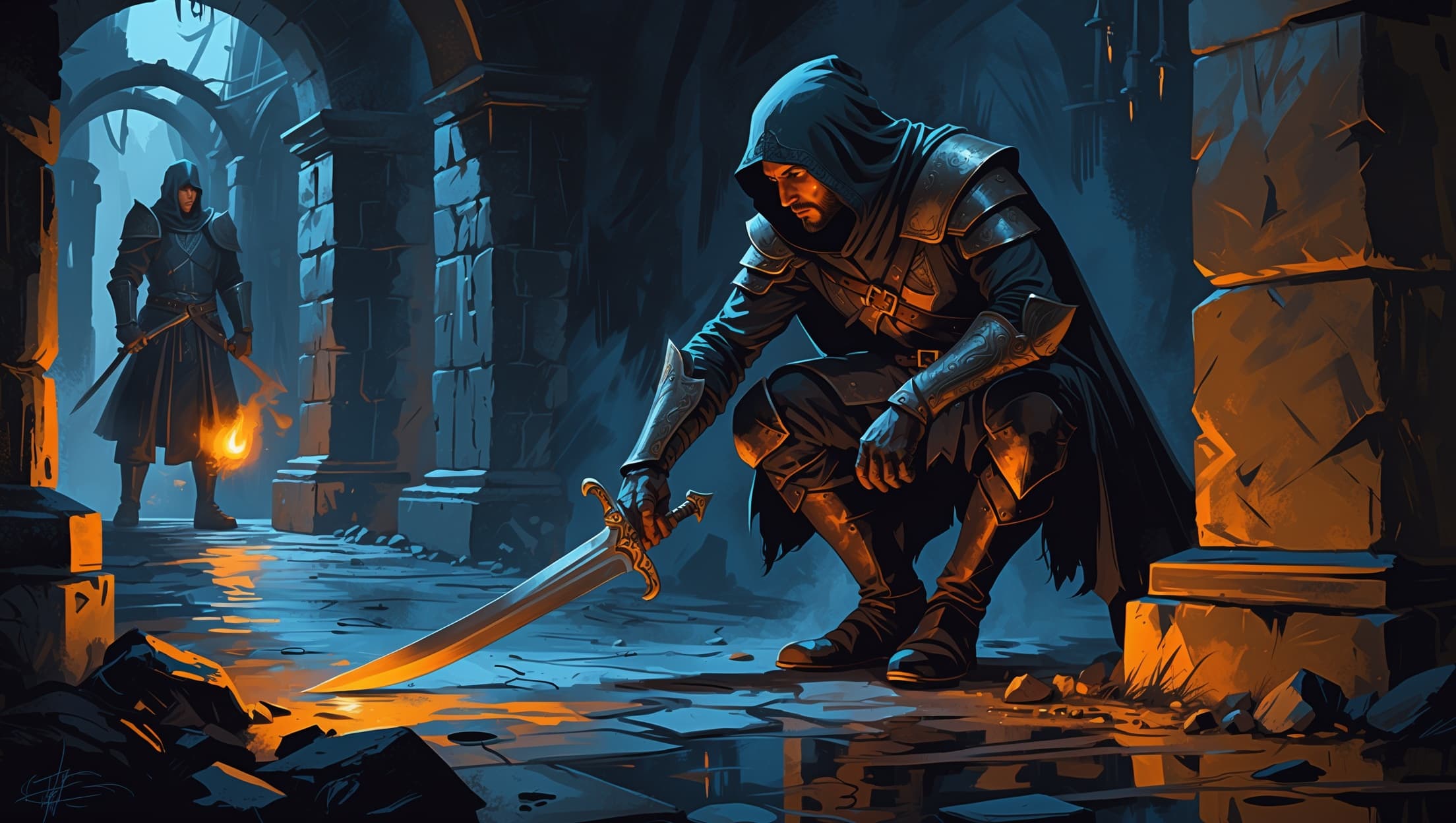
Sneak Attack 5e: The Rule Rogues Keep Misplaying
Sneak Attack 5e is four sentences in the Player's Handbook and one of the most consistently misapplied features in the game. It isn't a complicated rule. It's a rule with three separate conditions bundled into one paragraph, and tables tend to remember one of them, half-remember a second, and quietly invent a third that isn't actually written down anywhere.
The result is a Rogue player who either shorts themselves damage they earned, or a table that hands out Sneak Attack 5e in situations where the rule never actually applies. Neither is a house rule anyone agreed to. It's just what happens when a feature's trigger has more moving parts than its reputation suggests.
Sneak Attack 5e: The Actual Trigger
Here's the whole rule, broken into its real parts.
You can add Sneak Attack 5e damage once per turn when you hit a creature with an attack using a finesse weapon or a ranged weapon, and one of two conditions is also true: you have advantage on that attack roll, or another enemy of the target is within 5 feet of the target, that enemy isn't incapacitated, and you don't have disadvantage on your own attack roll.
That's the entire trigger. Weapon type first, then one of two ways to earn the extra damage. Miss either the weapon requirement or both damage conditions, and Sneak Attack 5e simply doesn't apply, no matter how sneaky the attack felt in the fiction.
The two conditions are an "or," not an "and." A Rogue standing next to an ally-flanked enemy doesn't also need advantage. A Rogue attacking alone from hiding doesn't also need a nearby ally. Either one, on its own, is enough.
The Weapon Requirement Everyone Forgets First
Before advantage or allies ever enter the conversation, the attack has to use a finesse weapon or a ranged weapon. Rapiers, shortswords, daggers, hand crossbows, and shortbows all qualify. A greatsword doesn't, and neither does a warhammer or a maul, even in the hands of a Rogue with every other condition met.
This trips up multiclass builds more than anything else. A Rogue who dips into Fighter or Barbarian for a heavier weapon option sometimes forgets that switching to a strength-based weapon quietly turns off Sneak Attack 5e entirely, no matter how much advantage or ally support is sitting on the table.
What "Once Per Turn" Actually Means
This is the phrase that causes the most confusion, and it comes from a single word swap: turn, not round.
A round in 5e combat includes every creature's turn in the initiative order. A turn is just one creature's slice of that round. Sneak Attack 5e's limit is tied to the turn, which means a Rogue's own attack action on their turn is one opportunity to apply it, and a reaction they take on someone else's turn, like an opportunity attack, is a separate opportunity, because it happens during a different creature's turn.
In practice, that means a Rogue can genuinely add Sneak Attack 5e twice within the same round: once on their own turn, and again later that round when an enemy provokes an opportunity attack. Both are legal. Neither breaks the once-per-turn rule, because they're two different turns.
- Weapon requirement: finesse or ranged weapon, no exceptions.
- Damage condition: advantage on the attack roll, OR an unincapacitated ally within 5 feet of the target and no disadvantage on your own roll.
- Frequency: once per turn, which is not the same as once per round.
- Reactions count separately: an opportunity attack on someone else's turn is a new turn for this purpose.
Six Ways Sneak Attack 5e Gets Misplayed
Most of the confusion clusters around a handful of repeat offenders.
Treating "once per turn" as "once per round." Covered above, and still the single most common mistake. A Rogue who assumes they're capped at one use per round is leaving real damage on the table every time an opportunity attack comes up.
Assuming a surprise round automatically grants Sneak Attack. Surprise stops a surprised creature from acting on its first turn. That's all it does by itself. It doesn't hand the attacker advantage. Advantage usually shows up in a surprise scenario because the attacker was hidden beforehand, and hiding does grant advantage, but the surprise and the advantage are two separate rules that happen to often travel together. A Rogue who steps out from cover in plain sight, with no ally nearby, doesn't get Sneak Attack 5e on a surprised target just because the target was surprised.
Stacking Sneak Attack 5e across multiple attacks in one turn. A Rogue who picks up Extra Attack through multiclassing, or gets an extra swing from some other source, still only adds Sneak Attack damage once that turn. Two qualifying hits don't mean two applications of the bonus.
Using it with the wrong weapon. Already covered, and still worth repeating because it's an easy detail to lose track of mid-build. Sneak Attack 5e is finesse-or-ranged only.
Forgetting the ally can't be incapacitated. The ally-adjacent condition specifically requires that the other enemy near your target isn't incapacitated. A Paralyzed or Unconscious ally standing next to the target doesn't satisfy the condition, even though they're technically within 5 feet.
Ignoring your own disadvantage. Even under the ally-adjacent path, if the Rogue has disadvantage on their own attack roll from any other source, poor lighting, a prone target's ranged penalty, whatever the cause, Sneak Attack 5e doesn't apply. Advantage isn't required for this path, but disadvantage still blocks it outright.
The ally-adjacent condition and the advantage condition are checked independently. Having disadvantage cancels the ally-adjacent path even if you'd otherwise qualify, and it also usually means you don't have advantage either, since advantage and disadvantage typically cancel each other out on the same roll.
Why This Rule Specifically Trips Tables Up
Other combat rules that get misplayed at the table, like opportunity attacks or flanking, tend to fail because someone forgets to check the trigger in the middle of a busy round. Sneak Attack 5e fails differently. The Rogue player almost always remembers to ask for it. What goes wrong is that the actual conditions get misremembered, simplified into something shorter and less accurate, and that simplified version becomes the house understanding of the rule without anyone deciding to change it.
"Sneak Attack works if I'm sneaky" is the informal version most tables run on. It's close enough to work most of the time, which is exactly what makes it dangerous. It quietly breaks down on the exact situations that actually matter: the surprise round that doesn't come with advantage, the multiclass turn with two attacks, the ally who's technically adjacent but paralyzed. None of those are edge cases invented for this article. They're the normal texture of a mid-level campaign with a multiclassed party and a Game Master calling for surprise checks regularly.
Where an AI Game Master Actually Helps
This is exactly the kind of feature StoryRoll is built to apply consistently, because it's a rules-literacy problem more than an attention problem. The system knows whether the weapon in hand is finesse or ranged, whether the attack roll actually has advantage and from what source, whether another enemy is within 5 feet of the target and whether that enemy is incapacitated, and whether Sneak Attack 5e has already been used on this specific turn versus an earlier one in the same round.
That doesn't take the decision away from the player. A Rogue still chooses when to attack, when to hide first, when to press an opportunity attack instead of holding back. What changes is that the extra damage gets applied exactly when the rule says it should, not based on a simplified version of the trigger that's been drifting slightly further from the actual text since session one.
If your Rogue has ever been told "no Sneak Attack, you already used it this round" when they hadn't, or granted it on a surprised target with no advantage and no ally in sight, that's not a table being unfair. That's the same gap that shows up whenever a feature has more conditions than anyone can hold in their head mid-fight.
Sneak Attack 5e comes down to three checks: the right weapon, either advantage or an unincapacitated ally within 5 feet, and a hard cap of once per turn, not once per round. The rule rewards Rogues who understand it precisely, because the imprecise version most tables actually play by tends to shortchange them on exactly the turns that matter most, a busy round with a reaction attack, a surprise round with no real advantage, a multiclass turn with an extra swing. Learn the real trigger once, and every one of those situations resolves itself correctly.
Play a Rogue on StoryRoll and let the AI Game Master track when Sneak Attack 5e actually applies.
Frequently Asked Questions
What triggers Sneak Attack in D&D 5e?
You need to hit with a finesse or ranged weapon, and either have advantage on the attack roll or have another enemy of the target within 5 feet of it, as long as that ally isn't incapacitated and you don't have disadvantage on the attack. Meet either condition and the extra damage applies, once per turn.
Is Sneak Attack once per turn or once per round?
Once per turn, not once per round, and the difference matters. A reaction you take on someone else's turn counts as a use during that turn, not your own. That means a Rogue can add Sneak Attack once on their own turn and again on an opportunity attack taken during an enemy's turn, since those are two separate turns even though they land in the same round.
Does Sneak Attack automatically trigger during a surprise round?
No. Surprise only stops the surprised creature from taking an action, bonus action, or reaction on its first turn. It doesn't grant advantage by itself. You still need advantage on the attack roll, usually from being hidden, or the ally-adjacent condition. Surprise and hidden-attacker advantage line up often, but they are two different rules doing two different jobs.
Can I use Sneak Attack with any weapon?
No. Sneak Attack only works with a finesse weapon or a ranged weapon. A Rogue swinging a greatsword or a warhammer never adds Sneak Attack damage, no matter how much advantage they have on the roll.
Does Sneak Attack stack with Extra Attack?
No. Sneak Attack's extra damage is capped at once per turn regardless of how many qualifying attacks land that turn. This comes up most with multiclass Rogues who pick up Extra Attack from a second class. Two qualifying hits on the same turn still only add Sneak Attack damage once.
What does "ally-adjacent" mean for Sneak Attack?
It means another enemy of your target is within 5 feet of that target when you attack. That ally can't be incapacitated, and you can't have disadvantage on your own attack roll. Meeting this condition lets you add Sneak Attack without needing advantage at all.
Related Reading
Written by StoryRoll
Founder of StoryRoll. Building AI-powered tabletop RPGs.
Related Posts
Falling Damage 5e: The Cap Everyone Forgets
Falling damage 5e is 1d6 per 10 feet, capped at 20d6. Most tables remember the first half and forget the cap, the timing, and the prone landing.
Critical Hits in D&D 5e: The Rule Everyone Misremembers
A critical hit in D&D 5e doubles your damage dice, not your damage. Here's the rule most tables misremember, and what actually doubles on a crit.
Mounted Combat 5e: The Half-Page Rule Everyone Misplays
Mounted combat 5e fits on half a page, and most tables still get it backward: warhorses can't trample, and falling off is a real risk.