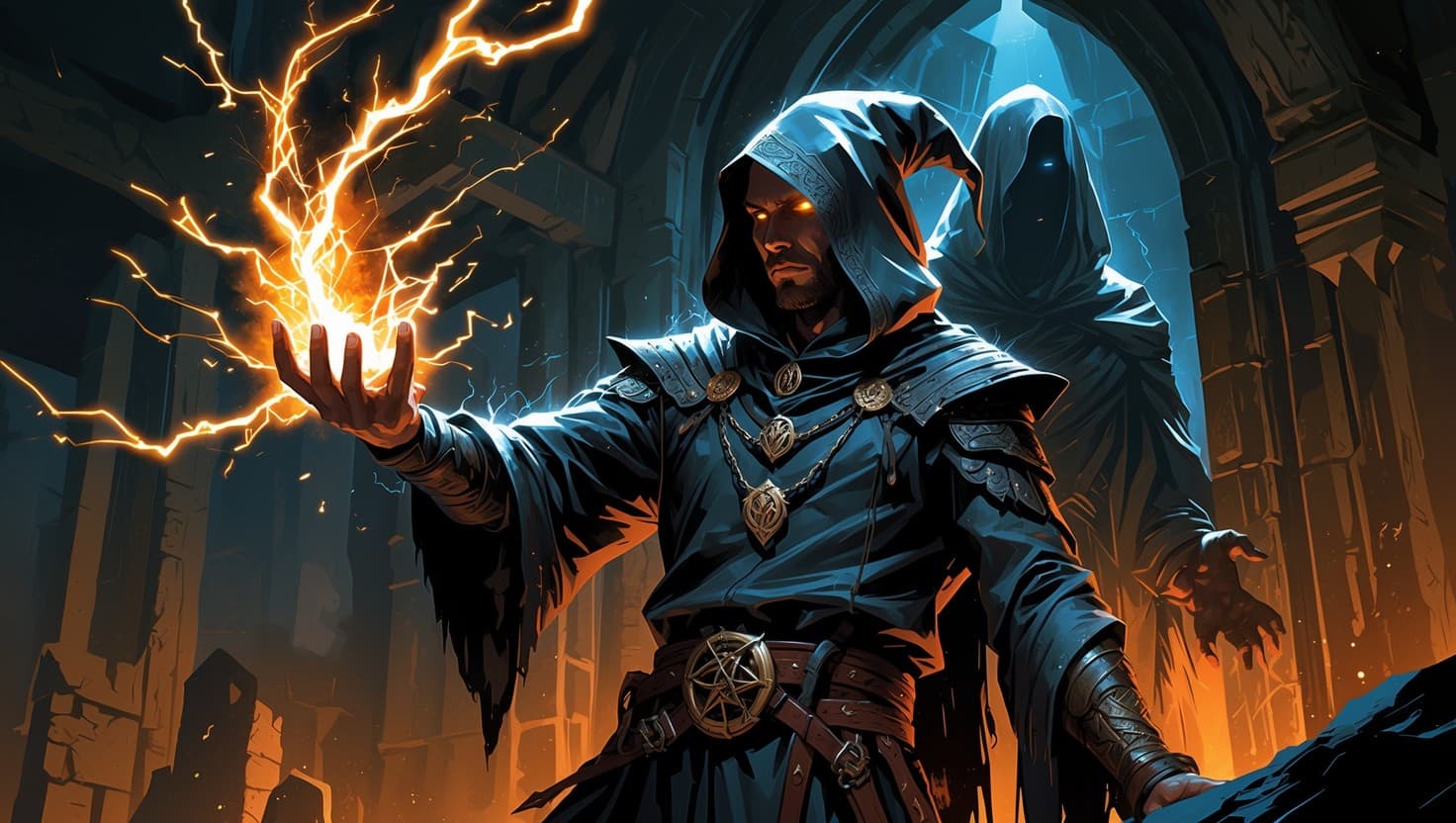
Playing a Warlock With an AI Game Master: The Definitive Guide
Every other spellcaster in D&D studied, prayed, or was born with it. Warlocks made a deal.
That single distinction changes everything about how the class plays - and it's exactly why Warlocks come alive with an AI Game Master in a way they rarely do at a human table. Your patron isn't a line in your backstory. It's a character. And StoryRoll's AI is built to run characters, not skip past them.
Why Warlocks Excel in AI D&D
The patron becomes a real presence
At most tables, "I made a pact with a fiend" gets a nod in session zero and is never mentioned again. The human GM has forty other things to track and your patron isn't one of them.
An AI GM doesn't forget. Tell StoryRoll who your patron is and what they want, and the AI will bring them back - a whispered demand before a fight, a debt called in at the worst possible moment, a flicker of approval when you do something suitably ruthless. The relationship that's supposed to define your class actually gets to define it.
Short-rest recovery finally gets tracked right
Warlocks recover spell slots on a short rest instead of a long one - the one mechanic in the game most likely to get fumbled by a tired GM at 11 PM. StoryRoll tracks this automatically and separately from every Wizard and Cleric at the table, so you're never stuck re-explaining that yes, you do get your slots back after that ten-minute break.
Invocations reward a GM who remembers details
Eldritch Invocations like Devil's Sight, Mask of Many Faces, and Eyes of the Rune Keeper only matter if the world responds to them. An AI GM that tracks lighting conditions, disguises, and readable runes turns your invocation picks into constant, tangible advantages instead of abilities you occasionally remember you have.
When you set up your Warlock in StoryRoll, describe the moment you made your pact - not just the patron's name. "I was drowning and something answered" gives the AI far more to work with than "I have a fiend patron." That single detail becomes a recurring image the AI returns to.
Best Warlock Patrons for AI Campaigns
The Fiend (The Reliable Damage Dealer)
Fiend is the most consistently strong patron in combat, and an AI GM that runs sustained, escalating fights rewards that consistency. Dark One's Blessing gives you temporary HP every time you drop a enemy, which snowballs hard against the multi-enemy encounters AI campaigns tend to favor.
- Dark One's Blessing - temp HP on a kill, and the AI narrates your patron's satisfaction each time it triggers
- Dark One's Own Luck - a clutch save or check reroll the AI treats as your patron intervening directly
- Hurl Through Hell - a devastating capstone the AI can turn into a genuinely disturbing narrative beat, not just a damage roll
Fiend is the patron for players who want their pact to feel dangerous in the most literal sense.
The Great Old One (The Roleplay Pick)
Great Old One is built for exactly what AI GMs do best: sustained, strange, alien communication. Telepathy at will means your patron can talk to you constantly, and StoryRoll will use that - unsettling asides, cryptic hints, thoughts that aren't quite yours slipping in during quiet moments.
Awakened Mind and Entropic Ward give you mechanical value, but the real draw is narrative. If you want a Warlock defined by an ongoing, uncomfortable relationship with something incomprehensible, no other patron gives the AI this much room to work.
The Archfey (The Bargain Pick)
Archfey suits campaigns built around deals, debts, and things that look generous until you read the fine print. Misty Escape rewards clever positioning, and Beguiling Defenses turns social encounters into a genuine strength - both play well in AI campaigns where negotiation and bargaining are treated as real mechanics, not just flavor.
Archfey is also the strongest pick if you want your pact itself to be the campaign's central mystery - what did you actually agree to, and what happens when your patron decides to collect?
Quick Build: The Fiend Blaster
- Race: Tiefling (Infernal Legacy synergy) or Custom Lineage for a feat
- Pact Boon: Pact of the Tome for utility, or Pact of the Blade if you want to fight in melee
- Key Invocations: Agonizing Blast, Devil's Sight, Repelling Blast
- Feat Pick: Fey Touched or Telekinetic for extra utility outside combat
- Playstyle: Eldritch Blast every turn, patron flavor everywhere else
Best Campaign Templates for Warlocks
D&D 5e: Classic Fantasy
Warlocks fit any D&D campaign, but they shine hardest in stories with a looming, personal antagonist - your patron can be that antagonist, or their rival, or the reason the real villain hasn't killed you yet.
Best campaign angles for Warlocks:
- Uncovering exactly what your pact actually cost, one clue at a time
- A patron who wants something from the same dungeon the party is already raiding
- Being caught between your patron's demands and the party's morals
- A rival warlock serving the same patron, competing for its favor
Sci-Fi Mode: The Bound Operative
Reflavor your patron as a rogue AI, a fractured alien intelligence, or a black-site experiment that answers when you call. Eldritch Blast becomes a weaponized psionic burst. Invocations become implants or granted subroutines you didn't fully consent to.
This mode leans into the "who do you actually answer to" tension that Warlock does better than any other class - your patron and your chain of command don't have to agree.
Fairy Tale Mode: The Fae Bargain
Fairy tales are full of exactly this deal: a desperate wish granted by something that names its own price later. Fairy Tale mode plays this completely straight, and Archfey patrons in particular slot in without any reskinning at all.
Your patron can be the fae lord who granted the wish, the price collector who shows up at the worst moment, or the reason the "happy" ending in this story comes with an asterisk.
Warlocks work in almost any tone, but they're weakest in campaigns with no room for a patron subplot at all. If you're planning something tightly plotted around a single external threat, tell the AI up front how much pact-related material you want woven in - a little seasoning versus a full second storyline.
Roleplaying a Warlock With an AI GM
Give your patron a voice, then use it
Decide how your patron communicates - dreams, whispers only you hear, a physical familiar, silence until it wants something - and tell the AI. Once it knows the channel, it will use it:
- The whisperer - "A voice under your thoughts says: you know what to do"
- The dream visitor - "You wake with the taste of ash and a clear instruction you didn't ask for"
- The silent debt - "Nothing. Your patron hasn't spoken in weeks. That silence is starting to worry you more than its demands ever did"
Whichever channel you pick shapes the tone of every future interaction.
Let the pact create friction
The most interesting Warlocks aren't fully aligned with their patron. Tell the AI where you and your patron disagree - it wants cruelty, you want mercy; it wants secrecy, your party deserves the truth - and the AI will use that gap as an ongoing source of tension rather than a one-time reveal.
Track the cost, not just the power
Warlock power comes from somewhere. Mention what you've noticed changing about yourself - a craving, a recurring dream, a reflex that isn't quite yours - and the AI will pick up on it and build consequences around it over time.
Example Session: Warlock in Action
Here's what a Warlock session actually looks like on StoryRoll:
You: I want to Eldritch Blast the cultist leader before he finishes the ritual, but first - does my patron have anything to say about this ritual? It looks like it's calling something.
AI GM: As you raise your hand to cast, the familiar cold settles behind your eyes. Your patron's voice slides in, unhurried: Careful. What he's calling isn't a rival of mine. It's kin. The cultist leader's chant rises in pitch, his circle of candles guttering blue. You have maybe one round before whatever he's summoning arrives.
You: Kin? I didn't know my patron had... family. I cast Eldritch Blast anyway, but I want to ask about that the second this is over.
AI GM: Two crackling beams of force slam into the cultist's chest, cutting the chant short - he drops before the summoning completes, the candles collapsing into ordinary smoke. The immediate danger passes. But your patron's voice lingers, quieter now, almost amused: Later, then. You'll want to be sitting down for this one.
You: That's not ominous at all. I search the ritual circle for anything that survived - notes, components, anything that tells me what "kin" means here.
AI GM: Beneath the scattered candles you find a scorched page, half-burned but legible: a sigil you don't recognize, and beneath it, in the cultist's shaking handwriting, a name. Not your patron's name - but close. Uncomfortably close.
Notice how the AI treats the patron as an active participant in the scene, not a one-time character-creation detail. That's the difference an AI GM makes for this class specifically.
Common Mistakes (And How to Avoid Them)
Setting up the patron once and never mentioning it again. The AI can only build on what you give it. A patron established in session zero and never referenced again will fade into the background - bring it up occasionally and the AI will run with it.
Forgetting your slots refresh on a short rest. This is the single most common Warlock mistake at any table. StoryRoll tracks it correctly, but you still have to remember to actually take the short rest and use the slots you're given back.
Only using Eldritch Blast. Pact of the Tome, Pact of the Chain, and your invocations exist to make Warlock more than a damage button. Use Disguise Self, Speak with Dead, or your familiar's scouting to solve problems Eldritch Blast can't.
Playing the pact as pure villainy. A Warlock doesn't have to be evil, and an interesting pact usually isn't a simple good-vs-evil arrangement. Ambiguity - a bargain that seemed reasonable at the time - gives the AI far more to work with than straightforward menace.
Ignoring Pact Boon utility. Pact of the Tome gives you three extra cantrips outside your normal list. Pact of the Chain gives you a familiar with real combat utility. Don't pick a boon and then forget what it does for the rest of the campaign.
Warlocks and AI Game Masters solve each other's biggest problems. The class needs a GM who treats its patron as a living relationship instead of a paragraph of backstory - and that's exactly what StoryRoll's AI is built to do. Whatever else changes about your build, the pact is the part worth investing in.
Pick Fiend if you want reliable damage with real narrative teeth, Great Old One if you want the deepest ongoing roleplay, or Archfey if you want your entire campaign to hinge on the fine print of a bargain. Then actually talk to your patron - out loud, in character - and watch the AI turn it into a story thread that outlasts any single session.
Create your Warlock on StoryRoll and find out what your patron actually wants.
Try These Free Tools
Keep your Warlock sharp between sessions with these resources:
- Short Rest Calculator - Track exactly when your Pact Magic slots come back, separate from your party's long-rest casters.
- Spell Slot Tracker - Keep Eldritch Blast, invocations, and your Tome cantrips organized.
- Backstory Generator - Build the moment your pact began with hooks your GM can use.
Frequently Asked Questions
Is Warlock a good class for AI D&D?
Yes, and for a specific reason: Warlock is the class most defined by a relationship, and an AI Game Master is built to run relationships. Your patron isn't a backstory footnote - it's an active presence the AI can voice, negotiate with, and use to complicate your story.
How does the AI track Pact Magic slots?
StoryRoll tracks your Warlock's short-rest slot recovery automatically, separately from every long-rest caster at your table. The AI also reminds you when a short rest is available mid-session, since that's the moment other classes tend to forget you exist.
What patron is best for AI campaigns?
Fiend is the most reliable damage patron and pairs well with an AI GM that runs relentless combat. Great Old One is the strongest roleplay pick - its telepathy and alien voice give the AI constant material. Archfey suits campaigns built around bargains, fae courts, and reversible-looking deals that never quite are.
Can I play a Warlock solo with an AI GM?
Warlocks solo well. Eldritch Blast plus Agonizing Blast is reliable single-target damage that doesn't run out, and your patron functions as a built-in NPC relationship even when you're the only player at the table.
Do I need to roleplay my pact constantly?
No. Some of the best Warlock play is quiet - a character who made a bad deal years ago and mostly avoids thinking about it. The AI will still surface the pact at the right moments (a debt called in, a whispered warning), so you don't have to perform it every turn to keep it present.
What's the biggest mistake new Warlock players make with an AI GM?
Treating the patron as flavor text instead of a character. If you never mention your patron after session zero, the AI has nothing to build on. Bring it up - even briefly - and the AI will turn it into an ongoing thread instead of a paragraph you wrote once and forgot.
Related Class Guides
Exploring other classes for your next AI D&D campaign? Check out our other definitive guides:
Written by StoryRoll
Founder of StoryRoll. Building AI-powered tabletop RPGs.
Related Posts
Playing a Monk With an AI Game Master: The Definitive Guide
Ki Points are the tightest resource budget in D&D 5e - and an AI Game Master is built to track every last one. Here's how to play a Monk well.
Playing a Druid With an AI Game Master: The Definitive Guide
Wild Shape isn't just a combat button - it's a second character an AI Game Master can react to in real time. Here's how to play a Druid well.
Playing a Sorcerer With an AI Game Master: The Definitive Guide
Sorcerers don't study magic - they are magic, and every spell is a live decision. Here's how to play one well with an AI Game Master.