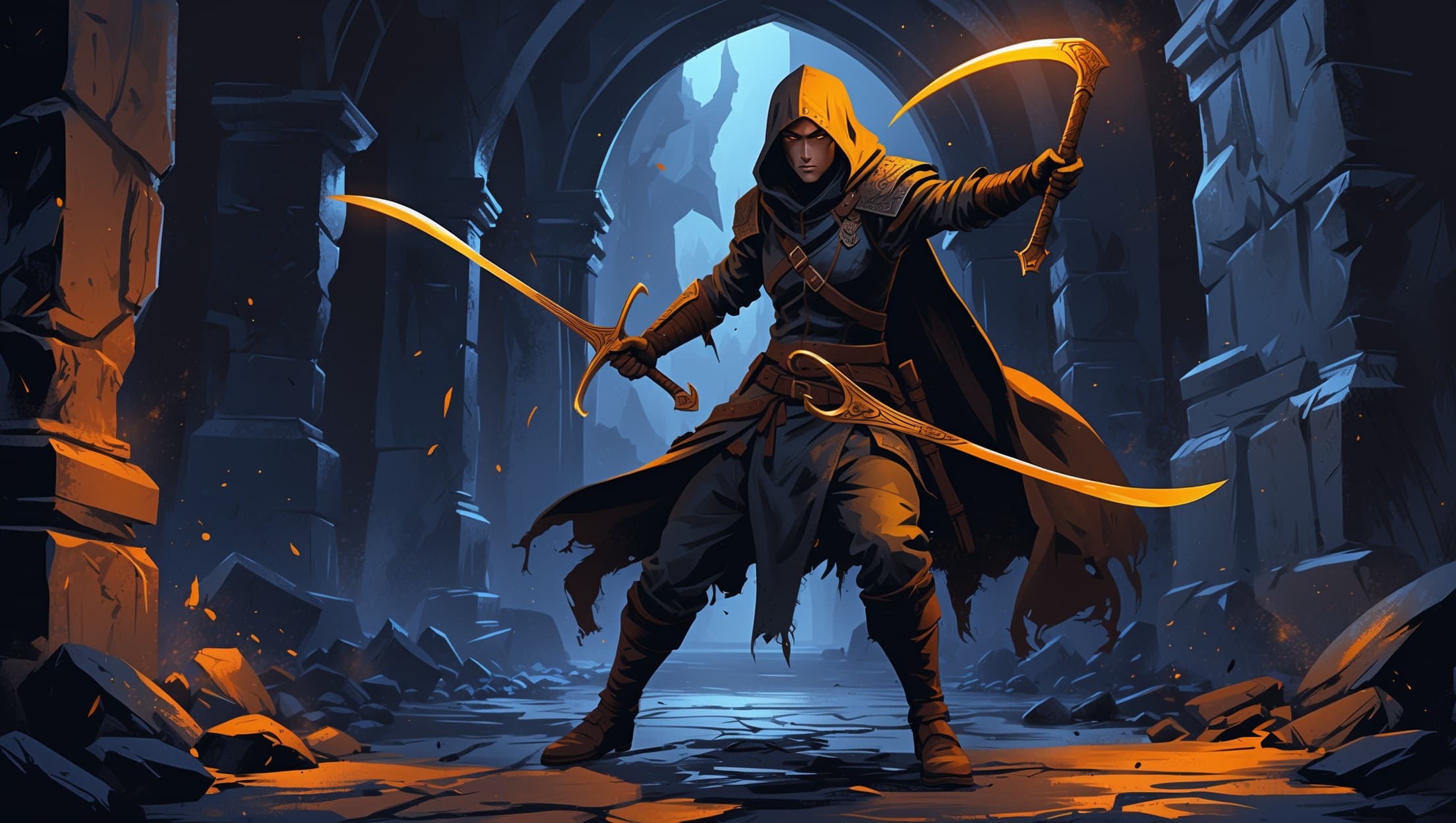
Two-Weapon Fighting 5e: The Off-Hand Attack Mistake Almost Every Table Makes
The fighter rolls two attacks with a shortsword and a dagger, adds Strength to both damage rolls without thinking twice, and the table moves on. Nobody notices anything wrong, because nothing looks wrong. That's exactly the problem. Two-weapon fighting 5e has a small, easy-to-skip clause buried in its wording, and most tables have been quietly overpaying damage on the off-hand attack for years without anyone catching it.
The base rule is short. The way tables actually run it usually is not the same thing.
Two-Weapon Fighting 5e: The Actual Rule
Here's the rule as written, stripped down to what it says.
When you take the Attack action and attack with a light melee weapon you're holding in one hand, you can use a bonus action to attack with a different light melee weapon you're holding in the other hand. You don't add your ability modifier to the damage of the bonus action attack, unless that modifier is negative.
That last clause is the part almost every table drops. The first attack, made with the Attack action, gets your full ability modifier like any other attack. The second attack, the bonus action one, does not, unless you have a specific feature that changes that.
Two-weapon fighting 5e grants an extra attack for a bonus action. It does not grant an extra ability modifier for that attack. Those are two separate things the rule text keeps deliberately apart.
Why the Off-Hand Attack Skips Your Ability Modifier
This isn't a typo in the rulebook. It's the balancing lever for the entire mechanic.
Two-weapon fighting already gives a character an extra attack roll for the cost of a bonus action, which is a real resource other builds spend on other things: a rogue's Cunning Action, a spellcaster's bonus action spell, a paladin's Divine Smite setup. If that bonus action attack also added a full Strength or Dexterity modifier on top, dual wielding would out-damage a single big weapon by a wide margin for free, no fighting style, no feat, nothing spent beyond the bonus action itself.
So the base rule caps it: you get the extra attack, but the damage on that attack is weapon dice only. A dagger's 1d4 stays 1d4. No modifier rides along unless something specifically says it does.
The exception in the rule runs the other way, too: if your ability modifier is negative, you still apply it to the bonus action attack. The rule isn't protecting you from a penalty, only withholding the bonus.
What Actually Adds the Modifier Back
Three things change the base rule, and mixing them up is the second most common two-weapon fighting 5e mistake.
The Two-Weapon Fighting fighting style. Available to Fighters, Rangers, and Paladins (and a few subclasses that grant fighting styles), this style says exactly one thing: when you engage in two-weapon fighting, you can add your ability modifier to the damage of the second attack. It does not change the light weapon requirement. It does not grant an extra attack you didn't already have. It only unlocks the modifier on the attack the base rule already gives you.
Certain class features. A handful of features, like a Ranger's Hunter's Mark interacting with dual attacks or specific subclass abilities, reference two-weapon fighting directly and can layer on top of it. Read the feature text closely. Most of them still assume the base no-modifier rule unless they say otherwise.
The Dual Wielder feat. This one does something different: it removes the light weapon requirement, letting you two-weapon fight with any one-handed melee weapons, including ones without the light property (a longsword and a shortsword, for instance). It also grants a static +1 to AC while wielding two melee weapons. It does not, by itself, add your ability modifier to the bonus action attack. You still need the fighting style for that.
- Base two-weapon fighting: bonus action attack, weapon dice only, no ability modifier (unless negative).
- + Two-Weapon Fighting fighting style: ability modifier now applies to the bonus action attack.
- + Dual Wielder feat: light weapon requirement removed, +1 AC while dual wielding, still no automatic modifier without the style.
- Both together: non-light weapons allowed, full modifier on both attacks, +1 AC.
The Light Weapon Requirement People Forget
Two-weapon fighting 5e only works with light weapons, in both hands, at the time of the attack. That trips up two kinds of players.
The first is anyone reaching for a longsword and a shortsword without the Dual Wielder feat. A longsword doesn't have the light property, so it can't be the weapon used for either the initial attack or the bonus action attack in vanilla two-weapon fighting. Rapiers, battleaxes, and warhammers have the same problem.
The second is anyone forgetting that a free hand is required. Two-weapon fighting needs a weapon in each hand, which means it doesn't combine with a shield, and it doesn't work if one of your hands is holding a two-handed weapon, a spellcasting focus that requires a free hand, or anything else occupying the slot.
Hand crossbows are the one ranged exception worth knowing. They're light, so a character can fire one with the Attack action and the second with a bonus action, using the exact same rule and the exact same missing-modifier default as melee.
A weapon without the light property can't be used for two-weapon fighting's bonus action attack, full stop, unless the Dual Wielder feat is in play. Checking a weapon's properties before the dice hit the table saves an argument mid-round.
Where Two-Weapon Fighting 5e Gets Misplayed
A short list covers most of the actual mistakes at real tables.
Adding the modifier by default. The single biggest one. Without the fighting style, the bonus action attack's damage is weapon dice alone.
Assuming any two one-handed weapons qualify. Both need the light property unless Dual Wielder changes that.
Forgetting it costs the bonus action. A rogue who used Cunning Action to Disengage doesn't also get the off-hand attack that same turn. A caster who wants to cast a bonus action spell has to choose between that and the second weapon.
Mixing up the fighting style with the feat. The style adds the modifier. The feat removes the light weapon requirement and adds AC. Neither one does what the other does.
Trying to two-weapon fight with a shield equipped. The off-hand needs to hold the second weapon, not a shield. A character can switch between shield-and-weapon and two-weapon fighting between turns, but not within the same attack sequence.
Did the 2024 Rules Change Two-Weapon Fighting 5e?
Mostly not. The 2024 Player's Handbook keeps the same core structure: a bonus action attack with a second light weapon, no ability modifier by default, and the Two-Weapon Fighting fighting style as the fix. The 2024 rules do fold the old "Light" weapon mastery property changes and general weapon mastery system into the broader combat rules, which can interact with two-weapon fighting depending on which weapon masteries a character has, but the base two-weapon fighting mechanic itself reads the same as it did in 2014.
Where an AI Game Master Actually Helps With This Rule
Two-weapon fighting 5e is exactly the kind of rule that survives a rules lawyer's read-through and then quietly gets misapplied every single combat round after that, because nobody rereads the fighting style text mid-fight to check whether this particular character actually has it.
That's the specific gap StoryRoll's AI Game Master closes. When a character built for dual wielding takes their bonus action attack, the system already knows whether that character has the Two-Weapon Fighting fighting style, whether both weapons are light (or whether Dual Wielder is in play), and whether a free hand is actually available. The damage roll comes back correct without anyone stopping the scene to check a splatbook.
That doesn't remove the build decision. A player choosing between the fighting style, Dual Wielder, and something else entirely is still making a real tradeoff. What disappears is the after-the-fact argument about whether that bonus action dagger should have added Dexterity or not.
Frequently Asked Questions
Do you add your ability modifier to the off-hand attack in two-weapon fighting 5e?
Not by the base rule. Two-weapon fighting 5e lets you make a bonus action attack with a second light weapon, but that attack does not add your ability modifier to the damage roll unless the modifier is negative. You need the Two-Weapon Fighting fighting style, or a class feature that says otherwise, to add it.
What weapons can you use for two-weapon fighting in 5e?
Both weapons need the light property, and both attacks need to be part of the same turn using the Attack action. Common light weapons include daggers, shortswords, scimitars, and hand crossbows. A weapon without the light property, like a longsword or rapier, cannot be used for the bonus action attack unless a feat removes that restriction.
Do you need a free hand to two-weapon fight in 5e?
You need a hand free to hold the second weapon, since two-weapon fighting requires one weapon in each hand. That is also why it does not work with a shield equipped, or with any weapon that requires two hands to wield, like a greatsword or longbow.
Does the Two-Weapon Fighting fighting style let you use non-light weapons?
No. The Two-Weapon Fighting fighting style only changes whether you add your ability modifier to the off-hand attack's damage. It does not remove the light weapon requirement. The Dual Wielder feat is the one that lets you fight with non-light one-handed weapons and raises your AC while you do it.
Can you two-weapon fight with a ranged weapon in 5e?
Yes, if the ranged weapon is light. Hand crossbows are the standard example: a character can make an attack with one hand crossbow, then use their bonus action to fire a second hand crossbow. The same missing-ability-modifier rule applies to that bonus action shot as it does to melee.
Two-weapon fighting 5e gives you a bonus action attack with a second light weapon, and that's it, until something adds more. The base rule skips your ability modifier on that second hit. The Two-Weapon Fighting fighting style adds the modifier back. The Dual Wielder feat drops the light weapon requirement and adds AC, but not the modifier by itself. Three separate pieces, easy to blend into one in your head, and worth separating out before the next dagger hits the table.
Play a dual-wielding Rogue or Ranger on StoryRoll and let the AI Game Master track exactly which bonus applies to which attack.
Related Reading
Written by StoryRoll
Founder of StoryRoll. Building AI-powered tabletop RPGs.
Related Posts
Shove in D&D 5e: The Attack Most Tables Get Wrong
Shove 5e is a free melee attack most tables forget they have, and the two tables that remember it usually run it wrong. Here's the actual rule.
Prone in D&D 5e: Why 'Melee vs. Ranged' Isn't the Actual Rule
The prone condition in D&D 5e isn't a melee-vs-ranged rule. It's a distance rule, and the difference changes how reach weapons and close-range shots actually resolve.
Sneak Attack 5e: The Rule Rogues Keep Misplaying
Sneak Attack 5e sounds simple until a table has to apply it live. Here's the actual trigger, the once-per-turn nuance, and the six ways it gets misplayed.