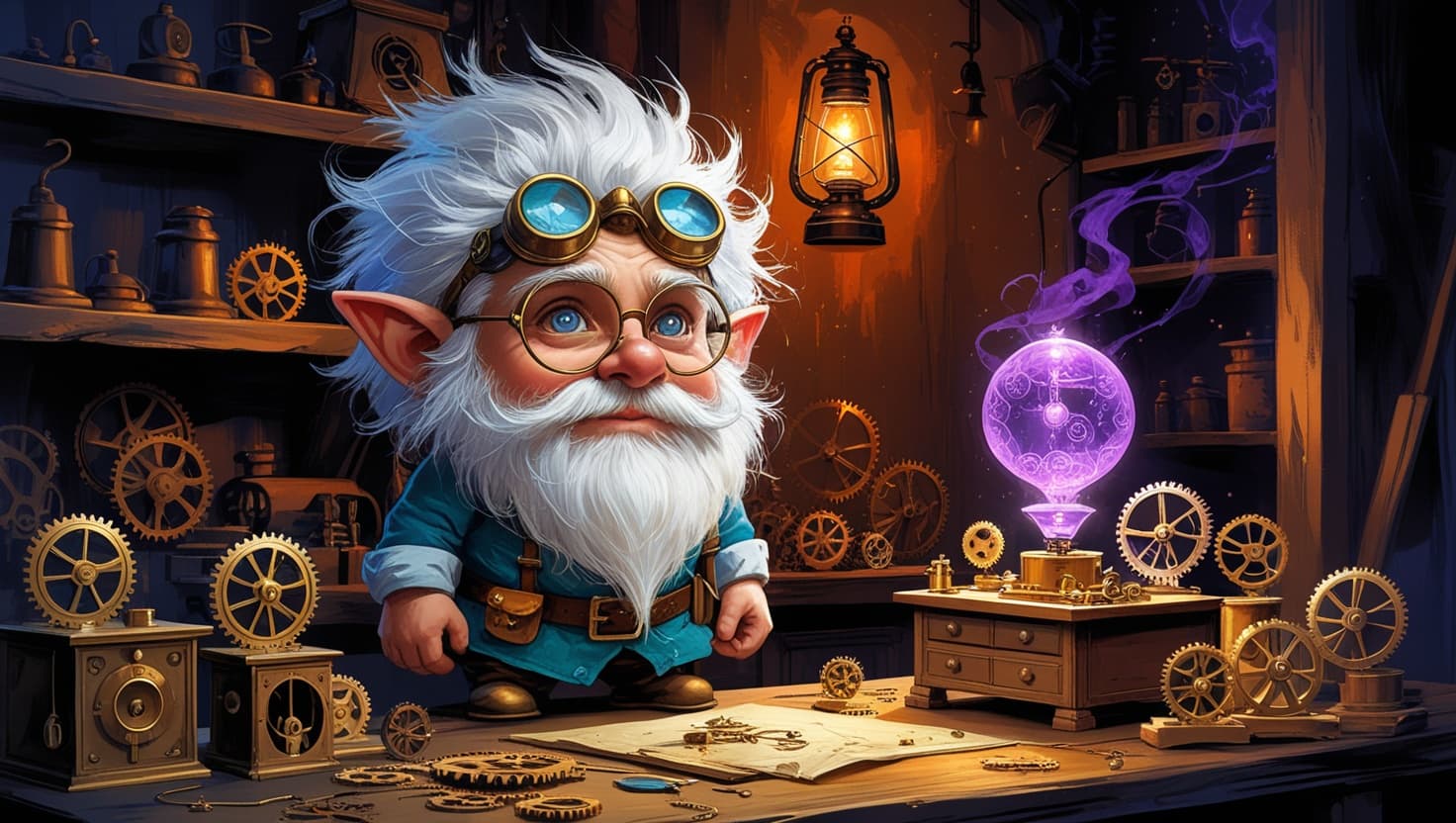
Playing a Gnome With an AI Game Master: The Complete Race Guide
Most D&D races give you a stat bonus and a passive trait. Gnomes give you a stat bonus, one of the best anti-magic defenses in the Player's Handbook, and a personality the race practically writes for you - curious, clever, and never quite able to leave a locked door or a strange machine alone.
Small in size but never small in presence, they split into two subraces that point at genuinely different characters: the fey-touched Forest type who talks to squirrels and blinks in and out of a hedge, or the Rock tinkerer who can build a working clockwork toy out of scrap in an afternoon. Either way, Gnome Cunning means you're one of the hardest races in the game to charm, frighten, or magically shut down.
Gnome Racial Traits, Explained
- +2 Intelligence. A fixed ability score increase that points straight at Wizard, Arcane Trickster Rogue, and Knowledge Domain Cleric.
- Small size, 25-foot speed. Gnomes are Small creatures, which affects carrying capacity and some equipment but not attack rolls.
- Darkvision (60 feet). See in dim light and darkness as if it were dim light.
- Gnome Cunning. Advantage on all Intelligence, Wisdom, and Charisma saving throws against magic - one of the strongest anti-magic traits any race gets.
- Subrace: Forest Gnome (+1 Dexterity, Minor Illusion cantrip, limited Speak with Animals) or Rock Gnome (+1 Constitution, Artificer's Lore, Tinker).
- Languages. Common and Gnomish.
None of these traits ask you to build around them the way a Dragonborn's breath weapon does. They stack quietly in the background, and the payoff shows up every time a spellcaster tries to charm, frighten, or dominate your character and simply fails.
Why Gnomes Are Built for AI Campaigns
A magic-resistance trait that never gets forgotten mid-session
Passive saving-throw bonuses are exactly the kind of rule a busy human GM loses track of three hours into a session - did the goblin shaman's fear spell account for your advantage, or did everyone just forget? StoryRoll's AI GM applies Gnome Cunning automatically on every qualifying save, so the advantage is always there whether or not anyone at the table remembers to call it out. For a race whose signature trait is a background bonus instead of an active ability, that consistency matters more than it would for almost anyone else.
Tinker gives the AI a persistent object to build a story around
A Rock subrace's Tinker trait lets you spend an hour and 10 gold to build a Tiny clockwork device - a toy, a fire starter, or a music box. On paper it's a minor crafting feature. In practice, StoryRoll's persistent memory turns that first little invention into a running thread: the music box you built in session two can still be sitting on an NPC's shelf in session twelve, or the fire starter you tinkered together might be the exact tool the plot needs later, because the AI GM doesn't let a crafted object quietly vanish the way an overworked human table sometimes does.
The subrace choice is a real fork, and the AI plays it straight
Forest and Rock aren't cosmetic variants - one gives you fey magic and stealth, the other gives you engineering and lore. An AI Game Master can lean into either direction hard: a Forest-blooded character who slips through a hedge maze an NPC swears doesn't exist, or a Rock tinkerer whose reputation precedes them into a town that needs something fixed. StoryRoll's narrator picks up on which subrace you picked and writes scenes that actually use it.
If you're torn between subraces, think about what kind of problem-solving you want your character to default to. Forest Gnome answers "how do I get past this" with illusion and stealth. Rock Gnome answers it by building something. Both are valid Gnome answers - pick the one that sounds more fun to play out loud.
Best Classes for Gnomes
Wizard - The Clean Mechanical Fit
The race and Wizard line up almost too well. The +2 Intelligence bonus goes directly into your spell save DC and spell attack bonus, and Gnome Cunning layers a second line of magic resistance on top of a class that already lives or dies by its own saving throws. A Forest-blooded Wizard gets a free Minor Illusion cantrip before they've even picked their first spell, which is a strong head start for a School of Illusion specialist.
StoryRoll's AI GM tends to reward this pairing narratively as much as mechanically - a small, sharp-minded spellcaster whose Intelligence and Gnome Cunning both trace back to the same fey-touched or tinkerer's-guild origin gives the narrator plenty of material for how NPCs react to someone who clearly knows more than they're letting on.
Rogue (Arcane Trickster) - Cunning With Sleight of Hand
A Forest subrace's +1 Dexterity and free Minor Illusion cantrip both point at Rogue, and the Arcane Trickster subclass turns that overlap into a genuinely strong build - Intelligence-based spellcasting layered on top of a class that already wants to stay Dexterity-forward and out of direct fights. Gnome Cunning also means an Arcane Trickster who gets caught mid-heist has a real shot at shrugging off whatever magical alarm or charm effect tries to stop them.
Cleric (Knowledge Domain) - The Scholar's Answer
Knowledge Domain is one of the few Cleric subclasses built around Intelligence rather than Wisdom for its bonus skills, which makes it an unusually good fit for a race whose only fixed bonus is Intelligence. A Rock-subrace Cleric with Artificer's Lore reads naturally as a scholar-priest who treats magic items and old machinery as two branches of the same subject.
Bard - Charisma With a Tinkerer's Toolkit
This race doesn't get any direct ability score synergy from its fixed bonuses, but the flavor fit is strong enough that it's worth calling out: gnomes are traditionally the game's tinkerers and tricksters, and a Bard who performs with mechanical puppets or fey-touched illusions built on Minor Illusion leans into that reputation even without a stat bonus backing it up.
Quick Build: Rock Gnome Wizard (School of Illusion)
- Ability Scores: Intelligence 16 (+2 racial), Constitution 15 (+1 racial), Dexterity 14
- Subrace Feature: Artificer's Lore for identifying magic items and old tech on sight
- Key Feature: Gnome Cunning plus School of Illusion's own resistance to being detected
- Playstyle: The party's answer to "how do we get past this" and "what is this thing," in equal measure
Roleplaying a Gnome With an AI GM
Decide what your character is curious about
Every member of this race in D&D lore runs on curiosity, but curiosity about what is entirely up to you. Some chase magical theory. Some chase mechanical puzzles. Some chase whatever the last strange thing they saw was, with no larger plan at all. That specific obsession is the single most useful detail you can hand an AI Game Master.
Tell StoryRoll what your character can't leave alone, and it builds encounters around that hook - a locked box nobody else in the party would bother with, an NPC inventor who recognizes a kindred spirit, or a magical anomaly that exists specifically to pull them off the main road.
Give the AI your subrace's flavor, not just its stat block
Fey ancestry on the Forest side and an engineering background on the Rock side aren't interchangeable window dressing - they imply different upbringings, different communities, and different relationships to the wider world. Mention which one your character actually grew up around, and StoryRoll's narrator can build NPCs and locations that fit: a hidden fey court for one, a workshop-town for the other.
Let Tinker or Minor Illusion be a recurring character beat
Because both subrace features produce something concrete - a small device or a small illusion - they're easy to turn into a running signature instead of a one-time mechanical footnote. A tinkerer who's built seven increasingly elaborate music boxes over a campaign, or a fey-blooded trickster whose favorite illusion is a double that always looks a little too smug, gives StoryRoll something specific to call back to later.
Gnomes don't come with a single dramatic trait the way a Tiefling's horns or a Dragonborn's breath weapon announce a character at a glance. What they have instead is a personality the whole race shares - relentless curiosity - that only becomes specific once you tell the AI what your character is actually curious about.
Campaign Ideas Across Game Modes
D&D 5e - The Inventor's Workshop or the Fey Court
The default read splits cleanly by subrace: a Rock tinkerer pulled between a workshop-town's practical needs and one invention too ambitious to be safe, or a Forest-blooded character caught between the mortal world and a fey court that never quite lets its own go.
Campaign hooks:
- A former mentor's workshop burns down under suspicious circumstances, and the blueprints for their last invention are missing
- A fey lord remembers a bargain your character's family made generations ago, and has finally come to collect
- A clockwork device you built starts doing things you never programmed it to do
Sci-Fi - The Compact Tech Specialist
In StoryRoll's Sci-Fi mode, the concept maps naturally onto a small-statured tech specialist or drone engineer whose gadgets and quick problem-solving make up for a lighter frame in a fight. Tinker becomes field-repair expertise; Gnome Cunning becomes a resistance to hostile neural interference.
Fairy Tale - The Forest's Clever Neighbor
Fairy Tale mode is home turf for this race: a fey-blooded tinkerer or trickster living at the edge of the deep woods, welcome in the village for their inventions and welcome in the forest for their blood, trusted fully by neither. It's a natural fit, and the AI's narrator leans into it easily.
Common Mistakes (And How to Avoid Them)
Picking a subrace for the stat bonus alone. Forest and Rock both feed different builds, but they also imply different characters. Pick the one whose feature you actually want to roleplay, not just the one that nudges your best stat a point higher.
Treating Gnome Cunning as something you have to remember to use. It's automatic - StoryRoll applies it on every qualifying save without you needing to ask. Don't play more cautiously than you need to out of a misplaced worry that you'll forget to claim it.
Letting curiosity stay generic. "Gnomes are curious" is true of the whole race and says nothing about your specific character. Pick one real obsession and hand it to the AI - it's worth more than a paragraph of generic flavor text.
Building a Tinker device once and never mentioning it again. A clockwork toy or music box is a great seed for a recurring detail. Bring it up again later and StoryRoll keeps building on it instead of letting it quietly disappear from the story.
Playing Small size as a mechanical downside to work around. Small size barely matters in 5e outside a few heavy weapon restrictions. It's not worth building your whole character concept around compensating for it.
Gnomes earn their place as one of D&D's most quietly strong races: a clean +2 Intelligence bonus, one of the best anti-magic passive traits in the game, and a subrace choice that hands you fey illusion tricks or hands-on tinkering depending on what kind of problem-solver you want to play. The mechanics support Wizard, Arcane Trickster Rogue, and Knowledge Domain Cleric without much build risk at all.
The curiosity is where the character actually lives, though, and it only pays off if you give the AI something specific to chase. Tell StoryRoll what your character can't leave alone, and the Game Master builds NPCs, inventions, and plot threads around that obsession for as long as the campaign runs.
Create your Gnome character on StoryRoll and find out what your curiosity actually costs you.
Try These Free Tools
Build your character with these free resources:
- Ability Score Calculator: plan your Intelligence bonus alongside your subrace's Dexterity or Constitution boost.
- Backstory Generator: generate a Forest or Rock Gnome backstory with hooks tied to fey ancestry or a tinkerer's guild.
- Spell List Filter: playing a Gnome Wizard, Cleric, or Arcane Trickster? Browse your full spell list by level.
Frequently Asked Questions
What is the best class for a Gnome in D&D 5e?
Wizard is the clean mechanical fit - the Gnome's +2 Intelligence goes straight into spell save DC and attack bonus, and Gnome Cunning stacks a second layer of magic resistance on top of a class that already lives and dies by its saving throws. Rogue (Arcane Trickster) is a close second, especially for a Forest Gnome, since the Dexterity subrace bonus and a free Minor Illusion cantrip both feed the same build. Cleric with the Knowledge Domain is a strong third pick for the same Intelligence synergy with a different role at the table.
What's the difference between a Forest Gnome and a Rock Gnome?
Forest Gnomes get +1 Dexterity, know the Minor Illusion cantrip for free, and can cast Speak with Animals a limited number of times to talk to small beasts - a fit for stealthy, fey-touched, trickster-leaning characters. Rock Gnomes get +1 Constitution, Artificer's Lore (double proficiency on History checks about magic items and technology), and Tinker, letting you spend an hour and a handful of gold building a tiny clockwork device - a fit for inventor, engineer, and gadgeteer characters. Both keep the base Gnome's +2 Intelligence, Darkvision, and Gnome Cunning.
How does an AI Game Master handle Gnome Cunning and other passive traits?
Gnome Cunning is easy for a human GM to lose track of mid-session, since it's a passive bonus that only matters the moment a saving throw comes up. StoryRoll's AI GM applies it automatically on every Intelligence, Wisdom, or Charisma save against magic, so you get the advantage every time without needing to remind the table. The same goes for Tinker's clockwork devices - once you've built one, the AI keeps it as a persistent object in your inventory instead of letting it quietly disappear between sessions.
Can I play a Gnome in non-fantasy StoryRoll modes?
Yes. In Sci-Fi mode, a Gnome-style character translates naturally into a compact tech specialist or drone engineer whose gadgets and quick thinking make up for a smaller frame. In Fairy Tale mode, a Gnome fits as a fey-blooded tinkerer or forest trickster living at the edge of the deep woods. The curious-inventor and clever-trickster throughlines carry across every setting StoryRoll supports.
Is Gnome a good race for a first D&D character?
Yes, especially for a Wizard or another Intelligence-based class. The +2 Intelligence bonus removes any guesswork about where your primary stat goes, Gnome Cunning gives new players a genuine mechanical edge against some of the game's nastier magic, and the subrace choice (Forest or Rock) hands you an immediate, concrete hook for who your character is without requiring a fully worked-out backstory on day one.
Written by StoryRoll
Founder of StoryRoll. Building AI-powered tabletop RPGs.
Related Posts
Playing an Aasimar With an AI Game Master: The Complete Race Guide
Aasimar pairs Charisma-friendly racial traits with a once-per-long-rest transformation and a built-in heal. Here's how the traits work, which subrace to pick, and how to build one with an AI Game Master.
Playing a Half-Orc With an AI Game Master: The Complete Race Guide
Half-Orcs pair +2 Strength/+1 Constitution with Relentless Endurance and Savage Attacks, two of the best survival and damage traits in D&D 5e. Here's how to build one and roleplay it with an AI Game Master.
Playing a Dragonborn With an AI Game Master: The Complete Race Guide
Dragonborn bring a breath weapon, draconic resistance, and a built-in clan identity to D&D 5e. Here's how to build one and roleplay it with an AI Game Master.