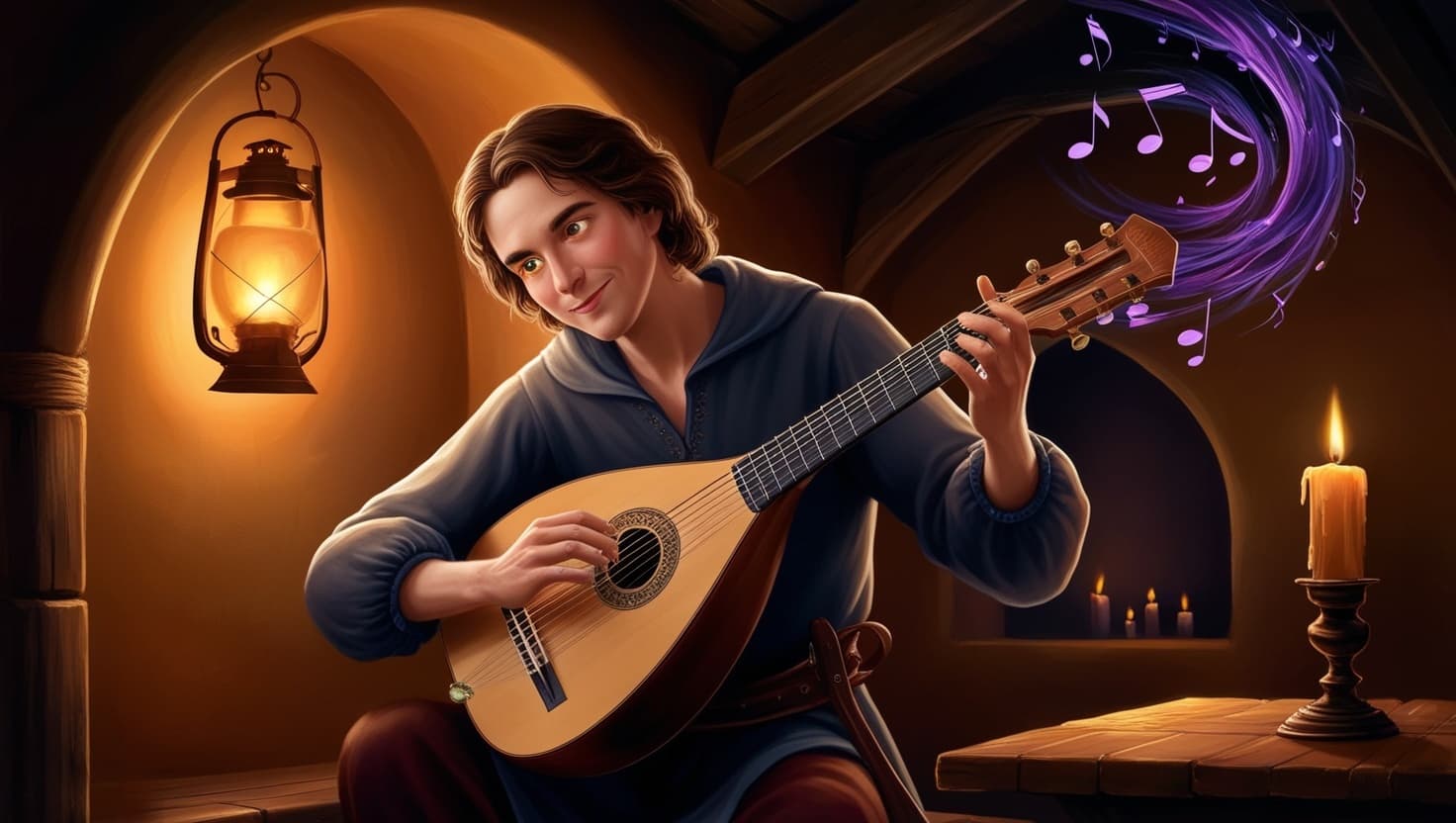
Playing a Bard With an AI Game Master: The Definitive Guide
Everyone thinks they know what a Bard does. Plays a lute between fights. Tells a joke. Provides the "comic relief" while the real classes do the work.
Here's what a Bard actually does: casts from one of the best spell lists in the game, hands out d6-to-d12 dice that turn allies' misses into hits, talks a guard captain out of a fight the party would have lost, and - when the conversation fails - drops Vicious Mockery on the way to hitting the enemy caster with a debuff no one saw coming. The Bard is not the class you bring because you couldn't find a better party. It's the class you bring because you know what's coming.
And an AI Game Master is the best possible scene partner for it.
Why Bards Excel in AI D&D
Jack of All Trades removes the "wrong build" problem
Every other class has checks it's simply bad at. You add half your proficiency bonus to every ability check that isn't already proficient - which means there is no skill check in the game where you're starting from zero. Persuasion, Arcana, Athletics, Survival, it doesn't matter. You always have a floor.
This matters enormously with an AI GM, because a good one doesn't script encounters around what your party happens to be good at. StoryRoll's AI calls for the check the situation actually demands - a Nature check to read the storm, an Intimidation check when diplomacy stalls, an Investigation check on a scene the Rogue already left. You're the one character built to never be the person standing there with nothing to roll.
Bardic Inspiration makes every roll at the table your business
Bardic Inspiration is the rare class feature that's more about your allies than about you. Hand a d6 (scaling up to a d12) to a struggling Fighter before their attack roll, and you've turned a miss into a hit without spending your own turn on anything but a bonus action.
In AI campaigns this becomes a running thread rather than a one-off trick, because the AI keeps combat and skill challenges varied enough that someone is always about to roll something that matters. Watching for the right moment to hand out inspiration - right before the Cleric's save, right before the Rogue's Stealth check to avoid the patrol - is its own kind of gameplay, and it's one only you get to play.
Talking is a real strategy, not a cutscene
The single biggest reason Bards come alive with an AI GM: the class's whole identity is built on the assumption that talking your way through a scene is a legitimate alternative to fighting through it. A lot of human tables treat social encounters as a speed bump before combat starts anyway. StoryRoll's AI treats a well-played Persuasion or Deception check as capable of ending an encounter outright - the guard captain stands down, the cultist reconsiders, the noble reveals what they were hiding.
That means your Charisma isn't a stat you're carrying for flavor. It's a build-defining resource the AI actually lets you spend.
Don't treat Charisma checks as a coin flip you narrate around. Describe how you're persuading someone - the specific lie, the specific appeal to their pride or fear - before you roll. The AI reads that framing and lets a clever approach shift the DC or the outcome, even on a middling roll.
Best Bard Builds for AI Campaigns
College of Lore (The Generalist)
Lore Bards get three extra skill proficiencies and Cutting Words - the ability to subtract a Bardic Inspiration die from an enemy's attack, check, or damage roll after you see the result. Combined with an already-strong spell list that reaches into other classes' territory (you can learn spells like Fireball or Mass Cure Wounds through Magical Secrets), Lore is the subclass built to have an answer for everything.
Cutting Words is quietly one of the best defensive tools in the game: shave the roll on the attack that would have downed your Wizard, or the save that would have let the boss shrug off your Hold Person. It's a reaction, so you're always holding a card.
Best for: Players who want maximum flexibility, campaigns with unpredictable challenge types, anyone who wants a spell list that grows into whatever the party is missing.
College of Valor (The Frontline Bard)
Valor Bards trade some spellcasting utility for real martial competence: medium armor, shields, and martial weapon proficiency, plus Combat Inspiration lets allies add the die to a damage roll or their AC instead of just an attack or check. Extra Attack arrives at level 6, letting you swing twice while still casting spells no one else in melee can.
This is the pick for players who want to stand in the front line and still be the one turning the tide with inspiration dice. The AI narrates Valor Bards as battlefield conductors - directing allies' hits while landing their own.
Best for: Solo play, small parties without a dedicated frontliner, players who want to fight and support at the same time.
College of Glamour (The Fae Manipulator)
Glamour Bards channel the Feywild directly. Mantle of Inspiration gives temporary HP and a free reaction move to everyone you inspire - turning Bardic Inspiration into a battlefield reposition tool - and Enthralling Performance can charm an entire room after a short performance, no spell slot required.
Glamour is the strongest social-manipulation subclass in the game, and it pairs unusually well with campaigns built around courts, negotiations, or fae bargains - exactly the kind of scene an AI GM can improvise indefinitely.
Best for: Court intrigue and negotiation-heavy campaigns, players who want charm effects without burning spell slots, fairy tale campaigns where the Feywild is already the setting.
Quick Build: The Party Conductor
- Race: Half-Elf (Charisma bonus, two extra skills, flexible stats) or Tiefling (Charisma, fire resistance, useful cantrips)
- College: Lore (flexibility) or Valor (frontline)
- Key Spells: Vicious Mockery, Faerie Fire, Healing Word, Hold Person
- Stat Priority: Charisma > Dexterity > Constitution
- Playstyle: Hang back just enough to cast freely, hand out inspiration before big rolls, and keep a debuff spell ready for whatever the AI throws at the party.
Best Campaign Templates for Bards
The Traveling Performer
The classic origin story, and it works because the AI treats your reputation as persistent world state. You arrive in a town, perform, and the AI tracks whether that performance made you allies, rivals, or targets for a rival troupe. Word travels ahead of you - the next town might already know your name, for better or worse.
The Information Broker
Bards collect secrets the way Rogues collect loot. Build a campaign around gathering rumors, playing factions against each other, and trading information for favors. The AI is well-suited to running a web of NPCs with competing interests, each one worth a different kind of leverage.
Court Intrigue
Put your character inside a royal court, a merchant guild, or a criminal syndicate's inner circle, and let Persuasion, Deception, and Insight checks drive the plot as much as any dice roll in combat does. This is where Glamour Bards in particular shine - Enthralling Performance and Mantle of Inspiration are built for exactly this kind of scene.
Tell the AI what your music or performance style actually is - sea shanties, battle poetry, sleight-of-hand card tricks, a single instrument you're obsessive about. Specific performance details give the AI something to reference in downtime scenes and something NPCs can react to, instead of a generic "you play a song."
Roleplaying a Bard With an AI GM
Your performance is your character, not your gimmick
The question isn't "what instrument do you play" - it's "why do you perform, and what does it cost you when the performance stops working?"
- The Showman - genuinely loves the spotlight, and the AI gets to test what happens when nobody's watching.
- The Reluctant Bard - magic came with the talent whether they wanted the attention or not.
- The Collector - performs to gather stories and secrets, not applause.
- The Wounded Optimist - uses charm and wit to paper over something they don't talk about.
- The Scholar-Bard - treats Lore college abilities as academic pursuit first, performance second.
Each archetype gives the AI different material to build on. The Showman gets tested by an audience that turns hostile. The Collector gets handed the secret they didn't know they were looking for. The Wounded Optimist gets a scene that finally makes them drop the act.
Bardic Inspiration is a resource, not a reflex
Handing out inspiration the instant combat starts feels generous, but it means the die is gone before the roll that actually needed it. The stronger habit: wait for the moment you can see is about to matter - the Rogue's Stealth check before the whole plan depends on it, the Cleric's save against a spell that would take them out of the fight. A well-timed Bardic Inspiration die is worth more than three handed out on reflex.
Lean into your spell list's range
You get a spell list that borrows the best utility, control, and even some damage spells from other classes. Don't default to only buff and debuff spells - Hold Person, Faerie Fire, and Dissonant Whispers all give the AI dramatic, decisive moments to narrate, and a well-placed control spell often does more for the party than another round of inspiration dice.
Example Session: Bard in Action
You: Before the guard captain can call for backup, I step forward with my lute still in hand and start talking - not pleading, just calm. "You know this garrison is undermanned tonight. You know what's really in those crates. I'm not here to make this harder for you than it already is."
AI GM: The captain's hand hovers near her sword hilt, but she doesn't draw it. Around her, three guards shift their weight, waiting for a signal that hasn't come. Something in your voice lands - not a threat, exactly. An offer. "Undermanned," she repeats, like she's tasting the word. "You know something about those crates you shouldn't." Make a Persuasion check.
You: I roll a 17 total. I keep going while she's still deciding: "I know your quartermaster is skimming off the top and putting your name on the manifest. I know because I've seen this exact arrangement in two other garrisons this season. I'm not here for you. I'm here for him."
AI GM: Something shifts behind her eyes - recognition, maybe relief. The sword hand relaxes. "Two other garrisons," she says slowly. "Same skimming, same name on the paper?" She glances at her guards, then back to you, voice dropping. "Walk with me. Not as prisoners. As people who apparently need to talk about my quartermaster." The three guards lower their weapons, confused but following her lead.
You: I use a Bardic Inspiration die on the Rogue as we walk - "Whisper, while they're distracted, see if you can find where that manifest is actually kept."
AI GM: Whisper peels off toward the record office without a second glance from the guards, your inspiration die tucked away for whenever she needs it. The captain leads you toward her quarters, still talking, entirely unaware she just walked her own evidence trail straight into your hands.
The Bard experience at its best: a fight that never starts, an inspiration die spent on exactly the right moment, and a scene that ends in information instead of initiative.
Common Mistakes (And How to Avoid Them)
Treating Bard as "the funny one" instead of a full caster. You have one of the best spell lists in the game and access to spells from other classes through Magical Secrets. Don't let comic relief crowd out a genuinely strong build.
Hoarding Bardic Inspiration. An unused inspiration die at the end of a session helped nobody. Hand it out before rolls that matter - you get more back on a short rest.
Skipping the framing on social checks. A flat "I persuade him" gives the AI nothing to work with. Describe the angle, the leverage, the specific lie or appeal, and let that framing shape how the AI adjudicates the roll.
Standing in the back doing nothing between spells. Vicious Mockery is a solid at-will cantrip. Use it. A Bard who only casts once per fight and otherwise waits is leaving damage and debuffs on the table.
Ignoring Jack of All Trades outside combat. New players often forget the bonus applies to every untrained check - initiative rolls included. It's not just a social-encounter feature.
Bards are the class built for exactly what an AI Game Master does best: responding, improvising, and rewarding a player who talks to the world instead of just fighting through it. Jack of All Trades means you're never locked out of a scene. Bardic Inspiration means every ally's big roll is partly your business. And the spell list gives you a real answer whether the AI throws combat, intrigue, or a locked door your way.
Start with Lore if you want maximum flexibility, Valor if you want to fight and support at once, or Glamour if your campaign lives in courts and bargains. Whatever college you pick, describe your performance and your angle - the AI runs with specifics far better than it runs with a generic "I try to convince them."
Hand out inspiration before the roll that matters, keep Vicious Mockery in rotation, and remember that talking your way past a fight is a win, not a shortcut.
Create your Bard on StoryRoll and find out what the table sounds like when someone's actually listening.
Try These Free Tools
Level up your Bard prep with these free resources:
- Spell Slot Tracker: track your prepared spells and remaining slots across encounters.
- Spell List Filter: browse the full spell list, including Magical Secrets picks, by level and concentration.
- Dice Roller: roll Bardic Inspiration dice and Vicious Mockery damage without breaking the scene.
Frequently Asked Questions
Is Bard a good class for AI D&D?
Bard might be the single best class for AI D&D. Jack of All Trades means you're never locked out of a check the AI throws at you, Bardic Inspiration turns you into a party-wide safety net, and the class's whole identity - talking, performing, improvising - is exactly what an AI Game Master is built to respond to in real time.
How does the AI handle Bardic Inspiration and social checks?
StoryRoll's AI GM calls for skill checks constantly in social and exploration scenes, not just combat, so Jack of All Trades and Bardic Inspiration see real use every session. Describe how you're persuading, distracting, or performing and the AI adjudicates the check and narrates the outcome in character.
What Bard college is best for AI campaigns?
Lore is the best all-rounder and rewards players who like having an answer for everything. Valor turns you into a genuine frontline fighter with combat-buffing inspiration. Glamour is the strongest social manipulator, built for campaigns heavy on courts, negotiations, and fae-adjacent intrigue.
Can I play a Bard solo with an AI GM?
Yes, and Bards solo unusually well. You get healing, decent damage through Vicious Mockery and cantrips, and Jack of All Trades means every skill check has a floor under it - there's no scene where a solo Bard is simply locked out.
Do I need to be funny or perform constantly to play a Bard well?
No. Plenty of great Bards are quiet manipulators, scholars, or soldiers who happen to channel magic through music - the performance is optional flavor, not a requirement. What matters is that you engage with people. The AI rewards Bards who talk to NPCs, not Bards who do bits.
Related Class Guides
Exploring other classes for your next AI D&D campaign? Check out our other definitive guides:
Written by StoryRoll
Founder of StoryRoll. Building AI-powered tabletop RPGs.
Related Posts
Playing a Monk With an AI Game Master: The Definitive Guide
Ki Points are the tightest resource budget in D&D 5e - and an AI Game Master is built to track every last one. Here's how to play a Monk well.
Playing a Druid With an AI Game Master: The Definitive Guide
Wild Shape isn't just a combat button - it's a second character an AI Game Master can react to in real time. Here's how to play a Druid well.
Playing a Sorcerer With an AI Game Master: The Definitive Guide
Sorcerers don't study magic - they are magic, and every spell is a live decision. Here's how to play one well with an AI Game Master.