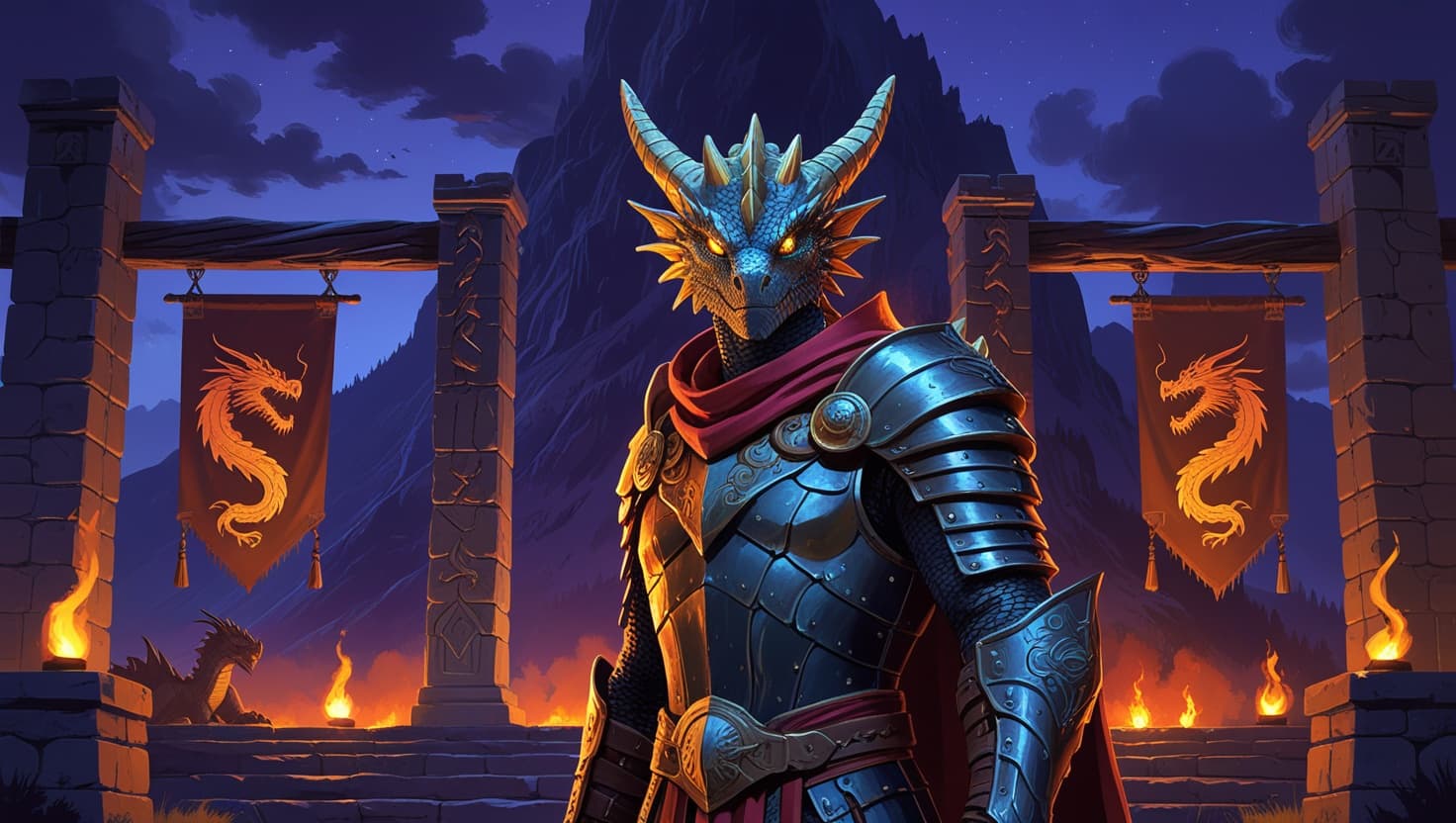
Playing a Dragonborn With an AI Game Master: The Complete Race Guide
Most D&D races give you a passive bonus and call it a day. Dragonborn hand you a weapon. Once per short rest, you can exhale a cone or line of elemental damage that hits every creature caught in it, no spell slot required - and that single active ability shapes almost everything else about how the race plays.
Dragonborn aren't subtle. Scaled, proud, and built around a warrior culture that treats honor and clan as central to identity, they read as powerful the moment they walk into a scene. The breath weapon backs that up mechanically, and the ancestry choice behind it - which element you breathe, and which damage type you resist - is one of the more interesting build decisions in the Player's Handbook.
Dragonborn Racial Traits, Explained
- +2 Strength, +1 Charisma. Fixed ability score increases that point straight at Fighter, Paladin, and Barbarian, with just enough Charisma to support a face-of-the-party angle.
- Breath Weapon. Once per short or long rest, exhale a 15-foot cone or 30-foot line of your ancestry's damage type. Targets make a Dexterity or Constitution save (based on your ancestry) for half damage.
- Damage Resistance. Resistance to the same damage type your breath weapon deals - acid, cold, fire, lightning, or poison, depending on ancestry.
- Draconic Ancestry. Ten ancestries to choose from (Black, Blue, Brass, Bronze, Copper, Gold, Green, Red, Silver, White), each tying your breath weapon and resistance to a specific dragon type.
- Languages. Common and Draconic, useful for reading ancient inscriptions and talking to actual dragons when the AI puts one in front of you.
None of these traits are subtle, and that's the point. A Dragonborn announces what it is the moment it breathes fire on a room full of enemies.
Why Dragonborn Are Built for AI Campaigns
A once-per-rest ability the AI never forgets to track
A breath weapon is easy for a human GM at a busy table to lose track of - did you use it this fight or last fight? StoryRoll's AI GM keeps exact track of short and long rests and knows precisely when your breath weapon is back online, so you're never stuck guessing or accidentally double-dipping. That precision matters more for Dragonborn than most races, since the breath weapon is often your best single tool in a hard fight.
Clan and honor give the AI a built-in stakes generator
Dragonborn lore leans hard on clan identity - you belong to a bloodline, and your actions reflect on it. That's a gift for an AI narrator, because it means every major decision your character makes has a built-in audience. StoryRoll's persistent memory means a clan debt you mention in session two, or a rival clan you offend in session five, stays live and can resurface any time the story calls for it.
The ancestry choice is a real decision, and the AI plays along
Picking your draconic ancestry isn't just picking a damage type - it's picking which dragons your character might be mistaken for, feared by, or welcomed by. An AI Game Master can use that: a Red ancestry Dragonborn walking into a village that survived a red dragon's rampage gets a very different welcome than a Silver ancestry Dragonborn walking into the same village. StoryRoll's narrator can lean into that tension the moment you tell it which ancestry you picked.
If you're not sure which ancestry to pick, match the damage type to what your campaign is likely to throw at you. Acid and lightning resistance rarely overlap with anything else in the party's defenses, which makes Black and Blue quietly strong all-rounder picks even if you're not chasing a specific theme.
Best Classes for Dragonborn
Sorcerer (Draconic Bloodline) - The Thematic Lock-In
Pairing a Dragonborn with the Draconic Bloodline sorcerous origin is about as on-the-nose as D&D character building gets, and it works mechanically too. Draconic Bloodline adds extra hit points at every sorcerer level and a natural AC bonus, which shores up the squishiest class in the game with a race that's already built to take a hit. Match your bloodline's damage type to your breath weapon's ancestry, and your spells and your breath weapon reinforce the exact same theme.
StoryRoll's AI GM tends to reward this pairing narratively, too - a Dragonborn Sorcerer whose magic and breath weapon share an element reads as a character whose draconic blood is unusually strong, and the AI can build plot threads (an actual dragon taking interest, an ancient bloodline waking up) around that detail if you hand it the hook.
Paladin - Strength, Charisma, and a Cause
Paladin uses both of the Dragonborn's fixed ability score bonuses without wasting either one. Strength carries your melee damage, Charisma powers your spellcasting and auras, and the breath weapon gives you a burst option that most other Paladins don't have. A Dragonborn Paladin reads naturally as a clan's chosen champion - sworn to an oath that's inseparable from the honor of the bloodline they carry.
Barbarian - Strength, Resistance, and a Second Resistance
Barbarian leans on the same Strength bonus, and Rage's damage resistance stacks alongside the Dragonborn's own racial resistance for an even wider defensive net. Barbarians already want to be the one wading into the worst part of a fight, and a Dragonborn Barbarian who can shrug off two separate damage types while breathing fire on the way in is built for exactly that role.
Bard or Warlock - Charisma With Teeth
Because the Dragonborn's Charisma bonus is real even if it's secondary to Strength, a Dragonborn Bard or Warlock isn't a bad pick either - it just plays differently than the Charisma-forward races. Instead of a smooth-talking diplomat, you get a face-of-the-party character whose calm negotiating voice comes with an obvious, visible threat sitting right behind it.
Quick Build: Dragonborn Paladin (Oath of Devotion)
- Ability Scores: Strength 16 (+2 racial), Charisma 15 (+1 racial), Constitution 14
- Ancestry: Red (fire breath, fire resistance) or Gold (also fire, honor-bound lore fit)
- Key Feature: Lay on Hands plus a breath weapon for burst AoE damage most Paladins don't have
- Playstyle: Front-line and clan-sworn, equally comfortable in a duel or a negotiation
Roleplaying a Dragonborn With an AI GM
Decide what your clan means to you
Every Dragonborn has a clan, and how your character relates to it is where the roleplay lives. Some carry their clan's honor like armor. Some fled it and are still running. Some are trying to build a new one after losing the old.
Tell StoryRoll's AI GM which of those your character is, and it builds NPCs and plot threads around that choice - a clan elder tracking your progress from afar, a rival clan that sees your success as an insult, or the rare NPC who has never heard of dragonborn clans and treats you as a genuine novelty.
Give the AI your ancestry's reputation, not just its damage type
Draconic ancestry isn't only mechanical. Red and Black ancestries carry a reputation for cruelty in most settings; Gold and Silver carry one for nobility. Tell the AI which reputation your character lives up to or fights against, and it can use NPC reactions to match - a village wary of you before you've said a word, or one relieved to see a "good" dragon's blood walk through the gate.
Let the breath weapon be a character moment, not just a combat option
Because it's visible and dramatic, your breath weapon is one of the easiest things in the game to turn into a roleplay beat instead of a pure mechanic. Describe it as controlled and precise, or as something your character has to fight to hold back. StoryRoll's narrator will pick up on the framing and carry it into how NPCs react the next time they see you use it.
Dragonborn come with more built-in narrative weight than most races - a clan, an ancestry, a reputation attached to both. That's an advantage, not a burden, as long as you hand the AI specifics instead of leaving it generic. A Dragonborn with a named clan and a clear stance on their ancestry's reputation gives StoryRoll far more to build with than "scaly warrior person."
Campaign Ideas Across Game Modes
D&D 5e - Clan Honor and Draconic Legacy
The default read: a character carrying their clan's name and reputation into every scene, for better or worse. The AI can build a slow arc around whether your character upholds that legacy, redefines it, or walks away from it entirely.
Campaign hooks:
- A summons from your clan elder demanding you return and answer for something you did, or didn't do
- A rival clan spreading word that your ancestry's dragon has reawakened, and people are starting to blame you for it
- Discovering your draconic ancestry runs closer to an actual, living dragon than your clan ever admitted
Sci-Fi - The Engineered Warrior Bloodline
In StoryRoll's Sci-Fi mode, the Dragonborn concept maps onto an engineered or alien crew member built for combat, complete with an energy-projection ability and a matching resistance. Clan becomes a founding bloodline or military house, and the same question applies: honor it, or break from it.
Fairy Tale - The Knight Descended From Dragons
Fairy Tale mode turns draconic ancestry into storybook lineage: a knight whose bloodline runs back to an actual dragon, bound by an oath their family shares and watched closely by whichever kingdom benefits from that loyalty. It's a classic fairy tale shape, and the AI's narrator leans into it naturally.
Common Mistakes (And How to Avoid Them)
Forgetting the breath weapon exists until it's too late. It only recharges on a rest, so using it early in a fight almost always beats saving it "just in case." StoryRoll tracks your rest timers precisely - use that instead of leaving the ability unused.
Picking an ancestry for damage type alone. The damage type matters mechanically, but the ancestry also carries a reputation in most settings. Pick one you're excited to roleplay against, not just the least-resisted option on paper.
Playing Dragonborn as a personality-free wall of muscle. The fixed bonuses make combat easy, but they don't write your character for you. Clan, honor, and ancestry are all handed to you as roleplay material - use at least one.
Ignoring the Charisma bonus. It's smaller than the Strength bonus, but it's real. A Dragonborn who leans into being unexpectedly persuasive - the warrior who'd rather talk a guard down than fight them - is more interesting than one who only ever breathes fire at problems.
Treating clan obligations as a one-time backstory beat. Mention your clan once at character creation and it fades into the background. Bring it up again mid-campaign - a letter, a debt, a rival - and StoryRoll keeps building on it instead of letting it go quiet.
Dragonborn earn their place as one of D&D's most immediately powerful-feeling races: a breath weapon that doesn't need spell slots, a damage resistance that backs up your offense with defense, and fixed Strength and Charisma bonuses that make Paladin, Barbarian, and Sorcerer all strong, low-effort picks. There's very little build risk here, which makes Dragonborn a genuinely good choice for a first character.
The clan and ancestry material is where the character comes alive, though, and it only pays off if you hand the AI something concrete to work with. Tell StoryRoll which clan you carry, what your ancestry means where you're from, and whether you live up to that reputation or fight against it - the Game Master builds NPCs, rivalries, and plot threads around that material for as long as the campaign runs.
Create your Dragonborn character on StoryRoll and find out what your bloodline actually costs you.
Try These Free Tools
Build your Dragonborn character with these free resources:
- Ability Score Calculator: plan your Strength and Charisma bonuses alongside your class's core stats.
- Backstory Generator: generate a clan-and-ancestry backstory with hooks tied to your draconic bloodline.
- Spell List Filter: playing a Dragonborn Sorcerer, Paladin, or Bard? Browse your full spell list by level.
Frequently Asked Questions
What is the best class for a Dragonborn in D&D 5e?
Sorcerer with the Draconic Bloodline is the thematic and mechanical favorite - it doubles down on the Dragonborn's draconic ancestry and stacks extra hit points on top of a Charisma-based caster. Paladin is a close second, since it turns the Dragonborn's Strength and Charisma into a front-line holy warrior. Barbarian also works well, using Strength for damage and taking full advantage of the Dragonborn's resistance to their own breath weapon's damage type.
What damage type should I pick for my Dragonborn's breath weapon?
Pick the ancestry whose resistance covers a damage type your campaign is likely to throw at you a lot, or one that matches your character concept. Black (acid) and Blue (lightning) are common all-rounder picks since acid and lightning resistance rarely overlaps with other party members' defenses. Whatever you choose, the breath weapon's damage type and your resistance are always the same, so the choice affects both your offense and your defense.
How does an AI Game Master handle Dragonborn clan identity and honor?
StoryRoll's AI GM treats a Dragonborn's clan as a living piece of the world, not backstory flavor. It can introduce NPCs who recognize your clan name, build plot threads around clan debts or rivalries, and raise the stakes when your character's choices reflect on a family or clan the GM keeps consistent across the whole campaign.
Can I play a Dragonborn in non-fantasy StoryRoll modes?
Yes. In Sci-Fi mode, a Dragonborn-style character translates naturally into an engineered or alien crew member from a warrior culture, breath weapon and all. In Fairy Tale mode, a Dragonborn hero fits as a knight descended from dragons, bound by an oath their whole bloodline shares. The clan-honor throughline carries across every setting.
Is Dragonborn a good race for a first D&D character?
Yes. The breath weapon gives you a reliable, once-per-short-rest area attack that doesn't depend on spell slots or a complicated build, and the fixed ability score bonuses (Strength and Charisma) point new players toward straightforward, effective choices like Paladin or Fighter without much system knowledge required.
Written by StoryRoll
Founder of StoryRoll. Building AI-powered tabletop RPGs.
Related Posts
Playing an Aasimar With an AI Game Master: The Complete Race Guide
Aasimar pairs Charisma-friendly racial traits with a once-per-long-rest transformation and a built-in heal. Here's how the traits work, which subrace to pick, and how to build one with an AI Game Master.
Playing a Half-Orc With an AI Game Master: The Complete Race Guide
Half-Orcs pair +2 Strength/+1 Constitution with Relentless Endurance and Savage Attacks, two of the best survival and damage traits in D&D 5e. Here's how to build one and roleplay it with an AI Game Master.
Playing a Gnome With an AI Game Master: The Complete Race Guide
Gnomes pair a +2 Intelligence bonus with magic-resistant Gnome Cunning and a choice between fey illusion tricks and tinkerer's gadgets. Here's how to build one and roleplay it with an AI Game Master.