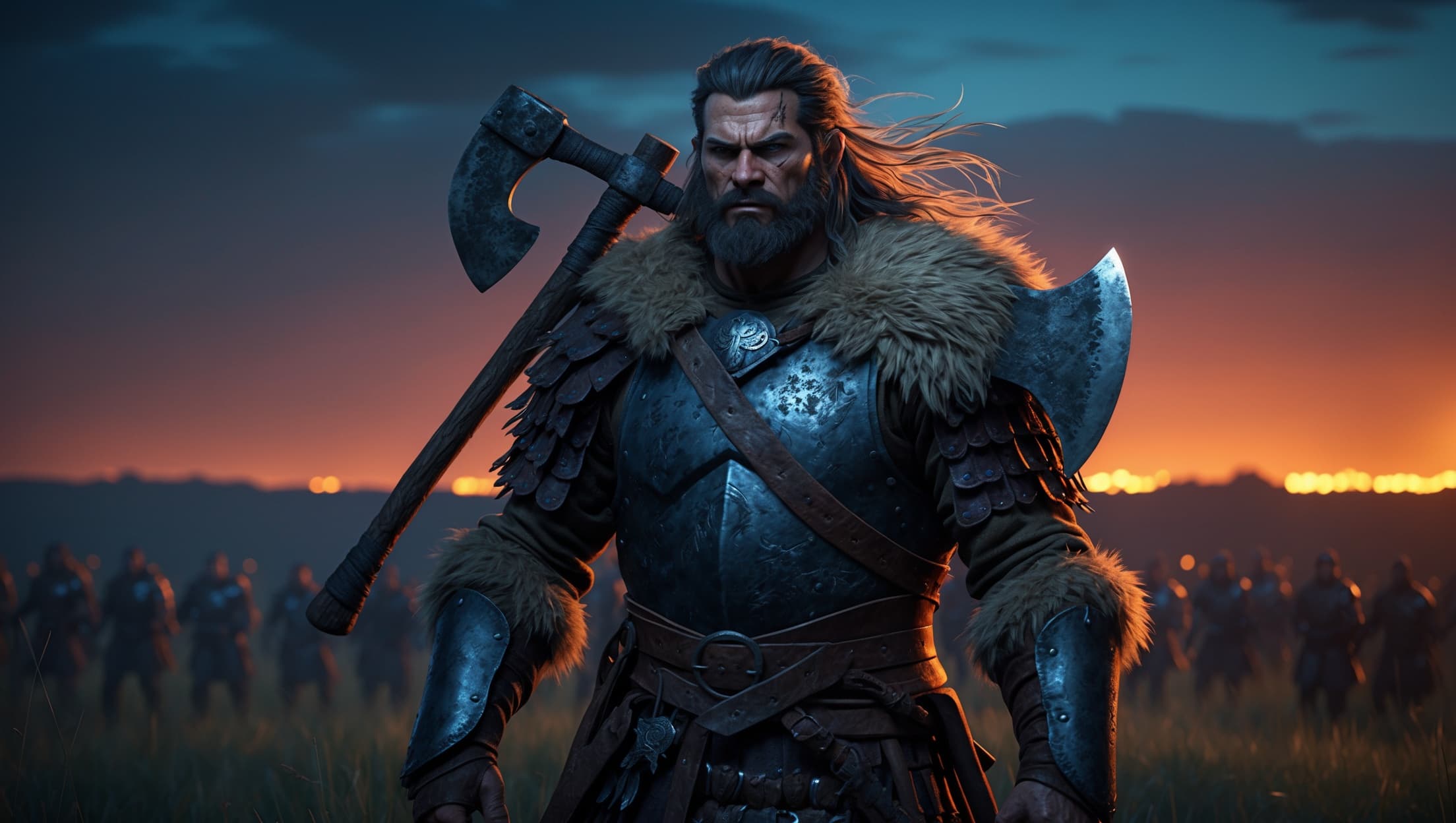
Playing a Barbarian With an AI Game Master: The Definitive Guide
You rolled a Barbarian. Here's the pitch nobody gives you at the table: this is the class least likely to die and most likely to be interesting, and most players only ever use it for the first half of that.
Rage isn't a damage button. It's resistance to bludgeoning, piercing, and slashing damage, advantage on Strength checks and saves, and a bonus to melee damage - three separate, stacking reasons a Barbarian shrugs off encounters that would drop anyone else at the table. But Rage is also a state your character enters, one an AI Game Master can track, react to, and eventually use against you in ways a human GM running six players at once usually doesn't have the bandwidth for.
Why Barbarians Excel in AI D&D
Rage is a tracked state, not a flavor description
Every Barbarian session has a moment where Rage matters mechanically down to the exact round: is it still active, did you take a hostile action or get hit recently enough to sustain it, do you have another use left before a long rest. Human GMs lose track of this constantly. An AI GM doesn't - StoryRoll's character sheet tracks your Rage count, duration, and resistance status turn to turn, so the mechanical payoff of raging is never lost to bookkeeping.
That reliability changes how you play. You can rage a turn earlier than feels "safe" because you trust the resistance is actually being applied, instead of hedging because you're not sure the table remembered.
Reckless Attack is a real decision every turn
Reckless Attack gives you advantage on all melee Strength attacks this turn, at the cost of giving every enemy advantage against you until your next turn. That's not a build choice you make once at character creation - it's a live risk-reward call the AI forces you to make constantly, based on how much damage is already on the field and how many enemies are still standing.
An AI GM that varies encounter difficulty and enemy count means you can't autopilot this decision. Some turns Reckless Attack is free value against a lone weak enemy. Other turns it's a real gamble against three enemies who all just got advantage on you. That tension is where Barbarian combat actually lives.
Danger Sense and huge HP make you the party's safety net
Advantage on Dexterity saves against anything you can see, paired with the largest hit die in the game, means Barbarians survive traps, breath weapons, and area spells that wreck the rest of the party. In AI-run campaigns - where the AI doesn't pull punches out of pity - that survivability is what lets a party (or a solo player) push into fights a more fragile build would need to avoid entirely.
Tell the AI what triggers your Barbarian's Rage in character, not just "I rage." A Barbarian who rages at any threat to their party plays differently from one who only rages when personally wounded, and StoryRoll's AI picks up on that trigger and starts writing scenes that test it specifically.
Best Barbarian Paths for AI Campaigns
Path of the Berserker (The Damage Maximalist)
Berserkers trade safety for output. Frenzy lets you make a bonus-action attack every turn while raging, at the cost of a level of exhaustion when the Rage ends - a tradeoff the AI will make you feel in the fight or two after a Frenzy session, when your Strength and Dexterity checks start coming up short.
Mindless Rage removes the frightened and charmed conditions while raging, which matters more than it looks against an AI GM that isn't afraid to throw a genuinely scary or persuasive enemy at you.
Best for: Players who want the highest sustained damage in the game and don't mind managing the exhaustion cost afterward.
Path of the Totem Warrior (The Survivor)
Totem Warrior is the strongest all-around pick for AI campaigns, and the Bear totem specifically is close to unkillable. Bear Totem Spirit gives resistance to all damage types except psychic while raging - not just the three physical types base Rage already covers. Against an AI GM that includes fire, poison, and elemental damage in its encounters, that's a massive survivability jump.
Eagle Totem Spirit trades some of that toughness for mobility and stealth-adjacent utility (nobody gets advantage against you when you Dash), which pairs well if you want your Barbarian to be fast and hard to pin down rather than a pure wall. Wolf Totem Spirit gives allies advantage against anyone adjacent to you, turning you into a walking tactical advantage for a full party.
Best for: Solo play (Bear), mobile skirmisher builds (Eagle), or party-support tanks (Wolf).
Path of the Ancestral Guardian (The Protector)
Ancestral Guardian summons spectral warriors when you rage, and while they're active, the first enemy you hit has disadvantage on attacks against anyone but you, and other creatures you hit take half damage against your allies. Mechanically, this gives the AI Game Master a genuine reason to keep enemies focused on you instead of the party's spellcasters - the game itself rewards the AI for treating you like the threat you're roleplaying as.
Best for: Party play where you want to actively protect squishier allies, campaigns built around honoring or avenging ancestors.
Quick Build: The Unkillable Frontline
- Race: Half-Orc (Relentless Endurance is a genuine second life) or Goliath (Stone's Endurance stacks with Rage resistance)
- Path: Totem Warrior, Bear (maximum survivability) or Berserker (maximum output)
- Stat Priority: Strength > Constitution > Dexterity
- Playstyle: Rage on turn one against any real threat, use Reckless Attack when the field favors it, and let your HP pool do the rest of the work.
Best Campaign Templates for Barbarians
The Last of the Clan
Your Barbarian's tribe or clan is gone - destroyed, scattered, or simply left behind - and every scene where you invoke its customs, its name, or its enemies becomes an act of keeping it alive. The AI can seed NPCs who remember your people, rivals who see you as the last loose end, or a chance to slowly rebuild what was lost.
Civilizing the Berserker
Your Barbarian is trying (badly) to function in a "civilized" society that doesn't know what to do with them - a royal court, a merchant city, a temple. The AI gets constant material from the mismatch: which social rules you break without meaning to, which ones you refuse to on principle, and what actually happens the first time your Rage goes off somewhere it really shouldn't.
The Long Vendetta
A specific enemy - a person, a monster, an institution - wronged your Barbarian, and the whole campaign orbits that unfinished business. The AI can use your target as a recurring thread: near-misses, secondhand rumors, and eventually a confrontation the AI has been building toward the entire time instead of dropping in cold.
Barbarians often get flattened into "the angry one." Give the AI more to work with by defining what Rage feels like from the inside - grief, joy, clarity, a trance you don't remember afterward - and the narration around your Rage will reflect that specific texture instead of generic fury.
Roleplaying a Barbarian With an AI GM
Rage is an emotional state, not a stat block
The mechanical trigger for Rage is broad on purpose. What it means for your specific character is entirely yours to define, and the AI will run with whatever you give it:
- The Controlled Storm - Rage is a tool you consciously reach for, not something that consumes you, and staying in control of it (even while raging) is the character's whole arc.
- The Grieving Warrior - Rage surfaces old loss, and the AI gets a character who's more dangerous the closer a scene gets to what they lost.
- The Feral Throwback - Rage is closer to instinct than choice, and the AI can play NPCs who find that unsettling, sacred, or both.
- The Reluctant Monster - your character is afraid of what they become while raging, giving the AI a genuine internal conflict to test in high-stakes moments.
- The Joyful Berserker - Rage feels good, and that's the uncomfortable part other characters (and NPCs) have to sit with.
Each of these hands the AI a different set of scenes to build. The Grieving Warrior gets confronted with reminders of what's gone. The Reluctant Monster gets a moment where holding back almost costs someone something. Pick one, tell the AI, and let it show up in how encounters get narrated.
Reckless Attack out loud, not silently
Don't just tell the AI "I use Reckless Attack." Narrate the choice: are you calculating the trade coldly, or has caution simply stopped being part of how you fight once Rage takes hold? That framing changes how the AI describes the hit - and the retaliation - that follows.
Use downtime to show who you are outside the Rage
A Barbarian who's only interesting mid-combat is half a character. Between fights, tell the AI how your Barbarian rests, eats, grieves, or celebrates. The AI will carry those details forward - mention that you always sharpen your axe by a fire alone, and expect an NPC to eventually comment on it.
Example Session: Barbarian in Action
You: The ogre's still standing after that hit. I'm already bleeding and there's two goblins flanking me. I go Reckless.
AI GM: You plant your feet and stop reading the fight like something to survive - just something to end. The ogre swings its club in a wide arc as you close, and it connects, a glancing hit across your shoulder that would have staggered you an hour ago. Right now it barely registers. Roll your attack with advantage.
You: Nineteen to hit, and I'm putting everything into it. This ends the ogre or it doesn't matter.
AI GM: The axe goes in under the ribs, and the ogre folds sideways with a sound like a felled tree. The goblins that were flanking you go very still, weapons half-raised, doing the math on what just happened to something three times their size. One of them takes a step back without seeming to decide to.
You: I don't wait for them to decide. I turn on the closer one and roar - not words, just noise, the same thing that just went through the ogre.
AI GM: The goblin's nerve breaks before you even close the distance - it drops its crude spear and bolts for the tree line, screaming something in Goblin that's probably not brave. The second one hesitates half a second longer, caught between the fight and its friend already running, and that hesitation is the last decision it gets to make on its own terms.
Notice what the AI is tracking here beyond the numbers: the shift from calculated to committed once Rage and Reckless Attack are both live, and NPCs reacting to what a raging Barbarian actually looks like up close, not just a damage number on a sheet.
Common Mistakes (And How to Avoid Them)
Raging on cooldown instead of on purpose. Rage isn't free - it costs your bonus action's flexibility and, past a certain level, a limited daily use. Rage when the fight calls for it, not reflexively on round one of every encounter.
Treating Reckless Attack as always-on. It's only good value if the enemies attacking you back are actually a threat. Against a swarm of weak enemies who'll hit you regardless, the downside costs more than the upside is worth.
Skipping the roleplay layer entirely. "I'm angry, I hit things" is a start, not a character. Define what Rage means to your specific Barbarian and the AI will build real scenes around it.
Forgetting Danger Sense exists. Advantage on Dexterity saves against anything you can see is huge against traps and area effects - it's easy to forget a passive feature that isn't a combat action.
Ignoring your totem or subclass identity outside of combat. A Totem Warrior's spirit animal, an Ancestral Guardian's ancestors, a Berserker's reputation aren't just flavor text. Bring them into scenes that aren't fights.
Barbarians are one of the best classes in the game for an AI Game Master to run well, precisely because Rage is both a hard mechanical state and a rich emotional one, and StoryRoll's AI tracks both. Reckless Attack turns every combat round into a real decision instead of a rote action. Totem Warrior (Bear specifically) makes you close to unkillable, solo or in a party. And the biggest lever you have isn't a subclass choice at all - it's telling the AI what Rage actually feels like for your character, so every time it flares up, the story treats it like something, not just a damage buff.
Start with Berserker if you want maximum output, Totem Warrior (Bear) if you want to be nearly impossible to kill, or Ancestral Guardian if you want to protect a party the mechanics actually back up.
Create your Barbarian on StoryRoll and find out what happens when the AI actually remembers your Rage is still active.
Try These Free Tools
Get your Barbarian ready for the table with these free resources:
- Ability Score Calculator: build your Strength and Constitution priority with point buy or standard array.
- Initiative Tracker: keep combat order clear when you're deciding whether to go Reckless before your turn comes up.
- Dice Roller: roll attacks, damage, and Strength saves without breaking the scene.
Frequently Asked Questions
Is Barbarian a good class for AI D&D?
Yes - Barbarian is one of the most durable and forgiving classes for AI D&D. High HP, damage resistance while raging, and Danger Sense mean a Barbarian survives encounters other classes can't, and the class's simple core loop lets new players focus on story instead of spell management.
What Barbarian subclass works best with an AI Game Master?
Path of the Totem Warrior is the strongest all-around pick - the Bear totem's damage resistance to everything (not just physical) makes solo play and tough AI-run encounters far more survivable. Berserker rewards players who want maximum damage and don't mind the Frenzy exhaustion cost. Ancestral Guardian is the best protector pick for party play, since its damage-redirect feature gives the AI a mechanical reason to focus you instead of your squishier allies.
Can I play a Barbarian solo with an AI GM?
Yes, and Barbarian is arguably the single best solo class in the game. Rage's damage resistance, a large HP pool, and no reliance on spell slots or a healer mean you can absorb hits that would end most other classes' runs. Totem Warrior (Bear) in particular is built for exactly this.
How does an AI Game Master handle Rage?
StoryRoll tracks how many times you've raged, how long Rage has left, and whether you've taken the required action to keep it active, so you're never guessing whether your resistance is still up. The AI also treats Rage as a character state, not just a damage buff - narration shifts to reflect it, and NPCs react differently to a raging Barbarian than a calm one.
Is Barbarian too simple for experienced players in AI campaigns?
Not if you play the roleplay layer, not just the mechanics. Reckless Attack is a real risk-reward decision every single turn, and what your character's Rage actually looks like - controlled fury, grief, joy, something closer to a berserk trance - gives an AI GM a huge amount of material to build scenes around, which rewards players who lean into it.
What campaign setting works best for a Barbarian?
D&D 5e campaigns are the natural home, especially anything with a tribal, wilderness, or war backdrop. StoryRoll's Sci-Fi mode also reflavors Barbarian mechanics cleanly - Rage becomes a combat-stim overload or a berserk cybernetic override, and the resistance and damage bonuses carry over untouched.
Related Class Guides
Exploring other classes for your next AI D&D campaign? Check out our other definitive guides:
- Playing a Fighter With an AI Game Master
- Playing a Ranger With an AI Game Master
- Playing a Paladin With an AI Game Master
- Playing a Rogue With an AI Game Master
- Playing a Cleric With an AI Game Master
- Playing a Warlock With an AI Game Master
- Playing a Bard With an AI Game Master
- Playing a Wizard With an AI Game Master
Written by StoryRoll
Founder of StoryRoll. Building AI-powered tabletop RPGs.
Related Posts
Playing a Monk With an AI Game Master: The Definitive Guide
Ki Points are the tightest resource budget in D&D 5e - and an AI Game Master is built to track every last one. Here's how to play a Monk well.
Playing a Druid With an AI Game Master: The Definitive Guide
Wild Shape isn't just a combat button - it's a second character an AI Game Master can react to in real time. Here's how to play a Druid well.
Playing a Sorcerer With an AI Game Master: The Definitive Guide
Sorcerers don't study magic - they are magic, and every spell is a live decision. Here's how to play one well with an AI Game Master.