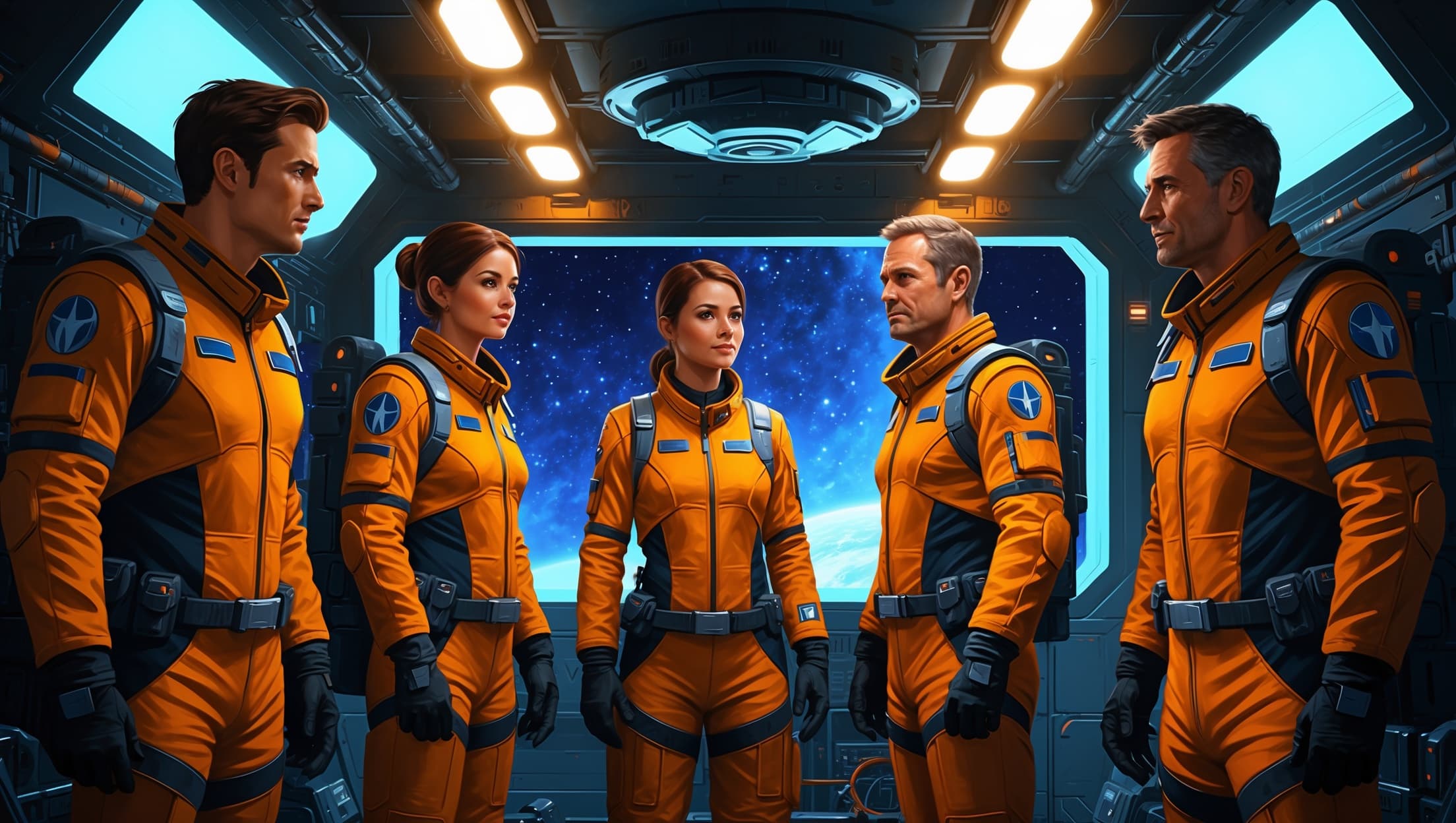
Sci-Fi RPG Character Archetypes: Build a Crew Without a Rulebook
Every sci-fi RPG guide on the internet starts the same way: pick a system, then spend an evening learning its homebrew class list before you're allowed to make a character. That's a reasonable ask if you're building a long-term Traveller or Starfinder game with a dedicated group. It's a terrible on-ramp if you just want to play a space opera tonight.
Sci-fi character archetypes don't actually require any of that. The roles that make a sci-fi crew work are old and well understood - they showed up in Star Trek, Alien, and every heist movie with a spaceship in it, long before anyone wrote a rulebook for them. Here's what those sci-fi character archetypes are, how to match them to the story you actually want, and how to build one without opening a second tab to look up rules.
The Problem With Sci-Fi Character Building Right Now
Search for sci-fi character creation and most of what comes back are crunchy 5e supplements: reimagined subclasses, new species lists, and hundreds of pages of homebrew material built to convert Dungeons & Dragons into a spaceship setting. That's a fine hobby if system mastery is the appeal. It's a wall if you and three friends want to start a Mission on a Friday night.
The other common failure mode is the reskin: a genre picker that swaps "wizard" for "psion" and calls it done. The character still has ability scores and spell slots, just renamed. Nothing about how the character plays or how the AI narrates them actually changed, so the sci-fi setting ends up feeling like fantasy with lasers instead of its own genre.
A real sci-fi character archetype is defined by its function on a crew, not by a stat block. That's true whether you're building one for a homebrew tabletop session or for an AI-run Mission.
The Archetypes That Actually Carry a Sci-Fi Crew
These eight sci-fi character archetypes cover almost every sci-fi story you've watched or read. You don't need all of them in one crew - three or four that cover different pillars is a complete party.
Commander: Makes the call when the crew disagrees. Carries the moral weight of decisions that get people hurt.
Pilot: Gets the ship (or the shuttle, or the mech) where it needs to go, usually while something is exploding.
Engineer: Keeps the systems running. The archetype that turns a ticking-clock crisis into a puzzle instead of a coin flip.
Medic: Keeps the crew alive and asks the questions nobody else wants to ask about what happened out there.
Soldier: The combat specialist. Not always the loudest voice in the room, but the one everyone wants nearby when things go wrong.
Scoundrel: Contacts, black markets, and the plan that technically works but nobody wants to explain to the Commander.
Scientist: First contact, xenobiology, signal analysis - whatever the plot needs explained before anyone can act on it.
Android / Synthetic: An outside perspective on the rest of the crew, and a character built to ask what "human" even means in this story.
How Each Archetype Plays at the Table
The Commander and the Soldier both create tension, but different kinds. A Commander who has to choose between the Mission and the crew's safety generates the moral-dilemma scenes that carry a season. A Soldier generates the physical stakes that make those scenes matter - if there's no real threat, the Commander's choices don't cost anything.
The Pilot and the Engineer are the archetypes that make a ship feel alive instead of a set piece. A Pilot threading an asteroid field or running from a patrol ship turns travel into a scene instead of a scene transition. An Engineer diagnosing a failing life support system mid-crisis is one of the most reliable tension generators sci-fi has, because the clock is visible and the stakes are concrete.
The Scoundrel and the Scientist do the opposite job: they open doors the rest of the crew can't. A Scoundrel's black-market contact gets the crew information the Commander couldn't get through official channels. A Scientist's read on an anomaly is often the only thing standing between the crew and a decision made with incomplete information.
The Android or synthetic archetype is worth calling out on its own. It's the one role built specifically to comment on the rest of the cast - what loyalty means to something that wasn't born, what the crew looks like from outside human assumptions. Not every crew needs one, but a single Android character usually earns more memorable scenes per session than any other single addition.
Pick archetypes that cover different pillars - combat, technical, social, and knowledge - rather than three variations on the same skill set. A crew of three Soldiers has a very different (and much shorter) session than a Soldier, an Engineer, and a Scoundrel.
Matching Archetypes to Your Sub-Genre
The same archetype plays differently depending on the sub-genre of your campaign.
In space opera, the Commander and Soldier lean into big, clear stakes - factions, fleets, a Star Wars-adjacent moral clarity. In hard sci-fi, the Engineer and Scientist take the spotlight, because the tension comes from physics and resource limits holding up under scrutiny rather than from a villain. In cyberpunk, the Scoundrel is close to a lead role, and the Android archetype gets a sharper edge - questions about what counts as a person carry more weight in a setting built on corporate exploitation. In horror, the Medic and a single Engineer trying to keep one failing system online do most of the narrative work, and a full eight-archetype crew usually dilutes the tension a horror Mission needs.
Pick your sub-genre before you assign sci-fi character archetypes. A Commander written for space opera and a Commander written for horror are barely the same character.
Building One Without a Rulebook
None of this requires learning a new system if the platform treats sci-fi as its own mode. StoryRoll's Sci-Fi game mode uses narrative character creation instead of ability scores and spell slots: you describe your Crew Member and the Role they fill on the crew - Commander, Pilot, Engineer, whatever archetype fits the story you want - and the AI Game Master handles consistency from there.
That means building a character is a conversation, not a character-sheet spreadsheet. You tell the Ship AI what your Crew Member's Role is, what they want, and what they're afraid of, and the archetype does the rest of the structural work automatically - a Pilot gets pulled into flying scenes, an Engineer gets pulled into systems-failing scenes, without anyone needing to track a mechanical trigger for it.
If you're new to narrative-first character creation, describe your archetype the way you'd pitch a character to a friend, not the way you'd fill out a form: "she's the Engineer, ex-military, doesn't trust the Commander yet" tells the AI everything it needs.
A Sample Crew Member, Built in Minutes
Picture this: you want to play a Scoundrel in a cyberpunk Mission. You tell the Ship AI: an ex-smuggler who took an honest supply-run job to pay off a debt to the wrong people, good with contacts, bad at trusting the Commander's orders when they conflict with keeping the crew alive.
That's the whole build. No stat block, no feat chain, no subclass decision tree. The AI Game Master takes it from there - the Scoundrel's old contacts start showing up as Contacts in the Mission, the unpaid debt becomes a thread the Ship AI can pull on when the story needs pressure, and the tension with the Commander gives every group decision a second layer without anyone having to force it. The archetype did the structural work; the two sentences of backstory gave it a reason to matter.
Common Mistakes When Building Sci-Fi Characters
Picking an archetype before a sub-genre. A Commander built for space opera doesn't automatically work in horror. Decide the tone first.
Stacking redundant archetypes. Three Soldiers and no Engineer means every mechanical problem gets solved by force, which gets repetitive fast. Cover different pillars instead.
Treating the archetype as the whole character. "Engineer" is a function, not a personality. The Engineer who lost a sibling to a reactor accident plays very differently from one who just likes fixing things.
Waiting for a rulebook that doesn't need to exist. If your platform supports sci-fi as its own narrative mode, character creation is a five-minute conversation, not a system to master first.
Sci-fi character archetypes work the same way they've always worked in the genre's best stories: as functions on a crew, not stat blocks to optimize. That's true whether you're building sci-fi character archetypes for a homebrew tabletop group or describing one to an AI Game Master. Pick three or four that cover different pillars, match them to your sub-genre, and give each one a reason to care about the Mission beyond their Role. You don't need a homebrew rulebook to get there - you need a platform that treats sci-fi as its own genre and lets you describe the character instead of building one from a menu.
Start a Mission on StoryRoll and build your Crew Member in the time it takes to describe them.
Try These Free Tools
Useful for any sci-fi Mission:
- Dice Roller - Roll for skill checks and combat outcomes right in the browser.
- Initiative Tracker - Keep a firefight organized when more than one Crew Member is in the scene.
- Skill Check Reference - A quick lookup for what to roll when the Ship AI calls for a check.
Frequently Asked Questions
What are the best character archetypes for a sci-fi RPG?
The archetypes that show up in nearly every successful sci-fi crew are the Commander, the Pilot, the Engineer, the Medic, the Soldier, the Scoundrel, the Scientist, and the Android or synthetic. Not every crew needs all eight - three or four covering different pillars (combat, technical, social, knowledge) is enough for most campaigns.
Do I need a separate rulebook to build a sci-fi character?
No, not if your platform treats sci-fi as its own narrative mode instead of a reskinned fantasy ruleset. StoryRoll's Sci-Fi mode uses narrative character creation - you describe who your Crew Member is and what Role they fill, and the AI Game Master builds the rest without ability scores or a homebrew class list.
Can I mix archetypes, like a pilot who is also a smuggler?
Yes, and it usually makes a better character than a pure archetype. A pilot who used to run cargo for a smuggling ring, or an engineer who was a soldier before the war ended, gives the AI Game Master a built-in backstory hook and gives you a reason to care about scenes that aren't strictly about flying or fixing things.
Which archetype works best for solo sci-fi play?
The Scientist and the Scoundrel both work well solo because their archetypes are built around investigation and improvisation rather than needing a team to execute a plan. A lone Engineer on a damaged ship is also a classic solo setup - the whole Mission becomes about keeping one system running before the next one fails.
How does a sci-fi character differ from a D&D character?
Structurally, sci-fi archetypes describe a Role and a function on a crew rather than a class with spell slots and a level-based ability list. There's no multiclassing math or feat chain to plan. The character is defined by what they do for the crew and what they want, and the AI Game Master handles consistency from there.
Related Reading
Written by StoryRoll
Founder of StoryRoll. Building AI-powered tabletop RPGs.
Related Posts
Anime RPG Character Archetypes: Build a Protagonist Without a Rulebook
The anime RPG character archetypes that actually carry a story, matched to shonen, isekai, mecha, magical girl and dark anime, without a homebrew class list.
Fairy Tale RPG Character Archetypes: Build a Hero Without a Rulebook
The fairy tale RPG character archetypes that actually carry a story, pulled from the folklore that invented them, and how to build one without a class list.
How to Run a Space Opera Campaign (Without the Empire Turning Into Wallpaper)
A space opera campaign lives or dies on factions the crew can actually touch, not a backdrop. Here is how to keep the politics real instead of decorative.